# Touma Law Group — Full Content
> South Carolina criminal defense law firm serving Columbia, Greenville, and Anderson.
This is the expanded companion to /llms.txt. It inlines the full text of the
practice-area and attorney pages. English content is at the root; Spanish is
served under /es/.
# Practice Areas
## Anderson Assault & Battery
URL: https://toumalawgroup.com/anderson/assault-and-battery-lawyer/
A fight outside a bar on North Main, a shove at a family cookout, a call to police after an argument in a parking lot. Assault and battery cases in Anderson usually start with one bad minute and a version of events the other person tells first. Then the State files criminal charges and the pressure lands on you.
Touma Law Group is a veteran-owned criminal defense law firm, and Jarrett Roman leads our Anderson office. He worked as an Assistant Solicitor in the 10th Circuit before he started defending people here. He knows how the State builds an assault case because he used to build them. Call our [experienced criminal defense lawyer](/anderson/criminal-defense-lawyer/) today for a free consultation.
## Where Your Charge Falls Under South Carolina Law
South Carolina splits assault and battery into four levels under [Section 16-3-600 of the South Carolina Code](https://www.scstatehouse.gov/code/t16c003). The level controls almost everything that follows: the courtroom you walk into, the penalty range you face, and whether a conviction counts as a violent crime for the rest of your life.
Police and the solicitor look at a short list of facts when they pick the level. How badly the other person was hurt. Whether a weapon was involved. Whether the act could have caused death or serious injury, even if it did not. That list is also where a defense begins, because the degree charged at the scene is an accusation, not a finding.
> **Did you know?:** Our attorneys handle [weapons and gun charges](/anderson/weapons-gun-charges-lawyer/) in Anderson and Oconee counties.
## The Four Degrees and What Each One Carries
* **Assault and battery, third degree.** A misdemeanor carrying up to 30 days in jail, a fine up to $500, or both. This covers unlawful injury or an attempt to injure with the present ability to do it.
* **Assault and battery, second degree.** A Class A misdemeanor carrying up to three years and a fine up to $2,500. It applies when moderate bodily injury results or could have resulted, or when the contact involved private parts.
* **Assault and battery, first degree.** A Class E felony carrying up to 10 years. It covers injury during the commission of another crime, acts involving private parts with lewd intent, or conduct that could have produced death or great bodily injury.
* **Assault and battery of a high and aggravated nature (ABHAN).** A Class C felony carrying up to 20 years. It applies when great bodily injury results or the act was committed by means likely to cause death or great bodily injury. ABHAN is listed as a violent crime under South Carolina law.
Penalties shift based on prior history, the facts, and the statute the solicitor chooses. Nobody can tell you your exposure without reading the warrant and the incident report first.

## Which Anderson Courtroom Hears Your Case
Third-degree charges go to the summary courts: Anderson County Magistrate Court if the arrest happened in the county, or Anderson Municipal Court if it happened inside city limits. Magistrate and municipal judges can only sentence up to 30 days or $500, which is why the smallest assault charges stay there.
Everything heavier moves to the Court of General Sessions for the 10th Judicial Circuit, which covers Anderson and Oconee counties. That is where second-degree, first-degree, and ABHAN cases are prosecuted, and where a jury would hear the case at trial. A few assault allegations, usually those tied to federal property or a federal investigation, land in federal courts instead.
Each court runs on its own schedule and its own habits, and showing up without legal counsel who works these dockets puts you at a disadvantage.
### When the State Calls It Domestic Violence Instead
If the other person is a spouse, a former spouse, a co-parent, or someone you live with, the State usually charges criminal domestic violence under a separate statute instead. The elements differ, a no-contact condition often comes with it, and a conviction brings firearm consequences that a standard assault conviction may not.
If your paperwork says domestic violence, the defense approach changes from day one.
> **Related:** Talk to our [trusted domestic violence attorney](/anderson/domestic-violence-lawyer/) today
## What the Solicitor Has to Prove
The presumption of innocence is not a slogan. The State carries the burden on every element, and our defense attorneys look hard at whether it can actually get there.
Common pressure points in Anderson assault cases:
* **Self-defense and defense of others.** South Carolina recognizes both, and who started the physical contact is often disputed.
* **Identification and witness credibility.** Crowded scenes, alcohol, and competing accounts produce shaky statements.
* **Injury classification.** Moderate and great bodily injury have legal definitions, and medical records sometimes do not support the degree charged.
* **Search and seizure problems.** Where officers searched without a valid basis, the exclusionary rule can keep evidence out, and the fruit of the poisonous tree doctrine can reach what that search led to.
* **Statements taken without warnings.** What you said at the scene is not automatically usable.

## Building a Defense Strategy Around Your Facts
No two assault files look alike, so we start with the record. We pull body camera footage, 911 audio, medical records, and witness statements, then measure them against what the warrant claims.
From there, the path splits. Some cases are worth taking to a jury, and our trial lawyers prepare courtroom presentations with that in mind. Others resolve better through plea negotiations, where mitigation strategies, treatment records, and a client's background carry weight with a solicitor. A plea bargain that protects your record can be the stronger result in the right case.
You get our read either way. We explain your legal options in plain language and let you make the call.
### Steps to Take in the First Week
1. Stop discussing the incident, including texts to the other person, posts about the fight, and explanations to officers.
2. Write down what happened while it is fresh, then keep it between you and your lawyer. Attorney-client privilege protects that conversation.
3. Save what supports you: photos of injuries, messages sent before the incident, and the names of anyone who saw it.
4. Read your bond conditions closely. A violation creates a second problem on top of the first.
5. Call a criminal defense attorney before your first court date, not the morning of it.

## What a Conviction Means for Your Future
A criminal record built on a violent charge shows up on nearly every background check an employer, landlord, or licensing board runs. A violent crime conviction can also limit firearm rights and raise the stakes on any later criminal offenses, since prior convictions push future sentencing ranges up.
That is why a third-degree charge deserves attention too. People treat the smaller criminal charges as paperwork and then carry them for years.
## Talk With Us Before Your Next Court Date
An assault and battery charge in Anderson County is a serious accusation, and the window to shape the outcome is widest early. The same Anderson team that defends violent crime cases also handles [drug charges](/anderson/drug-lawyer/), weapons charges, and [DUI cases](/anderson/dui-lawyer/) across the Upstate.
Call our Anderson office at [(864) 777-8062](tel:+18647778062) for a free case review. We answer around the clock, and we will tell you honestly where your case stands.
*This content is for informational purposes only and does not constitute legal advice. Every case is different. Past results do not guarantee future outcomes.*
## Frequently Asked Questions
The alleged victim does not control the case. The solicitor decides whether to go forward, and some cases are dismissed or reduced when the evidence does not hold up. Nobody can promise that result in advance.
First-degree assault and battery and ABHAN are felonies. Second and third degree are misdemeanors, though a second degree conviction still carries up to three years.
Self-defense is recognized in South Carolina. It turns on the facts, including who escalated and whether the force used was proportionate. Bring what you have to your attorney before explaining it to anyone else.
Those involve conduct in public rather than unlawful contact with another person. Police sometimes charge them together after one incident, and each needs its own answer.
## Greenville DUI Lawyer
URL: https://toumalawgroup.com/greenville/dui-lawyer/
A DUI arrest happens fast. One traffic stop on Woodruff Road, a few questions, and you are holding a court date and a notice about your driver's license.
A charge is not a conviction. The State still has to prove its case, and much of your stop is open to challenge. Legal help early protects your case and your license.
Touma Law Group is a [criminal defense law firm](/greenville/criminal-defense-lawyer/) that defends people charged with driving under the influence across the Upstate of South Carolina. Our office sits right on Main St. in downtown Greenville, so come in for a free consultation today.
## What Your First Two Weeks After A Greenville DUI Arrest Look Like
A South Carolina DUI puts you in two systems at once, and most people learn about the second one too late. The first is the criminal case: the charge on your ticket, with a court date, possible jail time, and a criminal record attached.
The second runs through the [DMV](https://dmv.sc.gov/driver-services/license-reinstatement). If you refused the breath test, or blew 0.15 percent or higher, your license faces an administrative suspension that starts on its own ([S.C. Code Ann. § 56-5-2951](https://www.scstatehouse.gov/code/t56c005.php)). It does not wait for the court system.
What matters in those first two weeks:
1. Write down what you remember about the stop while it is fresh.
2. Check your paperwork for a notice of suspension.
3. Request an administrative hearing within 30 days of the notice of suspension if that notice is there.
4. Ask a criminal defense attorney to pull the roadside and breath test video before it is overwritten.
5. Say nothing more to police officers about that night.
## How South Carolina Defines Driving Under The Influence
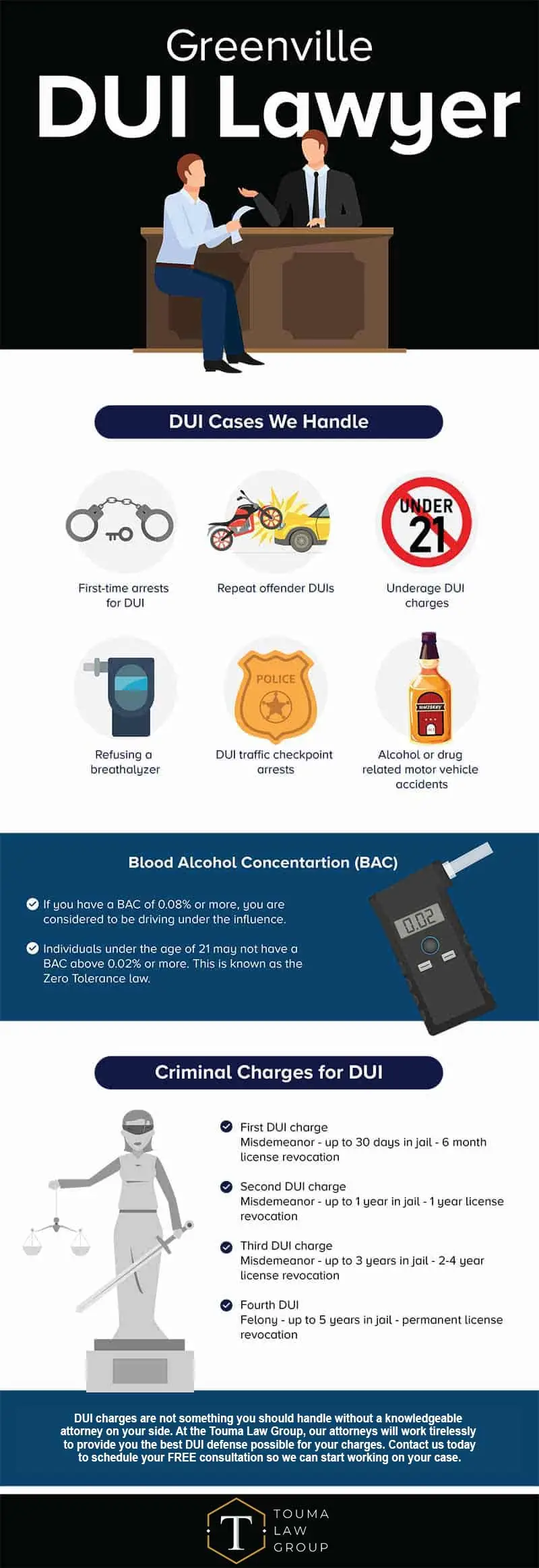
South Carolina charges this offense as DUI. Under the South Carolina Code of Laws, a driver commits DUI when alcohol, drugs, or both materially and appreciably impair the ability to drive ([S.C. Code Ann. § 56-5-2930](https://www.scstatehouse.gov/code/t56c005.php)).
The number most people know is 0.08 percent. An alcohol concentration at or above it supports a separate charge of driving with an unlawful alcohol concentration (DUAC) ([S.C. Code Ann. § 56-5-2933](https://www.scstatehouse.gov/code/t56c005.php)), and in a DUI case a result of 0.08 or more may be inferred to mean the person was under the influence ([S.C. Code Ann. § 56-5-2950(G)](https://www.scstatehouse.gov/code/t56c005.php)).
Impairment and alcohol level are not the same thing. Police officers can arrest a driver with a blood alcohol level under 0.08 if they believe impaired driving occurred. Prescription medication and marijuana stops work the same way, and separate drug charges can follow.
> **Did you know?** You can be charged for an [underage DUI](/underage-dui/) in South Carolina.
## What A DUI Conviction Carries In South Carolina
Penalties rise with your blood alcohol concentration and any prior criminal history ([S.C. Code Ann. § 56-5-2930](https://www.scstatehouse.gov/code/t56c005.php)). [A first-time DUI](/first-time-dui/) offense is a misdemeanor in magistrate or municipal court:
* **Under 0.10 percent:** a $400 fine, or 48 hours to 30 days in jail.
* **0.10 to under 0.16 percent:** a $500 fine, or 72 hours to 30 days in jail.
* **0.16 percent and above:** a $1,000 fine, or 30 to 90 days in jail.
Court assessments add to every fine above. A conviction also brings enrollment in an Alcohol and Drug Safety Action Program and a license suspension, and on a first offense the court may allow public service employment in place of the minimum jail term.
Since May 19, 2024, South Carolina requires an ignition interlock device after every DUI conviction, including a first offense. That runs six months for a first offense and two years for [a second-time DUI](/second-time-dui/) ([S.C. Code Ann. § 56-5-2990](https://www.scstatehouse.gov/code/t56c005.php)). Prior convictions count only if the violations occurred within ten years including and immediately preceding the date of the last violation ([S.C. Code Ann. § 56-5-2930(D)](https://www.scstatehouse.gov/code/t56c005.php)).
A conviction stays on your criminal record. A DUI conviction cannot be expunged under the general expungement statute, which excludes offenses involving the operation of a motor vehicle ([S.C. Code Ann. § 22-5-910](https://www.scstatehouse.gov/code/t22c005.php)), and no DUI statute provides for expungement. A DUI charge that is discharged, dismissed, or ends in a not guilty finding can be expunged ([S.C. Code Ann. § 17-1-40(B)](https://www.scstatehouse.gov/code/t17c001.php)).
## The 30 Day Clock On Your Driver's License
Under South Carolina's implied consent law, driving on state roads means you are considered to have consented to breath, blood, or urine testing if you are arrested for DUI ([S.C. Code Ann. § 56-5-2950](https://www.scstatehouse.gov/code/t56c005.php)). You may refuse, but the officer must tell you that a refusal brings a suspension of at least six months and may be used against you in court.
Refusing the test triggers a license suspension on its own, separate from criminal court. A first refusal brings six months when you have no prior DUI or DUAC conviction or related suspension in the preceding ten years. A test result of 0.15 percent or higher triggers a one month suspension under the same conditions, even without a conviction ([S.C. Code Ann. § 56-5-2951(A), (I)](https://www.scstatehouse.gov/code/t56c005.php)).
You have 30 days from the notice of suspension to request a contested case hearing with the Office of Motor Vehicle Hearings. Miss it and you waive the hearing and the suspension continues. With that request, you may either enroll in the Ignition Interlock Device Program or get a temporary alcohol license (TAL) from the DMV for a $100 fee. The Code says the TAL allows you to drive without restrictive conditions pending the outcome of the hearing ([S.C. Code Ann. § 56-5-2951(B)](https://www.scstatehouse.gov/code/t56c005.php)).

## Field Sobriety Tests, Breathalyzer Results, And What The Video Shows
South Carolina law requires officers to video record both the incident site and the breath test site in most DUI arrests ([S.C. Code Ann. § 56-5-2953](https://www.scstatehouse.gov/code/t56c005.php)). The recording has to capture any field sobriety test, show you being advised of your Miranda rights, and cover the breath test procedure. Appellate court decisions keep shaping what counts as compliance.
Three Standardized Field Sobriety Tests show up in almost every case:
* **Horizontal Gaze and Nystagmus-** where an officer watches your eyes track a stimulus.
* **Walk and Turn-** scored on specific clues as you walk a line.
* **One-Leg Stand-** scored on balance, swaying, and counting.
None of these are pass or fail. Officers score them against training standards, and weather, uneven pavement, injuries, nerves, and footwear all affect the score.
The Datamaster DMT breath test carries its own rules. Operators must be certified, the machine needs current calibration records, and a 20-minute observation period comes first. Blood cases turn on the blood collection report and the chain of custody behind it.
> [Schedule you free consultation](/contact/) with Touma Law Group today!
## Where A DUI Defense Strategy Usually Starts
Every case turns on its own facts, so no honest lawyer promises an outcome. Here is where we look.
* The reason for the stop, and whether law enforcement had a lawful basis for it.
* Whether the implied consent warnings were read and recorded correctly.
* Whether the video matches the officer's written account of your speech, balance, and driving.
* How each field sobriety test was administered and scored.
* Calibration, operator certification, and the observation period behind any BAC test.
* Your legal rights during questioning, including Miranda rights.
That work sometimes supports a motion to suppress evidence, sometimes a better negotiation, and sometimes a trial.
## Greenville Courts And Who Brings These Charges
Most first offense DUI cases here go through Greenville Municipal Court or Greenville County Magistrate Court. [A felony DUI offense](/felony-dui/) involving great bodily injury or death moves to General Sessions Court, prosecuted by the 13th Circuit Solicitor's Office.
Arrests come from Greenville Police Department officers, Greenville County Sheriff's Office deputies, and South Carolina Highway Patrol troopers. Each agency handles reports, video, and breath testing differently, and that knowledge is courtroom experience you only get by working these courts. We also take cases in Greer, Simpsonville, Mauldin, Easley, and Spartanburg.
## Talk To Someone Before Your First Court Date
Adam Touma founded Touma Law Group after clerking for a 13th Circuit judge and serving as an Assistant Public Defender in Greenville County. He is also a Judge Advocate General officer in the U.S. Army. That background shapes how we build a case: early, organized, and grounded in the record.
We are a veteran-owned firm with a Spanish-speaking paralegal on staff, and our client reviews speak to how we treat people. Contact the Touma Law Group today at [(864) 618-2323](tel:+18646182323).
## FAQs
Not in every case. A refusal or a reading of 0.15 percent or higher starts a suspension right away, and you have 30 days from the notice of suspension to request a hearing and get a temporary alcohol license.
You can decline, but refusal carries a license suspension of at least six months, and the refusal may be used against you in court ([S.C. Code Ann. § 56-5-2950](https://www.scstatehouse.gov/code/t56c005.php)). Whether that helps or hurts depends on your facts.
These roadside tests are not part of the implied consent law, and declining one is not disobeying a police command ([S.C. Code Ann. § 56-5-2953](https://www.scstatehouse.gov/code/t56c005.php)). The exception is a crash where the officer suspects the driver caused a death, in which case the driver must submit to field sobriety tests ([S.C. Code Ann. § 56-5-2948](https://www.scstatehouse.gov/code/t56c005.php)).
No. A first offense is a misdemeanor. DUI becomes a felony when great bodily injury or death results ([S.C. Code Ann. § 56-5-2945](https://www.scstatehouse.gov/code/t56c005.php)), and a fourth or later offense is a Class F felony.
A DUI conviction cannot be expunged under South Carolina's general expungement statute, and no DUI statute provides for expungement. Confirm your situation with a lawyer.
## Premier DUI Lawyers Columbia, SC
URL: https://toumalawgroup.com/columbia/dui-lawyer/
A DUI arrest in Columbia turns one bad night into two separate problems: a criminal charge in court and a driver's license suspension that runs on its own clock. Most people find out about the second one too late.
A charge is not a conviction. You still have choices, and a few of them expire fast.
Touma Law Group handles [criminal defense in Columbia](/columbia/criminal-defense-lawyer/) and across South Carolina. Our Columbia office sits at 1820 Bull Street, where our team is ready for you when you are.

## The 30-Day Deadline Nobody Tells You About
Two cases open the moment you are arrested, and they move on different tracks.
The first is the criminal case. That one gets a court date, and it runs on the court's schedule.
The second is administrative. If you refused the breath test, the [SCDMV](https://dmv.sc.gov/driver-services/license-reinstatement) suspends your license for six months when you have no prior DUI or DUAC conviction or related suspension in the preceding ten years. If you took the test and blew 0.15 or higher, the suspension is one month under the same conditions ([S.C. Code Ann. § 56-5-2951(A), (I)](https://www.scstatehouse.gov/code/t56c005.php)). Either way, you have 30 days from the notice of suspension, not the arrest date, to request a contested case hearing with the South Carolina Office of Motor Vehicle Hearings.
With that request, you may either enroll in the Ignition Interlock Device Program or get a temporary alcohol license (TAL) from SCDMV for a $100 fee. The Code says the TAL allows you to drive without restrictive conditions pending the outcome of the hearing ([S.C. Code Ann. § 56-5-2951(B)](https://www.scstatehouse.gov/code/t56c005.php)). If you do not request the hearing, you waive it and the suspension continues.
This is the single biggest reason to call a DUI attorney in Columbia during the first week, not the week before court.
> ***Related:*** What should I look for when [hiring a DUI defense lawyer](/questions-to-ask-a-dui-lawyer/) near me?
## How South Carolina Decides You Were Driving Under the Influence
South Carolina gives the State two ways to bring the same arrest into court.
**DUI** under [Section 56-5-2930](https://www.scstatehouse.gov/code/t56c005.php)**.** The State argues your ability to drive was materially and appreciably impaired by alcohol, drugs, or both. No specific number is required.
**DUAC** under [Section 56-5-2933](https://www.scstatehouse.gov/code/t56c005.php)**.** The State relies on the number alone, an alcohol concentration of 0.08 or more, with no proof of impairment needed.
Drivers under 21 face a license suspension at an alcohol concentration of 0.02 or more ([S.C. Code Ann. § 56-1-286](https://www.scstatehouse.gov/code/t56c001.php)). A prior DUI or DUAC conviction, plea, or bail forfeiture counts toward whether your case is a first, second, third, or fourth offense only if the violation occurred within ten years including and immediately preceding the date of the last violation ([S.C. Code Ann. § 56-5-2930(D)](https://www.scstatehouse.gov/code/t56c005.php)).

## What a First Offense Conviction Actually Carries
Penalties rise with your [blood alcohol concentration](/blood-alcohol-concentration-sc/) ([S.C. Code Ann. § 56-5-2930](https://www.scstatehouse.gov/code/t56c005.php)):
* **Below 0.10:** a $400 fine, or 48 hours to 30 days in jail. Courts may allow 48 hours of public service instead of the minimum jail term.
* **0.10 to below 0.16:** a $500 fine, or 72 hours to 30 days in jail.
* **0.16 or higher:** a $1,000 fine, or 30 to 90 days in jail.
Court assessments add to every fine, and a first offense fine cannot be suspended.
The consequences outside the courtroom last longer. Since May 19, 2024, South Carolina has been an all-offender ignition interlock state. Every DUI or DUAC conviction now carries an ignition interlock requirement for a person who wants to drive again, six months on a first offense and two years on a second ([S.C. Code Ann. § 56-5-2990](https://www.scstatehouse.gov/code/t56c005.php)). If you choose not to install the device, the license stays suspended indefinitely ([S.C. Code Ann. § 56-1-400(E)](https://www.scstatehouse.gov/code/t56c001.php)). Enrollment in the Alcohol and Drug Safety Action Program is also required. When SCDMV suspends a license, it also suspends registrations unless the person files and maintains proof of financial responsibility, which insurers certify on a form commonly called an [SR-22](/what-is-sr-22-insurance/) ([S.C. Code Ann. § 56-9-500](https://www.scstatehouse.gov/code/t56c009.php)). Confirm the exact requirement for your case with SCDMV or your insurer.
Second and later offenses carry mandatory jail exposure, and no part of the minimum sentence may be suspended. A DUI that causes great bodily injury or death is charged as felony DUI ([S.C. Code Ann. § 56-5-2945](https://www.scstatehouse.gov/code/t56c005.php)) and moves to General Sessions Court.
> Did you know? Touma Law Group offers [free consultations](/contact/).
## Where These Cases Come Apart
Every DUI case rests on evidence that officers collected under rules, and those rules give a defense lawyer something to work with. We review:
1. Whether the officer had a lawful reason to stop the vehicle in the first place.
2. Whether field sobriety tests were given and scored the way the training manual requires.
3. Whether the video recordings at the incident site and the breath test site meet Section 56-5-2953, including the 20-minute observation period and the reading of implied consent rights.
4. Whether the DataMaster was maintained and operated correctly by a certified operator.
5. Whether you received the implied consent advisement in writing, as the statute requires.
6. Whether a medical condition, an injury, or fatigue explains what the officer called impairment.
Nobody can promise what any of this produces. When the video falls short of the statute, the South Carolina Supreme Court has said the remedy is suppression of tainted evidence and not automatic dismissal ([State v. Lowery](https://www.sccourts.org/media/opinions/HTMLFiles/SC/28217.pdf)). Skipping the video review is how issues get missed.
> ***Learn More:*** How can a drunk driving lawyer near me [help with a first time DUI](/first-time-dui/)?
## The Columbia Courts You Could End Up In
Columbia straddles two counties, so the courthouse depends on exactly where the stop happened.
City of Columbia officers send cases to municipal court. Richland County and Lexington County deputies and the Highway Patrol send cases to magistrate court. A first offense misdemeanor DUI usually stays at that level. Felony DUI goes to General Sessions in the county where the arrest occurred, and filings there run through the clerk of court's office.
The same facts can move differently in Richland County than in Lexington County, and knowing the courtroom is part of the job.
## Who Handles Your Case at Our Columbia Office
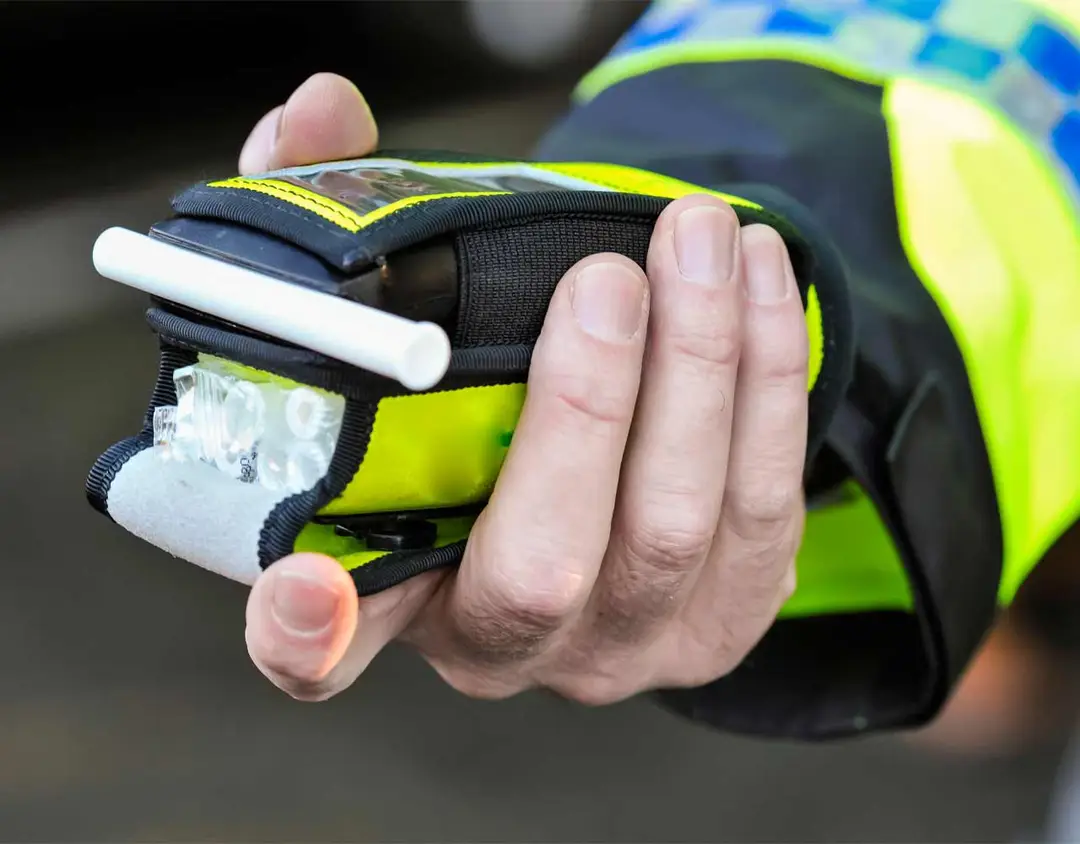
Adam Touma founded Touma Law Group and leads the Columbia office. He earned his Juris Doctor from the University of South Carolina School of Law, clerked for the Honorable Robin B. Stillwell in the 13th Judicial Circuit, and worked as an assistant public defender in Greenville County. He also serves as a JAG officer in the U.S. Army.
That background shapes how we work a case. We know how the other side builds a DUI file, and we go through it line by line. Touma Law Group is veteran-owned, and our team includes Spanish-speaking staff for clients who are more comfortable handling a legal matter in Spanish.
## Call Before the Clock Runs Out
The 30-day window is already running. We offer a free case review, and we handle DUI defense in Columbia, Lexington, Irmo, and the Midlands.
Call our Columbia office at [(803) 879-4499](tel:+18038794499) or contact us online to get started before it's too late.
## Frequently Asked Questions
If you want to drive after a conviction, yes. South Carolina's all-offender law took effect on May 19, 2024, and every DUI or DUAC conviction carries an ignition interlock requirement, six months for a first offense ([S.C. Code Ann. § 56-5-2990](https://www.scstatehouse.gov/code/t56c005.php)).
{' '}
You can, but that decision locks in the interlock requirement, ADSAP, a proof of financial responsibility requirement, and a conviction that the general expungement statute does not allow to be expunged ([S.C. Code Ann. § 22-5-910](https://www.scstatehouse.gov/code/t22c005.php)). Talk with an attorney about your options before your first court date.
{' '}
Not automatically. A refusal or a 0.15 or higher result triggers an administrative suspension. Within 30 days of the notice of suspension, you may request a contested case hearing and get a temporary alcohol license or enroll in the interlock program while that plays out.
{' '}
No. A first-offense DUI is a misdemeanor, usually handled in municipal or magistrate court. DUI becomes a felony when the State alleges it caused great bodily injury or death, and a fourth or later offense is a Class F felony ([S.C. Code Ann. § 56-5-2945](https://www.scstatehouse.gov/code/t56c005.php); [S.C. Code Ann. § 16-1-90(F)](https://www.scstatehouse.gov/code/t16c001.php)).
## Columbia Drug Trafficking Lawyer
URL: https://toumalawgroup.com/columbia/drug-trafficking-lawyer/
Drug trafficking charges in Columbia, SC carry serious legal consequences. If you are accused of possession with intent to distribute, manufacture, or transport illegal substances, a conviction can lead to significant fines and lengthy prison sentences. Understanding your legal rights and options is crucial if you are facing these charges.
A Columbia drug trafficking lawyer can review the charge and guide you through the legal process. This page is general information, not legal advice. A drug charge can result in a permanent criminal record, making it harder to find employment, secure housing, or regain your reputation. The severity of drug crime penalties often depends on the drug type, the amount involved, and whether there is a history of prior drug convictions.
[Contact our drug defense firm](/contact/) to schedule a free consultation with a Touma Law Group attorney, who will review the facts of your case.

## Types of Drug Trafficking Charges in Columbia, SC
Drug charges can vary based on the type and quantity of substances involved. The severity of the charges depends on factors such as intent, distribution methods, and whether the [case involves state or federal law](/federal-vs-state-drug-trafficking/).
Trafficking in a controlled substance carries mandatory prison terms that cannot be suspended, and probation may not be granted ([S.C. Code Ann. § 44-53-370(e)](https://www.scstatehouse.gov/code/t44c053.php)). Trafficking is based on weight, starting at 10 pounds of marijuana, 10 grams of cocaine, methamphetamine, or cocaine base, or 4 grams of heroin or fentanyl.
> **_Contact:_** Reach out to Touma Law Group for a [free case evaluation today!](/contact/)
### Possession with Intent to Distribute
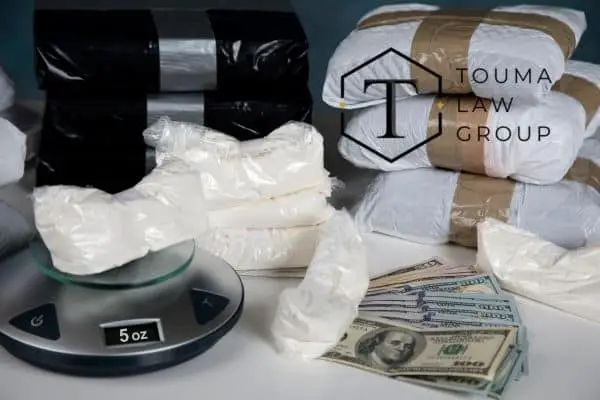
[Possession with intent to distribute](/possession-with-intent-in-sc/) is different from simple possession. It refers to being caught with controlled substances in a quantity that suggests selling rather than personal use. Law enforcement may consider packaging materials, scales, or large amounts of cash as evidence to support these charges. Possessing more than certain amounts, such as more than 28 grams of marijuana or more than one gram of cocaine, is prima facie evidence of a violation of the distribution statute ([S.C. Code Ann. § 44-53-370(d)(5)](https://www.scstatehouse.gov/code/t44c053.php)). That presumption can be challenged.
Unlike simple drug possession, which is often a misdemeanor on a first offense, possession with intent to distribute is a felony ([S.C. Code Ann. § 44-53-370(b)](https://www.scstatehouse.gov/code/t44c053.php)). It can lead to prison time and a criminal record. Prescription drugs that are unlawfully distributed can also lead to this charge.
### Distribution of Controlled Substances
Distributing illegal drugs, whether selling, delivering, or giving them to another person, is a serious criminal offense in South Carolina. The severity of the charge depends on the drug type and amount involved. Convictions for distributing controlled substances can result in significant jail time and fines, especially for repeat offenders or those accused of distributing to a person under 18 ([S.C. Code Ann. § 44-53-440](https://www.scstatehouse.gov/code/t44c053.php)).
A [Columbia drug charge attorney](/columbia/drug-lawyer/) can examine the details of your case to determine if any of your constitutional rights were violated during the arrest or investigation. In some cases, plea bargains may be an option to reduce the charges and avoid the harshest penalties.
> **_Did you know?_** Touma Law Group handles [federal drug charges in Columbia, SC](/federal-drug-classification-laws/).
### Manufacturing Drugs
[Manufacturing illegal substances](/manufacturing-charges-in-sc/), such as producing methamphetamine or growing marijuana without legal authorization, carries severe penalties. These charges can be based on evidence such as laboratory equipment, chemical precursors, or cultivation materials. The penalties depend on the drug and any earlier convictions.
If convicted, you may face prison time and fines. For example, manufacturing methamphetamine or cocaine base is a felony with up to 15 years in prison or a fine of up to $25,000, or both, for a first offense ([S.C. Code Ann. § 44-53-375(B)](https://www.scstatehouse.gov/code/t44c053.php)).
### Drug Trafficking Across State Lines
Drug trafficking cases that involve transporting controlled substances across state lines or internationally are often prosecuted at the federal level. Federal drug trafficking laws carry [mandatory minimum prison sentences](https://www.ussc.gov/research/quick-facts/mandatory-minimum-penalties) that can result in decades behind bars. Cases involving large quantities of drugs or international smuggling are often handled by federal agencies.
A criminal defense lawyer can review the federal charge and explain possible defenses. No result can be promised.
### Conspiracy to Traffic Drugs
You do not have to be caught with drugs in your possession to face drug trafficking charges. A conspiracy to traffic drugs involves planning or coordinating the sale, distribution, or transportation of illegal substances. Law enforcement agencies often use surveillance, wiretaps, and informants to build cases against individuals involved in drug trafficking networks.
Even if you were not directly in possession of drugs, a [conviction for conspiracy can result in severe drug crime penalties](/penalties-for-a-drug-conspiracy-conviction/) and lifelong consequences. A drug crime lawyer can explain how a conspiracy charge works and what the State must prove.
## The Drug Trafficking Legal Process
Being charged with drug trafficking in Columbia, South Carolina can be overwhelming. Understanding the legal process can help you prepare for what lies ahead. A drug defense lawyer can explain your legal options at each step.
### Investigation and Arrest
Law enforcement agencies conduct thorough investigations before making drug trafficking arrests. These investigations may involve undercover operations, wiretaps, and confidential informants. If you are arrested, it is important to remain silent and [contact a drug charge attorney](/columbia/drug-lawyer/) immediately.
The way evidence is collected during an investigation can have a major impact on your defense, and any improper police procedures could be grounds for having your drug charges reduced or dismissed. A criminal defense attorney can analyze whether law enforcement followed proper legal procedures during the investigation.

### Initial Court Appearances
After an arrest, the accused will have an initial court appearance, where they will be formally charged and informed of their rights. The court may set bail or deny it based on the severity of the charges. This stage is critical for establishing legal representation and preparing defenses against drug charges.
A drug charges lawyer can assess the strength of the prosecution's case and explain your options. Seeking legal advice early in the process can help you prepare.
### Pre-Trial Proceedings
During the pre-trial phase, drug defense attorneys review evidence, file motions, and negotiate with prosecutors. Evidence discovery allows the defense to examine law enforcement procedures and challenge any violations of constitutional rights. Negotiating a plea deal may also be an option, depending on the circumstances of the case.
Some drug charge cases can be reduced if errors in evidence collection are found or if alternative sentencing programs are available. A drug crime defense attorney can explain which strategy may fit your case.
### Trial Process
If the case goes to trial, both the prosecution and defense will present evidence, call witnesses, and argue their cases before a judge or jury. A defense strategy can highlight weaknesses in the prosecution's case, challenge evidence, or argue for a lesser charge. No result can be promised.
### Sentencing and Appeals
If convicted, the court will impose sentencing based on the severity of the offense. Sentences for drug trafficking convictions can include lengthy prison terms and substantial fines. If there were errors in the legal process, an [appeal may be possible to challenge the conviction](/appeal-a-criminal-conviction/) or sentence. An attorney can explain whether an appeal is available and what the deadlines are.
## Contact a Columbia, SC Drug Trafficking Lawyer Today
Charges for drug trafficking in Columbia, SC, are serious and require immediate legal action. If you are facing these charges, a drug trafficking lawyer can help you navigate the legal system and protect your rights. A drug crime conviction can have long-term consequences, and a lawyer can review whether the charges can be challenged.
Call Touma Law Group at [(803) 879-4499](tel:+18038794499) today to discuss your case. Our team of criminal defense lawyers represents people charged with a range of drug offenses. No lawyer can promise a particular outcome.
## Professional License Defense Attorney in Columbia
URL: https://toumalawgroup.com/columbia/professional-license-defense/
You spent years studying, passing exams, and investing in your training to earn your professional license. After a complaint, you may need a professional license defense attorney. When your career is on the line, you should not face the process alone.
Our legal team represents licensed professionals in LLR matters. If you have received notice of an investigation or a formal complaint, the choices you make in the next few days can affect how your case proceeds. A licensed South Carolina attorney at our firm must review the facts of your case before you rely on the general information on this page.
Touma Law Group has an office in Columbia. Contact our [Columbia criminal defense lawyers](/columbia/criminal-defense-lawyer/) today to talk about your situation before you speak with any investigator.
> **_Contact:_** Touma Law Group offers [free consultations](/contact/) for all criminal charges.
## Understanding the South Carolina LLR Disciplinary Process
The [South Carolina Department of Labor, Licensing and Regulation](https://llr.sc.gov/) (LLR) supports dozens of professional and occupational licensing boards across the state, from nursing and medicine to real estate and accountancy ([LLR boards list](https://llr.sc.gov/professions.aspx)). Each board applies its own licensing act together with the general provisions in [S.C. Code Ann. Title 40, Chapter 1](https://www.scstatehouse.gov/code/t40c001.php).
When someone files a complaint, the administrative process can begin. Understanding how it works helps you respond on time and plan your defense.
### The Initial Complaint Review and Investigation
If the director has reason to believe a licensee has violated the law or has become unfit to practice, or if a person files a written complaint, the director may initiate an investigation ([S.C. Code Ann. § 40-1-80(A)](https://www.scstatehouse.gov/code/t40c001.php)). LLR's [Office of Investigations and Enforcement](https://llr.sc.gov/oie/) investigates complaints involving a possible violation of a professional or occupational practice act.
Within thirty days after an investigation is initiated, the director must send the licensee a letter saying that a complaint has been filed and an investigation has begun, and asking the licensee to respond in writing within fourteen days. The director must also send a copy of the complaint, the name of the complainant (unless the board believes good cause exists to withhold it), and all materials filed with the complaint ([S.C. Code Ann. § 40-1-80(B)](https://www.scstatehouse.gov/code/t40c001.php)). The director may subpoena witnesses and require the production of relevant records (§ 40-1-80(C)).
Because the written response has a stated time frame, do not let the letter sit. Many license holders believe they can simply explain the situation and make it go away. What you put in writing or say to an investigator can become part of the record in a disciplinary proceeding, so speak with an attorney before you respond.
### Formal Complaints and Disciplinary Hearings
The results of an investigation must be presented to the board. If it appears that a violation has occurred or that a licensee has become unfit to practice, the board, in accordance with the Administrative Procedures Act, may take disciplinary action. No disciplinary action may be taken unless the matter is presented to and voted on by the board, and the board may designate a hearing officer or hearing panel to conduct hearings ([S.C. Code Ann. § 40-1-90(B)](https://www.scstatehouse.gov/code/t40c001.php)). Before a formal complaint is issued, the director must review the case to confirm that the department mailed the complaint to the licensee and gave the licensee an opportunity to respond (§ 40-1-90(A)).
A hearing resembles a trial in some ways. The state presents evidence of the alleged violations, and your attorney can present counterarguments, question witnesses, and offer mitigating evidence.

## Possible Consequences of Licensing Board Sanctions
A board decision can affect more than your current job. It can change your long-term career prospects and become part of the public record.
### Grounds for Discipline
In addition to the grounds in each board's own chapter, a board may cancel, fine, suspend, revoke, or restrict a license on grounds listed in [S.C. Code Ann. § 40-1-110](https://www.scstatehouse.gov/code/t40c001.php). Those grounds include being convicted of or pleading guilty or nolo contendere to a felony or a crime involving drugs or moral turpitude, practicing while under the influence of alcohol or drugs, and committing a dishonorable, unethical, or unprofessional act that is likely to deceive, defraud, or harm the public. Each incident is considered a separate violation.
### License Suspension and Revocation
Under [S.C. Code Ann. § 40-1-120](https://www.scstatehouse.gov/code/t40c001.php), once a board determines that grounds for discipline exist, it may issue a public reprimand, impose a fine not to exceed five hundred dollars unless otherwise specified by statute or board regulation, place the licensee on probation, restrict or suspend the license for a definite or indefinite time, or permanently revoke the license. A suspension means you must stop practicing for the period the board sets. A revocation permanently ends the license.
### Public Reprimand, Practice Limitations, and Costs
A final order of a board disciplining a licensee is public information (§ 40-1-120(C)). A board may also place conditions on a license, such as additional education or a supervisory period (§ 40-1-120(A)(3)). A licensee found in violation may also be directed to pay the reasonable costs of the investigation and prosecution ([S.C. Code Ann. § 40-1-170](https://www.scstatehouse.gov/code/t40c001.php)). If the board decides that discipline is not appropriate, it may issue a nondisciplinary letter of caution (§ 40-1-120(D)).
Discipline can have effects outside the board as well. For example, federal law allows exclusion from federal health care programs of an individual whose health care license was revoked or suspended by a State licensing authority for reasons bearing on professional competence, professional performance, or financial integrity ([42 U.S.C. § 1320a-7(b)(4)](https://www.law.cornell.edu/uscode/text/42/1320a-7)). Employers and insurers may have their own rules, so ask about your situation.
### Appeals
A person aggrieved by a final action of a board may appeal the decision to the Administrative Law Court in accordance with the Administrative Procedures Act and the rules of the Administrative Law Court, and serving a petition for review does not stay the board's decision ([S.C. Code Ann. § 40-1-160](https://www.scstatehouse.gov/code/t40c001.php)). Judicial review of a final agency decision in a contested case is also addressed in [S.C. Code Ann. § 1-23-380](https://www.scstatehouse.gov/code/t01c023.php). The Administrative Law Court's rules require the notice of appeal from a final agency decision to be filed, and a copy served on each party and the agency, within thirty days of receipt of the decision ([SCALC Rule 33(A)](https://www.scalc.net/Rules%20documents/25%20Official%20ALC%20Rules.pdf)). Appeal deadlines are short, so check the date you received your decision and ask an attorney about it as soon as you receive it.

## Who We Represent: Professional Licensing Across Industries
Our firm represents individuals facing licensing issues in South Carolina. Different professions are governed by different boards and rules, so the approach depends on the rules of your board.
### Medical and Healthcare Professionals
Healthcare professionals can face investigations after a patient complaint, a medication error allegation, or a malpractice claim. We represent clients before licensing boards that include:
- **Nursing:** Matters involving RNs, LPNs, and Nurse Practitioners, such as allegations of substance use, charting errors, or negligence.
- **Medical Examiners:** Matters involving physicians and other licensees of that board.
- **Chiropractic Examiners:** Complaints about treatment practices.
- **Psychology:** Complaints about boundaries or ethics.
- **Long Term Health Care Administrators:** Facility compliance issues that involve an individual administrator.
You can see the full list of boards on [LLR's website](https://llr.sc.gov/professions.aspx).
> _**Related:**_ Learn more about our [Columbia federal criminal defense lawyers](/columbia/federal-criminal-defense-lawyer/)
### Law Enforcement Certification
- **Criminal Justice Academy and Training Council:** Law enforcement certification is handled by the South Carolina Criminal Justice Academy and the Law Enforcement Training Council rather than an LLR board. By statute, "misconduct" includes a conviction or plea to a felony or crime of moral turpitude, the repeated use of excessive force, and wilfully making false or misleading statements to a court or an agency ([S.C. Code Ann. § 23-23-150](https://www.scstatehouse.gov/code/t23c023.php)).
- **Right to a hearing:** An officer against whom an allegation of misconduct has been received must be notified of the right to a contested case hearing, and must request it within the time the statute allows (§ 23-23-150(C) and (D)).
- **Pending allegations:** An officer with a pending misconduct allegation filed by an agency may not work as a law enforcement officer until the council issues a final decision or an appellate court rules (§ 23-23-150(G)).
### Real Estate and Financial Services
In the real estate and financial sectors, allegations of mismanagement or ethical breaches can lead to board action. We represent clients before boards that include:
- **Real Estate Commission and Real Estate Appraisers Board:** Agents, brokers, and appraisers facing complaints about misrepresentation or other alleged violations of the practice act.
- **Accountancy:** CPAs facing complaints about alleged tax or auditing errors or failure to maintain professional standards.

## Criminal Charges and License Denials
Professional licensing issues often overlap with criminal defense or with the initial application process.
### The Impact of a Criminal Charge on Your License
If you are facing a criminal charge, such as a DUI, domestic violence charge, or drug offense, the impact can reach your license. A conviction or plea to a felony or a crime involving drugs or moral turpitude is one of the grounds a board may rely on ([S.C. Code Ann. § 40-1-110(1)(h)](https://www.scstatehouse.gov/code/t40c001.php)). Some boards also have reporting requirements, so check the practice act and rules for your license.
Our legal team includes criminal defense lawyers who can look at how a criminal case may affect your professional standing. We can work on the criminal case with that in mind.
### Initial Licensing Process and Application Denials
Sometimes the problem begins before you receive a license. A board may deny an applicant who committed an act that would be grounds for discipline, and must deny an applicant who has not shown the required qualifications ([S.C. Code Ann. § 40-1-130](https://www.scstatehouse.gov/code/t40c001.php)).
A board may not deny a license solely because of a prior criminal conviction unless the conviction directly relates to the duties, responsibilities, or fitness of the occupation or profession. It also may not use vague terms such as "moral turpitude" or "good character" or rely on charges that were dismissed, nol prossed, or ended in a not guilty finding to deny a license. If a conviction may be the basis for a denial, the applicant must be given an opportunity to appear at an application hearing, and a denial based on criminal history must be issued in a written final order that is appealable to the Administrative Law Court ([S.C. Code Ann. § 40-1-140](https://www.scstatehouse.gov/code/t40c001.php)).
> _**Related:**_ See our [Columbia DUI lawyers](/columbia/dui-lawyer/)
## How Our Legal Representation Works
Licensing matters are administrative proceedings governed by Title 40, the board's own licensing act, and the Administrative Procedures Act. We review the complaint, the deadlines, and the evidence, and we explain the choices in front of you at each stage.
We understand the emotional weight a formal complaint can carry for you and your family. Your career is tied to your identity and finances. Handing the case to an attorney lets you stay focused on your daily life while the legal work is handled.
## Contact Us About Your License
A complaint is not a final decision. The earlier you speak with an attorney, the more time there is to review the deadlines that apply to you, but no lawyer can promise a particular result.
### Contact Our Columbia Office Today
If you have been contacted by an LLR investigator, received a notice of a formal complaint, or are facing a licensing board hearing, call our Columbia office at [(803) 879-4499](tel:+18038794499) to schedule a confidential consultation.
## Frequently Asked Questions
An investigation is a fact-finding step, not a final decision. Whether you may keep practicing depends on your board and on the facts. However, if an agency finds that public health, safety, or welfare imperatively requires emergency action, and says so in its order, it may order a summary suspension of a license while proceedings for revocation or other action are pending ([S.C. Code Ann. § 1-23-370(c)](https://www.scstatehouse.gov/code/t01c023.php)).
The statute requires the director to send the licensee notice of the complaint within thirty days after an investigation is initiated, with a request for a written response within fourteen days ([S.C. Code Ann. § 40-1-80(B)](https://www.scstatehouse.gov/code/t40c001.php)). We did not find an official source that sets the total length of an investigation, and it depends on the case. An attorney can ask the department about the status of your matter.
Read any letter carefully and note the response date. You may want to consult an attorney before you answer questions or provide a written statement, because what you say can become part of the record. Call Touma Law Group for a free consultation.
## Anderson Property Crimes Lawyer
URL: https://toumalawgroup.com/anderson/property-crimes-lawyer/
Being accused of a property crime can feel frightening and overwhelming. Many people never expect to face criminal charges, so when it happens, it can be hard to know what to do next. You may be worried about fines, jail time, or how a charge could affect your job, housing, or future background checks.
At [Touma Law Group](/about/), our criminal defense team represents people in Anderson and throughout South Carolina who face property crime allegations. We review the facts, explain the charge, and talk through the options. If you are under investigation or already charged, speaking with a lawyer early is worth considering. A licensed South Carolina attorney at the firm must review the facts of a case before anyone relies on the general information on this page.
> If you are facing a property crime charge, do not wait to get help. [Contact](/contact/) Touma Law Group today for a confidential consultation to talk about your situation.
## Understanding Property Crimes Under South Carolina Criminal Law

Property crimes are criminal offenses that involve taking, damaging, or misusing property that does not belong to you. Many of them are in [Title 16 of the South Carolina Code of Laws](https://www.scstatehouse.gov/code/t16c011.php). These cases do not always involve physical harm, but they are still criminal charges.
A conviction, whether it is a misdemeanor or a [felony](/what-makes-a-crime-a-felony-in-sc/), creates a criminal record. A record can come up in employment, housing, professional license, and background check settings. For many property offenses, the value of the property decides whether the charge is a misdemeanor or a felony.
## Common Property Crimes We Handle in Anderson, SC
Touma Law Group represents clients in a range of property-related cases, including the following. Penalties come from the statute cited and can be different for each charge.
- **Larceny and shoplifting.** Larceny of property valued at $2,000 or less is a misdemeanor with a fine of not more than $1,000 or imprisonment of not more than 30 days. Above $2,000 it is a felony, with up to five years if the value is under $10,000 and up to ten years if it is $10,000 or more ([S.C. Code Ann. § 16-13-30](https://www.scstatehouse.gov/code/t16c013.php)). Shoplifting has its own statute with the same value tiers ([S.C. Code Ann. § 16-13-110](https://www.scstatehouse.gov/code/t16c013.php)). See [petit vs. grand larceny](/petit-vs-grand-larceny/) and [shoplifting penalties](/penalties-for-shoplifting/).
- **Burglary.** Burglary does not require forced entry. It involves entering a building or dwelling without consent and with intent to commit a crime inside. First degree burglary is a felony punishable by life imprisonment, though the court may sentence a defendant to not less than fifteen years ([S.C. Code Ann. § 16-11-311](https://www.scstatehouse.gov/code/t16c011.php)). Second degree is a felony with up to ten years for a dwelling and up to fifteen years for another building ([§ 16-11-312](https://www.scstatehouse.gov/code/t16c011.php)). Third degree is a felony with up to five years for a first offense and up to ten for a second ([§ 16-11-313](https://www.scstatehouse.gov/code/t16c011.php)).
- **Criminal trespass.** Entering another person's land or premises after notice, or refusing to leave when asked, can be charged under [S.C. Code Ann. § 16-11-600 and following](https://www.scstatehouse.gov/code/t16c011.php). See our page on [criminal trespass in South Carolina](/south-carolina-criminal-trespassing-laws/).
- **Property damage and fire.** Willful and malicious injury to personal property is covered by [§ 16-11-510](https://www.scstatehouse.gov/code/t16c011.php), and injury to a tree, house, outside fence, or fixture of another by [§ 16-11-520](https://www.scstatehouse.gov/code/t16c011.php). Both use the same value tiers as larceny. Arson is in [§ 16-11-110](https://www.scstatehouse.gov/code/t16c011.php) and is divided into three degrees.
- **Receiving stolen goods.** It is unlawful to buy, receive, or possess goods that the person knows or has reason to believe are stolen, whether or not anyone is convicted of the theft ([S.C. Code Ann. § 16-13-180](https://www.scstatehouse.gov/code/t16c013.php)).
- **Theft by deception.** Obtaining a signature or property by false pretense with intent to cheat and defraud is covered by [S.C. Code Ann. § 16-13-240](https://www.scstatehouse.gov/code/t16c013.php).
- **Breach of trust and misappropriation.** A breach of trust with fraudulent intention is larceny under [S.C. Code Ann. § 16-13-230](https://www.scstatehouse.gov/code/t16c013.php), which can arise in workplace or business disputes.
- **Identity fraud.** Financial identity fraud and identity fraud are covered by [S.C. Code Ann. § 16-13-510](https://www.scstatehouse.gov/code/t16c013.php).
- **Armed robbery.** Robbery while armed with a deadly weapon, or while alleging that one was used, is a felony with a mandatory minimum term of not less than ten years and not more than thirty years ([S.C. Code Ann. § 16-11-330](https://www.scstatehouse.gov/code/t16c011.php)). It is one of the most serious property-related offenses.
The details of each charge, including the value of the property and the alleged intent, play a major role in how the case is handled and what penalties may apply.
## How Property Crime Charges Can Affect Your Life

Property crime penalties can extend beyond the courtroom. Possible consequences include:
- Jail or prison time, as set by the statute charged
- Fines and court costs
- Probation requirements
- Community service
- Restitution to alleged victims
- Difficulty with background checks
Even a first offense can have lasting consequences. An attorney can explain the specific statute and penalty range in your case.
> Learn More: [South Carolina laws on burglary and property crimes](https://www.scstatehouse.gov/code/t16c011.php).
## What to Do If You Are Accused of a Property Crime
If you are questioned or arrested for a property crime, your next steps matter. You may want to:
- Decline to discuss the case with law enforcement until you have spoken with an attorney
- Avoid explaining or justifying the situation on your own
- Preserve documents, receipts, texts, or messages related to the case
- Contact a defense attorney as soon as possible
Early legal advice can help you understand the charge and the process from the start.
## Reviewing the Defense of a Property Crime Case

At Touma Law Group, every case begins with a careful review of the facts. Depending on the case, that review may look at:
- Whether the evidence shows criminal intent
- Who owned the property and who had a right to possess it
- Whether the value alleged by the State is supported, since value decides the tier for many offenses
- Whether witnesses are reliable and whether their statements conflict
- Whether police conduct and search procedures followed the law
- How evidence was handled
In cases involving fire or serious property damage, a review may include the fire investigation and any dispute involving an insurance policy. No attorney can promise a particular result.
## Exploring Alternatives to Conviction
Not every case ends in a conviction. Depending on the facts, options may include:
- A negotiated plea
- Admission to a pretrial intervention program, which is available only if the circuit solicitor admits the person ([S.C. Code Ann. § 17-22-30 and following](https://www.scstatehouse.gov/code/t17c022.php))
- Restitution to the alleged victim
- Other negotiated resolutions with the prosecutor
A person who completes a pretrial intervention program successfully may apply to the court for an order to destroy the arrest records ([S.C. Code Ann. § 17-22-150](https://www.scstatehouse.gov/code/t17c022.php)). Whether any option is available depends on the charge and the person's record.
> Learn More: [Should I Plead Guilty?](/should-i-plead-guilty/)
## Talking With Touma Law Group
We know that a property crime charge can create stress and uncertainty. Our criminal defense team tries to explain the charge in plain language and to review the evidence with you at each stage of the case. We look at the facts of your situation instead of using a one-size-fits-all approach.

## Take the Next Step
A property crime accusation is serious, but a charge is not a conviction. A lawyer can review the evidence and explain what options may exist in your case.
If you are facing property crime charges in Anderson, South Carolina, contact our office at [(864) 777-8062](tel:+18647778062) to speak with an attorney. A licensed South Carolina attorney at the firm must review the facts of your case before you rely on any general information on this page.
## Domestic Violence Lawyer
URL: https://toumalawgroup.com/anderson/domestic-violence-lawyer/
Domestic violence charges in South Carolina are taken seriously and move quickly through the court system. An arrest can lead to bond conditions, no-contact restrictions, and consequences that affect your freedom, family, and future. If you are facing allegations in Anderson County, speaking with a [criminal defense attorney](/anderson/criminal-defense-lawyer/) who handles domestic violence cases early in the process is important.
Domestic violence cases often involve emotional situations, conflicting stories, and quick decisions by law enforcement. Court restrictions can take effect before all the facts are known. At Touma Law Group, our attorneys provide legal counsel designed to protect your rights and your criminal record from day one. A licensed South Carolina attorney at the firm must review the facts of your case before you rely on any general information on this page.
This page explains South Carolina domestic violence law, the degrees of the charge, related criminal charges, and how court orders and family court issues can intersect with a criminal case.
## Understanding Domestic Violence Laws in South Carolina
South Carolina's criminal domestic violence statute makes it unlawful to cause physical harm or injury to a household member, or to offer or attempt to cause physical harm or injury to a household member with apparent present ability under circumstances reasonably creating fear of imminent peril ([S.C. Code Ann. § 16-25-20(A)](https://www.scstatehouse.gov/code/t16c025.php)). A "household member" is a spouse, a former spouse, a person with whom you have a child in common, or a male and female who are cohabiting or formerly have cohabited ([S.C. Code Ann. § 16-25-10](https://www.scstatehouse.gov/code/t16c025.php)). In [Doe v. State, Opinion No. 27728 (S.C. Nov. 17, 2017)](https://www.sccourts.org/media/opinions/htmlfiles/SC/27728.pdf), the South Carolina Supreme Court declared that definition unconstitutional as applied to an unmarried same-sex couple who lived together, and held that the family court may not use it to keep people in similar relationships from seeking an order of protection. The Court did not rewrite the statute, and the Code still reads "a male and female," so whether a particular relationship is covered in a criminal case is a question for an attorney.
Many cases begin with a 911 call, a third-party report, or injuries observed by officers. An officer may arrest, with or without a warrant, a person the officer has probable cause to believe is committing or has freshly committed domestic violence, even if the accused disputes the claim and even if the act did not happen in the officer's presence ([S.C. Code Ann. § 16-25-70](https://www.scstatehouse.gov/code/t16c025.php)). If officers receive conflicting complaints from two or more household members, they must evaluate who was the primary aggressor, considering factors that include whether one person acted in self-defense.
Because these cases move quickly, early advice from a [criminal defense attorney in Anderson](/best-criminal-defense-attorney-anderson/) can help you avoid mistakes with statements, contact, and bond conditions before they affect your case.
## Degrees of Domestic Violence Charges in Anderson County
South Carolina grades criminal domestic violence into degrees. Each level carries different penalties and requires a defense approach based on the specific allegations ([S.C. Code Ann. § 16-25-20](https://www.scstatehouse.gov/code/t16c025.php)).
### Domestic Violence 3rd Degree
Third degree is the base offense. It is a misdemeanor punishable by a fine of $1,000 to $2,500, up to 90 days in jail, or both, and it may be tried in summary court ([S.C. Code Ann. § 16-25-20(D)](https://www.scstatehouse.gov/code/t16c025.php)). A court that suspends all or part of a sentence can require completion of a domestic violence intervention program.
Prosecutors can file other charges based on the same facts, such as assault and battery, because the domestic violence statute does not replace other assault laws ([S.C. Code Ann. § 16-25-80](https://www.scstatehouse.gov/code/t16c025.php)).
### Domestic Violence 2nd Degree
Second degree applies, for example, when moderate bodily injury results, when the person has one prior domestic violence conviction in the past ten years, or when the person violates a protection order while committing third-degree domestic violence. It is a misdemeanor punishable by a fine of $2,500 to $5,000, up to three years in jail, or both ([S.C. Code Ann. § 16-25-20(C)](https://www.scstatehouse.gov/code/t16c025.php)). A "protection order" includes a condition of bond ([S.C. Code Ann. § 16-25-10](https://www.scstatehouse.gov/code/t16c025.php)).
### Domestic Violence 1st Degree
First degree is a felony punishable by up to ten years in prison. It applies, for example, when great bodily injury results, when a firearm is used in any manner, when the person has two or more prior convictions within ten years, or when a listed circumstance such as impeding the victim's breathing accompanies a second-degree offense ([S.C. Code Ann. § 16-25-20(B)](https://www.scstatehouse.gov/code/t16c025.php)).
### Domestic Violence of a High and Aggravated Nature (CDVHAN)
Domestic violence of a high and aggravated nature is the most severe charge. It applies, for example, when the offense is committed under circumstances showing extreme indifference to the value of human life and great bodily injury results, and it is a felony punishable by up to twenty years in prison ([S.C. Code Ann. § 16-25-65](https://www.scstatehouse.gov/code/t16c025.php)).

## Related Criminal Charges Often Filed With Domestic Violence
Domestic violence cases do not always stand alone. Prosecutors can add other charges that increase exposure and complexity.
Charges that may accompany a domestic violence charge include:
- **Assault and battery**, which South Carolina grades in the first, second, and third degrees ([S.C. Code Ann. § 16-3-600](https://www.scstatehouse.gov/code/t16c003.php))
- **Violating the terms of an order of protection**, a misdemeanor punishable by up to thirty days in jail and a fine of up to $500 ([S.C. Code Ann. § 16-25-20(H)](https://www.scstatehouse.gov/code/t16c025.php)). The warning that [Section 20-4-60(B)(1)](https://www.scstatehouse.gov/code/t20c004.php) requires on every order states a $200 fine instead, and the Code does not say which controls, so ask an attorney which penalty applies
- **Entering a domestic violence shelter** where a household member resides, if you have been charged with domestic violence or are subject to certain orders ([S.C. Code Ann. § 16-25-125](https://www.scstatehouse.gov/code/t16c025.php))
- **Firearm charges**
- **Drug charges** arising from evidence found during an arrest
- **[Public disorderly conduct](https://www.scstatehouse.gov/code/t16c017.php)**, which includes certain public intoxication conduct ([S.C. Code Ann. § 16-17-530](https://www.scstatehouse.gov/code/t16c017.php))
Our attorneys review witness statements, body-camera footage, and the circumstances of the arrest to look for charging problems and constitutional issues.
## Restraining Orders, No-Contact Orders, and Protective Actions
After an arrest, the court that sets bond may impose conditions on your release, including restrictions on travel, association, and place of abode ([S.C. Code Ann. § 17-15-10(A)](https://www.scstatehouse.gov/code/t17c015.php)). A household member can also petition the family court for an order of protection, and the family court can include terms such as those listed below after a hearing ([S.C. Code Ann. § 20-4-60](https://www.scstatehouse.gov/code/t20c004.php)). Read more about [restraining orders and orders of protection in domestic violence cases](/restraining-orders-domestic-violence-cases/). Depending on the order, these can restrict:
- Where you can live, if the family court grants temporary possession of a residence to the petitioner after a hearing
- Contact with the alleged victim
- Temporary custody and visitation terms, after a family court hearing
- Property, including pets, and temporary financial support, after a family court hearing
Violating a protection order, even unintentionally, can lead to new criminal charges or raise the degree of a pending charge. We can help you understand the terms of an order, discuss whether a modification can be requested, and respond to alleged violations.
## Family Court, Custody, and Civil Implications
Domestic violence allegations often intersect with family court matters, including:
- Custody and visitation disputes, where whether a parent has perpetrated domestic violence is one of the factors a judge considers ([S.C. Code Ann. § 63-15-240](https://www.scstatehouse.gov/code/t63c015.php))
- Orders of protection under the Protection from Domestic Abuse Act ([S.C. Code Ann. § 20-4-20 and following](https://www.scstatehouse.gov/code/t20c004.php))
- Divorce proceedings and temporary support
A family court case and a criminal case are separate proceedings, and what happens in one can affect the other. Our attorneys handle the criminal defense side. Ask us how the criminal case may interact with a family court matter, and consult a family law attorney about custody or divorce itself.
> Learn More: [The Long-Term Impact of a Domestic Violence Conviction](/long-term-impact-of-domestic-violence-conviction/)
## How Our Criminal Defense Team Reviews Your Case
Our approach focuses on the facts, procedure, and constitutional protections.
We review:
- Police reports and investigative errors
- Search warrants and searches
- Witness credibility issues
- Medical records and injury claims
- Self-defense evidence
A bond hearing for a charge under Chapter 25 of Title 16 must occur within twenty-four hours after the arrest ([S.C. Code Ann. § 22-5-510(F)](https://www.scstatehouse.gov/code/t22c005.php)). At that hearing, we can speak to the court about reasonable conditions so that you can work, find housing, and prepare your defense. The court must also inform you in writing of your right to counsel and, if you cannot afford one, your right to court-appointed counsel ([S.C. Code Ann. § 16-25-120(D)](https://www.scstatehouse.gov/code/t16c025.php)).
## Legal Services at Touma Law Group
Touma Law Group handles a range of criminal defense matters, including:
- Criminal defense
- Domestic violence defense
- Assault and battery defense
- Drug charge defense
- Weapons and gun charge defense
We aim to give each client personal attention and to keep each case confidential.

## Why Clients Choose Touma Law Group
Touma Law Group offers:
- Personal attention to each case
- Clear explanations of the charge and your options
- Confidential handling of sensitive cases
- Clear contact information
- Direct communication about your case
Our attorneys understand how a criminal conviction can affect employment, housing, professional licensing, and family life. Every initial consultation is handled with discretion and respect.
> Learn More: [Do You Need a Lawyer for Domestic Violence Charges in SC?](/domestic-violence-charges-in-sc/)
## Speak With an Anderson, SC Domestic Violence Lawyer Today
Domestic violence charges in Anderson County call for prompt legal advice. Whether your case involves a criminal charge, a no-contact condition, or a family court order, early representation matters.
Contact our office today at [(864) 777-8062](tel:+18647778062) to schedule a confidential consultation and learn how we can help. We do not promise any particular result.
## Anderson Drug Possession Lawyer
URL: https://toumalawgroup.com/anderson/drug-possession-lawyer/
Drug possession charges in South Carolina can have serious consequences, including jail time, fines, and a criminal record. These charges can affect your job and your personal relationships. Being accused of possessing illegal substances can feel overwhelming, especially when the penalties include possible jail time, fines, or harsher penalties for a repeat offense. If you are facing drug charges in Anderson, SC, it is important to speak with an attorney early.
A criminal defense lawyer can explain the charge, review the evidence, and protect your rights throughout the legal process. [Contact](/contact/) a drug crime lawyer in Anderson, SC, to discuss your case. A licensed South Carolina attorney at the firm must review the facts of your case before you rely on the general information on this page.
## Drug Possession Laws in South Carolina
South Carolina's drug possession laws apply to [controlled substances](/controlled-substances-classified-sc/). Under South Carolina law, it is unlawful to knowingly or intentionally possess a controlled substance, unless it was obtained directly from, or under a valid prescription or order of, a practitioner acting in the course of professional practice ([S.C. Code Ann. § 44-53-370(c)](https://www.scstatehouse.gov/code/t44c053.php)).
### Simple Possession vs. Possession with Intent to Distribute
Understanding the difference between simple possession and [possession with intent](/possession-with-intent-in-sc/) to distribute (PWID) is important.
- Simple Possession: This charge involves possessing a controlled substance without intent to distribute. For most substances, a first offense is a misdemeanor. Some substances, such as fentanyl above a stated amount, are charged as felonies, and repeat offenses can carry harsher penalties ([S.C. Code Ann. § 44-53-370(d)](https://www.scstatehouse.gov/code/t44c053.php)).
- Possession with Intent to Distribute (PWID): The statute treats possession above certain amounts as prima facie evidence of a violation, and other evidence, such as packaging materials, may also be used to support the charge ([S.C. Code Ann. § 44-53-370(d)(5)](https://www.scstatehouse.gov/code/t44c053.php)). PWID is a felony for substances in Schedules I, II, and III. For Schedule IV and V substances, a first offense is a misdemeanor ([S.C. Code Ann. § 44-53-370(b)](https://www.scstatehouse.gov/code/t44c053.php)). Trafficking is a separate charge based on weight, with mandatory minimum terms. See [drug trafficking charges](/drug-trafficking-charges-in-sc/).
### Controlled Substances and Schedules
South Carolina categorizes controlled substances into five schedules ([S.C. Code Ann. § 44-53-160](https://www.scstatehouse.gov/code/t44c053.php)).
- Schedule I drugs (for example, heroin and LSD) are substances that the law places in that schedule based on a high potential for abuse and no accepted medical use in treatment in the United States ([S.C. Code Ann. § 44-53-180](https://www.scstatehouse.gov/code/t44c053.php) and [§ 44-53-190](https://www.scstatehouse.gov/code/t44c053.php)).
- Schedule V drugs include certain preparations with limited amounts of narcotics, such as some cough medicine with codeine. They are still illegal to possess without authorization ([S.C. Code Ann. § 44-53-270](https://www.scstatehouse.gov/code/t44c053.php)).
The schedule and the substance affect the penalties. For example, possessing most other controlled substances in Schedules I through V is a misdemeanor punishable by up to six months in jail or a fine of up to $1,000, or both, for a first offense ([S.C. Code Ann. § 44-53-370(d)(2)](https://www.scstatehouse.gov/code/t44c053.php)).
## Penalties for Drug Possession in Anderson, SC
The potential penalties for drug possession in South Carolina depend on factors such as the drug type, the amount, and whether it is a first or subsequent offense.

### Penalties for First-Time Offenders vs. Repeat Offenders
- First-Time Offenders: A first offense of simple possession is usually a misdemeanor, with penalties set by the substance. Some first-time charges may be eligible for a conditional discharge or pretrial intervention, described below.
- Repeat Offenders: A second or subsequent offense can carry higher penalties. For example, a second offense of possessing cocaine is a felony punishable by up to five years in prison or a fine of up to $7,500, and a third or subsequent offense is punishable by up to ten years or a fine of up to $12,500 ([S.C. Code Ann. § 44-53-370(d)(3)](https://www.scstatehouse.gov/code/t44c053.php)). When an offense counts as a second or subsequent offense is defined in [S.C. Code Ann. § 44-53-470](https://www.scstatehouse.gov/code/t44c053.php).
### Type and Amount of the Drug
The severity of penalties also depends on the type and quantity of the substance:
- [Small amounts of marijuana](/caught-with-a-small-amount-of-marijuana/): Possessing 28 grams (one ounce) or less is a misdemeanor punishable by up to 30 days in jail or a fine of $100 to $200 for a first offense. Larger amounts can support a PWID charge ([S.C. Code Ann. § 44-53-370(d)(5)](https://www.scstatehouse.gov/code/t44c053.php)).
- [Cocaine or methamphetamine possession](/possession-of-cocaine-penalties-in-south-carolina/): A first offense of possessing cocaine, or less than one gram of methamphetamine, is a misdemeanor punishable by up to three years in prison or a fine of up to $5,000, or both ([S.C. Code Ann. § 44-53-370(d)(3)](https://www.scstatehouse.gov/code/t44c053.php) and [§ 44-53-375(A)](https://www.scstatehouse.gov/code/t44c053.php)).
- Heroin and other Schedule I or II narcotics: A first offense is a misdemeanor punishable by up to two years in prison or a fine of up to $5,000, or both ([S.C. Code Ann. § 44-53-370(d)(1)](https://www.scstatehouse.gov/code/t44c053.php)).
### Additional Consequences
In addition to the direct penalties, a conviction for drug possession can have other consequences:
- Fines and Fees: Financial penalties can create a burden, especially for people who are already facing legal costs.
- Criminal Record: A criminal conviction for drug possession can limit employment opportunities and affect housing options.
> South Carolina sets out its prohibited acts and penalties for drug possession in [S.C. Code Ann. § 44-53-370](https://www.scstatehouse.gov/code/t44c053.php), and the penalties for methamphetamine are in [S.C. Code Ann. § 44-53-375](https://www.scstatehouse.gov/code/t44c053.php).
## Defenses Against Drug Possession Charges

If you are facing drug charges, a lawyer can review the evidence and explain which defenses may apply to the facts of your case.
### Unlawful Search and Seizure
An illegal search is a common issue in drug possession cases. The Fourth Amendment protects against unreasonable searches and seizures ([U.S. Const. amend. IV](https://www.law.cornell.edu/constitution/fourth_amendment)). If law enforcement obtained evidence through an unlawful search, your lawyer can ask the court to exclude the evidence.
### Proving Lack of Ownership
Another approach is to show that the drugs were not yours. The State must prove that you had the right and power to control the drugs, and that you knew about the drugs and intended to control them ([State v. Stewart, Opinion No. 28029 (S.C. 2021)](https://www.sccourts.org/media/opinions/htmlfiles/SC/28029.pdf)). Being near the drugs does not by itself answer those questions. If the State cannot establish them through credible witness statements or reliable laboratory analysis, that can affect the charge.
### Challenges to Evidence or Procedure
A criminal defense attorney will review the evidence and police procedures for errors or inconsistencies. By raising reasonable doubt, your lawyer can challenge the State's case.
## How a Lawyer Can Help With Drug Possession Charges
Hiring a drug lawyer can make a significant difference in how you understand and respond to your case. Here is how a drug defense lawyer can assist you:
**Protecting Your Rights**
Your attorney will work to ensure your constitutional rights are respected from the moment of arrest. This includes reviewing evidence obtained through a search, the validity of an arrest warrant, and whether law enforcement followed proper procedure.
**Discussing Plea Options**
Your lawyer can discuss the case with the solicitor. Depending on the circumstances, the options discussed may include probation, a diversion program, or a reduction of the charge.
**Building a Defense**
A criminal defense lawyer will build a defense tailored to your situation. This may include challenging laboratory analysis, questioning the accuracy of drug testing, presenting alternative explanations, or showing that the State has not met its burden of proof beyond a reasonable doubt.
## Can You Avoid a Conviction for Possession With a Drug Diversion Program?
South Carolina law provides two paths that can lead to dismissal for eligible people.
A person who has not previously been convicted of an offense under the state's controlled substances article, or of certain related drug offenses, may be eligible for a conditional discharge for a possession charge. The court, with the person's consent, may defer proceedings and place the person on probation. If the person completes the terms, the court discharges the person and dismisses the proceedings. If the person violates a term, the court may enter a finding of guilt. A discharge and dismissal can occur only once ([S.C. Code Ann. § 44-53-450](https://www.scstatehouse.gov/code/t44c053.php)).
Pretrial intervention is a program run by the solicitor. If a person completes it, the solicitor effects a noncriminal disposition of the charge, and the person may apply to the court for an order to destroy the arrest records. If the person violates the program agreement, the solicitor may end the person's participation and resume the prosecution ([S.C. Code Ann. § 17-22-150](https://www.scstatehouse.gov/code/t17c022.php)). Eligibility is reviewed under [S.C. Code Ann. § 17-22-60](https://www.scstatehouse.gov/code/t17c022.php).

## Get the Legal Support You Need
If you are facing drug charges or other drug offenses in Anderson, SC, you do not have to navigate the legal system alone. The penalties for drug crimes can be serious, and an attorney can explain the charge and guide you through the process.
Contact Touma Law Group in Anderson, South Carolina, today to [schedule a consultation](/contact/). Our firm can review the facts of your case and explain your options.
## Frequently Asked Questions
Your first step should be to contact a criminal defense lawyer as soon as possible. Early legal representation helps protect your rights, prevent mistakes during questioning, and ensure that evidence is reviewed before it is used against you.
It depends on the type and amount of the drug and on prior offenses. A first offense of simple possession of most substances, including cocaine, heroin, and less than one gram of methamphetamine, is a misdemeanor. A second offense involving cocaine, heroin, or methamphetamine is a felony, and possession above certain amounts can support a PWID charge, which is a felony for many substances ([S.C. Code Ann. § 44-53-370](https://www.scstatehouse.gov/code/t44c053.php) and [§ 44-53-375](https://www.scstatehouse.gov/code/t44c053.php)).
It depends on the facts. A charge may be dismissed if the evidence was obtained illegally, if the State cannot prove possession, or if procedural errors occurred. A conditional discharge or pretrial intervention may also lead to dismissal for eligible people, as described above.
Yes, you can be charged, but the State must prove that you had the right and power to control the drugs and that you knew about them and intended to control them. If your lawyer can show a lack of knowledge or control, that can affect the charge.
A conviction generally stays on your record unless it is removed through a process that the law allows. A conditional discharge or pretrial intervention can lead to dismissal and an application to expunge the records for eligible people. Eligibility depends on the charge and your record, so ask an attorney how this applies to you.
## Anderson Drug Trafficking Lawyer
URL: https://toumalawgroup.com/anderson/drug-trafficking-lawyer/
Drug trafficking is a serious crime in Anderson, SC, carrying penalties that can affect your freedom and your future. If you are facing a trafficking charge, it is important to understand the legal implications and to act quickly to protect your rights. South Carolina treats trafficking offenses as some of its most serious drug crimes, and every trafficking tier in the statute carries a prison term that cannot be suspended ([S.C. Code Ann. § 44-53-370(e)](https://www.scstatehouse.gov/code/t44c053.php)).
If you or someone you know is involved in a drug trafficking case, speaking with a criminal defense attorney early is important. [Contact](/contact/) us today for a consultation to discuss your options and how the law applies to your case. This page is general information, not legal advice. A licensed South Carolina attorney at Touma Law Group must review the facts of your case before you rely on it, and no attorney can promise a particular outcome.

## Understanding Drug Trafficking Charges in South Carolina
Drug trafficking is a serious criminal charge in South Carolina. Under the state statute, a person commits trafficking by knowingly selling, manufacturing, cultivating, delivering, purchasing, or bringing into the state a threshold amount of a [controlled substance](/controlled-substances-classified-sc/), or by knowingly being in actual or constructive possession of that amount ([S.C. Code Ann. § 44-53-370(e)](https://www.scstatehouse.gov/code/t44c053.php)). Methamphetamine and cocaine base are covered by a separate provision with its own thresholds ([S.C. Code Ann. § 44-53-375(C)](https://www.scstatehouse.gov/code/t44c053.php)). The charge is based on weight. The State does not have to prove that you intended to sell the drugs when the charge rests on possession.
Trafficking charges are often accompanied by severe penalties, including long prison sentences and substantial fines. The exact range depends on the drug, the weight, and whether the case is a first, second, or later offense.
## Common Substances Involved in Drug Trafficking Cases
Trafficking charges in South Carolina can involve several controlled substances. The statute names marijuana, cocaine, heroin, morphine and opium, fentanyl and fentanyl-related substances, LSD, MDMA, methaqualone, flunitrazepam, and GHB. Methamphetamine and cocaine base have their own trafficking provision. Prescription drugs can also be involved when they fall within one of these categories or are moved outside a valid prescription, and the specific medication matters. Each substance has its own threshold, and once the weight reaches that threshold, a trafficking charge can follow.
The first-tier thresholds are:
- Marijuana: 10 pounds
- Cocaine: 10 grams
- Methamphetamine or cocaine base: 10 grams
- Heroin, morphine, or opium: 4 grams
- Fentanyl or a fentanyl-related substance: 4 grams
- LSD and MDMA: 100 dosage units
- Methaqualone: 15 grams
- Flunitrazepam: 1 gram
- GHB: 50 milliliters or milligrams
The type of substance and the weight play a large role in the severity of the charge and the possible penalties. The weight of a controlled substance includes the pure form and any compound or mixture of it. For more on prescription medications, see our page on [prescription drug charges](/prescription-drug-charges/).
## Distinction Between Possession, Distribution, and Trafficking

It is important to distinguish between simple possession, [possession with intent](/possession-with-intent-in-sc/), and trafficking when it comes to drug-related charges:
- Simple possession means knowingly possessing a controlled substance without a valid prescription. A first offense for most substances is a misdemeanor ([S.C. Code Ann. § 44-53-370(c) and (d)](https://www.scstatehouse.gov/code/t44c053.php)).
- Possession with intent means possessing a controlled substance with the purpose of distributing it. The statute sets no weight threshold for this offense, and it carries different penalties than trafficking ([S.C. Code Ann. § 44-53-370(a) and (b)](https://www.scstatehouse.gov/code/t44c053.php)).
- Constructive possession applies when a person does not physically hold the drugs but has the ability and the intent to control them, for example drugs in a car or a room.
Trafficking is charged by weight, and the statute treats possession with intent to distribute as a lesser included offense of possession-based trafficking. Trafficking carries much harsher penalties than possession or distribution because of the mandatory terms attached to each weight tier. Understanding these distinctions is important in a defense, because each charge has different legal implications and different sentencing rules.
## Penalties for Drug Trafficking in South Carolina
Drug trafficking in Anderson, South Carolina, comes with severe legal consequences. The penalties depend on the drug and the weight. The [trafficking statute](https://www.scstatehouse.gov/code/t44c053.php) sets a prison term and a fixed fine for each tier, and it states that no part of the sentence may be suspended and probation may not be granted. Second and third offenses carry higher penalties than a first offense.
### Explanation of Penalties Based on Drug Type and Quantity
The penalties vary with the type of drug and the amount involved. These first-offense examples come from [S.C. Code Ann. § 44-53-370(e)](https://www.scstatehouse.gov/code/t44c053.php):
- [Marijuana trafficking](/marijuana-trafficking-charges-in-sc/) of 10 pounds or more but less than 100 pounds carries 1 to 10 years in prison and a $10,000 fine. Higher weights, or 100 to 1,000 plants, carry a mandatory 25 years.
- Cocaine trafficking of 10 grams or more but less than 28 grams carries 3 to 10 years and a $25,000 fine. At 28 grams or more but less than 100 grams, a first offense carries 7 to 25 years and a $50,000 fine. At 100 grams or more but less than 200 grams, the statute provides a mandatory 25 years.
- [Heroin trafficking](/heroin-trafficking-charges/) of 4 grams or more but less than 14 grams carries 7 to 25 years and a $50,000 fine for a first offense. At 14 grams or more but less than 28 grams, the statute provides a mandatory 25 years and a $200,000 fine, and at 28 grams or more it provides 25 to 40 years.
- Methamphetamine or cocaine base trafficking of 10 grams or more but less than 28 grams carries 3 to 10 years and a $25,000 fine for a first offense, under [§ 44-53-375(C)](https://www.scstatehouse.gov/code/t44c053.php).
The severity of the penalties increases as the weight increases, and each drug has its own defined threshold. Subsequent offenses carry longer prison terms and larger fines.
### Mandatory Minimum Sentences
South Carolina's trafficking statute sets mandatory terms. Even if there are mitigating circumstances or a clean criminal record, the court must follow the statute's range for the tier, and it cannot suspend the sentence or grant probation. For example, the statute provides a mandatory term of 25 years for 100 grams or more of cocaine, up to but not including 200 grams. A person sentenced to a mandatory 25 years is not eligible for parole, extended work release, or supervised furlough. Because the penalty comes from the statute, the weight attributed to a person is one of the most important issues in a trafficking case.
### Fines and Additional Penalties
In addition to prison, a person convicted of trafficking faces a fixed fine set by the statute for each tier. Those fines range from $10,000 to $200,000 depending on the drug and the weight. Prior convictions move a case into the higher tiers for second and third offenses. Trafficking is also listed as a violent crime in [S.C. Code Ann. § 16-1-60](https://www.scstatehouse.gov/code/t16c001.php), which has consequences for bail and pretrial intervention.
### Trafficking Across State Lines and Near Schools
Bringing a threshold amount of a controlled substance into South Carolina is one of the acts that the trafficking statute covers. If the facts also involve other states or large distribution networks, federal agencies may become involved, and federal law has its own penalties ([21 U.S.C. § 841(b)](https://www.law.cornell.edu/uscode/text/21/841)). Federal penalties are not always higher than state penalties, and our page on [federal vs. state drug trafficking](/federal-vs-state-drug-trafficking/) explains how they compare.
State law also makes it a separate offense to distribute, sell, purchase, manufacture, or possess with intent to distribute a controlled substance within a one-half mile radius of the grounds of a school, a public playground or park, a public vocational or technical school, or a college or university ([S.C. Code Ann. § 44-53-445](https://www.scstatehouse.gov/code/t44c053.php)). The person must know that he or she is within that distance, and the offense is a felony with a fine of up to $10,000, up to ten years in prison, or both.
Understanding the factors that influence sentencing is important when facing these charges. An attorney can review how the statute applies to the weight, the location, and the other facts of a case.
> Learn More: [Federal vs. State Drug Trafficking Charges](/federal-vs-state-drug-trafficking/)
## Why You Need an Anderson SC Drug Trafficking Lawyer
Facing drug trafficking charges in Anderson, South Carolina, can have life-altering consequences, and the legal process is complex. A licensed attorney can explain how the statute applies, protect your rights, and review the evidence against you. Cases from Anderson County are prosecuted by the solicitor for the tenth judicial circuit, which is made up of Anderson and Oconee counties ([S.C. Code Ann. § 14-5-610](https://www.scstatehouse.gov/code/t14c005.php)). Drug charges can also involve federal law, which means understanding both systems matters. A lawyer who focuses on drug defense can help you understand the details of your case and the legal options that may be available.

### Navigating the Complexities of State and Federal Drug Laws
Drug trafficking offenses can have both state and federal implications, especially when a case involves other states or large quantities. Federal and state law use different weight thresholds and different sentencing rules. For some drugs and weights the state mandatory minimum is higher, and for others the federal minimum is higher. An attorney can explain how the two systems work and which one applies to a particular charge. Understanding both systems helps you know the full range of possible consequences.
## Conducting a Thorough Investigation to Uncover Weaknesses in the Prosecution's Case
A criminal defense lawyer can review the prosecution's evidence for weaknesses or inconsistencies. That can include examining the evidence against you, such as how the weight was measured, whether your constitutional rights were violated during a search, or whether there were issues with the chain of custody. Evidence gathered through an unconstitutional search may be excluded ([Mapp v. Ohio](https://www.law.cornell.edu/supremecourt/text/367/643)). In some cases, an attorney may find problems in the investigation or procedural errors that affect the prosecution's argument. Whether that leads to a reduced or dismissed charge depends on the facts, and no result can be promised.
## Negotiating Plea Deals or Reduced Charges When Appropriate
Not all drug trafficking cases go to trial. A lawyer can discuss a plea with the prosecution, which could involve a different charge or a different sentence. Because possession with intent to distribute is a lesser included offense of possession-based trafficking, and because it carries different sentencing rules under [§ 44-53-370(b)](https://www.scstatehouse.gov/code/t44c053.php), the charge itself can be a subject of negotiation. When appropriate, a lawyer will use knowledge of the law to discuss a plea agreement based on the facts of your case. You decide whether to accept any plea offer, and an attorney can explain what each option means for your sentence and your record.
## Building a Defense for Trial
If your case goes to trial, the defense is built on the facts and the evidence. Your lawyer can prepare a defense strategy that may involve challenging the evidence, questioning witnesses, or presenting alternative explanations for the charges. The State has to prove each element of the charge beyond a reasonable doubt ([In re Winship](https://www.law.cornell.edu/supremecourt/text/397/358)), and a trial gives the defense the chance to hold the State to that burden.
Having a lawyer represent you in a drug trafficking case in Anderson helps you handle complex legal procedures and evidence rules, whether the case ends in a plea or a trial. If you are facing drug trafficking charges, speaking with a defense attorney as soon as possible is a first step in protecting your rights.
## The Impact of a Prior Conviction on Your Case
A prior felony or drug conviction can affect a drug trafficking case in several ways. In South Carolina, a prior record can lead to higher penalties and can influence the strategy of both the prosecution and the defense. Here are some ways a prior conviction might affect your case:

### 1\. Increased Sentences and Penalties
The trafficking statute itself sets higher sentences for second and later offenses. For example, under [§ 44-53-370(e)(2)](https://www.scstatehouse.gov/code/t44c053.php), a first offense involving 10 grams or more but less than 28 grams of cocaine carries 3 to 10 years, a second offense carries 5 to 30 years, and a third or subsequent offense carries a mandatory minimum of 25 years, up to 30. Prior drug convictions can therefore change the sentencing range that applies. The prosecution may seek the maximum penalty available, especially when charges involve large quantities.
### 2\. Impact on Plea Negotiations
Previous convictions can affect plea bargaining. Prosecutors may be less likely to offer a reduced charge if you have a prior record, particularly if it is drug-related. An attorney can still discuss a plea with the prosecution by presenting mitigating factors, and can explain whether cooperation with authorities is something to consider.
### 3\. Probation or Parole Violations
If you are currently on probation or parole for a prior offense, a new drug trafficking charge could lead to a violation proceeding. That may result in additional consequences, including revocation of probation or parole and the possibility of serving a sentence for the original offense in addition to any new sentence.
### 4\. Difficulty in Defending the Case
A prior conviction can make it harder for the defense to argue for leniency or to challenge certain parts of the case. If you have a history of drug-related offenses, it may be harder to persuade the court that the current allegation is an isolated incident. An attorney can still focus on weaknesses in the current case, such as problems with the evidence, an illegal search, or police procedures.
### 5\. Limited Eligibility for Certain Programs
Some programs are not available for a trafficking charge whether or not you have a record. A conditional discharge under [§ 44-53-450](https://www.scstatehouse.gov/code/t44c053.php) applies to possession offenses, not trafficking. Because trafficking is listed as a violent crime in § 16-1-60, a person charged with it is generally not considered for pretrial intervention under [§ 17-22-50](https://www.scstatehouse.gov/code/t17c022.php), unless the solicitor determines the elements of the crime do not fit the charge. A prior record can narrow your options further. An attorney can explain which programs apply to a specific charge.
### 6\. Long-Term Impact on Future Cases
A prior conviction can affect more than the current case. A drug conviction can complicate job opportunities, housing, and other parts of life, and it can raise the stakes in any later case.
In short, a prior conviction can increase the potential consequences of a drug trafficking charge. A criminal defense lawyer can review your record and the case to explain how it may affect the range of penalties and the options available.
## Take the First Step Toward Defending Against Drug Trafficking Charges

Drug trafficking charges in Anderson, SC, can be overwhelming, but you do not have to face them alone. An attorney can explain your rights and review the case with you. From challenging an illegal search to discussing a plea or preparing for trial, your attorney can walk you through each step and what it means.
Do not wait. Contact Touma Law Group in Anderson, South Carolina, today to [schedule your consultation](/contact/), or call [(864) 777-8062](tel:+18647778062). A licensed South Carolina attorney at the firm will review the facts of your case and explain your legal options.
## Greenville Gun and Weapon Charges Lawyer
URL: https://toumalawgroup.com/greenville/weapons-gun-charges-lawyer/
When facing a gun charge in Greenville, South Carolina, your freedom and Second Amendment rights are on the line. Navigating the complex world of state and federal gun laws can feel impossible, especially when you are up against a determined prosecutor. You need a gun charge attorney who can explain the law and your options.
Whether you are dealing with a simple weapons charge or a serious felony, the consequences of a criminal conviction can be life-altering. This page is designed to help you understand the gravity of gun crimes and the importance of speaking with a Greenville gun lawyer about your rights.
Our firm can review your case and explain how South Carolina gun law applies. We offer [free criminal defense consultations](/greenville/criminal-defense-lawyer/) to discuss your case and explore your legal options.

## Common Gun Crimes in South Carolina
South Carolina has specific laws governing the possession, use, and transfer of firearms. While recent changes have expanded gun ownership rights, violations can still lead to severe penalties. Here are some of the most common weapons charges we see in Greenville:
### Unlawful Possession of a Weapon
This can apply to individuals who are prohibited from owning a gun, such as those with a prior felony conviction, those convicted of domestic violence, or those with certain drug crimes on their record. [Unlawful possession of a weapon](/unlawful-possession-of-a-firearm/) can also include possessing a weapon in a prohibited location, such as a courthouse while court is in session or school property ([S.C. Code Ann. §§ 16-23-20 and 16-23-420](https://www.scstatehouse.gov/code/t16c023.php)).
> **_Contact:_** [Touma Law Group offers free consultations](/contact/). Schedule one today!
### Felon in Possession
Under both state and federal laws, a felony conviction can strip you of your right to own a firearm. Being [caught with a weapon as a felon](/possession-of-weapon-by-felon/) in possession can lead to serious state and federal charges, and federal law carries up to 15 years in prison for a violation ([18 U.S.C. § 924(a)(8)](https://www.law.cornell.edu/uscode/text/18/924)). State law carries up to five years for a first offense, with mandatory minimum terms for later offenses ([S.C. Code Ann. § 16-23-500](https://www.scstatehouse.gov/code/t16c023.php)).
### Unlawful Carrying of a Firearm
While the state's new Open Carry with Training Act and Constitutional Carry laws have changed what is considered unlawful, there are still strict regulations on where and how you can carry a weapon. Since March 7, 2024, a person who is not otherwise prohibited may carry a handgun without a permit, but carrying in a place the law prohibits can result in criminal penalties ([S.C. Code Ann. §§ 16-23-20 and 16-23-50](https://www.scstatehouse.gov/code/t16c023.php)).

### Possession of a Stolen Weapon
This is considered a serious felony and can lead to prison time. The law treats this as a separate crime from other examples of theft crimes and possession of a weapon.
A weapons attorney understands the nuances of these laws and can help you navigate the charges.
## Why You Need a Dedicated Gun Attorney
A gun charge is not a minor offense. A criminal conviction for a gun crime can have long-term penalties that affect your right to own a firearm in the future, your ability to get a job, and even your housing options. A single weapons charge can lead to a criminal record that follows you for the rest of your life.
A criminal defense attorney can:
- **Protect Your Rights:** From the moment of your arrest, your rights are at risk. An attorney can ensure law enforcement respects your rights under the Fourth Amendment regarding unlawful searches and seizures and your right to remain silent.
- **Challenge Evidence:** Your Greenville gun defense attorney will meticulously review the evidence against you, including the circumstances of your arrest, any statements you made, and how the firearm was seized. We can challenge the legality of the police's actions and, where appropriate, ask the court to suppress evidence.
- **Negotiate with Prosecutors:** In some cases, a plea offer may be an option to consider instead of a trial. An attorney can explain what an offer means for your record and your firearm rights.
- **Review Your Defenses:** Whether your case involves the castle doctrine, self-defense, or a simple misunderstanding of the law, an attorney can review the facts and the statutes that apply ([S.C. Code Ann. §§ 16-11-410 through 16-11-450](https://www.scstatehouse.gov/code/t16c011.php)). A review can include the legality of the initial stop, the chain of custody of the evidence, and whether the firearm was properly identified.
When you are facing a federal crime, the stakes are even higher. Federal laws, such as those related to a felon in possession, can carry significant penalties and, in some cases, mandatory minimum sentences ([18 U.S.C. § 924](https://www.law.cornell.edu/uscode/text/18/924)). Federal court operates differently from state court, so a federal charge calls for its own review.

## Understanding South Carolina Gun Law
The legal landscape for gun ownership in South Carolina has undergone significant changes. With the passage of the Open Carry with Training Act, and more recently, Constitutional Carry Law, individuals can carry a handgun without a concealed weapons permit (CWP), provided they are not otherwise prohibited.
However, there are still many restrictions and specific locations where firearms are banned, such as schools, courthouses, and government buildings. Violating these rules can lead to serious gun violations.
The Second Amendment protects the right to bear arms, but it is not an absolute right. There are limitations, and the [South Carolina Code of Laws](https://www.scstatehouse.gov/code/t16c023.php) outlines what those are. For example, a person with a prior criminal conviction, especially for violent crimes, drug-related crimes, or domestic violence, is often prohibited from possessing a weapon.
Our work as Greenville gun possession lawyers extends to a wide range of firearm-related crimes. These include not only unlawful possession and carrying but also more severe gun crimes, such as the possession of a sawed-off shotgun, or the use of a firearm in the commission of another offense, like a sex crime or examples of theft crimes.
> **_Related:_** In addition to your gun rights, you may [lose other rights if convicted with a felony](/rights-you-lose-convicted-of-felony/).
## The Criminal Justice System in Greenville
Navigating the criminal justice system in Greenville, South Carolina is easier with an attorney. From the initial arrest to a court appearance, an attorney can handle communications with law enforcement and the state prosecutor and help protect your rights at each stage.
A criminal defense attorney can help you understand the differences between felonies and misdemeanors, the potential for a criminal conviction, and the long-term penalties associated with each kind of crime. South Carolina classifies felonies from Class A to Class F, with maximum terms set by statute, such as not more than thirty years for a Class A felony ([S.C. Code Ann. §§ 16-1-20 and 16-1-90](https://www.scstatehouse.gov/code/t16c001.php)).
Whether your case is a misdemeanor or a felony, an attorney can review the charge and the evidence and explain your options. No lawyer can promise a particular result.

## Your First Step: A Criminal Defense Consultation
If you or a loved one are facing weapons charges in Greenville, do not wait. The sooner you contact a firearms attorney, the sooner we can begin building your defense. We will review the details of your case, explain the relevant laws, and discuss your options.
The consequences of a gun charge are too serious to handle alone. A criminal conviction can alter your life forever. Don't let a mistake or a misunderstanding of the law cost you your freedom. Contact Touma Law Group today at [(864) 618-2323](tel:+18646182323) for a criminal defense consultation.
## Columbia Juvenile Crime Lawyer
URL: https://toumalawgroup.com/columbia/juvenile-crime-lawyer/
Watching your child face legal issues is frightening for any parent. It’s normal to feel overwhelmed if they’re accused of a crime. The South Carolina juvenile justice system focuses on rehabilitation and a child’s well-being, differing from the adult system, but it can still be complex and confusing.
Understanding the juvenile court system in South Carolina is vital to safeguard your child’s future. If you are in Columbia facing juvenile charges, securing a [criminal defense lawyer](/columbia/criminal-defense-lawyer/) is crucial.
> > Let Touma Law Group stand with you and reach out today at [(803) 879-4499](tel:+18038794499) to get started on protecting your child’s future.
## Common Types of Juvenile Crimes in Columbia, SC
If your child is facing a juvenile charge, it’s important to understand the types of offenses and their potential consequences.

**Theft**
- Includes petty theft, shoplifting, and grand theft.
- Even small thefts can result in serious penalties and a juvenile record.
**Drug Offenses**
- Covers possession, distribution, and other drug-related charges.
- Severity depends on the type and amount of the substance involved.
**Assault and Battery**
- Ranges from minor fights (simple assault) to more serious incidents causing injury (aggravated assault).
- Any physical altercation can lead to legal consequences.
**Vandalism**
- Includes graffiti, property damage, and destruction of school or personal property.
- Often results in fines, community service, or restitution.
**Robbery**
- Involves taking property through force or threats.
- More serious than theft, with harsher legal implications for juveniles.
**Sex Offenses**
- It can include statutory rape or other inappropriate sexual conduct.
- Handled very carefully by the juvenile system due to the seriousness of these allegations.
> Related: [Statute of limitations on drug charges in SC](/statute-of-limitations-drug-charges-sc/)
## How Juvenile Cases Are Handled in Columbia, SC
South Carolina’s juvenile justice system works differently from the adult system. For purposes of the Children's Code, a "child" or "juvenile" is generally a person under 18. That does not include a person who is 17 or older and charged with a Class A, B, C, or D felony or a felony with a maximum prison term of 15 years or more, although the solicitor may send that case to family court ([S.C. Code Ann. § 63-19-20](https://www.scstatehouse.gov/code/t63c019.php)). Instead of focusing only on punishment, it’s designed to guide young people, help them make better choices, and give them a chance to turn their lives around.

### Arrest and Detention
If a child is suspected of a crime, police or even a school officer can take them into custody. Juveniles have important rights:
- The officer must notify the parent, guardian, or custodian as soon as possible ([S.C. Code Ann. § 63-19-810](https://www.scstatehouse.gov/code/t63c019.php)). The Children's Code does not say that a parent must be present during questioning.
- Miranda warnings are required before custodial interrogation, including the right to stay silent, and a child's age can be considered in deciding whether the child was in custody ([J.D.B. v. North Carolina, 564 U.S. 261 (2011)](https://www.law.cornell.edu/supremecourt/text/564/261)). The privilege against self-incrimination also applies in delinquency proceedings that can lead to commitment ([In re Gault, 387 U.S. 1 (1967)](https://www.law.cornell.edu/supremecourt/text/387/1)).
If the child isn’t released to their parents, they’ll be sent to a juvenile detention center.
### Initial Hearing and Detention Hearing
Within 48 hours of being detained (not counting weekends or holidays), a hearing must take place. At this hearing, a family court judge decides:
- Should the child go home with their family?
- Or should they stay in detention while the case continues?
### Adjudication Process
Juvenile court doesn’t use the word “guilty.” Instead, the judge decides if the child is “adjudicated delinquent,” which means the court believes the child committed the offense.
This process looks a lot like a trial, but without a jury. The judge hears the evidence and makes the decision alone.
### Disposition and Sentencing
If the judge finds a child delinquent, the next step is a disposition hearing. This part focuses on rehabilitation, not just punishment. Possible outcomes include:
- **Probation** – Following rules like going to school, obeying a curfew, or checking in with a probation officer.
- **Community Service** – Completing a set number of volunteer hours.
- **Rehabilitation Programs**– Things like counseling or substance abuse treatment.
- **Detention** – In serious cases, time in a juvenile detention center run by the [South Carolina Department of Juvenile Justice (SCDJJ)](https://djj.sc.gov/).
## Penalties for Juvenile Crimes in Columbia, SC
The penalties in the juvenile system are designed to help a young person correct their behavior and get back on track.
- **Probation and Community Service:** Probation and service are common outcomes for juveniles. Probation typically includes a behavior contract outlining rules for the child, helping them avoid a serious criminal record.
- **Juvenile Detention:** In cases involving serious crimes or repeat offenses, a judge may order a child to be held in a juvenile hall or a different type of detention center. These facilities focus on education and rehabilitation, aiming to help the child change their path.
- **Restitution and Fines:** The family court may order the child and their family to pay restitution to victims to cover damages. The court might also order the family to pay fines.
- **Rehabilitation Programs:** Often, the court will require a child to take part in rehabilitation programs, such as drug and alcohol education. These programs are designed to address the reasons behind the behavior and prevent future problems.

## Legal Defenses for Juvenile Crimes
When a child is facing charges, a strong defense is key. A juvenile criminal lawyer can use several different legal strategies to protect a child’s rights and future.
- **Lack of Intent:** A child’s mind is still developing. An attorney can argue that your child didn’t fully understand the consequences of their actions, which might lead to a reduced charge or dismissal.
- **Unlawful Search and Seizure**: Everyone has rights, even juveniles. If a police investigation involved an illegal search, an attorney can argue that the evidence found should be thrown out of court.
- **False Accusations:** Sometimes, a child can be wrongly accused due to mistaken identity or a false statement. A lawyer will investigate the details to prove the accusation is untrue.
- **Mental Health and Developmental Issues**: Mental health or developmental issues can be a factor in a child’s behavior. An attorney can present this information to the court to focus on treatment and counseling instead of punishment.
> Learn More: [What should you do if your child has been arrested](/what-you-should-do-child-arrested/)
## The Role of a Juvenile Crime Lawyer
Having a goodjuvenile criminal defense attorney is one of the most important things you can do for your child. It’s a lawyer’s job to protect your child’s rights and guide you through the process.
### Case Evaluation
A lawyer will do a full review of your child’s case. They will look at police reports, witness statements, and all the facts to build a strong defense strategy. This can include working with the solicitor to get a plea bargain or a pre-trial intervention.
### Representation in Court
A juvenile crime lawyer will stand with your child every step of the way in the courtroom aisle. They will argue for your child at a detention hearing, negotiate a plea resolution, and represent them at trial. Their job is to ensure that the court understands the full picture, not just the charges.
### Protecting Rights
A lawyer is there to ensure your child’s rights are protected. This includes making sure Miranda warnings were given correctly and that no evidence was gathered illegally. They also work to make sure your child is treated fairly and with respect.
### Guidance and Support
Handling the juvenile system alone is tough for families. A lawyer offers guidance, explaining steps and aiding in decisions for your child’s future. They also clarify long-term effects of a juvenile record on college or housing, like SC housing applications.
## FAQs About Juvenile Crimes
### What should I do if my child is charged with a crime in Columbia, SC?
Stay calm and get legal advice quickly. Ensure your child doesn’t talk to the police without a lawyer. Contact a Columbia criminal attorney experienced in juvenile cases.
### What are the potential penalties for juvenile crimes?
Penalties depend on the crime and may include community service, probation, fines, rehab programs, or juvenile detention. The aim is to aid the child, not just punish them.
### Can juvenile charges be expunged or sealed?
Some can. A person who was taken into custody for, charged with, or adjudicated delinquent for a status offense or a nonviolent crime may petition the family court to expunge the official records. The court may not grant the order unless the person is at least 18 and meets the other conditions in the statute, and an adjudication for a violent crime cannot be expunged ([S.C. Code Ann. § 63-19-2050](https://www.scstatehouse.gov/code/t63c019.php); [S.C. Code Ann. § 16-1-60](https://www.scstatehouse.gov/code/t16c001.php)). An attorney can tell you whether a particular record qualifies.
## Protecting Your Child’s Future
Facing a juvenile crime case in South Carolina is a difficult and stressful experience. But with the right help, you can make sure your child has the best chance for a good future. At Touma Law Group, we understand the juvenile justice code and how to protect your child’s rights. [Contact us](/contact/) now for a free, confidential consultation.
## Anderson Weapons & Gun Charge Lawyer
URL: https://toumalawgroup.com/anderson/weapons-gun-charges-lawyer/
Facing weapon and gun charges in Anderson, South Carolina, can have serious consequences for your future. A criminal accusation involving firearms can lead to a criminal record, fines and incarceration. When your freedom and reputation are on the line, it is important to have an Anderson gun charges lawyer review the facts of your case.
If you or a loved one has been charged with a weapon or gun-related offense in Anderson, SC, reach out to our [criminal defense attorneys](/anderson/criminal-defense-lawyer/) for a confidential consultation to discuss your legal options. A licensed South Carolina attorney at Touma Law Group must review the facts of a case before anyone relies on the general information on this page.
> Contact: Touma Law Group at [(864) 777-8062](tel:+18647778062)
## Understanding Weapon and Gun Charges in South Carolina
South Carolina's [firearm laws](https://www.scstatehouse.gov/code/t16c023.php) govern the possession, carrying and use of weapons. Since March 7, 2024, a person who is not otherwise prohibited by law may carry a handgun, openly or concealed, without a concealed weapons permit ([2024 Act No. 111](https://www.scstatehouse.gov/sess125_2023-2024/bills/3594.htm)). Even so, there are still limits on where a handgun may be carried and specific weapons crimes that carry serious criminal penalties.

Common weapon and gun charges in South Carolina include:
### Unlawful Gun Possession
This can apply to people who are prohibited from possessing firearms, such as a person with a prior conviction. South Carolina law makes it a felony for a person convicted of a crime punishable by a maximum term of imprisonment of more than one year to possess a firearm or ammunition, with listed exceptions. A first offense carries up to five years in prison, and later offenses carry mandatory minimum terms ([S.C. Code Ann. § 16-23-500](https://www.scstatehouse.gov/code/t16c023.php)).
### Possession of a Firearm During the Commission of a Violent Crime
If a person possesses a firearm, or visibly displays what appears to be a firearm or a knife, during a violent crime listed in [S.C. Code Ann. § 16-1-60](https://www.scstatehouse.gov/code/t16c001.php) and is convicted of that crime or an attempt, the court must impose five more years in prison in addition to the sentence for the violent crime. The indictment must allege the firearm or knife as a separate count ([S.C. Code Ann. § 16-23-490](https://www.scstatehouse.gov/code/t16c023.php)).
### Unlawful Carrying of a Handgun
While permitless carry is now allowed, it is still unlawful to carry a handgun into certain places, whether or not the person has a permit. The list includes a courthouse while court is in session, a law enforcement or detention facility, a polling place on election days, a daycare, a hospital or medical office unless authorized, and a church unless permission is given ([S.C. Code Ann. § 16-23-20](https://www.scstatehouse.gov/code/t16c023.php)). Possessing a firearm on school or college property without permission is a separate felony ([S.C. Code Ann. § 16-23-420](https://www.scstatehouse.gov/code/t16c023.php)). A first offense under Section 16-23-20 is a misdemeanor carrying up to $1,000 or one year, with higher penalties for later offenses ([S.C. Code Ann. § 16-23-50](https://www.scstatehouse.gov/code/t16c023.php)).
### Pointing or Presenting a Firearm
Pointing or presenting a loaded or unloaded firearm at another person, even without firing it, is a felony carrying up to five years in prison ([S.C. Code Ann. § 16-23-410](https://www.scstatehouse.gov/code/t16c023.php)). The statute states that it does not abridge the right of self-defense.
### Possession of Prohibited Weapons
Certain weapons, such as machine guns and sawed-off shotguns and rifles, are unlawful to possess in South Carolina, with listed exceptions. A violation is a felony carrying up to $10,000 or ten years ([S.C. Code Ann. §§ 16-23-210 through 16-23-260](https://www.scstatehouse.gov/code/t16c023.php)).
These criminal charges are often tied to other offenses, such as [drug crimes](/anderson/drug-lawyer/), domestic violence, assault and battery or property crimes, which can make the legal issues more complicated.
> [Contact](/contact/) Touma Law Group today to talk about your gun or weapons charge.
## The Criminal Justice Process in Anderson
Every case moves differently, but the process in South Carolina state court usually includes the stages below. A licensed attorney must review the specific charge and court.
01. **Arrest and Booking:** If law enforcement believes you committed a weapons crime, you may be arrested and processed. You have the right to remain silent under the [Fifth Amendment](https://www.law.cornell.edu/constitution/fifth_amendment), and you may ask for an attorney.
02. **Bond Hearing:** A person charged with a bailable offense must have a bond hearing within twenty-four hours of arrest, and the court considers conditions of release ([S.C. Code Ann. § 22-5-510](https://www.scstatehouse.gov/code/t22c005.php)).
03. **Preliminary Hearing:** A person charged with a crime a magistrate cannot try must be given notice of the right to a preliminary hearing, which looks at whether sufficient evidence exists to warrant detention and trial. The request must be made within ten days after the notice. The hearing is not held if the person is indicted by a grand jury or waives indictment first ([S.C. Rules of Criminal Procedure, Rule 2](https://www.sccourts.org/resources/judicial-community/court-rules/criminal/rule-2/)).
04. **Grand Jury (Felonies):** For felony weapon charges, a grand jury decides whether to indict, which formally charges the person, unless indictment is waived.
05. **Plea and Arraignment:** You are told the charge and asked to enter a plea of guilty or not guilty.
06. **Discovery:** Your criminal defense lawyer reviews the evidence, including reports from law enforcement, any lab reports, witness statements and other material gathered in the investigation.
07. **Motions:** Your lawyer may file motions to suppress evidence if your rights were violated during the investigation or arrest, such as an illegal search and seizure.
08. **Plea Negotiations:** Your attorney may discuss the case with the prosecution, which may lead to a plea agreement. No result can be promised.
09. **Trial:** If there is no plea agreement, the case may proceed to trial, where your attorney can cross-examine witnesses and argue the case to a judge or jury.
10. **Sentencing:** If convicted, the court decides the sentence within the range set by the statute, which can include fines, probation or prison time.
At Touma Law Group, a criminal defense attorney can explain each stage of an Anderson gun charge and what your rights are.

## Defense Strategies for Weapon & Gun Charges
Every criminal charge is different. Your Anderson weapon & gun charges lawyer will look at the specifics of your case to see which issues may apply. These may include:
- **Challenging the Evidence:** This could involve questioning how the firearm was found, issues with the chain of custody, or the reliability of witness testimony.
- **Illegal Search and Seizure:** If law enforcement obtained evidence of a firearm through an unlawful search, that evidence may be challenged under the [Fourth Amendment](https://www.law.cornell.edu/constitution/fourth_amendment).
- **Lack of Knowledge or Possession:** Arguing that you were unaware of the firearm's presence or that it did not belong to you.
- **Self-Defense:** If you used a firearm in lawful self-defense, South Carolina's Protection of Persons and Property Act may apply ([S.C. Code Ann. §§ 16-11-410 through 16-11-450](https://www.scstatehouse.gov/code/t16c011.php)).
- **Mistaken Identity:** If there is doubt about whether you were the person involved in the alleged offense.
- **Constitutional Carry Compliance:** Looking at whether the possession was within what South Carolina's current permitless carry law allows.
- **Challenging Prior Convictions:** If the charge is felon in possession of a firearm, your attorney may examine whether the prior conviction qualifies under the statute and its exceptions, including for convictions that were expunged, set aside or pardoned, or for which civil rights were restored ([S.C. Code Ann. § 16-23-500(F)](https://www.scstatehouse.gov/code/t16c023.php)).
Whether any of these apply depends on the facts, and no result can be promised.
## The Impact of a Criminal Record
A conviction for a weapon or gun charge can have wide and long-lasting consequences beyond the sentence. A criminal record can affect:
- **Employment Opportunities:** Many employers conduct background checks, and a conviction can affect job opportunities.
- **Housing:** Landlords may consider a criminal record when reviewing applications.
- **Educational Prospects:** College admissions and some school or state aid can be affected, and federal student aid can be limited while a person is incarcerated ([studentaid.gov](https://studentaid.gov/understand-aid/eligibility/requirements/criminal-convictions)).
- **Firearm Rights:** Certain convictions can lead to a loss of the right to possess firearms under state and federal law ([S.C. Code Ann. § 16-23-500](https://www.scstatehouse.gov/code/t16c023.php); [18 U.S.C. § 922(g)](https://www.law.cornell.edu/uscode/text/18/922)).
- **Social Stigma:** A criminal record can affect personal relationships and standing in the community.
For that reason, it is important to understand what a charge could mean for your future.

## Why Talk With an Anderson Gun Charge Lawyer
When facing a weapons charge, you may want a criminal defense attorney who is familiar with South Carolina law. A lawyer can help with:
- **Explaining the Charge:** Reviewing the statute, the possible penalties and how the facts fit.
- **Defense Planning:** Looking at the issues in your case and the options that may apply.
- **Plea Discussions:** Talking with the prosecution about the case if that makes sense for you.
- **Courtroom Representation:** Representing you in court if your case goes to trial.
- **Guidance Through Legal Complexities:** Explaining legal terms and each step of the criminal justice process.
Whether you are dealing with charges related to gun possession, violent crimes or any other criminal accusation involving weapons, a criminal defense lawyer can review your options. An attorney can also explain appeals if they become relevant.
A weapons charge can affect your freedom and your future. Contact Touma Law Group to talk about your case.
If you are facing weapon or gun charges in South Carolina, contact an Anderson criminal defense lawyer today at [(864) 777-8062](tel:+18647778062) for a confidential review of your case.
## Greenville Drug Lawyer
URL: https://toumalawgroup.com/greenville/drug-lawyer/
Facing a drug charge in Greenville, South Carolina, can be an overwhelming experience, with serious implications for your future. When you need a Greenville drug lawyer, it helps to understand the charges against you and the legal process. A [criminal defense attorney](/greenville/criminal-defense-lawyer/) can explain both. This page is general information, not legal advice.
> If you or a loved one are dealing with a drug offense, don't face it alone. [Contact us today](tel:+18646182323) for a confidential consultation.
Drug charges in South Carolina, from simple drug possession to more complex drug trafficking allegations, carry serious penalties. A conviction could lead to fines, jail time, and a lasting criminal record.
Whether you're accused of possessing controlled substances or dealing with charges related to prescription drugs, the stakes are high. A defense strategy built on the facts can help protect your rights.

## Understanding Drug Charges in Greenville
South Carolina law categorizes drug offenses based on the type and quantity of the controlled substance involved, as well as the alleged intent. These can range from misdemeanors to serious [felony drug charges](/felony-drug-charge-lawyer/) like:
- **Drug Possession:** This refers to having illegal controlled substances, like marijuana, cocaine, or opioids, on your person or property. Possession of drug paraphernalia can also lead to charges, and state law provides for a civil fine of up to $500 ([S.C. Code Ann. § 44-53-391](https://www.scstatehouse.gov/code/t44c053.php)).
- **Possession with Intent to Distribute (PWID):** This charge suggests you not only possessed drugs but intended to sell or distribute them. Possessing more than certain amounts is prima facie evidence of a distribution charge, and prosecutors may point to other facts, such as packaging or scales ([S.C. Code Ann. § 44-53-370(d)(5)](https://www.scstatehouse.gov/code/t44c053.php)).
- **Drug Trafficking:** This is the most severe drug charge, typically involving large quantities of controlled substances. Penalties for drug trafficking are significantly higher, and the trafficking statute sets mandatory prison terms that cannot be suspended ([S.C. Code Ann. § 44-53-370(e)](https://www.scstatehouse.gov/code/t44c053.php)).
- **Prescription Medication Offenses:** Illegally possessing or distributing prescription drugs, or fraudulently obtaining them, can also lead to serious criminal charges.
- **Drug Manufacture:** Producing controlled substances, such as methamphetamine, is a grave offense with harsh penalties.
> Learn more: [Common types of drugs](https://www.justice.gov/archive/ndic/pubs07/717/overview.htm) in SC
Each of these charges has its own elements and penalties.
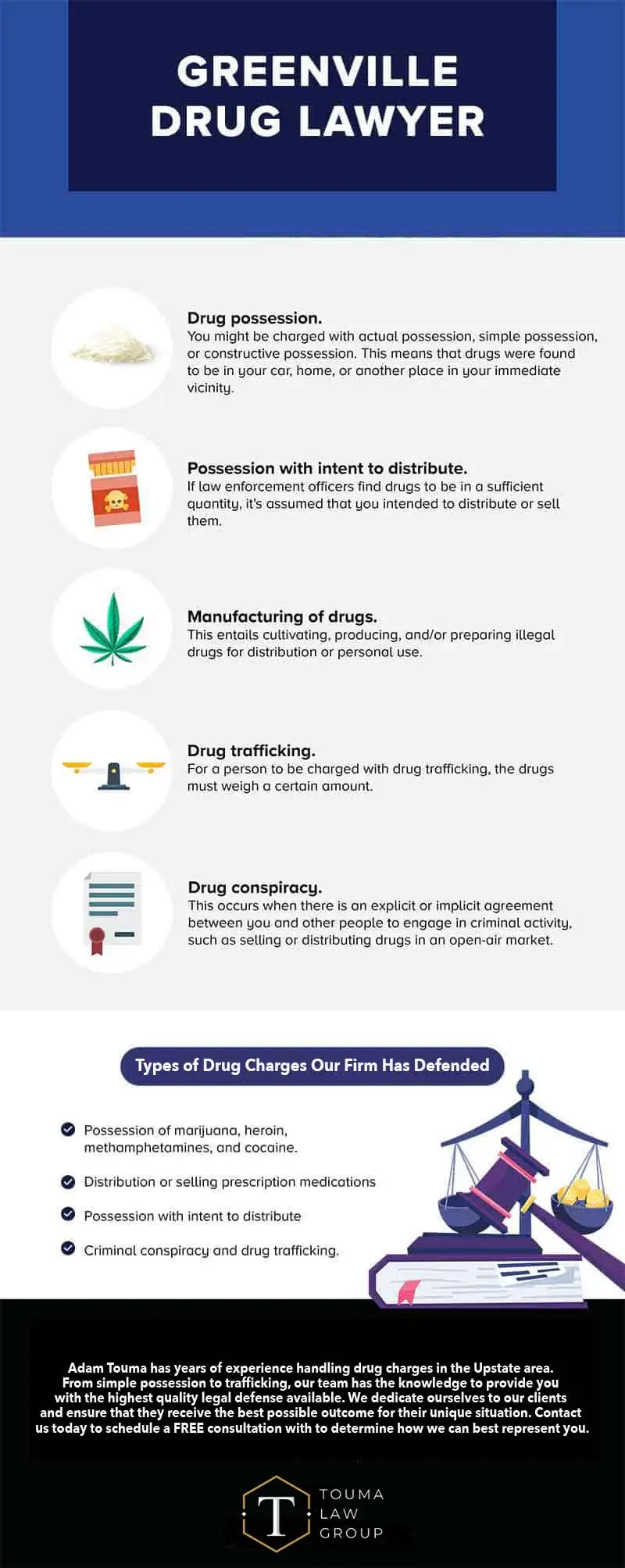
## The Legal Process: What to Expect
Navigating the legal process after a drug charge can be complex. From the initial arrest to potential plea deals or courtroom representation, a Greenville drug lawyer can explain each step.
1. **Arrest and Booking:** After an arrest, you'll be booked, fingerprinted, and photographed. It's vital to remain silent and request a lawyer immediately.
2. **Bond Hearing:** A judge will determine if you can be released on bail and set the bond amount.
3. **Preliminary Hearing:** This hearing determines if there's enough evidence for the case to proceed.
4. **Grand Jury (for felonies):** For serious felonies, a grand jury will decide if there's probable cause to issue an indictment.
5. **Arraignment:** You'll formally enter a plea of guilty or not guilty.
6. **Discovery:** Both sides exchange information and evidence. Your criminal defense attorney will meticulously review the drug analysis report, forensic evidence, and any details related to the chain of custody.
7. **Motions:** Your legal counsel may file motions to suppress evidence if there was an illegal search and seizure, or to dismiss charges. This is where your Fourth Amendment rights come into play.
8. **Plea Bargaining:** Your defense attorney may negotiate with the prosecution for plea deals, which could result in reduced charges or penalties.
9. **Trial:** If no plea agreement is reached, the case proceeds to trial. An attorney can prepare the defense for trial.
10. **Sentencing:** If convicted, the judge will determine your penalty.
> Related: [Do you need a lawyer for drug charges in South Carolina?](/lawyer-for-drug-charges-in-greenville/)
## Penalties for Drug Crimes in South Carolina
The penalties for drug crimes in South Carolina can be serious and vary depending on the specific charge, the type and quantity of the controlled substance, and your prior criminal record. These can include:
- **Fines:** Substantial monetary penalties.
- **Incarceration:** Jail or prison sentences, ranging from months to decades, with the possibility of incarceration.
- **Probation:** Supervised release with specific conditions.
- **Mandatory Minimums:** Some charges, especially for drug trafficking, carry mandatory minimum prison sentences.
- **Driver's License:** The drug penalty statutes list prison terms and fines, and they do not provide for a driver's license suspension. A commercial driver's license holder is disqualified for life for using a commercial motor vehicle in a felony drug manufacture, distribution, or dispensing offense ([S.C. Code Ann. § 56-1-2110(E)](https://www.scstatehouse.gov/code/t56c001.php)). Ask an attorney or SCDMV whether any other license consequence applies to your case.
- **Criminal Record:** A drug crime conviction can have long-lasting consequences, impacting employment, housing, and educational opportunities.
- **Federal Crimes:** In some cases, drug offenses can escalate to federal crimes, leading to even harsher penalties.
A Greenville drug lawyer can explain options such as conditional discharge for eligible first-time possession charges ([S.C. Code Ann. § 44-53-450](https://www.scstatehouse.gov/code/t44c053.php)), which can be used only once and requires a fee.

## Crafting Your Defense Strategy
When facing drug charges, a criminal defense lawyer can look at the facts and the evidence. Defense approaches that may apply, depending on the case, include:
- **Challenging the Search and Seizure:** If law enforcement conducted an [illegal search](/cop-search-your-car-in-south-carolina/) and seizure, any evidence obtained may be inadmissible in court due to violations of your Fourth Amendment rights.
- **Challenging the Chain of Custody:** Ensuring that the evidence (drugs) was handled properly from the point of seizure to the lab analysis is critical. Any breaks in the chain of custody can weaken the prosecution's case.
- **Disputing Possession:** Arguing that the State cannot prove you had the right and power to control the drugs, or that you knew about them and intended to control them ([State v. Stewart, Opinion No. 28029 (S.C. 2021)](https://www.sccourts.org/media/opinions/htmlfiles/SC/28029.pdf)).
- **Lack of Intent:** For charges like possession with intent or trafficking, proving that you did not intend to distribute or traffic the controlled substances.
- **Entrapment:** If law enforcement induced you to commit a crime you otherwise wouldn't have.
- **Mistake of Fact:** Arguing you genuinely believed a substance was something else.
- **Challenging Forensic Evidence:** Scrutinizing the drug analysis report and the methods used by forensic labs.
- **Violation of Due Process:** Ensuring all your constitutional rights were upheld throughout the legal process.
Your defense may involve investigation, interviewing witnesses, and reviewing all evidence presented by the prosecution.
## Why Choose a Greenville Drug Lawyer?
Drug-related charges call for a criminal defense lawyer who is familiar with South Carolina drug law. A local [Greenville drug lawyer](/greenville/simple-possession-lawyer/) can explain how the process works in Greenville County and the Upstate of South Carolina.
A lawyer can explain legal terms and guide you through each step of the case. That is true whether the case involves a charge of driving under the influence of drugs or a more serious distribution charge.
Whether you're dealing with charges related to Schedule I-V controlled substances, possession of heroin, or allegations of drug manufacture, an attorney can review the evidence and explain the options that may be open to you. No lawyer can promise a particular outcome.
Speaking with an attorney early can help you understand your situation. Contact Touma Law Group to discuss your case.
If you are facing drug charges in Greenville, South Carolina, contact a Greenville drug lawyer today at [(864) 618-2323](tel:+18646182323) for a confidential case evaluation.
## Clemson DUI Lawyer
URL: https://toumalawgroup.com/clemson/dui-lawyer/
If you have been charged with a DUI, you are probably feeling intense worry about your future. Driving under the influence is a serious criminal offense that can result in jail time, fines, and changes to your driving privileges. A DUI can also affect your reputation, your career, your education, and your relationships.
Speaking with a criminal defense attorney is an important step in understanding your options. Our Greenville office serves clients across South Carolina. If you live in Clemson, SC, and need legal representation for a DUI case, contact us at [(864) 618-2323](tel:+18646182323). A licensed South Carolina attorney at the firm must review the facts of your case before you rely on the general information on this page.
## What Happens After a DUI?
The penalties for a DUI depend on whether you have prior offenses within the last ten years and on your alcohol concentration. For a first offense, the statute provides for a fine of $400 or imprisonment for 48 hours to 30 days. At an alcohol concentration of 0.10% to less than 0.16%, the penalty is a fine of $500 or 72 hours to 30 days. At 0.16% or more, it is a fine of $1,000 or 30 to 90 days. Court costs and assessments may be added. A person convicted must also enroll in and complete an Alcohol and Drug Safety Action Program ([S.C. Code Ann. § 56-5-2930](https://www.scstatehouse.gov/code/t56c005.php)).
For a first offense, the DMV suspends the license, and the person may end the suspension by enrolling in the Ignition Interlock Device Program and obtaining an ignition interlock restricted license. The device must stay on the vehicle for six months after a first offense, two years after a second, three years after a third (four if the third offense is within five years of the first), and for life after a fourth or later offense ([S.C. Code Ann. § 56-5-2990](https://www.scstatehouse.gov/code/t56c005.php)). A driver may also be required to prove financial responsibility, such as with [special SR-22 insurance](/what-is-sr-22-insurance/). Each penalty increases for a second and third offense. For a fourth or later offense, the base penalty is imprisonment of one to five years, and it is higher at higher alcohol concentrations. If you have additional charges on top of your DUI charge, other penalties may apply.
In the state of South Carolina, there are requirements and deadlines that apply to your driver's license. If you refuse a breath test, or your alcohol concentration is 0.15% or more, the DMV suspends your license, and you have 30 days from the notice of suspension to request a contested case hearing ([S.C. Code Ann. § 56-5-2951](https://www.scstatehouse.gov/code/t56c005.php)). Whether a DUI conviction can be removed from a record depends on the law. The general first-offense expungement statute does not apply to an offense involving the operation of a motor vehicle ([S.C. Code Ann. § 22-5-910](https://www.scstatehouse.gov/code/t22c005.php)).

The first step [after your DUI charge](/after-a-dui-in-greenville/) is to contact a qualified criminal defense lawyer. A criminal attorney can review your case, explain your options, and discuss a defense strategy based on the facts. No lawyer can promise a particular result.
## How Does a DUI Affect Clemson University Students
A DUI arrest can be especially stressful for college students, whose futures have barely begun. Along with the criminal case, you may also face a separate process at [Clemson University](https://www.clemson.edu/index.html). The university has its own policies, which are described in the [Clemson University Student Handbook](https://www.clemson.edu/studentaffairs/find-support/dso/student-handbook.html). Depending on those policies, a DUI charge or conviction may affect:
- Your standing as a student
- Scholarships or financial aid
- Housing or participation in sports and clubs
The university process is separate from the criminal case, and the outcome of one does not decide the outcome of the other. A criminal lawyer can explain how the court case is likely to move, but the university decides its own process. Check the Student Handbook for the rules that apply to you.
## How a DUI Lawyer Can Help
A South Carolina DUI lawyer will review your case and all of the evidence. Perhaps there was a mistake in your field sobriety test, or an issue in your arrest process. South Carolina law requires the incident site and the breath test site to be video recorded, and that video can be part of the review ([S.C. Code Ann. § 56-5-2953](https://www.scstatehouse.gov/code/t56c005.php)). [Pretrial intervention](/pre-trial-intervention/) is generally not available for a DUI charge, unless the solicitor determines that the elements of the crime do not fit the charge ([S.C. Code Ann. § 17-22-50](https://www.scstatehouse.gov/code/t17c022.php)). Each case is unique.
At Touma Law, we review each DUI case on its facts. [Contact our office](/contact/) today for your free lawyer consultation.
## Greenville Homicide Lawyer
URL: https://toumalawgroup.com/greenville/homicide-lawyer/
Facing a homicide charge in Greenville is one of the most serious situations a person can face. Homicide cases often involve detailed investigations and severe penalties, including life imprisonment or, in some murder cases, the death penalty. A charge this serious calls for a licensed South Carolina attorney who can explain the statute the State is relying on and help you understand your rights.
If you or a loved one is under investigation or charged with homicide in Greenville, speak with an attorney as soon as possible. Touma Law Group represents people charged with serious crimes, including homicide offenses. A licensed South Carolina attorney at the firm must review the facts of a case before anyone relies on the general information on this page.
> Contact our [Greenville defense lawyers](/greenville/criminal-defense-lawyer/) at [864-618-2323](tel:+18646182323) to schedule a free consultation to discuss your case.
## Types of Homicide Cases in South Carolina
Homicide means one person causing the death of another. It is not always a crime, and South Carolina has several different homicide offenses with different elements and penalties. Which one the State charges depends on the evidence, the person's state of mind and how the death happened.
### Murder
South Carolina defines murder as "the killing of any person with malice aforethought, either express or implied" ([S.C. Code Ann. § 16-3-10](https://www.scstatehouse.gov/code/t16c003.php)). The statute does not divide murder into first, second or third degree.
[A person convicted of murder](/penalties-for-murder-in-south-carolina/) must be punished by death or by a mandatory minimum term of 30 years to life in prison. Life imprisonment under the statute means until death, without parole. The death penalty is possible only if the State seeks it and a statutory aggravating circumstance is found beyond a reasonable doubt in a separate sentencing proceeding ([S.C. Code Ann. § 16-3-20](https://www.scstatehouse.gov/code/t16c003.php)).
### Voluntary Manslaughter
Manslaughter is the unlawful killing of another without malice, express or implied. A person convicted must be imprisoned for not less than two years and not more than thirty years ([S.C. Code Ann. § 16-3-50](https://www.scstatehouse.gov/code/t16c003.php)). Voluntary manslaughter is a Class A felony ([S.C. Code Ann. § 16-1-90](https://www.scstatehouse.gov/code/t16c001.php)). Voluntary manslaughter is the unlawful killing of a human being in the sudden heat of passion upon sufficient legal provocation. The South Carolina Supreme Court has said that both the heat of passion and the legal provocation must be present at the time of the killing, and that the provocation must be such as to render the mind of an ordinary person incapable of cool reflection and produce an uncontrollable impulse to do violence ([State v. Cooley, 342 S.C. 63 (2000)](https://sccourts.org/opinions/htmlfiles/SC/25184.htm)).
If you are facing a manslaughter charge in Greenville, an attorney can review the evidence and explain how the statute applies to the facts alleged.
### Involuntary Manslaughter
Involuntary manslaughter requires criminal negligence, which South Carolina defines as the reckless disregard of the safety of others. A person convicted of involuntary manslaughter must be imprisoned for not more than five years ([S.C. Code Ann. § 16-3-60](https://www.scstatehouse.gov/code/t16c003.php)).

### Reckless Vehicular Homicide
When a person dies within three years as a proximate result of injury received by the driving of a vehicle in reckless disregard of the safety of others, the driver is guilty of reckless vehicular homicide. It is a felony punishable by a fine of $1,000 to $5,000 or imprisonment of up to ten years, or both, and the driver's license is revoked for five years ([S.C. Code Ann. § 56-5-2910](https://www.scstatehouse.gov/code/t56c005.php)). Our page on [reckless homicide](/reckless-homicide-in-south-carolina/) explains the offense in more detail.
### Felony DUI Resulting in Death
A driver under the influence of alcohol, drugs or both who does an act forbidden by law, or neglects a duty imposed by law, and thereby proximately causes death is guilty of felony driving under the influence. The statute requires a fine of $10,100 to $25,100 and imprisonment of one to twenty-five years when death results ([S.C. Code Ann. § 56-5-2945](https://www.scstatehouse.gov/code/t56c005.php)).
### Attempted Murder
A person who, with intent to kill, attempts to kill another person with malice aforethought commits attempted murder. It is a felony punishable by up to thirty years, and the sentence may not be suspended and probation may not be granted ([S.C. Code Ann. § 16-3-29](https://www.scstatehouse.gov/code/t16c003.php)).
## How a Greenville Homicide Lawyer Can Help
When you face a homicide charge, you need to understand the offense named in the warrant or indictment. The penalties and the available defenses depend on it. A criminal defense attorney can:
- Explain the legal process and your rights at each stage.
- Review the evidence the State has gathered, including reports, recordings, forensic results and witness statements.
- Look for legal issues with how evidence was obtained or handled.
- Discuss with you whether a defense such as self-defense may apply. South Carolina's Protection of Persons and Property Act can, in the situations it describes, give a person immunity from prosecution ([S.C. Code Ann. § 16-11-450](https://www.scstatehouse.gov/code/t16c011.php)).
- Talk with prosecutors about the charge, if that is appropriate in your case.
### Building a Defense Strategy
Every homicide case is different. Your lawyer starts by examining the evidence against you to see where it is strong and where it may have weaknesses, including possible constitutional issues. Depending on the facts, your lawyer may also discuss with you [a plea agreement](/should-i-plead-guilty/) or whether to take the case to trial. At trial the State must prove each element of the charged offense beyond a reasonable doubt.
### Understanding Local Procedures
The criminal justice system in South Carolina is complex, and changes in the law happen. An attorney who handles criminal cases in Greenville can explain how your case is likely to move through the court process and what to expect at each stage. Your attorney can also help you get information about your next court date from the clerk of court.
### Working With Outside Professionals
Some homicide cases involve forensic, medical or other technical evidence. A defense lawyer may consult outside professionals when the evidence calls for it, which can help in reviewing the State's case.
### Reviewing Your Case
The stakes are high when you are [facing a murder or manslaughter charge](/difference-between-homicide-and-murder/). A lawyer reviews the evidence, checks that your rights are protected and talks with you about your options. No lawyer can promise a particular result, and the right strategy depends on the facts and the charge.
### Plea Discussions
When a person is charged with a homicide offense, the prosecutor may be willing to talk about the charge in some cases. A lawyer can [explain how plea negotiations work](/what-to-expect-from-a-plea-bargain/) and help you decide whether to pursue one. Whether a plea is offered, and on what terms, is up to the prosecutor and the court.
## For More Information, Contact Touma Law Group
If you are facing homicide charges in Greenville, South Carolina, speak with a criminal defense attorney before you answer questions from investigators.
Touma Law Group's attorneys represent people charged with criminal offenses throughout South Carolina. We will explain the charge, what the State must prove and your options, based on what a review of your case shows.
[Contact us today](/contact/) to book a consultation and learn more about your options.
## Columbia Gun Charge Lawyer
URL: https://toumalawgroup.com/columbia/gun-charge-lawyer/
Gun charges in Columbia can carry serious penalties, including time behind bars, costly fines, and long-term damage to your record. Even a first offense involving a weapon can lead to consequences that affect your freedom, your job, and your future.
More severe offenses are felonies. Possession of a stolen handgun carries up to five years in prison ([S.C. Code Ann. §§ 16-23-30 and 16-23-50](https://www.scstatehouse.gov/code/t16c023.php)), and possession of a firearm during a violent crime adds a mandatory five years to the sentence for the violent crime ([S.C. Code Ann. § 16-23-490](https://www.scstatehouse.gov/code/t16c023.php)). These cases often move quickly, and it's important to act just as fast in protecting your rights.
A Columbia gun charge lawyer can guide you through the legal process and help you understand what is at stake. Given the complexities of firearm laws and the severity of potential penalties, it is important to speak with a licensed attorney early.
At Touma Law Group, our job is to review the charge and explain the options for clients facing accusations for different weapon-related charges at both the federal and state levels. Call [(803) 879-4499](tel:+18038794499) to get in touch with our lawyer at Touma Law Group and schedule your free initial consultation with a [Columbia defense attorney](/columbia/criminal-defense-lawyer/) who can review your case.
## Different Types of Gun Charges in Columbia
In [Columbia, SC, gun charges](/gun-charges-in-columbia-south-carolina/) can result in serious criminal penalties. The specific penalties vary depending on the offense. Here's an overview of common gun charges and their potential consequences:
- **Possession of a Firearm During the Commission of a Violent Crime**: A person who possesses a firearm, or visibly displays what appears to be a firearm or a knife, during a violent crime listed in [S.C. Code Ann. § 16-1-60](https://www.scstatehouse.gov/code/t16c001.php) and is convicted of that crime or an attempt must be imprisoned for five years in addition to the sentence for the violent crime. The five-year term is mandatory unless a longer mandatory minimum applies, and the indictment must allege it as a separate count ([S.C. Code Ann. § 16-23-490](https://www.scstatehouse.gov/code/t16c023.php)).
- **Discharging a Firearm into a Dwelling or Vehicle**: It is a felony to knowingly, unlawfully and deliberately, or with reckless disregard for life, discharge a firearm at or into an occupied dwelling, building or vehicle. The penalty is a fine of up to $20,000 and up to ten years in prison, or a fine of up to $50,000 and up to fifteen years if an occupant is struck or injured ([S.C. Code Ann. § 16-23-440](https://www.scstatehouse.gov/code/t16c023.php)). Since May 15, 2026, the offense is also on the list of violent crimes in Section 16-1-60.
- **Carrying a Firearm in a Restricted Area**: Since March 7, 2024, a person who is not otherwise prohibited may carry a handgun, openly or concealed, without a concealed weapons permit, but it is still unlawful to carry a handgun into the places listed in [S.C. Code Ann. § 16-23-20](https://www.scstatehouse.gov/code/t16c023.php), such as a law enforcement or detention facility, a courthouse while court is in session, a polling place on election days, and a daycare. Possessing a firearm on school or college property without permission is a separate felony carrying up to $5,000 and five years ([S.C. Code Ann. § 16-23-420](https://www.scstatehouse.gov/code/t16c023.php)). A person who carries a concealable weapon into private property clearly marked with a sign that meets the statute may be charged with trespass instead ([S.C. Code Ann. §§ 16-23-20(A)(11) and 16-11-620](https://www.scstatehouse.gov/code/t16c023.php)).
- **Pointing or Presenting a Firearm**: It is unlawful to present or point at another person a loaded or unloaded firearm. It is a felony punishable by a fine in the court's discretion or imprisonment for up to five years, and the statute does not abridge the right of self-defense ([S.C. Code Ann. § 16-23-410](https://www.scstatehouse.gov/code/t16c023.php)).
- **Possession of a Firearm During a Drug Trafficking Offense**: Drug trafficking as defined in S.C. Code Ann. § 44-53-370(e) is on the list of violent crimes in Section 16-1-60, so a person convicted of it who possessed a firearm can face the five-year additional sentence described above. Federal law also has its own firearm and drug trafficking penalties.
- **Murder or Attempted Murder Involving a Firearm**: Murder is punishable by death or a mandatory minimum of thirty years to life ([S.C. Code Ann. § 16-3-20](https://www.scstatehouse.gov/code/t16c003.php)), and attempted murder by up to thirty years with no suspension or probation ([S.C. Code Ann. § 16-3-29](https://www.scstatehouse.gov/code/t16c003.php)).
- **Assault and Battery Involving a Firearm**: South Carolina has no offense called "assault with a deadly weapon." A case involving a firearm is charged under the assault and battery statute, which has four levels from a third degree misdemeanor to a high and aggravated nature felony of up to twenty years ([S.C. Code Ann. § 16-3-600](https://www.scstatehouse.gov/code/t16c003.php)).
- **Possession of a Prohibited Weapon**: Certain weapons, such as machine guns and sawed-off shotguns and rifles, are unlawful to possess in South Carolina, with listed exceptions. A violation is a felony carrying a fine of up to $10,000, up to ten years in prison, or both ([S.C. Code Ann. §§ 16-23-210 through 16-23-260](https://www.scstatehouse.gov/code/t16c023.php)).
- **Possession of a Firearm After a Conviction**: It is a felony for a person convicted of a crime punishable by a maximum term of imprisonment of more than one year to possess a firearm or ammunition, with listed exceptions. A first offense carries up to five years, and later offenses carry mandatory minimum terms ([S.C. Code Ann. § 16-23-500](https://www.scstatehouse.gov/code/t16c023.php)). Read more about [felon in possession charges](/possession-of-weapon-by-felon/).
- **Possession of a Handgun by a Minor**: State law bars handgun possession by a person under eighteen, with limited exceptions, such as members of the Armed Forces on duty or training, or a temporary loan of a handgun for instruction under the immediate supervision of a parent or adult instructor ([S.C. Code Ann. § 16-23-30](https://www.scstatehouse.gov/code/t16c023.php)).

Each of these charges comes with significant legal consequences, including the potential for prison time, steep fines, and permanent criminal records. If you're facing any of these charges, it's important to [consult with a defense attorney](/consultation-with-a-criminal-defense-lawyer/) who can help you understand your options.
## How Does the Legal Process Work for Gun Charges in SC?
If you're arrested for a gun crime, the legal process can be complex and overwhelming. Understanding the steps involved can help you prepare for what lies ahead. Here's an overview of [what to expect after being arrested](/after-youve-been-arrested/) for a gun crime in Richland County, Lexington County, or the surrounding area of Columbia, SC:
### Initial Arrest and Booking
After your arrest, you'll be taken to a local police station, where you will undergo booking. This involves providing personal information, fingerprinting, and photographing. During this time, you will be informed of the charges against you, but you are not obligated to answer any questions until you have legal representation. If bail is applicable, it may be set during this phase.
### First Court Appearance (Arraignment)
A person charged with a bailable offense must have a bond hearing within 24 hours of arrest ([S.C. Code Ann. § 22-5-510(B)](https://www.scstatehouse.gov/code/t22c005.php)). In a General Sessions case, the Judicial Branch says the first court date is generally set within 45 to 60 days of arrest, and the second court date is set within 120 days of arrest, when the defendant tells the judge whether to plead guilty or request a jury trial ([Judicial Branch FAQ on criminal court](https://www.sccourts.org/media/qo3ng1z1/faq_eng_generalsessions.pdf)). People sometimes call the stage where you are told the charge and asked how you plead [an arraignment](/what-is-an-arraignment/).
- **Plea Options**: When you are [asked to enter a plea](/should-i-plead-guilty/), the choices include guilty and not guilty. A no contest plea is allowed only in a misdemeanor case and only with the consent of the court ([S.C. Code Ann. § 17-23-40](https://www.scstatehouse.gov/code/t17c023.php)), so it is generally not available for a felony weapons charge. It is important to have your attorney present before deciding on a plea.
- **Bail Decisions**: At the bond hearing, the judge may consider the nature and circumstances of the offense and the person's family ties, employment, financial resources, character, length of residence in the community, record of convictions, and record of flight or failure to appear ([S.C. Code Ann. § 17-15-30](https://www.scstatehouse.gov/code/t17c015.php)).
### Pretrial Hearings and Discovery
If you plead not guilty, the next step will involve pretrial hearings. During this phase, your criminal lawyer and the prosecution will exchange evidence through the discovery process. This includes police reports, witness statements, and other documents that may be used in court. Your attorney will review the evidence to look for weaknesses in the prosecution's case and begin building your defense.
- **Motions**: Your attorney may file motions to suppress evidence, challenge the legality of the arrest, or argue that certain evidence should not be admitted in court.
### Negotiation or Plea Deal (if applicable)
In some cases, your attorney may talk with the prosecution about a plea offer. If the evidence against you is weak, your attorney can also raise whether a dismissal or reduction is appropriate.
- **Plea Agreement**: If you accept a plea offer, you give up your right to a trial.
### Trial (If No Plea Agreement Is Reached)
If no plea deal is made, your case will proceed to trial. During the trial, both sides will present their arguments, evidence, and witness testimony. Your attorney will challenge the prosecution's evidence and attempt to raise reasonable doubt in the minds of the jury or judge. If you are convicted, the judge will then determine your sentence.
- **Jury vs. Bench Trial**: You have the right to a jury trial. If you choose a bench trial, the judge alone will decide your guilt or innocence.
- **Closing Arguments**: Both sides will give their closing arguments, summarizing the evidence and arguments made during the trial.
### Sentencing (If Convicted)
If convicted, the next step is sentencing. The severity of the sentence will depend on factors like the specific gun charge, whether a weapon was used in the commission of another crime, and your criminal history. Your attorney may argue for a lighter sentence based on mitigating factors, such as your lack of prior convictions or your cooperation with law enforcement.
- **Possible Sentences**: For gun crimes, sentences can range from probation to lengthy prison terms, depending on the offense.
### Appeal (If Possible)
If convicted, you have the [right to appeal the verdict](/appeal-a-criminal-conviction/). An appeal is not a retrial but a review of the trial proceedings to determine any legal errors significantly impactedted the outcome. If your attorney believes that errors occurred during your trial, they may file an appeal to challenge the conviction.
Throughout this entire process, it helps to have a gun crime defense attorney. An attorney can guide you through each step and explain your options, including a plea offer or trial. No lawyer can promise a particular result.
> **Related:** Learn more about [Federal Crime Charges](/columbia/federal-criminal-defense-lawyer/) and how Touma Law Group can help you.
## What to Do If You Are Charged With a Gun Crime

Being charged with a gun crime in Columbia, SC, can be a frightening experience, but knowing the right steps to take can help protect your rights. Here's what you should do if you're facing such charges:
### Remain Calm and Avoid Discussing the Case
It's crucial to stay calm and composed when facing criminal charges. Do not discuss the details of your criminal cases with anyone other than your attorney. Anything you say can be used against you, even if the conversation is casual. Keep in mind that anything you say to friends, family, or even police officers without legal representation present could negatively affect your case.
### Contact a Qualified Criminal Defense Attorney Immediately
Speaking with a criminal defense attorney as soon as possible is one of the most important steps you can take. A criminal defense lawyer can assess the circumstances surrounding your case, explain your rights, and discuss options for your defense. They can talk with prosecutors, represent you in hearings, and advise you about your situation.
### Do Not Consent to Searches or Make Statements Without an Attorney
You have the [right to refuse consent to searches](/cop-search-your-car-in-south-carolina/) unless the police have a valid search warrant. Similarly, you are under no obligation to make any statements to law enforcement officers without your attorney present. Always exercise your right to remain silent and consult with your attorney before answering any questions or agreeing to a search.
### How to Prepare for Hearings, Trial, and Any Potential Sentencing
Your attorney will guide you through each step of the legal process, including pretrial hearings, trial preparation, and potential sentencing. Here's how to prepare:
- **Pretrial Hearings**: These hearings can address bail, evidence, and motions filed by the defense or prosecution. Your attorney will review the legal requirements and the evidence, and can raise any issues that apply.
- **Trial Preparation**: If your case goes to trial, your attorney will gather evidence, interview witnesses, and develop a defense strategy. Make sure you follow your attorney's guidance throughout this process.
- **Sentencing**: If convicted, your attorney will work to ensure that any sentencing is fair and takes into account any mitigating circumstances, such as lack of criminal history or remorse.
Taking these steps can help you navigate the legal process and protect your future. Working with an attorney can help you understand your rights and the penalties that apply to your charge.
> **Did you know?** Touma Law Group offers Free Consultations. Call [(803) 879-4499](tel:+18646182323) today!
## How an Attorney Can Help You With a Gun Charge
If you're facing gun charges in Columbia, South Carolina, a knowledgeable gun charge lawyer can provide essential guidance throughout the legal process. Here's how they can help:
- **Providing Legal Advice on Navigating the Criminal Justice System**: A lawyer can offer advice on how to navigate the complexities of the criminal justice system. This includes explaining the charges you're facing, the potential penalties, and your legal rights. Your lawyer will help you understand every step of the process, from arraignment to trial, ensuring that you know what to expect and what decisions to make along the way.
- **Representing Clients in Negotiations or Plea Deals**: In many cases, a gun charge lawyer may negotiate with prosecutors to reduce charges or secure a plea deal. They can advocate for a more favorable outcome, such as a lesser sentence or alternative sentencing options like probation or rehabilitation programs. Negotiating plea deals can be crucial in avoiding lengthy prison sentences or other harsh penalties.
- **Ensuring That Constitutional Rights Are Protected**: One of the most important roles of a gun charge lawyer is ensuring that your constitutional gun rights are protected throughout the case. This includes reviewing whether law enforcement followed proper procedures when making the arrest, securing search warrants, and collecting evidence. If your rights were violated, your lawyer may be able to have certain evidence excluded or even have the case dismissed.
- **Investigating the Facts of the Case**: A lawyer will thoroughly investigate the facts surrounding your case, looking for any weaknesses in the prosecution's arguments or evidence. They may uncover errors, inconsistencies, or violations that could help build a stronger defense. This can include examining whether the firearm was unlawfully obtained, whether the arrest was made without probable cause, or if there were other legal issues in your case.
A gun charge lawyer can help make sure your rights are raised and protected. No lawyer can promise a particular outcome.
## Contact a Columbia Gun Charge Lawyer Today
A gun charge conviction in South Carolina can have lasting effects on your freedom, reputation, and future opportunities. Even a misdemeanor firearm offense can lead to jail time and a permanent criminal record, while felony charges carry even harsher penalties. Navigating these legal challenges alone can be overwhelming, making it important to speak with a lawyer.
If you're facing gun charges in Columbia, securing legal representation as soon as possible can make a significant difference in your case. A defense lawyer can analyze the details of your situation and the prosecution's evidence. Don't wait, [contact Touma Law](/contact/) to speak with an attorney today.
## Anderson DUI Lawyer
URL: https://toumalawgroup.com/anderson/dui-lawyer/
Facing a DUI charge in Anderson County can be a life-altering experience. The consequences of a DUI conviction can range from hefty fines and driving license suspension to jail time and a permanent mark on your driving record. With so much at stake, it’s important to have a knowledgeable DUI lawyer by your side to navigate the legal system and advocate for your rights. An experienced attorney understands the nuances of DUI laws in South Carolina, including implications of implied consent violations, and can discuss defense options tailored to your situation.
Whether this is your first offense or you’re dealing with a repeat charge, navigating the legal complexities of DUI cases requires experienced legal guidance. An Anderson DUI lawyer can help you understand the charges, possible penalties, and options available to you. If you're facing a DUI charge, don’t go it alone. Call Touma Law at [(864) 777-8062](tel:+18647778062) to talk through your options.
## Understanding DUI Charges in South Carolina
A DUI charge in South Carolina arises when a person is found to be operating a motor vehicle while impaired by alcohol or drugs, affecting their ability to drive safely. Here’s a closer look at what constitutes a DUI, the legal limits for alcohol concentration (BAC), and typical situations that can lead to these criminal charges.
Under [S.C. Code Ann. § 56-5-2930](https://www.scstatehouse.gov/code/t56c005.php), a driver can be charged with DUI if the person is under the influence of alcohol, drugs, or a combination of the two to the extent that the person’s faculties to drive a motor vehicle are materially and appreciably impaired. This applies not only to alcohol but also to illegal drugs, prescription medications, or any substance that causes impairment. Additionally, [signs of impairment observed by officers](/signs-of-impairment-police-look-for/), such as red or glassy eyes of the driver, can provide grounds for further testing.
## Legal Blood Alcohol Levels
[South Carolina has established specific BAC limits](/blood-alcohol-concentration-sc/) that vary depending on the driver’s age and license type:
- For adult drivers, it is unlawful to drive a motor vehicle with an alcohol concentration of 0.08% or more, an offense called driving with an unlawful alcohol concentration (DUAC) under [S.C. Code Ann. § 56-5-2933](https://www.scstatehouse.gov/code/t56c005.php).
- For commercial drivers, a first conviction for driving a commercial motor vehicle with an alcohol concentration of 0.04% or more carries a disqualification from driving a commercial motor vehicle for not less than one year under [S.C. Code Ann. § 56-1-2110](https://www.scstatehouse.gov/code/t56c001.php), and [S.C. Code Ann. § 56-1-2120](https://www.scstatehouse.gov/code/t56c001.php) prohibits driving a commercial motor vehicle with any measurable amount of alcohol in the body.
- For drivers under 21, an alcohol concentration of 0.02% or more results in a license suspension of three months (six months if there was a qualifying prior offense or suspension within the preceding three years) under [S.C. Code Ann. § 56-1-286](https://www.scstatehouse.gov/code/t56c001.php), part of [SC's zero-tolerance policy](/zero-tolerance-law-in-sc/).
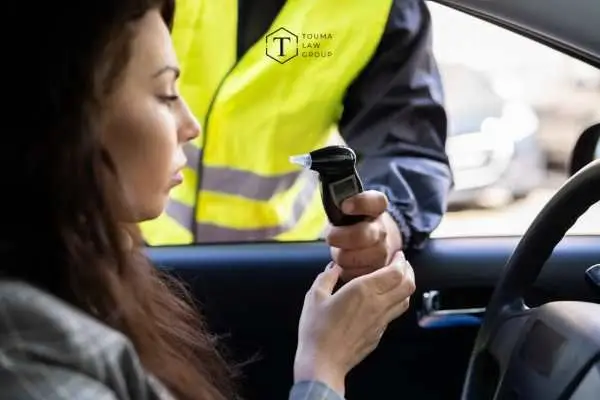
DUI does not require a specific test result. Under [S.C. Code Ann. § 56-5-2950(G)](https://www.scstatehouse.gov/code/t56c005.php), a result of 0.05% or less means the person is conclusively presumed not to be under the influence of alcohol, a result above 0.05% but below 0.08% gives rise to no inference either way and may be considered with other evidence, and a result of 0.08% or more means it may be inferred that the person was under the influence. Even results below the limit can lead to charges if there is evidence of impaired driving. Law enforcement officers may observe physical signs such as the eyes of the driver, unsteady movements, or slurred speech, which can prompt further investigation and potential charges.
## Common Scenarios Leading to DUI Charges
DUI charges can arise in various situations where law enforcement suspects impairment. Common scenarios include:
- **Traffic Stops**: Police may pull over a vehicle for erratic driving, speeding, or other traffic violations. Even minor traffic violations can lead to a DUI investigation if officers detect signs of impairment. If impairment is suspected, officers may conduct standardized field sobriety tests or request a breathalyzer test.
- **Accidents**: Drivers involved in accidents, even minor ones, may be subject to sobriety tests if officers on the scene suspect impairment.
- **Routine DUI Checkpoints**: At [sobriety checkpoints](/dui-checkpoint-in-south-carolina/), officers briefly stop vehicles to check for impaired drivers. If signs of impairment are noticed, further testing may be conducted.
- **Reports from Witnesses**: Sometimes, concerned witnesses report suspected drunk drivers to the police, who may then locate and stop the vehicle to investigate.
Each of these scenarios can lead to a DUI arrest if law enforcement determines there is probable cause. Understanding the factors that contribute to DUI charges can help individuals better comprehend their rights and the seriousness of a DUI case in South Carolina.
## Potential Consequences of a DUI Conviction
A DUI conviction in South Carolina can lead to serious repercussions that impact various aspects of a person's life. Understanding these potential consequences is important for anyone facing DUI charges.
### Criminal Penalties
Penalties are set by [S.C. Code Ann. § 56-5-2930](https://www.scstatehouse.gov/code/t56c005.php) and depend on the number of prior offenses within the previous ten years and on the person’s alcohol concentration. For [first-time DUI offenders](/first-time-dui/), the statute provides a fine of $400 or imprisonment for not less than 48 hours nor more than 30 days, and the court may provide for 48 hours of public service employment in place of the 48-hour minimum. If the alcohol concentration is at least 0.10% but less than 0.16%, the statute provides a fine of $500 or imprisonment for not less than 72 hours nor more than 30 days. At 0.16% or more, it provides a fine of $1,000 or imprisonment for not less than 30 days nor more than 90 days. Additional assessments under [S.C. Code Ann. § 56-5-2995](https://www.scstatehouse.gov/code/t56c005.php) are added to these amounts. Learn more about the [penalties of a DUI conviction](/penalties-for-a-dui-in-sc/).
For repeat offenses, the penalties become significantly harsher. A second offense carries a fine of $2,100 to $5,100 and imprisonment of five days to one year, a third offense carries a fine of $3,800 to $6,300 and imprisonment of 60 days to three years, and a fourth or subsequent offense carries imprisonment of one to five years, with higher ranges when the alcohol concentration is 0.10% or more. Every person convicted must also enroll in and complete an Alcohol and Drug Safety Action Program certified by the Office of Substance Use Services.
### Administrative Penalties
In addition to criminal penalties, individuals convicted of DUI in South Carolina face administrative consequences. Under [S.C. Code Ann. § 56-5-2990](https://www.scstatehouse.gov/code/t56c005.php), the Department of Motor Vehicles suspends the license of a person convicted of DUI or DUAC, and the person must enroll in the Ignition Interlock Device Program to end the suspension and obtain an ignition interlock restricted license. The device is required for six months for a first offense, two years for a second offense, three years for a third offense (four years if the third offense occurs within five years of the first), and for life for a fourth or subsequent offense.
A driver who refuses a breath, blood, or urine test, or who takes a test and has an alcohol concentration of 0.15% or more, also faces a separate administrative suspension under [S.C. Code Ann. § 56-5-2951](https://www.scstatehouse.gov/code/t56c005.php), and has 30 days from the notice of suspension to request a contested case hearing before the Office of Motor Vehicle Hearings. See our guide on [whether to take a breathalyzer in South Carolina](/breathalyzer-in-south-carolina/) for more detail.

### Financial Implications
The financial burden of a DUI conviction extends beyond the fine. A conviction can also bring court assessments, the cost of the Alcohol and Drug Safety Action Program, which the statute caps at $2,500 for all services, the cost of an ignition interlock device, and possible effects on your automobile insurance.
Overall, the consequences of a DUI conviction can be severe and long-lasting, affecting not only one’s criminal record but also personal finances and driving privileges. It is important for anyone facing such charges to seek legal counsel to understand the complexities of the situation.
## How a DUI Lawyer Can Help With Charges in Anderson
Facing DUI charges can be overwhelming. Here’s how an experienced DUI lawyer in Anderson, SC, can assist you.
### Legal Experience
A knowledgeable DUI lawyer understands the intricacies of local DUI laws and procedures. They are familiar with the specific rules and regulations in Anderson and can use this knowledge when reviewing your case. Whether the officer followed required procedures, such as the implied consent advisements, can be relevant to how a case proceeds.
### Case Evaluation
A DUI attorney will conduct a thorough evaluation of your case. This includes reviewing all available evidence, such as police reports, witness statements, and any dashcam footage. By examining these details, your lawyer can identify potential defenses that may apply to your situation, helping you understand the strengths and weaknesses of your case. They may raise questions about procedural standards, such as the administration of field sobriety tests or the accuracy of breath testing, as part of your defense.
### Defense Strategies
Several potential defenses can be raised against DUI charges. Common examples include challenging the legality of the traffic stop, arguing that law enforcement did not have probable cause to pull you over. Additionally, an attorney can question the accuracy and reliability of breathalyzer or blood alcohol testing, which can be influenced by factors like calibration and handling. The defense may also point to inconsistencies in the officer's observations of the eyes of the driver or other physical signs of impairment.
### Negotiation with Prosecutors
An [experienced Anderson defense lawyer](/anderson/criminal-defense-lawyer/) can also communicate with prosecutors on your behalf. Depending on the facts of the case, this may involve discussing the charges and the available options with the prosecutor.
In summary, a DUI lawyer in Anderson, SC, can offer support through legal knowledge, case evaluation, review of possible defenses, and communication with prosecutors.
## Steps to Take After a DUI Arrest
Being arrested for DUI can be a daunting experience, but knowing the steps to take can help protect your rights.
### Immediate Actions to Protect Your Rights
[After your arrest](/after-youve-been-arrested/), it’s important to remain calm and composed. Here are the key steps to follow:
- **Exercise Your Right to Remain Silent**: Politely decline to answer questions without your lawyer present. Anything you say can be used against you in court.
- **Request a Lawyer**: As soon as you are able, request legal representation. You have the right to an attorney, and invoking this right is vital for protecting yourself throughout the legal process.
- **Document the Incident**: Make notes about the circumstances surrounding your arrest while the details are still fresh in your mind. This can include the time, location, and any interactions with law enforcement.
- **Collect Evidence**: If possible, gather any relevant information, such as witness contact details or dashcam footage from your vehicle. This information may be useful in reviewing your case.
- **Follow Instructions**: Comply with any instructions given by law enforcement during the arrest. Avoid escalating the situation, as non-compliance can lead to additional charges.
- **Avoid Further Legal Issues**: While your case is pending, avoid any situations that could lead to further arrests or legal complications.
### Importance of Contacting a DUI Lawyer as Soon as Possible
Reaching out to a DUI lawyer soon after your arrest is important. Here’s why:
- **Legal Guidance**: An experienced DUI attorney can provide legal advice tailored to your situation. They will help you understand your rights and the legal options available to you.
- **Protection of Rights**: A lawyer can help make sure that your rights are respected throughout the process, from the arrest to potential court proceedings.
- **Meeting Deadlines**: If your license is suspended after a refusal or a result of 0.15% or more, you have 30 days from the notice of suspension to request a contested case hearing under [S.C. Code Ann. § 56-5-2951(B)](https://www.scstatehouse.gov/code/t56c005.php). The sooner you contact a lawyer, the more time there is to meet that deadline.
- **Navigating Complex Procedures**: DUI cases involve intricate legal procedures, including court appearances, hearings, and potential plea discussions. A knowledgeable attorney can help you understand these procedures.
Taking prompt action after a DUI arrest matters because some deadlines are short. By protecting your rights and contacting a DUI lawyer as soon as possible, you give yourself more time to understand your options.
## Are You Facing a DUI Charge? Contact Our Anderson Law Firm Today
If you are facing a DUI charge in Anderson, SC, the stakes are high, but you don't have to navigate this challenging situation alone. An experienced DUI lawyer can help you understand your rights and evaluate your options. Don’t wait until it’s too late to seek the legal help you need.
Contact our experienced team today for a consultation. We are here to provide guidance and support as you work through the complexities of your DUI charge.
## Anderson Drug Lawyer
URL: https://toumalawgroup.com/anderson/drug-lawyer/
Facing drug charges in Anderson County can be a daunting experience. The legal system can be complex and unforgiving, with serious consequences that can impact your life for years to come. Whether you are dealing with possession, trafficking, or distribution charges, having an experienced drug charge lawyer by your side is essential. A skilled attorney can help you navigate the legal process, protect your constitutional rights, and understand your options.
Don't let a drug conviction define your future. It's crucial to act quickly and seek legal representation to build a solid legal defense and understand the penalties you face. Contact our knowledgeable team today to schedule a consultation. We are committed to providing personalized support and guidance to help you understand your options and protect your rights. Your future is too important to leave to chance, call Touma Law at [(864) 777-8062](tel:+18647778062) now for the help you need.
## Common Types of Drug Charges in South Carolina and Their Penalties
Drug charges in South Carolina come in many forms, each carrying its own legal consequences. Understanding the most common types, from possession to trafficking, and their associated penalties can give insight into what individuals may face if charged with a drug-related offense in the state. The penalties below come from [S.C. Code Ann. § 44-53-370](https://www.scstatehouse.gov/code/t44c053.php) and [§ 44-53-375](https://www.scstatehouse.gov/code/t44c053.php), and they depend on the type of drug, the weight, and whether it is a first, second, or later offense.
### Possession
Possession charges are among the most common drug offenses. They can range from [misdemeanor possession offenses](/misdemeanor-possession/) for small amounts of controlled substances to felonies for larger quantities. Key points include:
- **Simple Possession**: Refers to having a small amount of illegal drugs for personal use. For example, possession of one ounce (28 grams) or less of marijuana is a misdemeanor.
- **Possession with Intent to Distribute**: An individual can be [charged with PWID](/possession-with-intent-in-sc/) when they have a larger quantity of drugs, indicating an intention to sell. This charge can lead to felony prosecution.
- **Constructive Possession**: [Constructive possession charges](/constructive-possession-in-south-carolina/) involve being in control of drugs without physically holding them, like when drugs are found in a vehicle or shared space. Proof of knowledge and access is key in these cases.
- **Possession of Drug Paraphernalia**: [Possession of items used for drug consumption](/possession-of-drug-paraphernalia/), like pipes or syringes. Although a lesser charge, it often accompanies other drug charges.
- **Possession of Prescription Drugs without a Prescription**: Involves having prescription medication without a valid prescription. This is illegal, and the penalty depends on the drug's schedule.
A drug possession conviction can result in severe penalties, which may include:
- **Misdemeanor Penalties**: For a first offense, possession of one ounce or less of marijuana carries up to 30 days in jail or a fine of $100 to $200. Possession of cocaine carries up to 3 years or $5,000, possession of a narcotic drug or LSD carries up to 2 years or $5,000, and possession of most other controlled substances carries up to 6 months or $1,000. See [S.C. Code Ann. § 44-53-370(d)](https://www.scstatehouse.gov/code/t44c053.php).
- **Felony Consequences**: If the quantity is larger or if there is evidence of intent to distribute, possession with intent to distribute is a felony. A first offense carries up to 5 years or $5,000 for marijuana and other non-narcotic Schedule I, II, and III drugs, and up to 15 years or $25,000 for cocaine, heroin, other narcotic drugs, LSD, crack cocaine, and methamphetamine. Second and later offenses carry higher penalties. See [S.C. Code Ann. § 44-53-370(b)](https://www.scstatehouse.gov/code/t44c053.php) and [§ 44-53-375(B)](https://www.scstatehouse.gov/code/t44c053.php).
- **Collateral Consequences**: A drug possession conviction can also affect employment opportunities, housing applications, and educational prospects.
### Trafficking
Trafficking is a serious offense that applies when a person sells, delivers, brings into the state, or knowingly possesses an illegal drug at or above a set weight. South Carolina has strict trafficking laws, with penalties based on the type and weight of the substance. For example, trafficking in cocaine can lead to mandatory minimum sentences, often requiring significant prison time based on the amount involved.
Trafficking in South Carolina is treated as a serious offense, with severe penalties that include:
- **Mandatory Minimum Sentences**: The penalties for drug trafficking are based on the amount of the drug involved, and no part of the sentence may be suspended and probation may not be granted. For example, trafficking in cocaine (10 grams or more) carries 3 to 10 years for a first offense involving 10 to less than 28 grams, and 25 to 30 years, with a mandatory minimum of 25 years, for 400 grams or more. Trafficking in marijuana begins at 10 pounds, and trafficking in heroin begins at 4 grams. See [S.C. Code Ann. § 44-53-370(e)](https://www.scstatehouse.gov/code/t44c053.php).
- **Substantial Fines**: In addition to prison time, trafficking convictions come with fixed fines. For cocaine, the fines range from $25,000 to $200,000, depending on the weight.
- **Long-Term Consequences**: A trafficking conviction can lead to a permanent criminal record, significantly hindering future job opportunities and the ability to obtain certain licenses.
### Manufacturing
Manufacturing charges pertain to the production or cultivation of illegal drugs. This could include growing marijuana plants or producing controlled substances through chemical processes. The severity of these charges often depends on the scale of production and the type of drug. Manufacturing is punished under the same provisions as possession with intent to distribute, and cultivating 100 or more marijuana plants falls under the marijuana trafficking tiers.
Convictions for drug manufacturing, including growing or producing illegal substances, can result in severe penalties:
- **Prison Sentences**: Manufacturing drugs is a felony. For a first offense, the penalty is up to 5 years for marijuana and other non-narcotic Schedule I, II, and III drugs, and up to 15 years for cocaine, heroin, other narcotic drugs, crack cocaine, and methamphetamine. Repeat offenses carry longer sentences. See [S.C. Code Ann. § 44-53-370(b)](https://www.scstatehouse.gov/code/t44c053.php) and [§ 44-53-375(B)](https://www.scstatehouse.gov/code/t44c053.php).
- **Fines**: For a first offense, the fine can be up to $5,000 for marijuana and similar drugs and up to $25,000 for cocaine, heroin, other narcotic drugs, crack cocaine, and methamphetamine.
- **Additional Charges**: Manufacturing methamphetamine in the presence of a minor child is a separate offense under [S.C. Code Ann. § 44-53-378](https://www.scstatehouse.gov/code/t44c053.php).
### Distribution
Distribution charges involve the selling or supplying of drugs to others. This offense can be classified similarly to trafficking but may involve smaller quantities or different circumstances, such as selling drugs to an undercover officer. Penalties can vary widely based on the specifics of the case.
Drug distribution charges involve selling or supplying drugs to others and can lead to serious consequences, including:
- **Felony Charges**: Distribution is a felony under [S.C. Code Ann. § 44-53-370(b)](https://www.scstatehouse.gov/code/t44c053.php). Sentences for a first offense run up to 5 years for marijuana and similar drugs, and up to 15 years for cocaine, heroin, other narcotic drugs, crack cocaine, and methamphetamine. Second and later offenses carry higher penalties.
- **Fines and Special Circumstances**: Fines for a first offense can reach $5,000 or $25,000, depending on the drug. Distributing to a person under 18 is covered by [S.C. Code Ann. § 44-53-440](https://www.scstatehouse.gov/code/t44c053.php), and distributing within one-half mile of a school, public park or playground, or college is a separate felony under [S.C. Code Ann. § 44-53-445](https://www.scstatehouse.gov/code/t44c053.php).
- **Impact on Future Opportunities**: A distribution conviction can have long-lasting effects on a person's ability to secure employment, obtain housing, or pursue education.
Understanding the types of drug charges and their penalties in South Carolina is crucial for anyone facing allegations. Each charge carries its own potential penalties and defenses. If you or someone you know is dealing with drug-related charges, consulting with a knowledgeable criminal defense attorney is essential to navigate the complexities of the criminal justice system effectively.
## How a Lawyer Can Help With Drug Charges in Anderson
Hiring a knowledgeable [criminal defense attorney in Anderson](/anderson/criminal-defense-lawyer/), South Carolina, can be crucial in protecting your rights and working towards a favorable outcome in your case. Here’s how an attorney can provide legal assistance:
### Their Legal Experience
A skilled lawyer brings in-depth knowledge of both state and federal drug laws. They understand the nuances of local laws, as well as how these intersect with federal regulations, giving them the tools to build effective defense strategies.
### Case Evaluation
An attorney will thoroughly evaluate the evidence against you, scrutinizing every detail for potential weaknesses. This includes examining police reports, witness statements, and any surveillance or forensic evidence. By identifying procedural errors or weak points in the prosecution’s case, they can help you mount a stronger defense.
### Building Defense Strategies
A drug lawyer can discuss various defense options based on the specifics of your situation. Common defenses include challenging the legality of the search and seizure, arguing against possession or intent to distribute, and, in some cases, advocating for community service or addiction treatment as an alternative to criminal charges. Each strategy is tailored to address your charges, although no lawyer can promise a particular result.
### Negotiations and Plea Bargaining
Your attorney can also negotiate with prosecutors to seek reductions in charges or penalties. An attorney can work to reduce the impact of your charges and may be able to seek a [plea deal that lowers the charges](/what-to-expect-from-a-plea-bargain/), reduces sentencing, or offers alternative outcomes like probation or treatment programs, depending on the facts of your case.
Hiring an experienced drug lawyer in Anderson County gives you a knowledgeable advocate on your side who can protect your rights and help you navigate complex legal challenges.
## Steps to Take After a Drug Arrest
If you find yourself arrested for a drug crime, it’s essential to act quickly and thoughtfully to protect your rights and options. Here are the [steps you should take after an arrest](/after-youve-been-arrested/):
1. **Exercise Your Right to Remain Silent**: You have the legal right to remain silent, and it’s crucial to exercise this right. Avoid discussing your case with law enforcement or anyone else until you have legal representation. Anything you say can be used against you in court.
2. **Contact a Criminal Defense Lawyer**: Reach out to an [Anderson criminal defense lawyer](/anderson/criminal-defense-lawyer/) as soon as possible. An attorney experienced in drug charges can provide invaluable guidance, help you understand the charges, and develop a defense strategy tailored to your case.
3. **Document the Circumstances of Your Arrest**: If possible, make notes about the events leading up to your arrest, including the location, time, and any witnesses. This information may be helpful for your attorney in building your defense.
4. **Do Not Discuss Your Case with Others**: Be cautious about discussing your arrest or the details of your case with friends or family. Conversations can unintentionally lead to information being used against you.
5. **Prepare for Court**: Your attorney will help you prepare for court appearances. Follow their legal advice regarding what to expect and how to behave during proceedings.
By taking these steps, you can better navigate the legal system and work towards a favorable outcome in your case.
## Need Legal Guidance? Consult an Experienced Anderson Drug Charge Attorney
If you’re facing drug charges in Anderson County, it’s crucial to understand that you don’t have to navigate this challenging situation alone. The stakes are high, with potential maximum sentences and significant penalties. Having an experienced drug charge lawyer can make a significant difference in the outcome of your case. Our dedicated legal team is ready to assess your situation and defend your rights.
Don’t wait until it’s too late. [Contact](/contact/) our criminal defense law firm today to schedule a free initial consultation and learn how we can assist you with your drug charges. Your future deserves protection, and we’re here to help you every step of the way.
## Anderson Criminal Defense Lawyer
URL: https://toumalawgroup.com/anderson/criminal-defense-lawyer/
An arrest in Anderson County moves faster than most people expect. Bond court comes first, then a court date, then decisions that are hard to take back.
You do not have to figure out what comes next on your own. Our Anderson office handles criminal charges across Anderson and Oconee counties, from a first misdemeanor in magistrate court to felony cases in General Sessions.
A charge is not a conviction. Contact our Anderson criminal defense attorney for a [free case review](/contact/) today.

## Where an Anderson Criminal Case Actually Gets Heard
Anderson County sits in South Carolina's 10th Judicial Circuit, which also covers Oconee County. Where your case lands depends on how serious the charge is.
Felonies and the more serious misdemeanors go to the Court of General Sessions at the Anderson County Courthouse on South Main Street. Lower-level misdemeanors usually stay in magistrate court or in Anderson Municipal Court, which generally handle offenses carrying up to 30 days in jail or a fine of up to $500.
The 10th Circuit Solicitor's Office prosecutes General Sessions cases for both counties, plus certain magistrate court matters. In General Sessions, the solicitor presents the case to a grand jury for indictment before it moves forward.
That split matters more than it sounds. The two tracks run on different timelines, in front of different judges, with different procedures and different options for resolving a case. A lawyer who works these courtrooms regularly knows which track your charge belongs on and what the realistic path looks like from there.

## Charges We Defend in Anderson and Oconee Counties
### DUI
A DUI charge in South Carolina carries fines, license consequences, and possible jail time, and the administrative side moves on its own schedule separate from the criminal case. Our [Anderson DUI lawyers](/anderson/dui-lawyer/) handle both tracks.
### Drug Possession, Distribution, and Trafficking
Drug charges range from simple possession up to trafficking, and the weight involved can change the charge entirely. We defend [drug charges in Anderson](/anderson/drug-lawyer/), including [simple possession](/anderson/drug-possession-lawyer/) and [trafficking cases](/anderson/drug-trafficking-lawyer/). How the stop and the search were conducted often matters as much as what was found.
### Domestic Violence
A domestic violence charge can affect where you live, whether you see your children, and whether you can own a firearm, often before the case is resolved. Our [Anderson domestic violence attorneys](/anderson/domestic-violence-lawyer/) handle these cases with the care they require.
### Weapons and Gun Charges
South Carolina gun law is detailed, and a charge can come from how a firearm was carried, who was carrying it, or what else was happening at the time. See our [Anderson gun charge defense](/anderson/weapons-gun-charges-lawyer/).
### Theft, Burglary, and Property Crimes
The dollar value involved often decides whether a property offense is a misdemeanor or a felony in South Carolina. Our [Anderson property crime lawyers](/anderson/property-crimes-lawyer/) work these cases from the valuation up.
### Federal Charges
Federal cases run on different rules, in a different courthouse, with different sentencing exposure. We handle federal criminal defense for all of our South Carolina clients.
### Serious Felonies and Violent Charges
Assault, armed robbery, and homicide charges carry the heaviest exposure in General Sessions. We take these cases, and we prepare them as if they are going to trial. If your charge is not listed here, call anyway. We handle criminal cases at every level in South Carolina.

## What South Carolina Sentencing Law Puts on the Table
South Carolina sorts classified offenses into six felony classes and three misdemeanor classes, each with its own maximum term under [S.C. Code § 16-1-20](https://www.scstatehouse.gov/code/t16c001). Felonies run from Class F, capped at five years, up to Class A, capped at thirty. Classified misdemeanors cap at three years for Class A, two for Class B, and one for Class C. Many unclassified misdemeanors carry less than a year. Some offenses carry penalties written into their own statutes instead.
Those are ceilings, not predictions. What a judge actually imposes depends on the facts, prior history, and the circumstances around the offense.
### The Record that Follows the Case
A conviction creates a public criminal record in South Carolina. Employers, landlords, and licensing boards can find it. Some charges can be expunged later depending on how the case ended and what the charge was, which is one reason how a case is resolved matters as much as whether it is resolved quickly.
### Supervision Instead of, or After, Custody
A judge may order probation rather than incarceration, with conditions like regular reporting, keeping steady employment, and staying out of further trouble. People who serve a prison sentence may become eligible for parole supervision after serving part of it. Violating the terms of either can send a case back in front of a judge.
### Fines and Restitution Are Not the Same Thing
A fine is a penalty paid to the state. Restitution is money paid to a victim for specific losses, like medical bills or replacing stolen property. A sentence can include both. Courts generally look at what a person can realistically pay when setting a payment schedule, and falling behind can carry its own consequences.
### What a Conviction Can Take Away
Beyond fines and jail, a felony conviction in South Carolina can affect:
* Voting rights, jury service, and eligibility for public office
* Professional licenses and the jobs that require them
* Firearm ownership
* Housing applications that run background checks
* Immigration status for people who are not citizens
* Custody and visitation questions in family court
* Access to federal student aid and some public benefits

## Pretrial Intervention and the Other Off-Ramps in the 10th Circuit
Not every case has to end in a conviction or a trial. South Carolina created pretrial intervention, usually called PTI, in 1980 under [S.C. Code Title 17, Chapter 22](https://www.scstatehouse.gov/code/t17c022). It diverts some defendants out of the court process entirely.
PTI is built for people charged with certain non-violent offenses who do not have significant criminal history. It covers General Sessions, magistrate, and municipal court charges. The 10th Circuit Solicitor's Office runs the program for both Anderson and Oconee counties out of its Anderson County Courthouse office, and the same office handles expungements.
Two things worth knowing. Admission is at the solicitor's discretion, so nobody can tell you in advance that you will get in. And completing the program can open the door to having the charge expunged, which is often the real reason it matters.
Whether PTI fits your situation depends on the charge, your record, and what the solicitor's office decides. We can look at your case and tell you honestly whether it is worth pursuing.
## How We Build a Defense For You
A case is only as strong as the evidence behind it, and that evidence has to hold up. We start by going through what the state actually has.
1. **Pull everything.** Incident reports, body camera and dash camera footage, 911 audio, witness statements, and any lab work. What the report says and what the footage shows are not always the same.
2. **Test how it was obtained.** Was there a lawful reason for the stop? Was the search valid? Were your rights explained before questioning? When evidence comes from a constitutional violation, we move to keep it out.
3. **Check the chain.** In drug and forensic cases, how evidence was collected, stored, and tested can matter as much as the result itself.
4. **Use the preliminary hearing.** Where one is available, it is an early look at the state's case and at how the officer tells the story under questioning.
5. **Prepare for trial, then negotiate from there.** A case that is ready for trial is a case that gets taken seriously in negotiation.
What the right approach looks like depends on the charge, the evidence, and the court handling the case. We will tell you where your case is strong and where it is not.

## What to Do the First 48 Hours After an Anderson Arrest
1. **Stop talking about the case.** Not to police, not to the other people involved, not on the phone from jail. Calls from detention are recorded.
2. **Say clearly that you want a lawyer.** Then stop answering questions. That request has to be unambiguous.
3. **Do not consent to a search.** Declining a search is not an admission of anything.
4. **Write down everything you remember.** Times, locations, who was there, what was said. Memory fades fast and details matter later.
5. **Save what you have.** Texts, photos, receipts, medical records, anything that places you somewhere or shows what happened.
6. **Keep your court date.** Missing it can bring a bench warrant and a new problem on top of the original charge.
7. **Call a defense lawyer before the first court appearance.** Early matters. Some options narrow once a case moves forward.
## Talk to a Lawyer Who Has Worked the Other Side of an Anderson Courtroom
[Jarrett Roman](/about/jarrett-roman/) is a partner at Touma Law Group and leads our Anderson office. Before he defended people in the 10th Circuit, he prosecuted them there as an Assistant Solicitor. He knows how these cases get built, which ones the state pushes hard, and where the weak points usually sit.
He came to law later than most. He served in the Marine Corps with a combat deployment to Fallujah, then in the Army's 101st Airborne Division with a tour in Kandahar. Between the service and the courtroom, he worked with The Bail Project, advocating for people who could not afford to buy their way out of pretrial detention. He is licensed in South Carolina and North Carolina.
Touma Law Group is veteran-owned. Founding partner Adam Touma is an active Army JAG officer and heads the Greenville office. That background shapes how we work: direct answers, steady preparation, and a lawyer who returns your call.
We also have Spanish-speaking staff, and our [Spanish-language site](https:/es/anderson/abogado-defensa-criminal/) covers the same information.
## Get a Free Case Review
Waiting rarely helps a criminal case. Evidence gets harder to track down, deadlines pass, and options close. Call Touma Law Group at [(864) 777-8062](tel:+18647778062). Your case review is free, and you will talk to someone who can tell you what you are actually facing.
Our Anderson office is at 2315 N Main St #100, Anderson, SC 29621, and we serve clients across Anderson County and Oconee County.
*This content is for informational purposes only and does not constitute legal advice. Every case is different. Past results do not guarantee future outcomes.*
## FAQs
A misdemeanor conviction still creates a criminal record that employers and landlords can see, and some carry real jail exposure. A lawyer can tell you what the charge actually risks and whether options like pretrial intervention are on the table before you decide how to handle it.
Felonies and more serious misdemeanors go to the Court of General Sessions at the Anderson County Courthouse. Lower-level misdemeanors are usually handled in magistrate court or Anderson Municipal Court. The 10th Circuit Solicitor's Office prosecutes the General Sessions cases.
PTI is aimed at non-violent charges for people without significant criminal history, and the 10th Circuit Solicitor's Office decides who gets in. Eligibility depends on the charge, your record, and the solicitor's judgment, so no lawyer can promise you a spot. We can tell you whether it is realistic enough to pursue.
A judge decides whether you can be released while the case is pending and on what conditions. The judge weighs things like the charge, your ties to the area, and any prior record. Having a lawyer there means someone is making your case rather than leaving it to the paperwork.
A dismissed charge can still appear on a background check until it is expunged. Expungement is a separate legal process with its own eligibility rules. In the 10th Circuit, expungements are handled through the solicitor's office in Anderson.
## Federal Money Laundering Defense Lawyer
URL: https://toumalawgroup.com/federal-case/money-laundering/
A federal money laundering charge can be complicated and stressful. Federal money laundering law covers financial transactions involving money that comes from specified criminal activity, when the transaction is done for certain prohibited purposes or involves more than $10,000. The penalties include prison terms of up to 20 years and substantial fines, so it is important to speak with an attorney early.
At Touma Law, our attorneys represent people facing federal money laundering charges. Our [federal defense attorneys](/federal-defense-lawyer/) can review the details of your case, examine the evidence, and discuss your options. General information on this page is not legal advice. A licensed South Carolina attorney at the firm must review the facts of your case before you rely on it.
> Call our firm at [(864) 618-2323](tel:+18646182323) to schedule a free consultation.
## Understanding Federal Money Laundering Charges
Federal money laundering laws are aimed at the practice of disguising the origins of money obtained through criminal activity. The two main statutes are [18 U.S.C. § 1956](https://www.law.cornell.edu/uscode/text/18/1956) and [18 U.S.C. § 1957](https://www.law.cornell.edu/uscode/text/18/1957), which were added by the Money Laundering Control Act of 1986 as part of the Anti-Drug Abuse Act of 1986.
Under § 1956(a)(1), a person is guilty if the person knows the property involved in a financial transaction represents the proceeds of some form of unlawful activity, conducts or tries to conduct a transaction that in fact involves the proceeds of "specified unlawful activity," and does so for one of the listed purposes. Those purposes include:
- intending to promote the carrying on of specified unlawful activity;
- intending to engage in certain tax offenses under the Internal Revenue Code;
- knowing the transaction is designed in whole or in part to conceal or disguise the nature, location, source, ownership, or control of the proceeds; or
- knowing the transaction is designed to avoid a transaction reporting requirement under state or federal law.
Section 1957 is different. It covers knowingly engaging, or attempting to engage, in a monetary transaction in criminally derived property of a value greater than $10,000 that is derived from specified unlawful activity. The government does not have to prove that the person knew the underlying offense was a specified unlawful activity ([§ 1957(c)](https://www.law.cornell.edu/uscode/text/18/1957)).
A person who conspires to commit an offense under § 1956 or § 1957 is subject to the same penalties as the offense that was the object of the conspiracy ([18 U.S.C. § 1956(h)](https://www.law.cornell.edu/uscode/text/18/1956)). The government does not have to prove an overt act to convict for a § 1956(h) conspiracy ([Whitfield v. United States, 543 U.S. 209 (2005)](https://www.law.cornell.edu/supremecourt/text/543/209)).
Money laundering is a felony. In addition to criminal penalties, the government may seek forfeiture of property involved in the offense. Federal money laundering laws apply to a wide range of transactions, including those involving banks, wire transfers, currency exchanges, and other financial institutions. Federal agencies such as the Internal Revenue Service, the Federal Bureau of Investigation, and the Drug Enforcement Administration may investigate these cases, and federal prosecutors bring the charges.
## What Are the Penalties for Money Laundering?
The statutes set these maximum penalties:
1. **Section 1956:** A fine of up to $500,000 or twice the value of the property involved in the transaction, whichever is greater, or imprisonment for up to 20 years, or both ([§ 1956(a)(1)](https://www.law.cornell.edu/uscode/text/18/1956)).
2. **Section 1957:** A fine under Title 18 or imprisonment for up to 10 years, or both. The court may impose an alternate fine of up to twice the amount of the criminally derived property involved ([§ 1957(b)](https://www.law.cornell.edu/uscode/text/18/1957)).
3. **Forfeiture:** On conviction under § 1956 or § 1957, the court must order forfeiture of any property involved in the offense, or any property traceable to it ([18 U.S.C. § 982(a)(1)](https://www.law.cornell.edu/uscode/text/18/982)).
4. **Restitution:** Where an identifiable victim suffered a financial loss from an offense covered by [18 U.S.C. § 3663A](https://www.law.cornell.edu/uscode/text/18/3663A), the court must order restitution to that victim.
5. **Supervised release:** After a prison term, a court can order supervised release with conditions set by the court ([18 U.S.C. § 3583](https://www.law.cornell.edu/uscode/text/18/3583)).
These are maximums. The actual sentence depends on the Sentencing Guidelines calculation, the factors the court considers under [18 U.S.C. § 3553(a)](https://www.law.cornell.edu/uscode/text/18/3553), the amount of money involved, and the role the defendant is found to have played. The fine limits in 18 U.S.C. § 3571 also apply.
A federal money laundering conviction can have lasting effects. A person facing a felony charge should speak with an attorney who can review the specific statute charged.
## Evidence Used to Prove Money Laundering
The evidence the government uses varies by case. Common examples include:
1. **Financial records**: Bank statements, wire transfer records, and other documents showing the movement of funds.
2. **Witness testimony**: Testimony from people who took part in or saw the transactions, such as bank employees or co-defendants.
3. **Documentary evidence**: Contracts, emails, and other writings the government says show the purpose of the transactions.
4. **Surveillance footage**: Video of people the government says were exchanging money or conducting suspicious transactions.
5. **Forensic accounting analysis**: Examination of financial records by forensic accountants to look for patterns the government says point to laundering.
6. **Undercover operations**: Evidence from sting operations. Under [§ 1956(a)(3)](https://www.law.cornell.edu/uscode/text/18/1956), a transaction involving property that a law enforcement officer represented to be criminal proceeds can be charged even though the property was not in fact criminal proceeds.
7. **Statements**: Statements by the defendant or co-defendants that the government says show knowledge of the scheme.

The government must prove each element of the charged offense beyond a reasonable doubt, including that the defendant acted knowingly. A defense attorney can challenge whether the evidence is enough and whether it can be used at trial.
## How Can You Defend Against Money Laundering Charges?
Defense strategies depend on the facts of the case and the statute charged. Common examples include:
### Lack of Intent or Knowledge
Under § 1956(a)(1), the government must prove the defendant knew the property involved represented proceeds of some form of unlawful activity, and that the defendant acted for one of the listed purposes. A defense attorney may argue that the defendant did not know the funds came from criminal activity or did not intend to conceal anything. That can involve evidence of the defendant's lack of involvement in or awareness of the underlying offense.
### Lack of Sufficient Evidence
A defense attorney may challenge the government's evidence and argue that it does not establish every element beyond a reasonable doubt. That can involve reviewing financial records, transaction data, and other evidence for weaknesses or inconsistencies.
### Constitutional Violations
An attorney may ask the court to suppress evidence obtained through illegal searches or seizures in violation of the Fourth Amendment. If law enforcement obtained evidence unlawfully, such as through a warrantless search or a wiretap without proper authorization, the court may exclude it.
### Entrapment
In some cases a defendant may argue that law enforcement induced them to engage in conduct they would not otherwise have engaged in. A defense attorney can present evidence to support an entrapment claim.
### Questions About the Reach of the Statute
Federal money laundering law has limits. For example, conduct outside the United States is covered only if it meets the conditions in [§ 1956(f)](https://www.law.cornell.edu/uscode/text/18/1956): the conduct is by a United States citizen or, for a non-citizen, occurs in part in the United States, and the transactions involve funds or monetary instruments of a value exceeding $10,000. An attorney can examine whether the government can reach the conduct charged.

These are examples only. Which strategy fits depends on the unique facts and circumstances of each case, so it is important to work with an attorney to review the specific situation.
## Can You Be Charged With Money Laundering if You Didn't Know the Funds Were From Illegal Activity?
Prosecutors can file a charge based on what they believe the evidence shows, but a conviction under § 1956 requires proof that the person knew the property represented proceeds of some form of unlawful activity. The statute defines that knowledge to mean the person knew the property came from some form, though not necessarily which form, of activity that constitutes a felony under state, federal, or foreign law ([§ 1956(c)(1)](https://www.law.cornell.edu/uscode/text/18/1956)). So a person does not have to know the specific crime that produced the money, but the government does have to prove knowledge that the money came from criminal activity.
Section 1957 also requires that the person act knowingly. It does not require proof that the person knew the underlying offense was a "specified unlawful activity" ([§ 1957(c)](https://www.law.cornell.edu/uscode/text/18/1957)).
The government may try to prove knowledge from circumstances, such as how the transactions were structured or what the defendant said. Whether the evidence in a particular case is enough is a question an attorney can examine.
## Call Touma Law if You Need Help With a Money Laundering Charge
Facing a federal money laundering charge can be overwhelming, but you do not have to go through it alone. Our attorneys represent people accused of federal money laundering.
[Reach out to our legal team](/contact/) today to schedule a consultation. A licensed South Carolina attorney at the firm must review the facts of your case before any advice is given about it.
## Federal Identity Theft Defense Lawyer
URL: https://toumalawgroup.com/federal-case/identity-theft/
Facing federal identity theft charges can be overwhelming. Identity theft involves the unauthorized use of someone else's personal information, and federal charges can carry prison sentences, fines, restitution, and in some cases a mandatory prison term that must run consecutive to the sentence for the underlying offense.
These cases often involve detailed investigations and a large amount of records. Having a knowledgeable federal identity theft defense lawyer review the charges can help you understand the legal process and your rights.
At the Touma Law Group, our attorneys represent people charged with federal identity theft. Our [federal defense lawyers](/federal-defense-lawyer/) can review the evidence in your case and explain your options. General information on this page is not legal advice. A licensed South Carolina attorney at the firm must review the facts of your case before you rely on it.
> Do not face these charges alone. Call [(864) 618-2323](tel:+18646182323) today to schedule a free consultation.
## When Can You Be Charged With Identity Theft?
Federal identity theft charges involve the illegal acquisition, transfer, or use of another person's identifying information. The main federal statute is [18 U.S.C. § 1028](https://www.law.cornell.edu/uscode/text/18/1028), which was expanded by the Identity Theft and Assumption Deterrence Act of 1998. Section 1028(a)(7) makes it a crime to knowingly transfer, possess, or use, without lawful authority, a means of identification of another person with the intent to commit, aid, or abet, or in connection with, a federal offense or a state or local felony. [18 U.S.C. § 1028A](https://www.law.cornell.edu/uscode/text/18/1028A), added by the Identity Theft Penalty Enhancement Act of 2004, adds a separate offense called aggravated identity theft.
A person can face federal charges for activities such as stealing personal information, creating false identification, or using someone else's identity to commit fraud or another offense.
### Types of Identity Theft Crimes
The following descriptions are examples of conduct that is sometimes charged as identity theft or an offense related to it. The charge in a particular case depends on the facts and on which federal statute the government selects.

1. **Identity Theft:** Knowingly transferring, possessing, or using another person's means of identification, such as a Social Security number, driver's license number, or financial account information, without lawful authority and with the intent to commit or in connection with an unlawful activity (18 U.S.C. § 1028(a)(7)).
2. **Aggravated Identity Theft:** Knowingly transferring, possessing, or using another person's means of identification, without lawful authority, during and in relation to certain listed felonies. The listed felonies include theft of public money (§ 641), bank embezzlement (§ 656), most fraud and false statement offenses in Chapter 47 of Title 18, and mail, bank, and wire fraud (18 U.S.C. § 1028A(a)(1) and (c)).
3. **Identity Document Fraud:** Producing, transferring, or possessing false identification documents or the equipment used to make them (18 U.S.C. § 1028(a)(1) through (6)).
4. **Phishing and Spoofing:** Schemes that deceive people into giving personal information, such as passwords or credit card numbers, through fraudulent emails, websites, or electronic communications. These are often charged as wire fraud or computer offenses.
5. **Credit Card and Access Device Fraud:** Using stolen or counterfeit credit card numbers or other access devices to obtain money or goods ([18 U.S.C. § 1029](https://www.law.cornell.edu/uscode/text/18/1029)).
6. **Employment and Benefits Identity Theft:** Using another person's identity to obtain employment or government benefits, such as claiming unemployment benefits fraudulently.
7. **Tax-Related Identity Theft:** Filing false tax returns using another person's Social Security number to claim refunds or credits.
8. **Medical Identity Theft:** Using someone else's personal information to obtain medical services, prescriptions, or insurance coverage.
9. **Child Identity Theft:** Using a minor's personal information, often for financial fraud.
10. **Misuse of a Social Security Number:** Using a Social Security number obtained on the basis of false information, or falsely representing a number to be a person's Social Security number ([42 U.S.C. § 408](https://www.law.cornell.edu/uscode/text/42/408)).
These are examples only. The specific charges and penalties depend on the circumstances of each case and the statutes the government charges.
## Federal Laws For Identity Theft
Federal identity theft cases can involve several statutes, including:
1. **18 U.S.C. § 1028, fraud and related activity in connection with identification documents:** The statute that covers identification documents and, under subsection (a)(7), the transfer, possession, or use of another person's means of identification.
2. **18 U.S.C. § 1028A, aggravated identity theft:** Adds a mandatory 2 year prison term, on top of the sentence for the underlying felony, for a person who uses another person's means of identification during and in relation to a listed felony. The term is 5 years if the underlying felony is a terrorism offense listed in the statute.
3. **18 U.S.C. § 1029, fraud and related activity in connection with access devices:** Covers fraud involving credit card numbers, account numbers, and similar access devices.
4. **Fair and Accurate Credit Transactions Act (FACTA):** Enacted in 2003 as an amendment to the Fair Credit Reporting Act. It is a consumer protection law rather than a criminal statute, and among other things it gives consumers the right to a free credit report from each nationwide consumer reporting agency once during any 12-month period ([15 U.S.C. § 1681j](https://www.law.cornell.edu/uscode/text/15/1681j)).
5. **Social Security Act, 42 U.S.C. § 408:** Makes certain misuse of Social Security numbers a crime.
6. **Computer Fraud and Abuse Act, 18 U.S.C. § 1030:** Can apply when personal information is obtained through unauthorized access to a protected computer ([18 U.S.C. § 1030](https://www.law.cornell.edu/uscode/text/18/1030)).
These laws provide the framework for investigating and prosecuting identity theft offenses. Penalties under them can include prison, fines, and forfeiture.
## Penalties if You Are Convicted of Identity Theft
Penalties for federal identity theft depend on the statute charged and the facts of the case. Under [18 U.S.C. § 1028(b)](https://www.law.cornell.edu/uscode/text/18/1028):
- The maximum is 15 years in prison for certain offenses, including an offense under subsection (a)(7) in which the person obtains anything of value totaling $1,000 or more in a one-year period.
- The maximum is 5 years for other production, transfer, or use of a means of identification, and for other offenses under (a)(3) and (a)(7).
- The maximum is 20 years if the offense was committed to facilitate a drug trafficking crime, in connection with a crime of violence, or after a prior conviction under the statute.
- The maximum is 30 years if the offense was committed to facilitate an act of domestic or international terrorism.
For aggravated identity theft under § 1028A, the court must impose 2 years in prison in addition to the punishment for the underlying felony. The court may not place the person on probation for that offense, and the term generally may not run at the same time as any other prison term ([18 U.S.C. § 1028A(b)](https://www.law.cornell.edu/uscode/text/18/1028A)).
### Jail Time
The prison terms listed above are maximums. A judge calculates an advisory Guidelines range and considers the sentencing factors in [18 U.S.C. § 3553(a)](https://www.law.cornell.edu/uscode/text/18/3553) before choosing a sentence.
### Fines
Fines are set by the statute charged and by [18 U.S.C. § 3571](https://www.law.cornell.edu/uscode/text/18/3571). For a felony, an individual can be fined up to $250,000, or up to twice the gross gain or loss if that is greater.
### Restitution Payments
For offenses against property under Title 18, including offenses committed by fraud or deceit, the court must order restitution to an identifiable victim who suffered a financial loss ([18 U.S.C. § 3663A](https://www.law.cornell.edu/uscode/text/18/3663A)). That can include unauthorized charges and fraudulent loans.
### Supervised Release
In addition to prison time, a court can order a period of supervised release after release from prison, with conditions set by the court ([18 U.S.C. § 3583](https://www.law.cornell.edu/uscode/text/18/3583)).
### Asset Forfeiture
Under § 1028(b)(5), a court can order forfeiture of personal property used or intended to be used to commit the offense. Other forfeiture statutes, such as [18 U.S.C. § 981(a)(1)(C)](https://www.law.cornell.edu/uscode/text/18/981), cover proceeds of violations of §§ 1028 and 1029.
A federal identity theft conviction can also have lasting effects on employment, finances, and personal relationships.
## Common Defense Strategies for Federal Identity Theft
Defense strategies for federal identity theft charges are meant to challenge the government's case or reduce the consequences. Common strategies include:
### Lack of Intent
Section 1028(a)(7) requires that the person acted knowingly, without lawful authority, and with the intent to commit or in connection with an unlawful activity. One defense is to show that the defendant believed they had permission to use the information or did not know the information belonged to another person.
### Mistaken Identity
Another strategy is to argue that the defendant was wrongly identified as the person who committed the offense. This can involve evidence of an alibi or inconsistencies in the evidence linking the defendant to the crime.
### Insufficient Evidence
A defense attorney can challenge the evidence by questioning the reliability of witness testimony, challenging whether certain evidence can be used at trial, or pointing out gaps in the government's case.
### Fourth Amendment Violations
An attorney may ask the court to suppress evidence obtained through illegal searches or seizures in violation of the defendant's Fourth Amendment rights. If law enforcement obtained evidence unlawfully, the court may exclude it.

### Cooperation and Leniency
In some cases a defendant may choose to cooperate with the government. Substantial assistance in the investigation or prosecution of another person can lead the government to ask the court for a lower sentence ([18 U.S.C. § 3553(e)](https://www.law.cornell.edu/uscode/text/18/3553) and [U.S.S.G. § 5K1.1 (Guidelines Manual, Nov. 1, 2026)](https://www.ussc.gov/sites/default/files/pdf/guidelines-manual/2026/CHAPTER_5.pdf)). The court decides whether to grant it.
### Plea Negotiations
Defense attorneys may discuss [plea negotiations](/what-to-expect-from-a-plea-bargain/) with prosecutors. A plea agreement under [Federal Rule of Criminal Procedure 11](https://www.law.cornell.edu/rules/frcrmp/rule_11) may involve dismissal of other charges or a sentencing recommendation. Because § 1028A adds a mandatory consecutive term, the charges the person pleads to can matter a great deal.
Defense strategy for federal identity theft depends on the facts of the case and the evidence available. A defendant should work closely with a criminal defense attorney who can review the strengths and weaknesses of the government's case.
## Schedule a Free Consultation For Help With an Identity Theft Charge
If you are facing federal identity theft charges, an attorney can review the charges and explain your options. At Touma Law, our attorneys represent people charged with federal identity theft.
[Contact us today](/contact/) to schedule a consultation. A licensed South Carolina attorney at the firm must review the facts of your case before any advice is given about it.
## Federal Embezzlement Defense Lawyer
URL: https://toumalawgroup.com/federal-case/embezzlement/
When facing federal embezzlement charges, it is important to speak with a defense attorney who can explain how federal law applies to your situation. A federal embezzlement accusation can lead to prison, fines, restitution, and forfeiture, and the penalties depend on which federal statute is charged.
At Touma Law, our attorneys represent people charged with or under investigation for federal embezzlement. General information on this page is not legal advice. A licensed South Carolina attorney at the firm must review the facts of your case before you rely on it.
If you are facing federal embezzlement charges or are under investigation for alleged embezzlement, reach out to our team. You can also read about our [federal criminal defense attorneys](/federal-defense-lawyer/).
> Call [(864) 618-2323](tel:+18646182323) today to schedule a free consultation and learn more about how we can help protect your rights.
## How is Embezzlement Defined Under Federal Law?
There is no single federal "embezzlement" statute. Several federal laws cover the fraudulent taking or misuse of money or property that was lawfully placed in someone's care, and each one has its own elements. In general terms, embezzlement involves a person who was given lawful access to money or property and then took or misused it for their own benefit or for someone else's.
Depending on the statute charged, the government may have to prove things such as:
1. **Entrustment or Authority:** Some statutes, such as the bank embezzlement laws, require that the person was an officer, employee, or agent of a particular kind of institution and had custody or care of the funds.
2. **Conversion or Misapplication:** The person took, converted, or misapplied the money or property. [18 U.S.C. § 641](https://www.law.cornell.edu/uscode/text/18/641), for example, covers a person who "embezzles, steals, purloins, or knowingly converts" property of the United States.
3. **Intent:** The government must prove the required state of mind for the statute charged. Some statutes require that the act be done knowingly, willfully, or with intent to defraud.
Embezzlement can take various forms, such as skimming cash receipts, diverting funds into personal accounts, or altering financial records to conceal a taking. It is treated as a white-collar offense, and a conviction can lead to imprisonment, fines, restitution, and other consequences.
### Federal Laws and Statutes Related to Embezzlement
Federal laws related to embezzlement are found mainly in [Title 18 of the United States Code](https://uscode.house.gov/browse/prelim@title18&edition=prelim). The most commonly charged sections include:
1. **[18 U.S.C. § 641](https://www.law.cornell.edu/uscode/text/18/641), public money, property, or records:** Covers embezzling, stealing, or knowingly converting money or property of the United States or its agencies. The maximum penalty is 10 years in prison, or 1 year if the value does not exceed $1,000.
2. **[18 U.S.C. § 656](https://www.law.cornell.edu/uscode/text/18/656), theft, embezzlement, or misapplication by a bank officer or employee:** Applies to officers, directors, agents, and employees of certain banks, including Federal Reserve banks, national banks, and insured banks. The maximum penalty is 30 years in prison and a $1,000,000 fine, or 1 year if the amount does not exceed $1,000.
3. **[18 U.S.C. § 657](https://www.law.cornell.edu/uscode/text/18/657), lending, credit, and insurance institutions:** Applies to officers, agents, and employees of certain federal lending, credit, and insurance institutions. The penalties are the same as under § 656.
4. **[18 U.S.C. § 666](https://www.law.cornell.edu/uscode/text/18/666), theft or bribery concerning programs receiving federal funds:** Applies to an agent of an organization or of a state or local government that received more than $10,000 in federal benefits in a one-year period, when the property involved is valued at $5,000 or more. The maximum penalty is 10 years in prison.
5. **[18 U.S.C. § 1341](https://www.law.cornell.edu/uscode/text/18/1341) and [18 U.S.C. § 1343](https://www.law.cornell.edu/uscode/text/18/1343), mail fraud and wire fraud:** Embezzlement schemes that use the mail or interstate wire communications, such as electronic transfers, are sometimes charged this way. The maximum penalty is 20 years in prison, or 30 years and a $1,000,000 fine if the offense affects a financial institution or involves a presidentially declared disaster or emergency.
Fines for federal felonies are also governed by [18 U.S.C. § 3571](https://www.law.cornell.edu/uscode/text/18/3571), which allows a fine of up to $250,000 for an individual for a felony, or up to twice the gross gain or twice the gross loss if that is greater. The charge, the amount involved, and the facts of the case determine which statute applies.
## Potential Penalties for Federal Embezzlement Convictions
The penalties for a federal embezzlement conviction depend on the statute charged, the amount involved, and the factors the court considers at sentencing. They can include:
1. **Prison Sentence:** The maximum terms are listed above and range from 1 year to 30 years depending on the statute and the amount. The court calculates an advisory range under the Sentencing Guidelines and considers the factors in [18 U.S.C. § 3553(a)](https://www.law.cornell.edu/uscode/text/18/3553).
2. **Fines:** The fine limits are set by the statute charged and by 18 U.S.C. § 3571, as described above.
3. **Restitution:** For offenses against property under Title 18, including offenses committed by fraud or deceit, the court must order restitution to an identifiable victim who suffered a pecuniary loss ([18 U.S.C. § 3663A](https://www.law.cornell.edu/uscode/text/18/3663A)).
4. **Probation:** Federal law allows a sentence of probation for some offenses, but not for Class A or Class B felonies or where a statute bars it ([18 U.S.C. § 3561](https://www.law.cornell.edu/uscode/text/18/3561)). Whether probation is realistic in a given case depends on the charge and the Guidelines.
5. **Forfeiture:** Property traceable to certain offenses can be forfeited. See, for example, [18 U.S.C. § 981(a)(1)(C)](https://www.law.cornell.edu/uscode/text/18/981), which covers proceeds of violations of §§ 656 and 657 and of offenses that count as "specified unlawful activity."
6. **Professional and Employment Consequences:** A conviction can affect a professional license or a person's employment. Which consequences apply depends on the licensing body and the employer.
7. **Civil Lawsuits:** Victims may also bring civil claims for their losses.
The court's Guidelines calculation and the judge's discretion determine the sentence in an individual case.
## Common Defense Strategies for Embezzlement Charges
When facing federal embezzlement charges, a person needs to understand the defenses that may apply. Common defense strategies include:
1. **Lack of Intent**: Arguing that the client did not have the required intent, for example because of a misunderstanding, mistake, or coercion.
2. **Lack of Evidence**: Challenging the government's evidence, including gaps, inconsistencies, or weaknesses. This may involve reviewing financial records, transaction details, and witness testimony.
3. **Good Faith Belief**: In some cases a person accused of embezzlement may have believed in good faith that they had authority to access or use the funds or property.
4. **Duress or Coercion**: Arguing that the defendant was compelled to act under threat or pressure, supported by evidence of the threats.
5. **Insufficient Control or Authority**: Arguing that the client lacked the custody, control, or position the statute requires, which can undercut the government's case.

These strategies challenge the government's case or the evidence against the accused. Which ones apply depends on the facts of each case.
## How is Federal Embezzlement Different From Other Theft Crimes?
Federal embezzlement differs from other theft crimes mainly in jurisdiction and in the nature of the offense. Here are some key distinctions:
### Jurisdiction
These cases are prosecuted under federal law and usually involve property or funds connected to the federal government, a federally regulated financial institution, an organization receiving federal funds, or the use of the mail or interstate wires. Other theft crimes, such as larceny or robbery, are usually prosecuted by the state when they involve property that has no such federal connection.
### Nature of the Offense
Embezzlement involves taking or misusing property that the person lawfully had access to, often through a position of trust or authority. That distinguishes it from other theft crimes, where the person takes property without permission or by force. Some federal embezzlement statutes, such as those covering bank employees, apply to people in a particular position. Others, such as § 641, are written more broadly.
### Penalties
Federal charges can lead to prison, fines, restitution, and forfeiture. The severity depends on the statute charged, the amount involved, and the defendant's criminal history. Penalties for other theft crimes vary by jurisdiction and the circumstances of the offense.
Federal embezzlement cases involve legal questions that differ from state theft cases. A defendant facing federal charges should speak with a criminal defense lawyer who can review the specific statute and the evidence.
## Need Help With an Embezzlement Charge?
If you are facing federal embezzlement charges, an attorney can review the charge, explain the process, and discuss your options. At Touma Law, our attorneys represent people charged with federal embezzlement.
[Contact us](/contact/) today to schedule a consultation. A licensed South Carolina attorney at the firm must review the facts of your case before any advice is given about it.
## Federal Drug Conspiracy Defense Lawyer
URL: https://toumalawgroup.com/federal-case/drug-conspiracy/
Being charged with federal drug conspiracy is a serious matter that calls for prompt legal advice. A conspiracy charge is based on an agreement with one or more people to commit a drug offense, whether or not the offense was actually carried out. Federal law sets the same penalties for the conspiracy as for the offense the conspiracy was meant to accomplish ([21 U.S.C. § 846](https://www.law.cornell.edu/uscode/text/21/846); for import and export offenses, [21 U.S.C. § 963](https://www.law.cornell.edu/uscode/text/21/963)). That can mean a long prison sentence and a large fine.
This can make defending against such charges difficult. For a drug conspiracy under § 846, the government does not have to prove that anyone committed an overt act to carry out the agreement ([United States v. Shabani, 513 U.S. 10 (1994)](https://www.law.cornell.edu/supremecourt/text/513/10)). If you or a loved one is facing a drug conspiracy charge, it is important to speak with a [federal criminal defense law firm](/federal-defense-lawyer/) as soon as possible.
At Touma Law, our attorneys represent people charged with federal drug conspiracy. Call us at [(864) 618-2323](tel:+18646182323) for a free consultation to talk about your situation. General information on this page is not legal advice. A licensed South Carolina attorney at the firm must review the facts of your case before you rely on it.
## Understanding Federal Drug Conspiracy Charges
A federal drug conspiracy charge involves an agreement between two or more people to violate federal drug laws. The government has to prove that an agreement existed and that you knowingly and voluntarily joined it. Even if the accused did not personally handle drugs, they can still be charged if the government believes they were part of the agreement.
These cases can arise from investigations that use wiretaps, informants, or undercover agents. Because the charge turns on what people agreed to and what each person knew, the evidence is often communications, financial records, and the testimony of other people charged in the case.
## Penalties For a Drug Conspiracy Conviction
A person convicted under § 846 is subject to the same penalties as the underlying drug offense. Those penalties are set by [21 U.S.C. § 841(b)](https://www.law.cornell.edu/uscode/text/21/841) and depend mainly on the type and quantity of the drug. For example:
- For the largest quantities listed in § 841(b)(1)(A), such as 5 kilograms or more of a mixture containing cocaine or 50 grams or more of methamphetamine, the sentence may not be less than 10 years or more than life.
- For the quantities listed in § 841(b)(1)(B), such as 500 grams or more of a mixture containing cocaine or 5 grams or more of methamphetamine, the sentence may not be less than 5 years or more than 40 years.
- For other Schedule I and II substances below those quantities, § 841(b)(1)(C) sets a maximum of 20 years. For less than 50 kilograms of marijuana, § 841(b)(1)(D) sets a maximum of 5 years.
A prior conviction for a serious drug felony or serious violent felony can raise these ranges. Fines are set by the same statute and by [18 U.S.C. § 3571](https://www.law.cornell.edu/uscode/text/18/3571). Whether a mandatory minimum applies to a particular person depends on the quantity the court finds and on provisions such as the "safety valve" in [18 U.S.C. § 3553(f)](https://www.law.cornell.edu/uscode/text/18/3553), which can allow a sentence below a mandatory minimum when strict conditions are met.
A conviction can also lead to forfeiture. A person convicted of a federal drug felony must forfeit property that was proceeds of the offense or that was used to commit or facilitate it ([21 U.S.C. § 853](https://www.law.cornell.edu/uscode/text/21/853)). In limited circumstances a court may also order restitution ([18 U.S.C. § 3663](https://www.law.cornell.edu/uscode/text/18/3663)).

The effects of a conviction extend beyond the sentence. A criminal record can affect employment, housing, and educational opportunities, and it can strain personal relationships. Because of these consequences, it is important to have an attorney review the charges and the evidence early.
## What Does a Drug Conspiracy Defense Lawyer Do?
Criminal defense attorneys play an important role for people facing charges. They begin with an initial consultation and case evaluation to understand the facts and review the government's allegations. Next, they investigate: they gather evidence, review witness statements, and examine whether law enforcement acted lawfully.
The attorney then develops a defense strategy based on the circumstances of the case. That strategy may involve challenging the admissibility of evidence, questioning witness credibility, or offering an alternative explanation for the alleged conduct. An attorney can also discuss with the prosecutor whether a plea agreement is available under [Federal Rule of Criminal Procedure 11](https://www.law.cornell.edu/rules/frcrmp/rule_11) and whether it makes sense for you.
> **Related Content**: [Federal Drug Classification Laws](/federal-drug-classification-laws/)
Throughout the legal process, a federal drug conspiracy lawyer represents you in court and advises you at each stage of the case.
## Common Defense Strategies for Conspiracy
Defense strategies for drug conspiracy charges can include:
1. **Lack of Knowledge or Intent**: Arguing that the accused did not know about the conspiracy or did not intend to take part in it.
2. **Insufficient Evidence**: Challenging the government's evidence by questioning its reliability, credibility, or legality. The government must prove each element beyond a reasonable doubt.
3. **Entrapment**: Asserting that law enforcement induced the defendant to commit an offense the defendant was not otherwise inclined to commit.
4. **Fourth Amendment Violations**: Contesting the [legality of search and seizure](https://constitution.congress.gov/constitution/amendment-4/) procedures and asking the court to exclude evidence obtained unlawfully.
5. **Duress or Coercion**: Claiming that the defendant took part under duress, fearing for their safety if they did not comply.
6. **Plea Negotiations**: Discussing a plea agreement with prosecutors, which may involve dismissal of other charges or a sentencing recommendation under Rule 11(c)(1).
7. **Constitutional Challenges**: Raising issues such as due process or other rights violations that may affect the charges or the evidence.
8. **Alibi**: Presenting evidence that the accused was elsewhere at the time of specific events the government alleges.
9. **Witness Credibility**: Challenging the credibility of government witnesses, including co-defendants and informants, through cross-examination and impeachment.
10. **Alternative Explanations**: Offering another explanation for the evidence the government presents.
Which strategies fit depends on the facts of each case and requires careful review by an attorney.
## Why You Should Hire an Attorney for a Conspiracy Charge
Early legal representation matters in federal cases for several reasons:
1. **Timely Advice**: By contacting a lawyer right after being charged or learning of an investigation, you can get advice on the legal process, your rights, and possible defenses before you make decisions.
2. **Early Review of the Case**: Early involvement lets a lawyer review the evidence, speak with the prosecutor, and decide whether motions to challenge evidence are appropriate.
3. **Avoiding Further Complications**: Without a lawyer, people may make statements or take actions that harm their case. A lawyer can handle contact with law enforcement on your behalf.
In drug conspiracy cases the stakes are high, and decisions made early can affect the rest of the case.
## Can You Be Charged With Drug Conspiracy if You Were Only Minorly Involved?
You can be charged with drug conspiracy even if you were only peripherally involved. To convict, the government must prove that a conspiracy existed and that you knowingly and intentionally joined it. Your level of involvement does not by itself decide whether you are charged.
For example, if you provided help such as transportation, communication, or money to people involved in a drug conspiracy, the government may argue that you were part of it. Whether the evidence shows an agreement and your knowing participation is a question a lawyer can examine.
A smaller role can matter at sentencing. Under the Sentencing Guidelines, a court may reduce the offense level by 2 to 4 levels for a minor or minimal participant ([U.S.S.G. § 3B1.2 (Guidelines Manual, Nov. 1, 2026)](https://www.ussc.gov/sites/default/files/pdf/guidelines-manual/2026/CHAPTER_3.pdf)). Whether that applies depends on the facts found by the court.
## Evidence That is Typically Used to Prove a Federal Drug Conspiracy
In federal drug conspiracy cases, several kinds of evidence can be used to try to prove an agreement and each person's part in it. Common examples include:
1. **Witness Testimony:** Statements from co-defendants, informants, or witnesses who observed or took part in the alleged conspiracy.
2. **Physical Evidence:** This may include drugs, paraphernalia, weapons, money, or other items seized during investigations.
3. **Electronic Communications:** Records of phone calls, text messages, emails, or other communications the government says show coordination or planning.
4. **Surveillance Footage:** Video or audio recordings of alleged transactions or meetings.
5. **Financial Records:** Bank statements, wire transfers, or other documents showing transactions the government links to drug trafficking or money laundering.
6. **Travel Records:** Travel patterns or airline tickets the government says show movement of people involved.
7. **Cooperation Agreements:** Testimony from people who have agreed to cooperate with the government. A prosecutor can ask the court to reduce a cooperating defendant's sentence for substantial assistance ([18 U.S.C. § 3553(e)](https://www.law.cornell.edu/uscode/text/18/3553); [U.S.S.G. § 5K1.1 (Guidelines Manual, Nov. 1, 2026)](https://www.ussc.gov/sites/default/files/pdf/guidelines-manual/2026/CHAPTER_5.pdf)).
8. **Expert Testimony:** Testimony from witnesses such as law enforcement officers or forensic analysts about topics like [drug trafficking patterns](/what-constitutes-drug-trafficking/).
These are examples only, and the evidence in a case varies. A [felony drug lawyer](/felony-drug-charge-lawyer/) can explain how the evidence in your case may affect your defense.
## Call Our Firm for Help With a Conspiracy Charge
If you are facing a federal drug charge, speak with an attorney before you make statements or decisions about the case. Our attorneys can review the charges, explain the process, and discuss your options.
[Contact us today](/contact/) to schedule a consultation. A licensed South Carolina attorney at the firm must review the facts of your case before any advice is given about it.
## Federal Defense Lawyer
URL: https://toumalawgroup.com/federal-defense-lawyer/
Navigating the complexities of the federal legal system requires extensive experience and a thorough understanding of federal laws and regulations. Accusations of federal crimes, ranging from drug trafficking to white-collar fraud, can carry serious penalties and lasting consequences. At our law firm, we focus on defense strategies tailored to the unique demands of federal cases.
Our experienced federal defense lawyers are committed to protecting your rights and guiding you through each step of the legal process. In this blog post, we will explore the critical role of a federal defense lawyer, the types of federal crimes, and how legal representation can help you understand your case and your options.
The stakes are high. Our federal defense lawyers have the knowledge and resources necessary to prepare your case carefully and to advocate for you at every stage.
> Don't leave your future to chance. Contact us today at [(864) 618-2323](tel:+18646182323) for a consultation and take the first step toward safeguarding your rights.
## What Are Federal Crimes?
Federal crimes are violations of laws enacted by the federal government and are listed in the United States Code (U.S.C.). Federal offenses are investigated by federal agencies such as the Federal Bureau of Investigation (FBI), Drug Enforcement Administration (DEA), Bureau of Alcohol, Tobacco, Firearms and Explosives (ATF), and Internal Revenue Service (IRS), and they are prosecuted by United States Attorneys, who under [28 U.S.C. § 547](https://www.law.cornell.edu/uscode/text/28/547) prosecute for all offenses against the United States.
Many federal offenses include an element that connects the conduct to federal jurisdiction. Examples include:
- Interstate or international activities, such as wire fraud under [18 U.S.C. § 1343](https://www.law.cornell.edu/uscode/text/18/1343), which requires a transmission in interstate or foreign commerce
- Federal property, such as lands reserved or acquired for the use of the United States within the special maritime and territorial jurisdiction defined in [18 U.S.C. § 7](https://www.law.cornell.edu/uscode/text/18/7)
- Federal officers and employees, such as the offense of killing or attempting to kill an officer or employee of the United States engaged in official duties under [18 U.S.C. § 1114](https://www.law.cornell.edu/uscode/text/18/1114)
## Examples of Federal Crimes
Federal crimes encompass a wide range of conduct that violates U.S. federal laws:
### Drug Crimes
One significant category is drug offenses. Under [21 U.S.C. § 841(a)](https://www.law.cornell.edu/uscode/text/21/841), it is unlawful to knowingly or intentionally manufacture, distribute, or dispense, or possess with intent to manufacture, distribute, or dispense, a controlled substance. The penalty depends on the substance and the quantity involved. For example, [21 U.S.C. § 841(b)(1)(A)](https://www.law.cornell.edu/uscode/text/21/841) provides for a sentence of not less than 10 years and not more than life in cases involving specified quantities, such as 1 kilogram or more of a mixture containing heroin or 50 grams or more of methamphetamine.
Federal law establishes five schedules of controlled substances in [21 U.S.C. § 812](https://www.law.cornell.edu/uscode/text/21/812), and under [21 U.S.C. § 811](https://www.law.cornell.edu/uscode/text/21/811) the Attorney General may by rule add substances to a schedule or transfer them between schedules. You can read more about [federal drug classification laws](/federal-drug-classification-laws/) on our site.
### Violent Crimes
Some violent offenses are federal crimes when a federal statute applies. For example, [18 U.S.C. § 1201](https://www.law.cornell.edu/uscode/text/18/1201) covers kidnapping when the person is willfully transported in interstate or foreign commerce, when the offender travels in or uses an instrumentality of interstate or foreign commerce, when the act occurs within the special maritime and territorial jurisdiction of the United States, or when the victim is a federal officer or employee engaged in official duties, among other circumstances. Carjacking, which involves taking a motor vehicle by force and violence or by intimidation with intent to cause death or serious bodily harm, is a federal offense under [18 U.S.C. § 2119](https://www.law.cornell.edu/uscode/text/18/2119) when the vehicle has been transported, shipped, or received in interstate or foreign commerce.
Bank robbery is another example. Under [18 U.S.C. § 2113](https://www.law.cornell.edu/uscode/text/18/2113), taking or attempting to take property from a bank by force and violence or by intimidation is a federal offense, and the statute defines "bank" to include banks organized or operating under federal law and institutions insured by the Federal Deposit Insurance Corporation. The statute does not require that the robbery cross state lines.
### Sex Offenses
Federal statutes also address certain sex offenses, particularly those involving child exploitation and human trafficking. For example, [18 U.S.C. § 2251](https://www.law.cornell.edu/uscode/text/18/2251) addresses the sexual exploitation of children, [18 U.S.C. § 2252](https://www.law.cornell.edu/uscode/text/18/2252) addresses certain activities relating to material involving the sexual exploitation of minors, [18 U.S.C. § 1591](https://www.law.cornell.edu/uscode/text/18/1591) addresses sex trafficking of children or by force, fraud, or coercion, and [18 U.S.C. § 1589](https://www.law.cornell.edu/uscode/text/18/1589) addresses obtaining labor or services by force, threats, or other prohibited means.
### Financial Crimes
Financial crimes, often referred to as white-collar crimes, include a range of illegal activities such as fraud, embezzlement, securities fraud, and money laundering. Federal statutes include mail fraud ([18 U.S.C. § 1341](https://www.law.cornell.edu/uscode/text/18/1341)), wire fraud ([18 U.S.C. § 1343](https://www.law.cornell.edu/uscode/text/18/1343)), bank fraud ([18 U.S.C. § 1344](https://www.law.cornell.edu/uscode/text/18/1344)), securities and commodities fraud ([18 U.S.C. § 1348](https://www.law.cornell.edu/uscode/text/18/1348)), and money laundering ([18 U.S.C. § 1956](https://www.law.cornell.edu/uscode/text/18/1956)). These offenses involve deception or concealment connected to financial gain.
**Learn More**: [Common Grounds for Filing a Criminal Appeal](/common-grounds-for-filing-a-criminal-appeal/)
The Securities and Exchange Commission (SEC) can bring civil actions in federal district court to enjoin violations of the securities laws, and under [15 U.S.C. § 78u(d)](https://www.law.cornell.edu/uscode/text/15/78u) it may transmit evidence to the Attorney General, who may in his discretion institute criminal proceedings. Criminal cases involving financial crimes are prosecuted by United States Attorneys.
## How Do Federal Charges Differ From State Level Charges?
[Federal charges differ from state charges](/federal-vs-state-charges/) in several ways. Federal charges are brought for violations of federal laws established by the United States Congress, and under [18 U.S.C. § 3231](https://www.law.cornell.edu/uscode/text/18/3231) the district courts have original jurisdiction, exclusive of the courts of the States, of all offenses against the laws of the United States. Examples of federal offenses include tax evasion under [26 U.S.C. § 7201](https://www.law.cornell.edu/uscode/text/26/7201) and offenses against federal officers and employees.
On the other hand, state charges are brought for violations of state laws, which are enacted by state legislatures. In South Carolina, for example, murder ([S.C. Code Ann. § 16-3-10](https://www.scstatehouse.gov/code/t16c003.php)), common law robbery ([§ 16-11-325](https://www.scstatehouse.gov/code/t16c011.php)), assault and battery ([§ 16-3-600](https://www.scstatehouse.gov/code/t16c003.php)), and state drug offenses ([§ 44-53-370](https://www.scstatehouse.gov/code/t44c053.php)) are defined by state statutes.
### Types of Crimes Prosecuted
Federal and state systems each prosecute a range of offenses, and some conduct can violate both federal and state law. Under the dual-sovereignty doctrine, which the U.S. Supreme Court declined to overturn in [Gamble v. United States, 587 U.S. 678 (2019)](https://www.law.cornell.edu/supremecourt/text/17-646), the federal government and a state may each prosecute conduct that violates the laws of both.
### Investigative and Prosecutorial Bodies
Federal cases are investigated by federal agencies such as the Federal Bureau of Investigation (FBI), Drug Enforcement Administration (DEA), Bureau of Alcohol, Tobacco, Firearms and Explosives (ATF), Internal Revenue Service (IRS), and Homeland Security. Prosecution in federal cases is handled by United States Attorneys ([28 U.S.C. § 547](https://www.law.cornell.edu/uscode/text/28/547)).
In contrast, state cases are investigated by state and local law enforcement agencies, such as state police and county sheriffs. In South Carolina, a solicitor is elected in each judicial circuit, and the Attorney General is the chief prosecuting officer of the State with authority to supervise the prosecution of all criminal cases in courts of record ([S.C. Const. art. V, § 24](https://www.scstatehouse.gov/scconstitution/A05.pdf)).
### Legal Procedures
Federal cases are tried in federal courts, which follow the [Federal Rules of Criminal Procedure](https://www.law.cornell.edu/rules/frcrmp/). Under the Fifth Amendment, a person cannot be held to answer for a capital or otherwise infamous crime unless on a presentment or indictment of a grand jury ([U.S. Const. amend. V](https://www.law.cornell.edu/constitution/fifth_amendment)), and under [Fed. R. Crim. P. 7](https://www.law.cornell.edu/rules/frcrmp/rule_7) an offense punishable by death or by imprisonment for more than one year must be prosecuted by indictment unless the defendant waives indictment.
State cases are tried in state courts, which follow the criminal procedure rules of that state. Those rules differ from state to state.
### Potential Penalties
A federal sentence is set within the limits of the statute that defines the offense. In imposing a sentence, a federal court considers the U.S. Sentencing Guidelines, but those Guidelines are advisory and do not require a particular sentence. In [United States v. Booker, 543 U.S. 220 (2005)](https://www.law.cornell.edu/supremecourt/text/04-104), the Supreme Court made the Guidelines effectively advisory, so the court must consider the Guidelines ranges but may tailor the sentence in light of other statutory concerns. Some federal offenses carry mandatory minimum sentences, as in the drug example above.

State sentences depend on the state's laws and the specific circumstances of the offense. A sentence in either system can differ widely depending on the charge, the statute, and the facts of the case.
## What to Expect from the Federal Criminal Court Process
The federal criminal court process is a complex and multifaceted journey that begins with an investigation and can extend through appeals. Understanding the stages involved is important for anyone facing federal charges, as the process involves several steps, each with its own procedures and potential outcomes.
### Investigation
The federal criminal process typically starts with an investigation conducted by federal agencies such as the FBI, DEA, ATF, or IRS. These agencies gather evidence through surveillance, wiretaps, undercover operations, and other investigative techniques. During this phase, law enforcement officials may conduct searches and seizures, issue subpoenas, and interview witnesses. The goal is to build a case that can withstand legal scrutiny.
### Filing Charges
Once evidence is collected, the case is presented to a federal prosecutor, who decides whether to file charges. For an offense punishable by death or imprisonment for more than one year, this generally involves presenting the case to a grand jury, which reviews the evidence and determines whether to return an indictment, unless the defendant waives indictment ([Fed. R. Crim. P. 7](https://www.law.cornell.edu/rules/frcrmp/rule_7)).
If the grand jury issues an indictment, formal charges are filed, and an arrest warrant may be issued. In some cases, a case begins with a criminal complaint filed with the court, which can lead to an arrest and, if the defendant is entitled to one, a preliminary hearing ([Fed. R. Crim. P. 5(d)](https://www.law.cornell.edu/rules/frcrmp/rule_5)).
### Initial Proceedings
After an arrest, the defendant is taken without unnecessary delay before a magistrate judge ([Fed. R. Crim. P. 5(a)](https://www.law.cornell.edu/rules/frcrmp/rule_5)). In a felony case, the judge must inform the defendant of the complaint, the right to retain counsel or to request appointed counsel, the circumstances under which the defendant may secure pretrial release, any right to a preliminary hearing, and the right not to make a statement ([Fed. R. Crim. P. 5(d)](https://www.law.cornell.edu/rules/frcrmp/rule_5)). Under [18 U.S.C. § 3142](https://www.law.cornell.edu/uscode/text/18/3142), the judicial officer issues an order that, pending trial, the person be released or detained.
The next step is arraignment, where the defendant enters a plea ([Fed. R. Crim. P. 10](https://www.law.cornell.edu/rules/frcrmp/rule_10)). A defendant may plead not guilty, guilty, or, with the court's consent, no contest (nolo contendere) ([Fed. R. Crim. P. 11(a)](https://www.law.cornell.edu/rules/frcrmp/rule_11)). If the defendant pleads not guilty, the case moves forward to the pre-trial phase.
### Pre-Trial
The pre-trial phase involves a series of motions and hearings. Defense attorneys may file motions to suppress evidence, to dismiss charges based on a defect in the indictment or in instituting the prosecution, and to seek discovery ([Fed. R. Crim. P. 12(b)(3)](https://www.law.cornell.edu/rules/frcrmp/rule_12) and [Fed. R. Crim. P. 16](https://www.law.cornell.edu/rules/frcrmp/rule_16)). This period also includes plea bargaining, where the defense and prosecution may [negotiate a plea deal](/what-to-expect-from-a-plea-bargain/) to avoid trial under [Fed. R. Crim. P. 11](https://www.law.cornell.edu/rules/frcrmp/rule_11). If an agreement is reached, the defendant may plead guilty or no contest to a charged offense or to a lesser or related offense, and the agreement may provide that the government will dismiss other charges or will recommend or agree to a particular sentence or sentencing range, as [Rule 11(c)](https://www.law.cornell.edu/rules/frcrmp/rule_11) describes. If no deal is made, the case proceeds to trial.
### Trial
During the trial, both the prosecution and defense present their cases to a judge or jury. This includes opening statements, witness testimonies, cross-examinations, and closing arguments. The prosecution must prove every fact necessary to constitute the crime charged beyond a reasonable doubt ([In re Winship, 397 U.S. 358 (1970)](https://www.law.cornell.edu/supremecourt/text/397/358)).
The defense may present evidence and witnesses to refute the charges and cast doubt on the prosecution's case. After both sides have presented their cases, the jury deliberates and returns a verdict of guilty or not guilty. A trial may be held without a jury only if the defendant waives a jury trial in writing, the government consents, and the court approves ([Fed. R. Crim. P. 23(a)](https://www.law.cornell.edu/rules/frcrmp/rule_23)).
### Sentencing
If the defendant is found guilty, the case moves to the sentencing phase. Under [18 U.S.C. § 3553(a)](https://www.law.cornell.edu/uscode/text/18/3553), the court must impose a sentence sufficient, but not greater than necessary, to comply with the purposes set out in the statute, and in doing so must consider factors including the nature and circumstances of the offense, the history and characteristics of the defendant, and the sentencing range established by the [Federal Sentencing Guidelines](https://www.ussc.gov/guidelines). As noted above, the Guidelines are advisory.
Under [18 U.S.C. § 3551(b)](https://www.law.cornell.edu/uscode/text/18/3551), an individual found guilty of an offense is sentenced to a term of probation, a fine, or a term of imprisonment, and under [18 U.S.C. § 3556](https://www.law.cornell.edu/uscode/text/18/3556) the court shall order restitution in accordance with section 3663A and may order restitution in accordance with section 3663. The defense and prosecution may present arguments about the appropriate sentence.
### Appeals
Following sentencing, the defendant may [appeal a criminal conviction](/appeal-a-criminal-conviction/) to a federal appellate court, which has jurisdiction of appeals from final decisions of the district courts ([28 U.S.C. § 1291](https://www.law.cornell.edu/uscode/text/28/1291)). A defendant may also seek review of a sentence on certain grounds, such as a sentence imposed in violation of law or as a result of an incorrect application of the Guidelines ([18 U.S.C. § 3742(a)](https://www.law.cornell.edu/uscode/text/18/3742)). The appeals process involves submitting written briefs and, in some cases, oral arguments before the appellate judges.
The appellate court reviews the trial record for legal errors. Under [28 U.S.C. § 2106](https://www.law.cornell.edu/uscode/text/28/2106), an appellate court may affirm, modify, vacate, set aside, or reverse a judgment and may remand the case for further proceedings. A party may also petition the U.S. Supreme Court for a writ of certiorari under [28 U.S.C. § 1254](https://www.law.cornell.edu/uscode/text/28/1254).
### The Role of a Federal Criminal Defense Lawyer
A federal criminal defense lawyer plays an important role in navigating the complexities of the federal criminal justice system. Their primary responsibility is to defend individuals or entities accused of federal crimes, working to ensure their rights are protected throughout the legal process. From the moment an individual becomes aware of federal charges or an investigation, a federal criminal defense lawyer can provide legal counsel and representation.
One of the initial roles of a federal defense lawyer is to conduct a thorough assessment of the case. This involves reviewing the charges, examining the evidence presented by federal investigators, and identifying potential legal issues or defenses. The lawyer will gather additional evidence, interview witnesses, and work with experts if necessary to build a defense strategy tailored to the specific circumstances of the case.

During the pre-trial phase, the federal defense lawyer is responsible for filing and arguing various motions that can affect how the case proceeds. These motions might seek to suppress illegally obtained evidence, dismiss charges due to procedural errors, or compel the prosecution to provide specific evidence. The lawyer's goal is to test the prosecution's case and look for opportunities to address its weaknesses before trial.
If the case goes to trial, the federal criminal defense lawyer's role becomes even more important. They represent the defendant in court, presenting arguments, cross-examining witnesses, and introducing evidence to support the defense. The lawyer's ability to communicate effectively with the judge and jury is important in presenting the defense. The defense lawyer's experience is important in highlighting reasonable doubt and protecting the defendant's constitutional rights throughout the trial process.
## Call Our Federal Defense Attorneys Today
Navigating the federal criminal justice system can be daunting and overwhelming, but you don't have to face it alone. A federal defense lawyer can explain the process, protect your rights, and advocate for you from the initial investigation through trial and appeals.
If you or a loved one is facing federal charges, don't wait to seek professional legal help. [Contact](/contact) our experienced federal defense team today for a consultation. Let us explain your options and represent you at each stage of your case.
## Columbia Sex Crime Lawyer
URL: https://toumalawgroup.com/columbia/sex-crime-lawyer/
If you have been charged with a sex crime in Columbia, it is important to speak with a licensed criminal defense attorney as early as possible. A [Columbia criminal lawyer](/columbia/criminal-defense-lawyer/) can review the charge and explain your options.
An attorney can explain what to expect at each stage of the process, from the first court dates to a possible plea or a trial. To talk about your charge, call our firm at [(803) 879-4499](tel:+18038794499) to schedule a free consultation. A licensed South Carolina attorney at our firm must review the facts of your case before you rely on the general information on this page.
## What Makes a Sex Crime?
South Carolina's sex offenses are defined by statute. The most commonly charged group of offenses is criminal sexual conduct (CSC), which is set out in [S.C. Code Ann. §§ 16-3-651 through 16-3-659.1](https://www.scstatehouse.gov/code/t16c003.php). Many of these offenses turn on a "sexual battery," which the statute defines, and on circumstances such as force, coercion, the age of the person accused, or the age or condition of the other person.
Other offenses, such as indecent exposure, sexual exploitation of a minor, and the unauthorized sharing of intimate images, are found in other parts of the Code. Each offense has its own elements that the State must prove.
### South Carolina's Laws on Sex Crimes
Criminal sexual conduct is divided into degrees under [S.C. Code Ann. §§ 16-3-652 through 16-3-654](https://www.scstatehouse.gov/code/t16c003.php):
- **First degree:** Sexual battery combined with certain circumstances, such as the use of aggravated force. It is a felony punishable by imprisonment for not more than thirty years ([§ 16-3-652](https://www.scstatehouse.gov/code/t16c003.php)).
- **Second degree:** Sexual battery accomplished by aggravated coercion. It is a felony punishable by imprisonment for not more than twenty years ([§ 16-3-653](https://www.scstatehouse.gov/code/t16c003.php)).
- **Third degree:** Sexual battery accomplished by force or coercion without aggravating circumstances, or where the actor knows or has reason to know the other person is mentally defective, mentally incapacitated, or physically helpless. It is a felony punishable by imprisonment for not more than ten years ([§ 16-3-654](https://www.scstatehouse.gov/code/t16c003.php)).
Assault with intent to commit criminal sexual conduct is punishable as if the criminal sexual conduct had been committed ([§ 16-3-656](https://www.scstatehouse.gov/code/t16c003.php)).
Because the penalties are set by statute, a conviction for a sex offense can carry a long prison sentence. The exact exposure depends on the specific charge, so it is important to know exactly what you are charged with.
## How Our Columbia Sex Crime Lawyers Can Help
Facing criminal charges in the Columbia, South Carolina area is stressful. Our attorneys can review the charging documents, explain the statute you are charged under, and explain your options. A sex crime case can be complex, and the facts matter a great deal.
### What a Criminal Defense Lawyer Does
A criminal defense lawyer can help you understand the legal process when you are facing a charge. Your lawyer can review the evidence, look at how it was collected, advise you about your rights, and represent you in court. No lawyer can promise a particular outcome.
### Services Offered by a Columbia Sex Crime Lawyer
Touma Law Group represents people accused of sex offenses in the Columbia area. We understand the fear, confusion, and stress that come with these allegations. We explain each step of the case so that you can make informed decisions.
## Types of Cases Handled by Our Columbia Sex Crime Lawyer
Our attorneys handle charges that include the following.
### Criminal Sexual Conduct With a Minor
South Carolina law has a separate set of offenses for criminal sexual conduct with a minor ([S.C. Code Ann. § 16-3-655](https://www.scstatehouse.gov/code/t16c003.php)). These offenses are divided into degrees based on the age of the minor and other facts. Examples include:
- **First degree:** Sexual battery with a victim who is less than eleven years of age. The statute provides for a mandatory minimum of twenty-five years or life imprisonment (§ 16-3-655(A)(1) and (D)(1)).
- **Second degree:** Sexual battery with a victim who is fourteen or less but at least eleven, or a victim who is at least fourteen but less than sixteen where the actor is in a position of familial, custodial, or official authority or is older than the victim. A person convicted under this subsection faces imprisonment of not more than twenty years (§ 16-3-655(B) and (D)(3)). The statute does not allow a conviction under item (B)(2) if the person is eighteen or younger and engaged in consensual sexual conduct with a person who is at least fourteen.
- **Third degree:** A person over fourteen who wilfully and lewdly commits or attempts a lewd or lascivious act upon a child under sixteen. This is a felony punishable by a fine, imprisonment of not more than fifteen years, or both (§ 16-3-655(C) and (D)(4)).
South Carolina does not use the term "statutory rape" in these statutes. A person under fourteen who is accused of violating these sections is tried as a juvenile ([S.C. Code Ann. § 16-3-659](https://www.scstatehouse.gov/code/t16c003.php)).
### Indecent Exposure Charges
[Section 16-15-130](https://www.scstatehouse.gov/code/t16c015.php) makes it unlawful to wilfully, maliciously, and indecently expose one's person in a public place, on property of others, or to the view of any person on a street or highway. A violation is a misdemeanor punishable by a fine in the court's discretion, imprisonment of not more than three years, or both.
A person convicted of indecent exposure is required to register as a sex offender only if the court makes a specific finding on the record that, based on the circumstances of the case, the person should register ([S.C. Code Ann. § 23-3-430(C)(1)(f)](https://www.scstatehouse.gov/code/t23c003.php)).
### Other Types of Sexual Offenses
Other offenses in South Carolina law include:
- **Sexual exploitation of a minor.** These offenses are divided into first, second, and third degree. First degree is a felony with a sentence of not less than five years nor more than twenty years ([S.C. Code Ann. § 16-15-395](https://www.scstatehouse.gov/code/t16c015.php)), and second degree is a felony with a sentence of not less than three years nor more than ten years ([§ 16-15-405](https://www.scstatehouse.gov/code/t16c015.php)). Third degree is addressed in [§ 16-15-410](https://www.scstatehouse.gov/code/t16c015.php).
- **Disseminating intimate images without consent.** Under [S.C. Code Ann. § 16-15-332](https://www.scstatehouse.gov/code/t16c015.php), the penalty ranges from a misdemeanor to a felony depending on the intent behind the act and whether it is a first or later offense.
- **Sexual extortion.** See [S.C. Code Ann. § 16-15-430](https://www.scstatehouse.gov/code/t16c015.php).
If you are facing one of these charges, contact our office to talk about your case.
## The Sex Offender Registry
South Carolina maintains a sex offender registry that is run by the State Law Enforcement Division (SLED) ([S.C. Code Ann. § 23-3-410](https://www.scstatehouse.gov/code/t23c003.php)). A person who is convicted of, or pleads guilty or nolo contendere to, an offense listed in the statute must register ([S.C. Code Ann. § 23-3-430](https://www.scstatehouse.gov/code/t23c003.php)). The statute sorts listed offenses into tiers, and the offenses on the list include criminal sexual conduct in the third degree (Tier I) and criminal sexual conduct in the second degree (Tier II).
A person required to register generally must register twice each year for life, subject to the termination provisions of the statute, and must register in each county where the person resides, owns real property, is employed, or attends school; a person classified as a Tier III offender under federal law must register every ninety days ([S.C. Code Ann. § 23-3-460](https://www.scstatehouse.gov/code/t23c003.php)). A person who meets the statute's requirements may apply to SLED to end the registration requirement ([S.C. Code Ann. § 23-3-462](https://www.scstatehouse.gov/code/t23c003.php)). Failing to register or to give required notices is a separate crime with its own penalties ([S.C. Code Ann. § 23-3-470](https://www.scstatehouse.gov/code/t23c003.php)).
Registration is a separate consequence from the prison sentence. Because the registry rules depend on the exact offense of conviction, they are an important part of any plea decision.
## Defense Strategies in Sex Crime Cases
The right approach depends on the facts, the charge, and the evidence. Issues that can come up include the following.
One approach is to test whether the State can prove each element of the charged offense beyond a reasonable doubt. The State bears that burden in a criminal trial ([In re Winship, 397 U.S. 358 (1970)](https://www.law.cornell.edu/supremecourt/text/397/358)). In cases where consent or the circumstances of an encounter are at issue, communications and other records may be relevant, and an attorney can review them.
Another is to examine how the police gathered evidence. Searches, interrogations, and the handling of evidence are all subject to constitutional limits, including the Fourth Amendment and the rules for custodial interrogation ([Miranda v. Arizona, 384 U.S. 436 (1966)](https://www.law.cornell.edu/supremecourt/text/384/436)). If evidence was obtained unlawfully, a defense lawyer can ask the court to suppress it.
Evidence of a complaining witness's sexual conduct is generally not admissible in criminal sexual conduct prosecutions, with limited exceptions that the judge must decide in a hearing ([S.C. Code Ann. § 16-3-659.1](https://www.scstatehouse.gov/code/t16c003.php)). An attorney can explain how those rules apply in a particular case.
## Call Touma Law Group Today for a Free Consultation
If you or someone you know has been charged with a sex crime in South Carolina, speak with a licensed criminal defense attorney. At Touma Law Group, [our attorneys](/about/) represent people accused of sexual offenses. We understand the sensitive nature of these cases. Call [(803) 879-4499](tel:+18038794499) to talk about your options.
## West Columbia Criminal Defense Lawyer
URL: https://toumalawgroup.com/west-columbia/criminal-defense-lawyer/
When you face a criminal case, you should not go into it unprepared. A West Columbia criminal lawyer can explain the charge, protect your rights and talk with you about your options. A lawyer who understands how the criminal justice system works can help you decide what steps to take next.
Touma Law Group serves West Columbia from its Columbia office at 1820 Bull Street, Columbia, SC 29201. Call [(803) 879-4499](tel:+18038794499) to schedule a free consultation. Our [Columbia criminal defense attorneys](/columbia/criminal-defense-lawyer/) can review the charge with you. A licensed South Carolina attorney at our firm must review the facts of your case before you rely on the general information on this page.
## What Should I Do First if I've Been Arrested?
If you have been arrested, you have the right to remain silent and the right to a lawyer. Under [Miranda v. Arizona](https://www.law.cornell.edu/supremecourt/text/384/436), police must warn you of those rights before they question you while you are in custody, and the [Fifth Amendment](https://www.law.cornell.edu/constitution/fifth_amendment) protects you from being forced to incriminate yourself. You can ask for a lawyer before you answer questions. If you think there may be a [warrant for your arrest](/warrant-for-your-arrest/), a lawyer can help you find out and explain how to handle it.
Do not resist the arrest, even if you disagree with what the officers are doing. In South Carolina, knowingly resisting an arrest by a person you know or reasonably should know is a law enforcement officer is a separate misdemeanor, punishable by a fine of $500 to $1,000, up to one year in jail, or both ([S.C. Code Ann. § 16-9-320(A)](https://www.scstatehouse.gov/code/t16c009.php)). You can raise your disagreement with the arrest later in court, with the help of your attorney.
## Why Should I Hire a Criminal Defense Lawyer?
The [Sixth Amendment](https://www.law.cornell.edu/constitution/sixth_amendment) gives a person accused of a crime the right to the assistance of counsel. A West Columbia criminal defense attorney can explain the law and the court process, and can review the evidence in your case.
A lawyer can point out possible weaknesses in the prosecution's case, look into possible defenses, and help you understand [your rights throughout a criminal case](/understanding-your-rights-when-arrested/).
A lawyer can investigate your case, interview witnesses, prepare evidence, file the necessary paperwork and keep you informed about what is happening at each stage of your case. The outcome of a case depends on the facts, the evidence and the law, and no lawyer can promise a particular result.
## What Do Criminal Defense Lawyers Do?
Criminal defense attorneys represent people who are facing criminal charges. They give legal advice, speak with prosecutors, interview witnesses and represent clients at trial.

A lawyer's job includes [appearing in court](/what-to-expect-in-criminal-court/) for a client and explaining the law and the process to people who do not know it. A lawyer can also review whether there were errors or misconduct in the investigation or the proceedings, and can tell clients about the options available to them. Depending on the charge, those options can include plea negotiations, a trial, or a program such as pretrial intervention, which the [Pretrial Intervention Act](https://www.scstatehouse.gov/code/t17c022.php) governs for eligible defendants.
## Tips on Hiring a Lawyer for Criminal Defense Cases
When you look for a lawyer in South Carolina, consider the lawyer's legal experience, knowledge of [South Carolina laws](https://www.scstatehouse.gov/code/statmast.php) and license to practice in the state. A person may practice law in South Carolina only if enrolled as a member of the South Carolina Bar ([S.C. Code Ann. § 40-5-310](https://www.scstatehouse.gov/code/t40c005.php)).
### Schedule a Consultation With Attorneys
It helps to meet a lawyer before you hire one. Touma Law offers free consultations. It is important that you feel comfortable talking about your case with your lawyer and that the lawyer explains legal concepts in a way you understand. You should feel listened to and treated with respect.
### Ask About Their Experience
Ask whether a lawyer is willing to represent you in court if your case requires it, and how the lawyer would approach a case like yours. You can [ask a defense lawyer questions](/ask-a-columbia-criminal-defense-lawyer/) about their experience with cases similar to yours. Keep in mind that no lawyer can promise a result, so be cautious about anyone who does.
### Look at Their Reviews
Communication matters. A lawyer should be able to explain legal matters clearly and keep you updated on the progress of your case. Online reviews can give you an idea of how a firm works with clients, but they describe other people's cases and do not predict the result in yours.

Ask potential lawyers about their qualifications and how they communicate. Which court hears your case depends on the charge and where it is alleged to have happened. The [SC Judicial Branch courthouse directory](https://www.sccourts.org/courts/courthouse-search/) lists the county courthouses, and your attorney can confirm where your case will be heard.
## Criminal Cases We Handle
Touma Law Group is a criminal defense firm that represents people facing criminal offenses in West Columbia and the surrounding area from its Columbia office. The criminal cases we handle include:
- Criminal defense
- DUI charges: a first offense carries, at the lowest tier, a fine of $400 or 48 hours to 30 days in jail, and higher alcohol concentrations carry higher penalties ([S.C. Code Ann. § 56-5-2930](https://www.scstatehouse.gov/code/t56c005.php))
- Drug charges, including simple possession, drug crimes and drug trafficking ([S.C. Code Ann. § 44-53-370](https://www.scstatehouse.gov/code/t44c053.php))
- Domestic violence ([S.C. Code Ann. § 16-25-20](https://www.scstatehouse.gov/code/t16c025.php))
- Theft charges ([S.C. Code Ann. § 16-13-30](https://www.scstatehouse.gov/code/t16c013.php))
- Student defense
- Juvenile defense: a child accused of breaking a state or local law is generally handled in Family Court, with exceptions set out by statute ([S.C. Code Ann. § 63-3-510](https://www.scstatehouse.gov/code/t63c003.php))
- Gun charges ([S.C. Code Ann. § 16-23-50](https://www.scstatehouse.gov/code/t16c023.php))
- Assault and battery ([S.C. Code Ann. § 16-3-600](https://www.scstatehouse.gov/code/t16c003.php))
- Federal charges
- White collar crimes
Penalties differ by charge and can change when the General Assembly amends a statute, so confirm the current law and your specific charge with your attorney. An attorney at our firm can review your charge with you and explain how the court process works.
## Schedule a Free Consultation With Our Defense Firm
Whether or not you have a prior criminal history, facing criminal charges can be frightening. If you have been accused of a crime in South Carolina, you may be worried about your future. You may face serious consequences, including financial penalties or prison time.
You do not have to face the process alone. Our attorneys can listen to what happened, explain the charge and talk with you about your options.
You can set up a free consultation by calling our Columbia office at [(803) 879-4499](tel:+18038794499). In the initial consultation, we will listen to your side of the story and discuss how the charges against you may be addressed. We cannot promise any particular result.
## Shandon Criminal Defense Lawyer
URL: https://toumalawgroup.com/shandon/criminal-defense-lawyer/
Touma Law Group represents people facing criminal charges in Shandon, a neighborhood in Columbia, South Carolina (see the [Shandon Neighborhood Council](https://shandonneighborhood.org/)). Our Columbia office at 1820 Bull Street, Columbia, SC 29201 serves Shandon.
Our attorneys represent people charged with DUI, drug possession, theft, assault, white-collar crime and domestic violence, among other charges. We understand the consequences of a criminal conviction, and we can explain the charge you face and the court where your case will be heard, whether it is a state or a federal court.
If you are facing charges in Shandon, contact us at [(803) 879-4499](tel:+18038794499) to schedule a free consultation with one of our attorneys. A licensed South Carolina attorney at our firm must review the facts of your case before you rely on the general information on this page.
## Benefits of Hiring a Shandon Sc Criminal Defense Lawyer
When you are accused of a crime, the consequences can be serious. Jail time, fines and other penalties can affect your future. A criminal defense attorney can explain the charge and the court process, and can speak for you when you deal with the prosecutor and the court.
At Touma Law Group, our attorneys represent people charged with many kinds of criminal offenses. We can explain your rights, including the right to a fair trial under the [Sixth Amendment](https://www.law.cornell.edu/constitution/sixth_amendment), and we will review the evidence in your case with you.
Facing criminal charges is stressful. Contact Touma Law Group to schedule a free consultation with a [Columbia defense attorney](/columbia/criminal-defense-lawyer/).
## Types of Cases Handled by Shandon Sc Criminal Defense Lawyers
A criminal defense lawyer represents people accused of crimes. The lawyer gives legal advice and represents the client in court. Defense lawyers need to know criminal law, including the United States Constitution and state and federal statutes.

At Touma Law Group, we handle cases such as DUI defense, drug charges, assault, white-collar crimes and domestic violence. If you are facing criminal charges in Shandon, call our Columbia office at [(803) 879-4499](tel:+18038794499) to talk about your case. Penalties can change when the General Assembly amends a statute, so confirm the current law and your specific charge with your attorney.
### Drug Offenses
Drug charges can have serious consequences. For example, manufacturing, distributing or possessing with intent to distribute a Schedule I or II narcotic drug carries up to fifteen years in prison, a fine of up to $25,000, or both for a first offense ([S.C. Code Ann. § 44-53-370(b)](https://www.scstatehouse.gov/code/t44c053.php)). Simple possession of many controlled substances is a misdemeanor on a first offense. Possession of 28 grams (one ounce) or less of marijuana carries up to 30 days in jail or a fine of $100 to $200 for a first offense, and larger amounts can be presumed to be possession with intent to distribute ([S.C. Code Ann. § 44-53-370(d)(5)](https://www.scstatehouse.gov/code/t44c053.php)).
A [Columbia drug defense lawyer](/columbia/drug-lawyer/) can review the evidence in the case, speak with the prosecutor and talk with you about your options.
### DUI
A DUI conviction can lead to fines, jail time and a license suspension. A first offense carries, at the lowest tier, a fine of $400 or 48 hours to 30 days in jail, and higher alcohol concentrations carry higher penalties ([S.C. Code Ann. § 56-5-2930](https://www.scstatehouse.gov/code/t56c005.php)). A person convicted must also complete an Alcohol and Drug Safety Action Program. If you are facing DUI charges in Shandon, talk with a criminal defense attorney about your case. Read more about [Columbia DUI representation](/columbia/dui-lawyer/).
### Theft and Property Crimes
Theft and property crimes involve the unlawful taking of another person's property. Examples include shoplifting, burglary, robbery, larceny, embezzlement and fraud. South Carolina grades larceny by value. Larceny of $2,000 or less is petit larceny, a misdemeanor, and larceny above that amount is grand larceny, a felony ([S.C. Code Ann. § 16-13-30](https://www.scstatehouse.gov/code/t16c013.php)).
If you are facing a theft or property crime charge, contact a criminal defense attorney. Our [Columbia theft lawyers](/columbia/theft-lawyer/) can review your case and explain your options.
### Assault & Battery Charges
South Carolina grades assault and battery by degree, from a third-degree misdemeanor (up to 30 days or a fine of up to $500) to assault and battery of a high and aggravated nature, a felony carrying up to twenty years ([S.C. Code Ann. § 16-3-600](https://www.scstatehouse.gov/code/t16c003.php)). If you have been charged in Shandon, a [Columbia assault attorney](/columbia/assault-and-battery-lawyer/) can review your case and advise you on your legal rights.
### Sex Crimes
Sex crimes are among the most serious offenses a person can be accused of. A conviction can carry a long prison sentence and, for certain offenses, registration on the sex offender registry ([S.C. Code Ann. § 23-3-430](https://www.scstatehouse.gov/code/t23c003.php)).

If you have been charged with a sex crime in Shandon, contact a criminal defense lawyer to discuss the charge and your legal options.
### White Collar Crimes
White-collar crimes are non-violent crimes that involve fraud or other deceptive activities, typically for financial gain. They can include tax evasion, accounting fraud, embezzlement, money laundering and computer crimes. The penalties depend on the offense, and a conviction can be serious even when no violence is alleged.
### Weapons and Gun Charges
Weapons and gun charges can result in jail or prison time and a criminal record. Unlawfully carrying a handgun in a restricted place is a misdemeanor on a first offense, punishable by a fine of up to $1,000, up to one year in jail, or both ([S.C. Code Ann. § 16-23-50(A)(2)](https://www.scstatehouse.gov/code/t16c023.php)). A person convicted of a crime punishable by more than one year in prison cannot lawfully possess a firearm or ammunition, and a violation is a felony ([S.C. Code Ann. § 16-23-500](https://www.scstatehouse.gov/code/t16c023.php)).
If you are facing weapons charges in Shandon, a lawyer can review the charge and the facts with you.
## Skills a Defense Lawyer Needs in South Carolina Courts
Criminal defense practice in South Carolina requires an understanding of the state's laws, court rules and procedures. Here are some of the areas a defense lawyer must know.
### Knowledge of South Carolina Criminal Law
A defense attorney must understand the state's criminal statutes, including how offenses are classified and what penalties apply. South Carolina classifies felonies by maximum sentence, from Class F (up to five years) to Class A (up to thirty years), and an offense with a term of less than one year is a misdemeanor ([S.C. Code Ann. § 16-1-10](https://www.scstatehouse.gov/code/t16c001.php) and [§ 16-1-20](https://www.scstatehouse.gov/code/t16c001.php)).
### Understanding of Legal Defenses
A defense attorney should know which legal defenses may be available in a case and how they are raised in court. This includes affirmative defenses and procedural defenses, such as challenges to a stop or a search under the [Fourth Amendment](https://www.law.cornell.edu/constitution/fourth_amendment).
### Careful Case Analysis
When building a defense, an attorney must look at each case from several angles, including the evidence, the witnesses and the law that applies.
### Clear Communication
A lawyer must be able to explain the case clearly to the court, to the prosecutor and to the client.
### Working With Clients and Others in the Process
A defense attorney needs to listen to the client and to work with others in the process, such as prosecutors and judges.
### Knowledge of the Specific Statutes Involved in the Case
When you face criminal charges, ask whether your lawyer understands the specific statutes in your case and how they could affect it. A lawyer can explain the laws related to your charge and the facts surrounding it. Which court hears a charge depends on the offense and on where it is alleged to have happened. The [SC Judicial Branch courthouse directory](https://www.sccourts.org/courts/courthouse-search/) lists the county courthouses, and your attorney can confirm where your case will be heard.
## Call a Shandon SC Criminal Defense Lawyer Today
If you or someone you know is facing criminal charges in Shandon, South Carolina, speak with a lawyer before you make decisions about your case. Touma Law Group represents people accused of crimes in the Shandon area, including charges such as drug possession, theft and assault and battery. We cannot promise any particular result, but we can explain the charge and your options. Call our Columbia office at [(803) 879-4499](tel:+18038794499) for a free consultation.
## Powdersville Criminal Defense Lawyer
URL: https://toumalawgroup.com/powdersville/criminal-defense-lawyer/
Every American holds a constitutional right to defense counsel after being charged with a crime. This does not mean that you have to settle for the public defender provided by the court. Public defenders work hard and have an important role in our justice system, but nearly always have too much on their plate, working multiple cases simultaneously and having limited time to dedicate to one client at a time.
Criminal charges can have an enormous impact on your life and you will want to be sure your case is in good hands. Finding the right Powdersville criminal defense lawyer to represent you in your jury trial, regardless of the type of crime you are being charged with, can be a difficult task; but also one of the most important. At Touma Law Group we will build a criminal defense team to put the outcome of your case first. We will fight to protect your rights and build a vigorous defense to get you the best possible result for your case. Contact us today to schedule a free case consultation!
## Criminal Classifications Under State Law
Criminal offenses in South Carolina can be classed into one of 6 types of felonies or 3 types of misdemeanors. This is largely the case, but it should also be noted that in the [South Carolina Code of Laws](https://www.scstatehouse.gov/code/t16c001.php) §16-1-10(D) several unique offenses are exempt from the standard classification system, allowing for unique punishments on conviction as defined in the state statutes.
> _FAQ:_ [_Do you lose your license for a DUI in SC?_](/lose-your-license-for-a-dui/)
A criminal offense fitting into the normal classification system used in South Carolina will have the length of the jail time that could be applied depend on the misdemeanor or felony class it falls under. Under South Carolina law, that is broken down as follows:
- One year for a Class C misdemeanor conviction
- Two years for a Class B misdemeanor conviction
- Three years for a Class A misdemeanor conviction
- Five years for a Class F felony
- 10 years for a Class E felony
- 15 years for a Class D felony
- 20 years for a Class C felony
- 25 years for a Class B felony
- 30 years for a Class A felony
Further penalties, including fines community service, probation, or license suspension, can be applied individually to cases. An attorney with experience in criminal law will be able to go into detail during your case consultation about what type of punishment you may face given the charges brought against you, as well as whether or not you are likely to see further penalties.

## Powdersville Criminal Statute of Limitations
Many states follow a legal concept called a statute of limitations. This limits how long prosecutors have to level charges against an individual after a crime is committed. If the deadline to begin the process has passed, no charges can be filed for the case.
> _Learn More:_ [_Can a cop search my car?_](/cop-search-your-car-in-south-carolina/)
South Carolina, however, does not follow a statute of limitations for criminal cases. This means that you may be tried for a crime, no matter how much time has passed since it was committed. This makes it even more critical to get in touch with an experienced Powdersville criminal defense attorney, as they will know what steps to take to defend your case.
## Hire a Powdersville Criminal Defense Lawyer
Each and every criminal case has unique circumstances which can impact the possible outcome. From violent crime to fraud, to even lesser charges, any criminal charges could have a severe impact on your future. With the potential for negative outcomes and a permanent mark on your criminal record is so high, it is never a good idea to attempt to tackle criminal charges without the professional advice of an experienced attorney.
The talented Powdersville criminal defense lawyer with the Touma Law Group can help lay out all your options as you prepare for trial, give you your chances for getting supplementary punishment, and guide you through the appeals process if necessary. Our attorneys are knowledgeable and tenacious and will be your closest ally throughout your criminal case. Call our [criminal defense firm](/) today or schedule an appointment online for a free case consultation to see how we can help you!
## Mauldin Criminal Defense Lawyer
URL: https://toumalawgroup.com/mauldin/criminal-defense-lawyer/
While arrest rates have been dropping for decades, thousands of South Carolina residents are arrested on criminal charges every year. And while we are innocent until proven guilty, in the eyes of the law, it’s hard to stay calm with the threat of time behind bars hanging over your head.
If you are facing criminal charges in South Carolina, you need an experienced criminal defense attorney on your side. At Touma Law Group, we give our clients legal advice from the perspective of specialists in the field of criminal defense law. No matter your legal issue, our Mauldin criminal defense lawyers will be there every step of the way.
## Do I Need an Attorney?
You don’t always need an attorney to represent you, but a good rule of thumb is that if you are facing jail time then you should hire a lawyer. Even if you are just facing fines or community service, having an experienced attorney on your side is still a good idea, but not always necessary.
There are many benefits to having an experienced attorney on your side. Attorneys have the ability to communicate with the prosecution prior to meeting in court and are able to discuss plea deals and aspects of the case that may lead to your charges being dropped before you ever go to court. They also know the ins and outs of the court system, and know “loopholes” that the average citizen doesn’t know, such as being able to notice if police officers have made mistakes in the police reports relating to your case, etc.
> _Learn More:_ [_When can a cop search your car in South Carolina?_](/cop-search-your-car-in-south-carolina/)
If you choose to represent yourself rather than hire an attorney, you set yourself up for missing many opportunities to be found innocent or to be given a lesser sentence. For many people, this can mean the difference between spending years in jail on felony charges versus getting to go home at the end of your trial. While some people may choose to risk it, you should never gamble with years of your life. If you are facing serious charges, leaving your future to chance may erase your future entirely.

## Should You Just Use a Public Defender?
While asking the court for a public defender might seem kinder to your wallet, the saying “You get what you pay for” rings very true. Public defenders are by no means inexperienced or “bad” attorneys, but they are more often than not [overworked, underpaid, and overwhelmed](https://www.nbcnews.com/news/us-news/public-defenders-nationwide-say-they-re-overworked-underfunded-n828111). Many public defenders have dozens of cases on their docket at all times, meaning that their attention is split into many, many different ways at all times. Often public defenders in smaller court systems will attend court sessions back to back, multiple days a week, representing up to 10 different clients a day.
Regardless of how good or smart an attorney is, attorneys make mistakes every single day, just like the rest of us. If your attorney is juggling 40 other cases, they’re a lot more likely to do accidental harm to your case than if they’re working at a private firm and only have 5 cases to worry about. And while you can file for ineffective counsel and ask for a new public defender from the court, there is no guarantee that your request will be honored, or that your new public defender will be any less busy.
> _FAQ:_ [_Do you lose your license for a South Carolina DUI?_](/lose-your-license-for-a-dui/)
If you’re facing more than a few days in jail, or a couple hundred in fines, a public defender is not the right way to go. The average cost of hiring private defense counsel is around $8000. With prices as low as $1000, and as high as $15,000, there is no way to know your actual expected cost until you receive a quote from an attorney. You can also use criminal defense attorney listings in your area, or in South Carolina as a whole, to be able to narrow down your choices within your price range.
## Get a Free Consultation With a Mauldin Criminal Defense Lawyer
If you’ve been arrested for criminal offenses in Mauldin, South Carolina, the law firm of Touma Law Group is here for you. Our criminal defense firm is a dedicated advocate for those fighting against criminal charges, and provides our courtroom and trial experience to all of our clients to ensure their case ends with the best outcome possible. If you’re ready to call a criminal defense attorney today, we’re ready to help you overcome your criminal defense issues. Call us today for a free consultation.
## Lake Murray Criminal Defense Lawyer
URL: https://toumalawgroup.com/lake-murray/criminal-defense-lawyer/
If you are facing criminal charges in the Lake Murray area of South Carolina, you should speak with a criminal defense lawyer as soon as possible. A lawyer can explain the charge, discuss your options and represent you during your case.
Touma Law Group serves Lake Murray from its Columbia office at 1820 Bull Street, Columbia, SC 29201. Call [(803) 879-4499](tel:+18038794499) to schedule a free consultation. A licensed South Carolina attorney at our firm must review the facts of your case before you rely on the general information on this page.
## Benefits of Hiring a Criminal Defense Lawyer
If you or someone you care about has been charged with a crime near Lake Murray, a defense lawyer can explain how the process works and what each step means. The [Sixth Amendment](https://www.law.cornell.edu/constitution/sixth_amendment) gives a person accused of a crime the right to the assistance of counsel.
A criminal defense lawyer can review the evidence, advise you about your rights, and represent you in court if needed. A lawyer can also talk with the prosecutor about the charge, including whether a plea is a good choice for you. No lawyer can promise that charges will be reduced or dismissed. A defense lawyer works to make sure the case is handled properly and that the State is held to its burden of proof at trial.
## Why You Should Work With Our Lake Murray Criminal Defense Lawyers
Touma Law Group is a criminal defense law firm. The attorneys at our firm understand how stressful it is to face criminal charges and take the time to explain your case to you.
Our firm handles many types of criminal charges, including drug offenses, boating offenses, gun offenses and violent crimes.
### Background and Experience
The attorneys at Touma Law Group represent people facing criminal charges. We handle criminal matters that include drug possession, driving under the influence of drugs or alcohol, assault, federal drug charges, boating under the influence, white-collar crimes and more. If you need legal advice and representation for criminal charges near Lake Murray, contact Touma Law Group for a confidential consultation.
### Our Areas of Focus in Criminal Defense
Our firm represents clients facing criminal charges that include:
- Drug crimes: possession, distribution, trafficking and manufacturing.
- Violent crimes: assault and battery, robbery, homicide and other violent offenses.
- DUI: driving under the influence of drugs or alcohol, or driving with an alcohol concentration of 0.08 percent or more.
- White-collar crimes: embezzlement, bribery, fraud and other financial crimes.
- Juvenile offenses.
### Free Initial Consultations
Finding the right attorney for a criminal case can be difficult. We offer free initial consultations to people in Lake Murray and the surrounding area.

During a consultation, an attorney can listen to what happened, explain the charge you face and talk about your options. Contact us to schedule your free consultation.
## Types of Criminal Charges and Offenses Handled by Our Lake Murray Attorneys
Our criminal defense attorneys handle charges that range from misdemeanors to felonies. The sections below describe a few of them. Penalties can change when the General Assembly amends a statute, so confirm the current law and your specific charge with your attorney.
### DUI
Being [charged with driving under the influence](/after-a-dui-in-greenville/) (DUI) in South Carolina can have serious consequences. A first offense carries, at the lowest tier, a fine of $400 or 48 hours to 30 days in jail, and higher alcohol concentrations carry higher penalties ([S.C. Code Ann. § 56-5-2930](https://www.scstatehouse.gov/code/t56c005.php)). Driving with an alcohol concentration of 0.08 percent or more is a separate offense with the same penalties ([S.C. Code Ann. § 56-5-2933](https://www.scstatehouse.gov/code/t56c005.php)). A DUI conviction also requires completing an Alcohol and Drug Safety Action Program, and your driver's license is addressed in a separate process.
Operating a boat while impaired is a separate misdemeanor. For a first offense, the penalty is a fine of $200 or 48 hours to 30 days in jail ([S.C. Code Ann. § 50-21-112](https://www.scstatehouse.gov/code/t50c021.php)).
### Sex Crimes
Sex crimes are taken very seriously in South Carolina. A conviction can carry jail or prison time, fines and, for certain offenses, a requirement to register on the [sex offender registry](https://scor.sled.sc.gov/ConditionsOfUse.Aspx). Which offenses require registration is set out in [S.C. Code Ann. § 23-3-430](https://www.scstatehouse.gov/code/t23c003.php). Sex crime allegations include criminal sexual conduct, solicitation of a minor and offenses involving child sexual abuse material.
### Weapons and Gun Charges
Weapons and gun charges are serious criminal offenses in South Carolina. Unlawfully carrying a handgun in a restricted place is a misdemeanor on a first offense, punishable by a fine of up to $1,000, up to one year in jail, or both ([S.C. Code Ann. § 16-23-50(A)(2)](https://www.scstatehouse.gov/code/t16c023.php)). A person convicted of a crime punishable by more than one year in prison cannot lawfully possess a firearm or ammunition, and a violation is a felony ([S.C. Code Ann. § 16-23-500](https://www.scstatehouse.gov/code/t16c023.php)).
### Assault and Battery
[Assault and battery is a serious offense](/columbia/assault-and-battery-lawyer/) in South Carolina. The law grades it by degree, from third degree (a misdemeanor with up to 30 days in jail or a fine of up to $500) to assault and battery of a high and aggravated nature, a felony carrying up to twenty years ([S.C. Code Ann. § 16-3-600](https://www.scstatehouse.gov/code/t16c003.php)). If you have been charged, talk with a lawyer as soon as possible.

### Violent Crimes
Violent crimes are among the most serious criminal charges. They include offenses in which a person is accused of causing or threatening physical harm, such as assault and battery, armed robbery, homicide and kidnapping.
### Domestic Violence
Domestic violence is a crime in South Carolina. The law charges it by degree: domestic violence in the third degree is a misdemeanor with a fine of $1,000 to $2,500 or up to 90 days in jail, and the first degree is a felony carrying up to ten years ([S.C. Code Ann. § 16-25-20](https://www.scstatehouse.gov/code/t16c025.php)). A conviction can also have other consequences, so speak with a lawyer about your charge.
## Call Touma Law Group Today and Schedule a Free Consultation
If you are facing criminal charges near Lake Murray, Touma Law Group can review your case and explain your options. We understand that being charged with a crime is stressful. We cannot promise a particular result, but we can explain the charge and how the process works.
[Contact our team](/contact/) or call our Columbia office at [(803) 879-4499](tel:+18038794499) to schedule a free initial consultation and discuss your defense options.
## Irmo Criminal Defense Lawyer
URL: https://toumalawgroup.com/irmo/criminal-defense-lawyer/
If you are facing criminal charges in Irmo, South Carolina, talk with a criminal defense lawyer about your rights and your options. The criminal justice system works differently from other areas of law, and the right approach depends on the charge and the evidence.
Touma Law Group serves Irmo from its Columbia office at 1820 Bull Street, Columbia, SC 29201. Call [(803) 879-4499](tel:+18038794499) to schedule a free confidential consultation with one of our attorneys. A licensed South Carolina attorney at our firm must review the facts of your case before you rely on the general information on this page.
## The Role of a Criminal Defense Lawyer in Irmo
A criminal defense lawyer represents people the government has charged with a crime. The lawyer reviews the evidence, speaks with witnesses, prepares legal documents and represents the client in court. The [Sixth Amendment](https://www.law.cornell.edu/constitution/sixth_amendment) gives a person accused of a crime the right to the assistance of counsel.

A lawyer can also advise you about plea offers and sentencing. A guilty plea must be made knowingly and voluntarily, and the court must be satisfied of that before it accepts the plea ([Boykin v. Alabama](https://www.law.cornell.edu/supremecourt/text/395/238)). If you are facing criminal charges in Irmo, you can [consult a Columbia criminal defense lawyer](/ask-a-columbia-criminal-defense-lawyer/) about your case.
A lawyer can evaluate your case, talk with you about possible defenses, and represent you in [criminal court hearings](/what-to-expect-in-criminal-court/). Ask any lawyer you are considering about their knowledge of South Carolina law and their experience with the court where your case will be heard.
## Types of Crimes That Can Be Handled by Our Criminal Defense Lawyers
An Irmo criminal defense lawyer can represent people charged with a range of crimes. The sections below describe a few of them. Penalties can change when the General Assembly amends a statute, so confirm the current law and your specific charge with your attorney.
### Drug-related Crimes
Drug crimes in South Carolina can carry jail or prison time and fines. For example, manufacturing, distributing or possessing with intent to distribute a Schedule I or II narcotic drug carries up to fifteen years in prison, a fine of up to $25,000, or both for a first offense ([S.C. Code Ann. § 44-53-370(b)](https://www.scstatehouse.gov/code/t44c053.php)). Simple possession of many controlled substances is a misdemeanor on a first offense, but larger amounts can be presumed to be possession with intent to distribute ([S.C. Code Ann. § 44-53-370(d)](https://www.scstatehouse.gov/code/t44c053.php)).
A lawyer can review the charge and the evidence. Read about [defense strategies for different drug charges](/drug-charges-dropped/) to learn how these cases can be approached.
### DUI
If you have been charged with driving under the influence of drugs or alcohol (DUI) in Irmo, contact a criminal defense attorney as soon as possible. A first offense carries, at the lowest tier, a fine of $400 or 48 hours to 30 days in jail, and higher alcohol concentrations carry higher penalties ([S.C. Code Ann. § 56-5-2930](https://www.scstatehouse.gov/code/t56c005.php)). A [DUI offense carries serious penalties](/penalties-for-a-dui-in-sc/), and a conviction also requires completing an Alcohol and Drug Safety Action Program. Your driver's license is addressed in a separate process.
### Theft Charges
If you are accused of theft in Irmo, talk with a lawyer early, even for a charge that seems minor. South Carolina grades larceny by value. Larceny of $2,000 or less is petit larceny, a misdemeanor with up to 30 days in jail or a fine of up to $1,000, and larceny above $2,000 is grand larceny, a felony ([S.C. Code Ann. § 16-13-30](https://www.scstatehouse.gov/code/t16c013.php)).

### Weapons Charges
Weapons charges can result in jail or prison time. Unlawfully carrying a handgun in a restricted place is a misdemeanor on a first offense, punishable by a fine of up to $1,000, up to one year in jail, or both ([S.C. Code Ann. § 16-23-50(A)(2)](https://www.scstatehouse.gov/code/t16c023.php)). A person convicted of a crime punishable by more than one year in prison cannot lawfully possess a firearm or ammunition ([S.C. Code Ann. § 16-23-500](https://www.scstatehouse.gov/code/t16c023.php)).
### Financial Crimes
Financial crimes such as fraud and embezzlement can lead to jail time and other penalties upon conviction. The charge and the penalty depend on the facts and the amount involved.
### White Collar Crimes
White-collar crimes involve deception or fraud for financial gain. They can be committed by individuals or organizations in their business activities. Examples include embezzlement, money laundering, bribery, identity theft and corporate fraud. The penalties depend on the offense and the facts.
## Qualifications to Look for When Hiring an Irmo Criminal Defense Lawyer
When you are facing criminal charges in Irmo, choose a lawyer you can trust to explain your case. A few things to consider are listed below.
### Licensing and Experience Level of the Attorney
In South Carolina, a person may practice law only if enrolled as a member of the South Carolina Bar, and licenses to practice are granted by the Supreme Court ([S.C. Code Ann. § 40-5-310](https://www.scstatehouse.gov/code/t40c005.php) and [§ 40-5-220](https://www.scstatehouse.gov/code/t40c005.php)). Ask whether a lawyer is licensed in South Carolina.
It also helps to ask about a lawyer's experience handling cases similar to yours and how familiar the lawyer is with the criminal justice system.
### The Reputation of the Firm and Attorney
Look at what other people say about a firm. Check with the local bar association or read online reviews to learn how others have found the firm to work with. Reviews describe other people's experiences and do not predict the result in your case.
## Benefits of Having a Criminal Defense Lawyer on Your Side
If you are charged with a criminal offense in Irmo, a lawyer can help you understand the charges, review the evidence and discuss the possible outcomes. A defense attorney can also protect your rights and guide you through the legal process, explain the potential consequences and speak for you in court.
### Prepare and Present Your Case in Court
The outcome of a criminal case can affect many parts of your life, so preparation matters at every stage of a case. A lawyer can help you prepare for hearings and, if the case goes to trial, for the trial.

Which court hears your case depends on the charge and where it is alleged to have happened. The [SC Judicial Branch courthouse directory](https://www.sccourts.org/courts/courthouse-search/) lists the county courthouses, and your attorney can confirm where your case will be heard.
### Provide Advice on How to Deal With Charges and Penalties
Facing criminal charges can be stressful and overwhelming. A lawyer can explain the charges and the possible penalties, discuss how a defense might be built, and help you protect your rights. A lawyer can also discuss plea agreements with you if one is offered.
### Plea Agreements
If you have criminal charges, an attorney at Touma Law Group can talk with you about your options, including whether to [negotiate a plea](/should-i-plead-guilty/) if one is offered. In a plea agreement, a person pleads guilty or no contest to a charge, and the prosecutor may agree to reduce or dismiss other charges. A lawyer can explain the advantages and disadvantages so you can decide whether it is in your interest. No lawyer can promise that a prosecutor will offer a plea.
For help with a criminal case, [contact Touma Law Group](/contact/). We offer a free consultation to talk about your options.
## Forest Acres Criminal Defense Lawyer
URL: https://toumalawgroup.com/forest-acres/criminal-defense-lawyer/
If you need a criminal defense attorney in the Forest Acres area of South Carolina, Touma Law Group can review your charge and talk with you about your options. Our firm represents people facing drug charges, violent crime charges, weapons charges, DUI, theft charges, white collar crime charges and federal charges.
Touma Law Group serves Forest Acres from its Columbia office at 1820 Bull Street, Columbia, SC 29201. To talk about your case, call [(803) 879-4499](tel:+18038794499). A licensed South Carolina attorney at our firm must review the facts of your case before you rely on the general information on this page.
## Types of Criminal Charges Our Firm Handles
Touma Law Group represents people charged with drug crimes, violent crimes, DUI, theft, white collar crimes and federal crimes. The sections below describe how South Carolina law treats some of these charges. Penalties can change when the General Assembly amends a statute, so confirm the current law and your specific charge with your attorney.
### Drug Charges
Drug charges in South Carolina can carry jail or prison time and fines. Simple possession of many controlled substances is a misdemeanor on a first offense, but penalties depend on the substance, and larger amounts can be presumed to be possession with intent to distribute. For example, possession of 28 grams (one ounce) or less of marijuana is a misdemeanor with up to 30 days in jail or a fine of $100 to $200 for a first offense ([S.C. Code Ann. § 44-53-370(d)(5)](https://www.scstatehouse.gov/code/t44c053.php)). Manufacturing, distributing or possessing with intent to distribute a Schedule I or II narcotic drug carries up to fifteen years in prison, a fine of up to $25,000, or both for a first offense ([S.C. Code Ann. § 44-53-370(b)](https://www.scstatehouse.gov/code/t44c053.php)).
If you face a drug charge, talk with a [Columbia drug defense lawyer](/columbia/drug-lawyer/) about the evidence, how it was collected and what the statute requires the State to prove.
### Violent Crimes
A violent crime involves the use or threat of physical force. Examples include murder, assault, domestic violence, robbery and rape. South Carolina charges assault and battery by degree, from a third-degree misdemeanor (up to 30 days or a $500 fine) to assault and battery of a high and aggravated nature, a felony carrying up to twenty years ([S.C. Code Ann. § 16-3-600](https://www.scstatehouse.gov/code/t16c003.php)). Domestic violence is also charged by degree, and the first degree is a felony carrying up to ten years ([S.C. Code Ann. § 16-25-20](https://www.scstatehouse.gov/code/t16c025.php)).
If you have been accused of a violent crime in [Forest Acres, South Carolina](https://www.forestacres.net/), contact a criminal defense lawyer as soon as possible so that someone can start reviewing the evidence and the charge with you.
### DUI
Driving under the influence is a serious offense. A first offense carries, at the lowest tier, a fine of $400 or 48 hours to 30 days in jail, and higher alcohol concentrations carry higher penalties. A second offense carries a fine of $2,100 to $5,100 and five days to one year in jail at the lowest tier ([S.C. Code Ann. § 56-5-2930](https://www.scstatehouse.gov/code/t56c005.php)). Prior offenses within the preceding ten years count toward these penalties ([S.C. Code Ann. § 56-5-2933(D)](https://www.scstatehouse.gov/code/t56c005.php)). A DUI conviction also requires completing an Alcohol and Drug Safety Action Program, and the license consequences are handled separately.

If you are facing a DUI charge, speak with a lawyer before your court date. Read more about the work of our [Columbia DUI lawyers](/columbia/dui-lawyer/).
### Theft Charges
South Carolina grades larceny by the value of the property. Larceny of $2,000 or less is petit larceny, a misdemeanor punishable by up to 30 days in jail or a fine of up to $1,000. Larceny above $2,000 is grand larceny, a felony carrying up to five years if the value is under $10,000 and up to ten years if it is $10,000 or more ([S.C. Code Ann. § 16-13-30](https://www.scstatehouse.gov/code/t16c013.php)).
If you have been charged with a theft offense in the Forest Acres area, a [Columbia theft defense lawyer](/columbia/theft-lawyer/) can explain the charge and the legal process.
### Federal Crimes
Federal crimes are offenses against the laws of the United States. Examples include computer crimes ([18 U.S.C. § 1030](https://www.law.cornell.edu/uscode/text/18/1030)), drug distribution ([21 U.S.C. § 841](https://www.law.cornell.edu/uscode/text/21/841)), hate crimes ([18 U.S.C. § 249](https://www.law.cornell.edu/uscode/text/18/249)) and money laundering ([18 U.S.C. § 1956](https://www.law.cornell.edu/uscode/text/18/1956)). The federal district courts have jurisdiction over these offenses ([18 U.S.C. § 3231](https://www.law.cornell.edu/uscode/text/18/3231)), and United States attorneys prosecute them ([28 U.S.C. § 547](https://www.law.cornell.edu/uscode/text/28/547)).
Federal cases follow different rules and procedures than state cases. If you are accused of a federal crime, speak with a [federal defense attorney](/columbia/federal-criminal-defense-lawyer/) about the charge.
## Benefits of Hiring a Criminal Defense Lawyer in Forest Acres
A lawyer can help you understand the charge, the possible penalties and the steps in the court process. The [Sixth Amendment](https://www.law.cornell.edu/constitution/sixth_amendment) gives a person accused of a crime the right to the assistance of counsel.
### Defense Strategies and Tactics
Every defense depends on the facts and the law. A lawyer may question whether the evidence was lawfully obtained, test whether the prosecution can prove each element of the charge, and [discuss a possible plea](/should-i-plead-guilty/) with you and the prosecutor. A lawyer can also explain the risks of going to trial. A lawyer cannot promise how a case will end.
We know that being charged with a crime can be a frightening experience with long-term consequences. A lawyer's role is to explain your options so that you can make informed decisions.
### Possible Penalties and Case Resolutions
Depending on the charge and the facts, a case can end in a conviction, a reduced charge, a dismissal or an acquittal, and a lawyer can explain what each of those could mean for you. No attorney can promise a particular result. Some defendants may qualify for programs such as pretrial intervention, which the [Pretrial Intervention Act](https://www.scstatehouse.gov/code/t17c022.php) governs.
### Effects of a Criminal Record
A criminal record can come up in background checks and may affect opportunities such as employment and housing. In some cases a record can be expunged. For example, a person convicted of an offense carrying no more than 30 days or a $1,000 fine may apply to the circuit court to expunge the record after three years, if there has been no other conviction. The remedy can be used only once, and it does not apply to an offense involving the operation of a motor vehicle ([S.C. Code Ann. § 22-5-910](https://www.scstatehouse.gov/code/t22c005.php)). Whether you qualify depends on your charge and your record, so ask your attorney.

If you face criminal charges, you can talk with an attorney about how to [protect your rights](/understanding-your-rights-when-arrested/) during the case.
### Knowledge of State and Local Law
When you look for a criminal defense lawyer in the Forest Acres area, ask about the lawyer's knowledge of South Carolina law and court procedures. State criminal charges are governed by the South Carolina Code of Laws, which is available from the [South Carolina Legislature](https://www.scstatehouse.gov/code/statmast.php). Which court hears a charge depends on the offense and on where it is alleged to have happened. The [SC Judicial Branch courthouse directory](https://www.sccourts.org/courts/courthouse-search/) lists the county courthouses, and your attorney can confirm where your case will be heard.
## What to Expect When Working With a Forest Acres Defense Attorney
Our attorneys offer a free and confidential initial consultation. It is a chance for an attorney to meet you and listen to your side of the story. You can share the details of your case so the attorney can discuss your options with you.
No two criminal cases are the same, so a lawyer will look at the facts of your case before suggesting any strategy. A first step is usually to gather and review the available evidence, such as police reports and any recordings.
## Call Touma Law Group Today for Help With a Criminal Charge
If you need a lawyer in Forest Acres, South Carolina, contact Touma Law Group. Our [Columbia criminal defense attorneys](/columbia/criminal-defense-lawyer/) can review your charge and explain your options. Call our Columbia office at [(803) 879-4499](tel:+18038794499) to schedule your free consultation.
## Five Points Criminal Defense Lawyer
URL: https://toumalawgroup.com/five-points/criminal-defense-lawyer/
If you have been charged with a crime in Five Points, South Carolina, you should talk with a criminal defense lawyer who can explain the charge and your rights.
Our attorneys represent people facing charges such as DUI, drug charges, disorderly conduct and theft, among others. A defense attorney can help you understand the criminal justice system and what to expect at each step.
Touma Law Group serves Five Points from its Columbia office at 1820 Bull Street, Columbia, SC 29201. Call our criminal defense team at [(803) 879-4499](tel:+18038794499) to talk about your charges. A licensed South Carolina attorney at our firm must review the facts of your case before you rely on the general information on this page.
## What Should I Do After an Arrest?
If you have been arrested, you can take certain steps to protect yourself and your rights. [After an arrest](/after-youve-been-arrested/), you should:
### Remain Calm
Do not do or say anything that officers could read as combative toward law enforcement. Do not resist the arrest in any way. In South Carolina, knowingly resisting an arrest by a person you know or reasonably should know is a law enforcement officer is a separate misdemeanor, punishable by a fine of $500 to $1,000, up to one year in jail, or both ([S.C. Code Ann. § 16-9-320(A)](https://www.scstatehouse.gov/code/t16c009.php)). Even if you believe the arrest is unjustified, stay calm and cooperate. You can challenge the arrest later in court.
### Exercise Your Right to Remain Silent
The [Fifth Amendment](https://www.law.cornell.edu/constitution/fifth_amendment) to the United States Constitution protects you from being forced to incriminate yourself, and under [Miranda v. Arizona](https://www.law.cornell.edu/supremecourt/text/384/436) police must warn you of your right to remain silent before they question you while you are in custody. You can use this right and decline to answer questions until you have talked with an attorney. Statements you make to police, whether written or oral, can be used against you in court.
### Request a Lawyer
You also have the right to an attorney. The [Sixth Amendment](https://www.law.cornell.edu/constitution/sixth_amendment) protects the right to the assistance of counsel, and in [Gideon v. Wainwright](https://www.law.cornell.edu/supremecourt/text/372/335) the U.S. Supreme Court held that a state must provide a lawyer to a defendant charged with a felony who cannot afford one. Ask for a lawyer as soon as possible after your arrest.
### Do Not Consent to Searches
You can decline to consent to a [search by law enforcement](/cop-search-your-car-in-south-carolina/). Say so calmly, and do not physically resist if officers search anyway. Under [Schneckloth v. Bustamonte](https://www.law.cornell.edu/supremecourt/text/412/218), a search that is made with voluntary consent can be lawful without a warrant, so what you say matters. Talk with a lawyer about any search.
### Contact a Five Points Criminal Defense Lawyer
Finally, contact a criminal defense lawyer as soon as possible after your arrest. A lawyer can advise you on how to handle your case and how to protect your rights throughout the process.
## Why Should I Hire a Criminal Defense Lawyer?
If you are charged with a crime, you should speak with a criminal defense lawyer as early as you can. A lawyer can explain the charge and talk with you about possible defenses. Here are five reasons to hire a criminal defense lawyer:
- Knowledge of the law: A criminal defense lawyer studies criminal law and criminal procedure. A lawyer understands how the legal system works, which matters when you are defending against criminal charges.
- Representation in court: A criminal defense lawyer speaks for you in court and works to protect your rights and interests throughout the process.
- Negotiation: Defense lawyers talk with prosecutors about the charges and about plea offers. A plea offer is up to the prosecutor, and no lawyer can promise that a charge will be reduced or dismissed.
- Courtroom procedure: A defense attorney knows how to present a case in court and how hearings and trials work.
- Support: A criminal defense lawyer understands the stress and anxiety that come with facing criminal charges and can explain each step as it comes.
## What Do Criminal Defense Lawyers Do?
Criminal defense lawyers represent people charged with a crime. Their main role is to protect their client's rights and to see that the client receives a fair trial. Defense attorneys need to know South Carolina's criminal law, including constitutional, state and [federal laws](/federal-vs-state-charges/). They also need to know the rules of evidence and the court procedures that apply to the case.

Defense lawyers start by researching the law and gathering evidence. They interview witnesses and review police reports. They prepare legal documents such as motions and present them in court. They also represent clients in plea negotiations and sentencing hearings.
## What to Look for When Hiring a Defense Attorney
When you consider hiring a criminal defense attorney, take the time to research and [ask questions of a defense lawyer](/ask-a-columbia-criminal-defense-lawyer/) about your case. Here are some factors to consider when you select an attorney:
### Experience
Look for attorneys who handle criminal cases similar to yours, whether the charge is DUI, a drug offense, a felony or a juvenile offense. Ask about the attorney's background and the kinds of cases the attorney has handled. No attorney can promise a result, so be cautious about any attorney who does.
### Reputation
Research potential attorneys to see what other people have said about them. Check reviews online and ask friends or family for recommendations. Reviews describe other people's experiences and do not predict the result in your case.
### Fees
Ask about fees in advance so you know what to expect. Ask attorneys about their payment policies and make sure you understand any costs that may be associated with your case.
## Criminal Cases We Handle
We represent people charged with offenses that range from misdemeanors to felonies. Penalties differ by charge and can change when the General Assembly amends a statute, so confirm the current law and your specific charge with your attorney.
Drug charges are among the cases we handle. These cases can be complicated. Simple possession of many controlled substances is a misdemeanor on a first offense, but penalties depend on the substance, and larger amounts can be presumed to be possession with intent to distribute ([S.C. Code Ann. § 44-53-370](https://www.scstatehouse.gov/code/t44c053.php)). We review the evidence and the charge with each client.

DUI charges can also be complex. A first offense carries, at the lowest tier, a fine of $400 or 48 hours to 30 days in jail, and higher alcohol concentrations carry higher penalties ([S.C. Code Ann. § 56-5-2930](https://www.scstatehouse.gov/code/t56c005.php)).
We also represent people accused of violent crimes such as assault and battery, which South Carolina grades by degree from a third-degree misdemeanor to a felony of a high and aggravated nature carrying up to twenty years ([S.C. Code Ann. § 16-3-600](https://www.scstatehouse.gov/code/t16c003.php)). If you are charged with a violent crime, talk with a criminal defense attorney.
Public disorderly conduct is a misdemeanor punishable by a fine of up to $100 or up to 30 days in jail, and a first-time offender may be eligible for a conditional discharge ([S.C. Code Ann. § 16-17-530](https://www.scstatehouse.gov/code/t16c017.php)).
We also handle theft cases, including vehicle theft and break-in charges. South Carolina grades larceny by value, with petit larceny of $2,000 or less a misdemeanor and larceny above that amount a felony ([S.C. Code Ann. § 16-13-30](https://www.scstatehouse.gov/code/t16c013.php)).
## Schedule a Free Consultation With Touma Law Group
Whether you are facing a first charge or a repeat charge and need a criminal defense lawyer in the Five Points area of South Carolina, Touma Law Group can talk with you about your options. Our [Columbia defense attorneys](/columbia/criminal-defense-lawyer/) can review your charge and explain the process. We cannot promise any particular result.
Contact Touma Law Group today at [(803) 879-4499](tel:+18038794499) to schedule a free initial consultation.
## Chapin Criminal Defense Lawyer
URL: https://toumalawgroup.com/chapin/criminal-defense-lawyer/
If you are facing charges in Chapin, South Carolina, a criminal defense lawyer can explain the charges, protect your rights and represent you in court. A defense attorney knows the criminal law and the court process, and can guide you through each step of your case, answer your questions and talk with the prosecutor on your behalf.
Touma Law Group serves Chapin from its Columbia office at 1820 Bull Street, Columbia, SC 29201. To talk about your situation, call [(803) 879-4499](tel:+18038794499). A licensed South Carolina attorney at our firm must review the facts of your case before you rely on the general information on this page.
## Why You Need a Chapin SC Criminal Defense Lawyer
If you are facing criminal charges, you should talk to a lawyer before you make decisions about your case. A lawyer can give you legal advice [after you are arrested](/after-youve-been-arrested/) by law enforcement and help you understand the choices in front of you. The [Sixth Amendment](https://www.law.cornell.edu/constitution/sixth_amendment) gives a person accused of a crime the right to the assistance of counsel.
## Types of Charges and Crimes a Criminal Defense Lawyer Can Help With
A Chapin criminal defense lawyer can represent people facing a wide range of charges, from misdemeanors to felonies. The most common types of offenses include:
- Drug crimes: possession, distribution, trafficking and manufacturing of controlled substances.
- Sex crimes: criminal sexual conduct and related offenses.
- Violent crimes: murder, assault and battery, robbery and kidnapping.
- Theft crimes: larceny, burglary and shoplifting.
- White collar crimes: fraud, embezzlement and identity theft.
- DUI: driving under the influence of alcohol or drugs ([S.C. Code Ann. § 56-5-2930](https://www.scstatehouse.gov/code/t56c005.php)).
### Felony Charges
A felony is a serious crime with serious penalties. South Carolina classifies felonies by their maximum sentence, from Class F (up to five years) to Class A (up to thirty years), and an offense with a term of less than one year is a misdemeanor ([S.C. Code Ann. § 16-1-10](https://www.scstatehouse.gov/code/t16c001.php) and [§ 16-1-20](https://www.scstatehouse.gov/code/t16c001.php)). Some offenses, such as murder, are exempt from those classes and carry their own penalties.
A conviction can have lasting effects beyond the sentence. For example, a person convicted of a crime punishable by more than one year in prison cannot lawfully possess a firearm or ammunition in South Carolina ([S.C. Code Ann. § 16-23-500](https://www.scstatehouse.gov/code/t16c023.php)). If you are charged with a felony, speak with a criminal defense lawyer right away.

A criminal charge is an accusation that a person broke a criminal law. Many charges are brought in South Carolina state court, where the circuit solicitor attends the courts of general sessions and prepares their dockets ([S.C. Code Ann. § 1-7-330](https://www.scstatehouse.gov/code/t01c007.php)). Some conduct is charged in federal court instead. The federal district courts have jurisdiction over offenses against the laws of the United States ([18 U.S.C. § 3231](https://www.law.cornell.edu/uscode/text/18/3231)), and United States attorneys prosecute them ([28 U.S.C. § 547](https://www.law.cornell.edu/uscode/text/28/547)). If you are facing a federal charge, read about a [federal criminal defense lawyer](/columbia/federal-criminal-defense-lawyer/).
### Marijuana Charges
Possession of marijuana is a crime in South Carolina. Possession of 28 grams (one ounce) or less is a misdemeanor, punishable by up to 30 days in jail or a fine of $100 to $200 for a first offense. Possession of more than that amount can be presumed to be possession with intent to distribute ([S.C. Code Ann. § 44-53-370(d)(5)](https://www.scstatehouse.gov/code/t44c053.php)). In some first-offense cases a court may defer proceedings and place a person on probation under the conditional discharge provision ([S.C. Code Ann. § 44-53-450](https://www.scstatehouse.gov/code/t44c053.php)). Read more about [misdemeanor possession](/misdemeanor-possession/), and talk with a lawyer about the facts of your case.
### Violent Crimes
Violent crimes involve force or the threat of force. South Carolina law charges many of them by degree. Assault and battery runs from a third-degree misdemeanor (up to 30 days or a $500 fine) to assault and battery of a high and aggravated nature, a felony carrying up to twenty years ([S.C. Code Ann. § 16-3-600](https://www.scstatehouse.gov/code/t16c003.php)). Domestic violence is also charged by degree ([S.C. Code Ann. § 16-25-20](https://www.scstatehouse.gov/code/t16c025.php)). Other violent offenses include murder, robbery and kidnapping.
### White Collar Crimes
[White-collar crime](/columbia/white-collar-crime-lawyer/) is non-violent criminal activity related to finance or business. Examples include fraud, embezzlement, bribery and money laundering. These cases often involve financial records, so the evidence can be technical.
### Juvenile Crimes
A child accused of breaking a state or local law is generally handled in Family Court, which has exclusive original jurisdiction over those cases, with exceptions set out by statute ([S.C. Code Ann. § 63-3-510](https://www.scstatehouse.gov/code/t63c003.php)). Juvenile cases follow different procedures than adult cases, so a minor accused of a crime should have a [juvenile criminal defense lawyer](/columbia/juvenile-crime-lawyer/) to explain the process and the options.
### Drug Offenses
Drug penalties vary with the substance, the amount and your record. Manufacturing, distributing or possessing with intent to distribute a Schedule I or II narcotic drug carries up to fifteen years in prison, a fine of up to $25,000, or both for a first offense. Other Schedule I, II or III substances carry up to five years, a fine of up to $5,000, or both for a first offense ([S.C. Code Ann. § 44-53-370(b)](https://www.scstatehouse.gov/code/t44c053.php)). If you have been charged, a lawyer can review the charge and talk with you about how the case may proceed.
## Choosing the Right Criminal Defense Lawyer for Your Needs
If you are accused of a crime, choose a lawyer who handles criminal defense cases and who you feel comfortable working with. Consider the lawyer's experience with charges like yours, how well the lawyer communicates, and how the firm explains its fees.
### Qualities to Look for in a Defense Lawyer
When looking for a criminal defense lawyer in Chapin, SC, consider these qualities:
- Knowledge of the criminal charges and court procedures that apply to your case.
- Willingness to review the evidence carefully and explain what it shows.
- Clear, regular communication and respect for your questions.
- A lawyer you are comfortable speaking with, whether your case is resolved before trial or goes to a criminal trial.
## Defense Strategies a Chapin Lawyer May Use
Every case is different, and the right approach depends on the evidence and the charge. A defense lawyer may review whether police had a lawful basis for a stop or a search under the [Fourth Amendment](https://www.law.cornell.edu/constitution/fourth_amendment), whether statements were taken in line with [Miranda v. Arizona](https://www.law.cornell.edu/supremecourt/text/384/436), and whether the prosecution can prove each part of the charge. A lawyer can also discuss a possible plea or a trial with you. In a criminal prosecution, the accused has the right to a public trial by an impartial jury under the Sixth Amendment.
## Working With Touma Law Group From Chapin
Touma Law Group is a South Carolina criminal defense firm. We represent clients facing a range of charges, and we cannot promise any particular result in a case. Contact our Columbia office at [(803) 879-4499](tel:+18038794499) to talk about your charges with an attorney.
## Cayce Criminal Defense Lawyer
URL: https://toumalawgroup.com/cayce/criminal-defense-lawyer/
A criminal charge in Cayce, South Carolina, can affect your freedom, your job and your record. A criminal defense lawyer can review the charge, explain your rights and talk with you about your options at each stage of the case.
Touma Law Group serves Cayce from its Columbia office at 1820 Bull Street, Columbia, SC 29201. Call [(803) 879-4499](tel:+18038794499) to talk about your case. A licensed South Carolina attorney at our firm must review the facts of your case before you rely on the general information on this page.
## What Should I Do if I've Been Arrested?
[After an arrest](/after-youve-been-arrested/), the steps you take can affect your case. Under [Miranda v. Arizona](https://www.law.cornell.edu/supremecourt/text/384/436), police must warn you of your right to remain silent and your right to a lawyer before they question you while you are in custody. The [Fifth Amendment](https://www.law.cornell.edu/constitution/fifth_amendment) protects you from being forced to incriminate yourself. You can say that you want to speak with a lawyer before answering questions.
Do not resist the arrest, even if you believe it is a mistake. In South Carolina, knowingly resisting an arrest by a person you know or reasonably should know is a law enforcement officer is a separate misdemeanor, punishable by a fine of $500 to $1,000, up to one year in jail, or both ([S.C. Code Ann. § 16-9-320(A)](https://www.scstatehouse.gov/code/t16c009.php)). Disagreements about the arrest are raised later, in court, through your attorney.
## Why Should I Hire a Criminal Defense Lawyer?
The [Sixth Amendment](https://www.law.cornell.edu/constitution/sixth_amendment) gives a person accused of a crime the right to the assistance of counsel. In [Gideon v. Wainwright](https://www.law.cornell.edu/supremecourt/text/372/335), the U.S. Supreme Court held that a state must provide a lawyer to a defendant charged with a felony who cannot afford one. If you can hire your own lawyer, you choose who represents you.
The stakes can be high. South Carolina classifies felonies by maximum sentence, from Class F felonies (up to five years) to Class A felonies (up to thirty years), and offenses with a term of less than one year are misdemeanors ([S.C. Code Ann. § 16-1-10](https://www.scstatehouse.gov/code/t16c001.php) and [§ 16-1-20](https://www.scstatehouse.gov/code/t16c001.php)). Some offenses, such as murder, are exempt from those classes and have their own penalties. A lawyer can tell you which category your charge falls into and what that means for your case.
## What Do Criminal Defense Lawyers Do?
Criminal defense lawyers represent people who have been charged with a crime. They explain the charges and your rights under the law, and they answer your questions as the case moves forward.
A defense lawyer reviews the evidence, looks into how police gathered it, and speaks with witnesses. In federal court, [Rule 26.2 of the Federal Rules of Criminal Procedure](https://www.law.cornell.edu/rules/frcrmp/rule_26.2) addresses when a party must produce a witness's statement after that witness testifies. State court cases follow South Carolina's own rules.
A lawyer can also speak with the prosecutor about the case. Depending on the charge and the facts, that may include discussing whether a pretrial program is available. South Carolina's [Pretrial Intervention Act](https://www.scstatehouse.gov/code/t17c022.php) sets out who may be considered for that program. No lawyer can promise how a prosecutor or a judge will decide.
## Tips on Hiring a Defense Lawyer
If you are facing criminal charges in Cayce, a few steps can help you choose a lawyer:
- Research your options. Look for lawyers who handle criminal defense cases, and read their websites.
- Ask questions. Ask about the lawyer's practice areas and who will work on your case. Make sure you feel comfortable talking with them.
- Read reviews. Online reviews and testimonials can give you a sense of how a firm communicates with clients, but they are not a prediction of what will happen in your case.
- Discuss fees. Ask about fees and payment options at the start so there are no surprises.
## Criminal Cases We Handle
Touma Law Group is a South Carolina criminal defense firm. Our attorneys defend people charged with a range of state offenses, including:
- [Drug crimes](/columbia/drug-lawyer/). Simple possession of many controlled substances is a misdemeanor on a first offense. Penalties depend on the substance, and larger amounts can be presumed to be possession with intent to distribute, which carries heavier penalties ([S.C. Code Ann. § 44-53-370](https://www.scstatehouse.gov/code/t44c053.php)).
- [DUI](/columbia/dui-lawyer/). A first offense carries, at the lowest tier, a fine of $400 or 48 hours to 30 days in jail, and higher alcohol concentrations carry higher penalties ([S.C. Code Ann. § 56-5-2930](https://www.scstatehouse.gov/code/t56c005.php)).
- Assault and battery. South Carolina grades these charges by degree, from a third-degree misdemeanor to a felony of a high and aggravated nature that carries up to twenty years ([S.C. Code Ann. § 16-3-600](https://www.scstatehouse.gov/code/t16c003.php)).
- [Domestic violence](/columbia/domestic-violence-lawyer/). Domestic violence in the third degree is a misdemeanor with a fine of $1,000 to $2,500 or up to 90 days in jail, and the first and second degrees carry more serious penalties ([S.C. Code Ann. § 16-25-20](https://www.scstatehouse.gov/code/t16c025.php)).
- Sex crimes
- Homicide
- Theft and fraud. Larceny of $2,000 or less is petit larceny, a misdemeanor, and larceny above that amount is grand larceny, a felony ([S.C. Code Ann. § 16-13-30](https://www.scstatehouse.gov/code/t16c013.php)).
Penalties can change when the General Assembly amends a statute, and the facts of your case matter. Confirm the charge and the current penalty with your attorney before you make any decision.
## Schedule a Free Consultation With Our Defense Firm
If you or someone you know has been accused of a crime in Cayce, South Carolina, you should speak with a lawyer before you make decisions about your case. Our attorneys offer a free initial consultation for people facing criminal charges. During the consultation we will review what happened, explain the charge, and talk through your legal options and what to expect from the process.
Call our Columbia office at [(803) 879-4499](tel:+18038794499), or use the [contact page](/contact/) to reach us.
## Berea Criminal Defense Lawyer
URL: https://toumalawgroup.com/berea/criminal-defense-lawyer/
Facing criminal charges in South Carolina is extremely daunting, due to strict courts, long wait times, and even stricter sentencing. Whether you have dealt with criminal courts in South Carolina before or not, navigating the system and courts can be difficult for those who do not deal with the court system on a daily basis.
If you have received criminal charges in South Carolina, call Touma Law Group. With daily experience in and out of South Carolina courtrooms, Touma Law Group is the right choice for any of your criminal legal needs.
## Should I Just Use a Public Defender?
While using a public defender is definitely the cheapest option, the saying “you get what you pay for” rings extremely true in these cases. Public defenders are talented and passionate attorneys, who have forgone well-paying careers to help the citizens of their states and counties, but that often comes with extremely heavy caseloads and low funding. What this means for their clients is that their attorney is often overworked, unpaid, and doesn’t have the money or resources needed in some cases to gather case-breaking evidence.
Our criminal justice system has a responsibility to provide competent counsel to everyone who asks, except in extreme circumstances, but having an amazing and talented lawyer isn’t helpful when that lawyer doesn’t have enough time to actually fight your case the way it should be fought.
> _Related Content:_ [_What is Pre-Trial Intervention?_](/pre-trial-intervention/)
You also must qualify for a public defender. In South Carolina, you must make under $12,450 in a single-person household or under $25,750 for a family of four. If you make above these listed amounts, you are not eligible to request a public defender, as the state believes you are capable of hiring and affording your own attorney. This is done in an attempt to stop everyone from using public defenders and overworking the public defenders even more.
If you are facing very basic charges, and really only need an attorney at your side in name to make sure everything is filed properly and you are at court on time, then a public defender is a good option. If you are facing serious charges, such as federal crimes or sex crimes, it is always better to hire a private attorney who has the time and resources to lead your case to the best possible outcome.

## How Much Does a Criminal Defense Attorney Cost?
The total and final cost of a criminal defense attorney can vary greatly from case to case, dependent on the criminal defense team you choose, the type of crime, as well as how complicated the case is. Almost all criminal defense attorneys charge by the hour, somewhere between $250-$700 an hour depending on experience and the type of crime you are being charged with. If you have a long and complicated case, these billable hours can stack up extremely quickly.
If you have a simple case, you may qualify to be charged a simple lump sum. This can happen if you are facing [first time DUI charges](/first-time-dui/), for example, and have been offered community service, or if you are being charged with another crime that does not have a jail sentence attached to it.
The average criminal defendant spends between $3500 to $5500 total, which includes all court and filing fees, but not any fines assigned to you during your sentencing.
> _Learn More:_ [_Understanding Your Miranda Rights_](/miranda-rights/)
## Schedule a Free Consultation With a Berea Criminal Defense Lawyer Today
If you are facing any serious criminal offense or criminal investigations in Berea, or the greater Greenville South Carolina area, there is no time to waste. The longer you wait to hire an attorney, the harder it will be for your criminal lawyer to get your charges reduced or dropped. Clearing your criminal record and avoiding jail time are the ultimate goals, and with an experienced attorney from the [Touma Law Group](/) on your side, you stand the best possible chance.
Whether you are [facing a drug charge](/greenville/drug-lawyer/) or drug possession, [domestic violence charges](/greenville/domestic-violence-lawyer/), white-collar crime charges, violent crimes, or any myriad of federal charges, putting your best foot forward should be your goal, and at Touma Law Group we know that no matter your legal issues, we can help. We’re here to help you build the strongest defense possible, to get your criminal matters behind you and your life back on track. Call us today for a free consultation.
## Felony Drug Charge Lawyer
URL: https://toumalawgroup.com/felony-drug-charge-lawyer/
If you have been charged with a felony drug crime in South Carolina, speak with a South Carolina criminal defense attorney about the charge as soon as you can. This page is general information, not legal advice, and an attorney at the firm must review the facts of a case before anyone relies on it.
Felony charges are always serious. A drug charge can carry added exposure if it is alleged to involve a person under 18 ([S.C. Code Ann. § 44-53-440](https://www.scstatehouse.gov/code/t44c053.php)) or to have happened within one-half mile of a school, public playground or park, or college ([S.C. Code Ann. § 44-53-445](https://www.scstatehouse.gov/code/t44c053.php)), on top of any jail time and fines for the underlying charge.
South Carolina treats a range of conduct as drug offenses, including possession, manufacturing, distribution, trafficking, and sale. Simple possession of most drugs is a misdemeanor on a first offense, but it can be a felony on a later offense or for more than two grains of fentanyl, and distribution, possession with intent to distribute, manufacturing, and trafficking are felonies ([S.C. Code Ann. § 44-53-370](https://www.scstatehouse.gov/code/t44c053.php)). A felony drug conviction on your public criminal record can make it harder to find a job and can affect other parts of your life, such as custody and firearm rights.
At Touma Law Group, our Greenville drug crimes lawyers represent people charged with drug offenses in Greenville and throughout South Carolina. We will review the facts of your case and explain your options, and no lawyer can promise a particular result. Call our [criminal defense law firm](/) today for a free initial consultation at [864-618-2323](tel:+18646182323) about your alleged drug offense.
## Defenses for Your South Carolina Drug Crime
To convict you of unlawful possession of a controlled substance, the State has to prove that
- You knowingly or intentionally possessed the substance
- The substance was a controlled substance listed in the state schedules
- You did not obtain it directly from, or under a valid prescription or order of, a practitioner acting in the course of professional practice
These elements come from [S.C. Code Ann. § 44-53-370(c)](https://www.scstatehouse.gov/code/t44c053.php). You may have a legal defense if the substance was not found on your body. If it was found near you or in your vehicle or residence, the State has to prove more, and the case may come down to small details. A [drug defense lawyer in Greenville](/greenville/drug-lawyer/) can review the circumstances of your case to determine which facts may allow you to challenge the charges against you.

You may also have a defense if you did not know what the substance was, or if it was a prescription drug, including oxycodone, that you obtained under a valid prescription from a medical professional. If there are questions about what the substance was, it can be submitted for scientific testing to confirm whether it is a controlled substance. If it is not, the possession charge could be dismissed.
Drug cases typically involve questions about police searches and whether the officers met all legal requirements before searching your residence, body, or car. A Greenville drug possession lawyer can look for weaknesses in the evidence, if they exist.
## Understanding Constructive Possession Vs. Actual Possession
South Carolina courts treat possession as either actual or constructive. Actual possession means the drugs were in a person's physical custody. For instance, a person who has a baggie containing heroin in a pocket is in actual possession of the heroin. A person can also be in constructive possession of drugs that are not on the person.
For constructive possession, the State must prove that the person had the right and power to control the drugs and also that the person knew about the drugs and intended to control them ([State v. Stewart, Opinion No. 28029 (S.C. 2021)](https://www.sccourts.org/media/opinions/htmlfiles/SC/28029.pdf)). Whether the drugs belonged to you therefore can matter, and mere presence near drugs does not by itself answer those questions. Read more about [constructive possession](/constructive-possession-in-south-carolina/).
## How Our Felony Drug Crime Lawyers Can Help
At Touma Law Group, our Greenville criminal defense lawyers can review the evidence in your [drug charge case](/lawyer-for-drug-charges-in-greenville/) and explain your options. In some cases it is necessary to resolve the case through negotiation instead of only raising defenses or challenging the evidence.
Depending on the details of your case, other legal options may be available, including the following.
### Pretrial Intervention
A lawyer can ask the circuit solicitor whether you may be considered for the pretrial intervention program, also known as a diversion program. If a person successfully completes the program, the solicitor enters a noncriminal disposition of the charge ([S.C. Code Ann. § 17-22-150](https://www.scstatehouse.gov/code/t17c022.php)). Some people cannot be considered. Drug trafficking is listed as a violent crime in [S.C. Code Ann. § 16-1-60](https://www.scstatehouse.gov/code/t16c001.php), and a person charged with a crime of violence as defined there generally is not considered for intervention, unless the solicitor determines the elements of the crime do not fit the charge ([S.C. Code Ann. § 17-22-50](https://www.scstatehouse.gov/code/t17c022.php)).
### Plea Bargains
Our defense team can present facts and supporting evidence to the prosecutor and the court. Sometimes our attorneys direct clients to prepare for court by completing specific tasks before the hearing. A plea agreement can change a charge or lead to a program, but no result can be promised.
### Conditional Discharge
For a possession charge, a person who has not previously been convicted of an offense under the state's controlled substances article, or of a state or federal marijuana, stimulant, depressant, or hallucinogenic drug offense, may be eligible for a conditional discharge. The court, with the person's consent, may defer proceedings and place the person on probation, and if the person completes the terms, the proceedings are dismissed without an adjudication of guilt. This can happen only once, and a fee applies ([S.C. Code Ann. § 44-53-450](https://www.scstatehouse.gov/code/t44c053.php)). It does not apply to distribution, trafficking, or manufacturing charges.
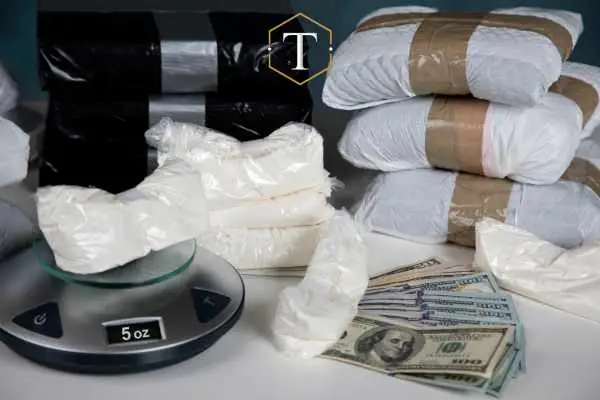
### Expungement
After a dismissal under a conditional discharge, a person may apply to the court to expunge the records of the arrest and proceedings ([S.C. Code Ann. § 44-53-450(B)](https://www.scstatehouse.gov/code/t44c053.php)). A person who completes pretrial intervention may apply for an order to destroy the arrest records ([S.C. Code Ann. § 17-22-150](https://www.scstatehouse.gov/code/t17c022.php)). Whether a record can be expunged depends on the statute that applies, so ask an attorney about your case.
## Contact Our Greenville Felony Drug Charge Lawyer Today for Legal Advice
If you have been charged with a drug crime in Greenville or anywhere in South Carolina, contact a Greenville drug crime attorney who can investigate your case and help you understand your constitutional rights.
Regardless of the drug involved, it is important to have an attorney on your side who knows how to approach these situations. The drug crime lawyers at Touma Law Group will work to protect your legal rights. To schedule a free and confidential consultation, contact our [Greenville defense attorneys](/greenville/criminal-defense-lawyer/) today at [864-618-2323](tel:+18646182323).
## Underage DUI in South Carolina
URL: https://toumalawgroup.com/underage-dui/
In South Carolina, a driver under 21 can be charged with DUI like any other driver. A DUI conviction can occur if a driver was under the influence of alcohol, drugs, or both to the extent that the driver's faculties to drive were materially and appreciably impaired ([S.C. Code Ann. § 56-5-2930](https://www.scstatehouse.gov/code/t56c005.php)), or if the driver drove with an alcohol concentration of 0.08 or more, which is the separate offense of driving with an unlawful alcohol concentration (DUAC) ([S.C. Code Ann. § 56-5-2933](https://www.scstatehouse.gov/code/t56c005.php)). The penalty tiers in those sections do not depend on the age of the driver.
South Carolina also has a separate rule for drivers under 21. A person under 21 who drives with an alcohol concentration of 0.02 or more faces a license suspension, and a refusal to take the chemical test also leads to a suspension ([S.C. Code Ann. § 56-1-286](https://www.scstatehouse.gov/code/t56c001.php)).
When an underage driver has been drinking, the officer can pursue the license suspension under Section 56-1-286 or charge the driver under the DUI statutes or the underage alcohol statutes. If the officer starts suspension proceedings under Section 56-1-286, the officer cannot prosecute the same incident under Section 63-19-2440, Section 63-19-2450, Section 56-5-2930, or Section 56-5-2933. If the officer does not use Section 56-1-286, a driver under 21 can still be charged, and a driver with an alcohol concentration of 0.08 or more can be charged with DUI or DUAC.
An arrest of a teenager or young adult for an alcohol related driving incident can be stressful. A South Carolina criminal defense attorney can explain the process and the legal rights of the driver at each stage.
## What is the Legal Process for an Underage DUI Case?
An underage driver can face two separate processes. The first is the under 21 license suspension under Section 56-1-286, which is an administrative matter handled through the South Carolina Department of Motor Vehicles (SCDMV) and, if you ask for a hearing, the Office of Motor Vehicle Hearings. The second is a criminal case, if the officer charges the driver with DUI, DUAC, or an underage alcohol offense. The suspension is not a criminal conviction, but it is a real consequence of its own.
If the test registers 0.02 or more, or if the driver refuses, the officer issues a notice of suspension. Within 30 days of the notice, the driver may request a contested case hearing and either enroll in the Ignition Interlock Device Program or get a temporary alcohol license (TAL) from SCDMV for a $100 fee. A TAL for a driver under 21 carries an ignition interlock restriction for three months ([S.C. Code Ann. § 56-1-286(L)](https://www.scstatehouse.gov/code/t56c001.php)). If the driver does not request a hearing, the driver waives it, and must enroll in an Alcohol and Drug Safety Action Program (ADSAP) within 30 days or no TAL is issued ([S.C. Code Ann. § 56-1-286(K)](https://www.scstatehouse.gov/code/t56c001.php)). It is important to get in touch with a [Greenville DUI lawyer](/greenville/dui-lawyer/) if you were stopped for an underage DUI.
## The Penalties for an Underage Driver in South Carolina
Even when the case is an administrative suspension and not a criminal conviction, there are consequences, including the loss of driving privileges and a required alcohol program.
If a driver under 21 refuses the chemical test, SCDMV suspends the license for six months. The suspension is one year if, within the three years before the violation, the driver was convicted of DUI, DUAC, or felony DUI (or a similar law of another state), or had a prior suspension under Section 56-1-286, Section 56-5-2951, or Section 56-5-2990 ([S.C. Code Ann. § 56-1-286(F)](https://www.scstatehouse.gov/code/t56c001.php)).
If the driver takes the test and the result is 0.02 or more, the suspension is three months, or six months with that same kind of prior within three years ([S.C. Code Ann. § 56-1-286(G)](https://www.scstatehouse.gov/code/t56c001.php)). In place of serving the rest of the suspension, the driver may enroll in the Ignition Interlock Device Program, with a device for the time remaining on the suspension and for at least three months ([S.C. Code Ann. § 56-1-286(H)](https://www.scstatehouse.gov/code/t56c001.php)). These rules are separate from the penalties for a DUI conviction in Section 56-5-2930, which apply if the driver is convicted of [first time DUI](/first-time-dui/) or a [second offense](/second-time-dui/).
A driver who does not request a hearing, or whose suspension is upheld, must enroll in ADSAP ([S.C. Code Ann. § 56-1-286(L), (K)](https://www.scstatehouse.gov/code/t56c001.php); [ADSAP information](https://bhdd.sc.gov/office-substance-use-services/services/treatment/dui-services)). Anyone convicted of DUI must complete an ADSAP as well ([S.C. Code Ann. § 56-5-2930(H)](https://www.scstatehouse.gov/code/t56c005.php)).
## Challenging an Underage DUI Suspension in South Carolina
The suspension can be challenged in some cases. The driver has 30 days from the notice of suspension, not from the date of the arrest, to request a contested case hearing. The scope of the hearing is limited to whether the driver was lawfully arrested or detained, was given the required written and verbal advisement of rights, refused the test, or, if tested, whether the result was 0.02 or more, the person who gave the test was qualified, the test followed the Code, and the machine worked properly. SCDMV and the arresting officer carry the burden of proof ([S.C. Code Ann. § 56-1-286(P)](https://www.scstatehouse.gov/code/t56c001.php)). Your [Greenville juvenile crime lawyer](/greenville/juvenile-criminal-defense-lawyer/) can review whether the arrest was lawful, the accuracy of the machine, and whether the driver actually refused to take the test.
> _FAQ:_ [_Is DUI a felony in SC?_](/felony-dui/)
## What Happens if Police Find Alcohol in the Car I Am in?
A person under 21 commits a misdemeanor by purchasing, attempting to purchase, consuming, or knowingly possessing beer or wine ([S.C. Code Ann. § 63-19-2440](https://www.scstatehouse.gov/code/t63c019.php)) or other alcoholic liquors ([S.C. Code Ann. § 63-19-2450](https://www.scstatehouse.gov/code/t63c019.php)). Possession is prima facie evidence that the alcohol was knowingly possessed. Whether a person who is a passenger in a vehicle "knowingly possessed" alcohol depends on the facts of the case, and a lawyer should review them. You may be charged with possession of alcohol even if you are not charged with DUI.
A conviction carries a fine of $100 to $200, or imprisonment for up to 30 days, or both, and a required alcohol prevention education or intervention program of at least eight hours. SCDMV also suspends the driver's license for 120 days for a first conviction and one year for a second or later conviction ([S.C. Code Ann. § 56-1-746](https://www.scstatehouse.gov/code/t56c001.php)).
## Contact Touma Law Group to Consult an Attorney
At [Touma Law Group](/), we handle underage drinking and driving cases and other alcohol or drug related offenses. We can explain the rules above and talk through the facts of your situation. A licensed South Carolina attorney at the firm must review the facts of your case before anyone relies on this page, which is general information and not legal advice. Our [criminal defense lawyers](/greenville/criminal-defense-lawyer/) will listen to you and explain your legal options.
## Felony DUI in South Carolina
URL: https://toumalawgroup.com/felony-dui/
Driving under the influence of drugs or alcohol can lead to serious charges. If you drive while impaired and cause great bodily injury or death to another person, you face felony DUI with mandatory prison time. If you are being charged with a felony DUI in South Carolina, call Touma Law Group today.
We work with clients throughout the Upstate on their felony DUI cases and help them handle the license suspension that comes with a DUI charge. Contact us at [(864) 618-2323](tel:+18646182323) to talk about your case. A licensed South Carolina attorney at the firm must review the facts of your case before anyone relies on this page, which is general information and not legal advice.
## What Constitutes a Felony DUI in South Carolina?
Two situations lead to felony level DUI charges in South Carolina, and a third situation adds a separate charge without making the DUI a felony:
### Great Bodily Injury or Death
Under [S.C. Code Ann. § 56-5-2945](https://www.scstatehouse.gov/code/t56c005.php), a person who drives under the influence and, by an act forbidden by law or a neglected legal duty in driving, proximately causes great bodily injury or death to another person is guilty of felony driving under the influence. The Code defines "great bodily injury" as bodily injury that creates a substantial risk of death or that causes serious, permanent disfigurement, or protracted loss or impairment of the function of any bodily member or organ. When great bodily injury results, the sentence includes a mandatory fine of $5,100 to $10,100 and mandatory imprisonment of 30 days to 15 years.
### A Minor Passenger
A driver who commits DUI, DUAC, or felony DUI with a passenger under the age of 16 in the vehicle may also be convicted of child endangerment, which is a separate offense added to the underlying charge ([S.C. Code Ann. § 56-5-2947](https://www.scstatehouse.gov/code/t56c005.php)). The Code sets the penalty at up to one-half of the maximum fine and/or the maximum term of the underlying offense, with no suspension of the penalty and no probation, plus a license suspension and an ignition interlock device for three months. A passenger under 16 does not by itself make a DUI a felony.
### Fourth or Later Offense
A fourth or subsequent DUI or DUAC offense is a Class F felony ([S.C. Code Ann. § 16-1-90(F), § 16-1-100(A)](https://www.scstatehouse.gov/code/t16c001.php)). The penalty is imprisonment of 1 to 5 years, 2 to 6 years if the alcohol concentration was 0.10 to under 0.16, and 3 to 7 years if it was 0.16 or more ([S.C. Code Ann. § 56-5-2930](https://www.scstatehouse.gov/code/t56c005.php)). A third offense is not a felony. It is a Class A misdemeanor with a fine of $3,800 to $6,300 and 60 days to 3 years of imprisonment, with higher ranges at higher alcohol concentrations.
## Penalties for a Felony DUI
Drivers convicted of a felony DUI face administrative penalties in addition to the criminal sentence. SCDMV suspends the license of a person convicted under Section 56-5-2945. After the person is released from prison, the person must enroll in the Ignition Interlock Device Program, end the suspension, and obtain an ignition interlock restricted license. The device is required for three years when great bodily injury results and five years when a death occurs ([S.C. Code Ann. § 56-5-2945(C)](https://www.scstatehouse.gov/code/t56c005.php)).
The Code sets the sentence for felony DUI as a mandatory fine and mandatory imprisonment. The penalties differ depending on whether the DUI resulted in great bodily injury or death.
For cases involving great bodily injury, the Code requires a fine of $5,100 to $10,100 and imprisonment of 30 days to 15 years. Part of the mandatory sentence cannot be suspended, and probation cannot be granted for any portion.

In the event of a DUI resulting in death, the Code requires a fine of $10,100 to $25,100 and imprisonment of 1 to 25 years. The same rule applies: part of the mandatory sentence cannot be suspended, and probation cannot be granted for any portion.
When SCDMV suspends a license, it also suspends registrations unless the person files and maintains proof of financial responsibility, which an insurer commonly certifies on a form called an SR-22 ([S.C. Code Ann. § 56-9-500](https://www.scstatehouse.gov/code/t56c009.php)). Confirm the exact requirement for your case with SCDMV or your insurer ([SCDMV license reinstatement](https://dmv.sc.gov/driver-services/license-reinstatement)).
A felony conviction will be listed on an individual's criminal record, which can create issues with finding housing and employment.
Facing DUI charges, and particularly felony charges, can have major consequences. If you find yourself in that position, contact a criminal defense attorney early so that your case can be reviewed.
## How Do You Defend Against Felony DUI Charges?
Felony DUI cases are difficult. To convict under Section 56-5-2945, the State must prove that you drove under the influence and that an act forbidden by law or a neglected legal duty in driving proximately caused great bodily injury or death to another person. Evidence in these cases can include witnesses who describe impaired driving, evidence of drinking recovered by law enforcement officers, medical records, and chemical test results. A person suspected of causing a crash that killed someone must submit to field sobriety tests and to chemical tests ([S.C. Code Ann. § 56-5-2948](https://www.scstatehouse.gov/code/t56c005.php); [S.C. Code Ann. § 56-5-2946](https://www.scstatehouse.gov/code/t56c005.php)).
A [DUI lawyer](/greenville/dui-lawyer/) may review whether breath or blood samples were properly obtained and may look at medical records to see whether the injuries meet the Code's definition of great bodily injury. Contacting a defense attorney quickly gives more time to review the evidence in your case. No lawyer can promise an outcome.
> _Related:_ [_What to do After a DUI in Greenville_](/after-a-dui-in-greenville/)
## Hire a DUI Attorney in South Carolina
DUI charges, and especially felony DUI charges, can put your future in jeopardy. If your charge involves injury or death, speak with a DUI attorney as soon as possible.
If you have been charged with a felony DUI in upstate SC, contact the team of [Greenville criminal defense attorneys](/greenville/criminal-defense-lawyer/) at Touma Law Group. Schedule an appointment with our online form or over the phone to talk about your case.
## Misdemeanor DUI in South Carolina
URL: https://toumalawgroup.com/misdemeanor-dui/
In South Carolina, state laws impose strict penalties on drivers convicted of drunk driving. Those criminal penalties can include fines, jail time, loss of driving privileges, and an ignition interlock device (IID), which is a breathalyzer connected to your motor vehicle's ignition. Navigating the legal consequences of a drunk driving charge is confusing.
If you have been charged with driving under the influence of alcohol or drugs in Greenville or anywhere in South Carolina, seek legal representation right away from a DUI criminal defense lawyer.
At Touma Law Group, our criminal defense team defends people charged with felony and misdemeanor DUI offenses in South Carolina. To schedule a free and confidential consultation, call our Greenville criminal defense law firm today at [864-618-2323](tel:+18646182323). A licensed South Carolina attorney at the firm must review the facts of your case before anyone relies on this page, which is general information and not legal advice.
## What Counts as a DUI in Greenville, SC?
South Carolina law says a person commits DUI when alcohol, drugs, or a combination of both materially and appreciably impair the person's faculties to drive a motor vehicle ([S.C. Code Ann. § 56-5-2930(A)](https://www.scstatehouse.gov/code/t56c005.php)). It does not matter whether drugs, alcohol, or a combination of both caused the impairment. The statute covers any other drug or substance that causes impairment, and it does not matter whether a drug was legally prescribed.
However, the State must prove the following elements for you to be convicted of a DUI charge:
- That you were driving. You could be in your car listening to music, sleeping, or even passed out behind the wheel, but the State must still prove that you drove a motor vehicle while impaired. Whether a person found asleep in a parked or stopped car was "driving" depends on the facts of the case, and a lawyer should review them.
- That your "faculties to drive" were appreciably or materially impaired. This can be shown with a blood test or breathalyzer result, testimony from the arresting officer, statements from other witnesses, or video of your performance on the roadside field sobriety tests (FSTs).
Your DUI criminal defense attorney can review the breathalyzer results, cross-examine the police officer on whether there was bias, look into other explanations for your performance on the field sobriety tests, and identify "sobriety witnesses" who can testify about your ability to operate a motor vehicle at the time of the incident. What any of that produces depends on the facts, and no lawyer can promise an outcome.
## What is the Difference Between a Misdemeanor DUI and a Felony DUI?
In South Carolina, law enforcement officers can arrest you for DUI based on probable cause that you were operating a motor vehicle while materially and appreciably impaired by drugs, alcohol, or a combination of both. You can also be charged with driving with an unlawful alcohol concentration (DUAC) if a chemical test shows your alcohol concentration was 0.08 or more ([S.C. Code Ann. § 56-5-2933](https://www.scstatehouse.gov/code/t56c005.php)). DUI and DUAC carry the same penalty tiers.
First and second offense DUI and DUAC are misdemeanors. A third offense is a Class A misdemeanor, and only a fourth or later offense is a Class F felony ([S.C. Code Ann. § 16-1-90(F), § 16-1-100(A)](https://www.scstatehouse.gov/code/t16c001.php)). "Felony DUI" is a separate offense that applies when impaired driving causes great bodily injury or death. These are the main situations that raise the stakes:
- Great bodily injury or death. If a person drives under the influence and, by an act forbidden by law or a neglected legal duty in driving, proximately causes great bodily injury or death to another person, the person can be charged with [felony DUI](/felony-dui/) ([S.C. Code Ann. § 56-5-2945](https://www.scstatehouse.gov/code/t56c005.php)). The Code defines great bodily injury as bodily injury that creates a substantial risk of death or that causes serious, permanent disfigurement, or protracted loss or impairment of the function of any bodily member or organ.
- Subsequent DUI offenses. A third DUI offense is not a felony. It is a Class A misdemeanor, and a fourth or subsequent offense is a Class F felony ([S.C. Code Ann. § 16-1-90(F), § 16-1-100(A)](https://www.scstatehouse.gov/code/t16c001.php)).
- A DUI offense with minors in the vehicle. A passenger under 16 does not turn a DUI into a felony. Instead, a person 18 or older who commits DUI, DUAC, or felony DUI with a passenger younger than 16 in the vehicle can also be convicted of a separate offense, child endangerment. The penalty is up to one-half of the maximum fine and/or term of the underlying offense, with no suspension of the penalty and no probation, plus a license suspension and an ignition interlock device for three months ([S.C. Code Ann. § 56-5-2947](https://www.scstatehouse.gov/code/t56c005.php)).
> _Related:_ [_First Time DUI in South Carolina_](/first-time-dui/)
## What is the Legal Limit in Greenville, SC?
DUI in South Carolina is impairment based. The State must prove that you were driving while your faculties to drive were materially and appreciably impaired, and Section 56-5-2930 does not set a specific alcohol level. Your alcohol concentration can still be used as evidence of impairment, and 0.08 is the alcohol concentration for the separate DUAC offense ([S.C. Code Ann. § 56-5-2933](https://www.scstatehouse.gov/code/t56c005.php)).
South Carolina law also provides for inferences based on the blood test or breathalyzer results ([S.C. Code Ann. § 56-5-2950(G)](https://www.scstatehouse.gov/code/t56c005.php)):
- If your alcohol concentration was 0.05 or less, it is conclusively presumed that you were not under the influence of alcohol;
- If your alcohol concentration was over 0.05 and under 0.08, there is no inference either way about whether you were under the influence; and
- If your alcohol concentration was 0.08 or more, it may be inferred that you were under the influence, and you can still challenge the State's evidence and present your own evidence.
## What is the Sentence for Felony DUI Offense in South Carolina?
The legislature sets criminal laws and potential punishments, and judges apply them when a person pleads guilty or is found guilty at trial. For felony DUI, the Code sets mandatory ranges that depend on the result of the crash ([S.C. Code Ann. § 56-5-2945](https://www.scstatehouse.gov/code/t56c005.php)):
- Great bodily injury: a mandatory fine of $5,100 to $10,100 and mandatory imprisonment of 30 days to 15 years.
- Death: a mandatory fine of $10,100 to $25,100 and mandatory imprisonment of 1 to 25 years.
Part of the mandatory sentence cannot be suspended, and probation cannot be granted for any portion. After release from prison, the person must enroll in the Ignition Interlock Device Program, and the device is required for 3 years when great bodily injury results and 5 years when a death occurs.
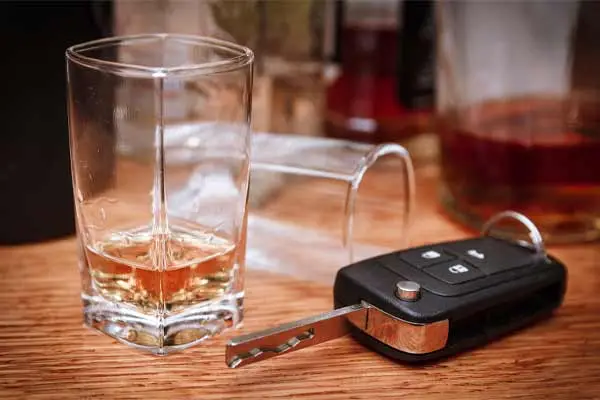
If a person pleads guilty or is found guilty of felony DUI, the judge must sentence within those ranges. Your [Greenville criminal attorney](/greenville/criminal-defense-lawyer/) can explain how the Code applies to the facts of your case.
## Contact Our Greenville DUI Criminal Defense Attorneys Today for Legal Advice
If you are facing jail time, your DUI criminal defense attorney can review your case and explain your options, including how the sentencing ranges apply to you. No lawyer can promise an outcome. After a DUI arrest, it is important to contact a [DUI lawyer in Greenville](/greenville/dui-lawyer/) as soon as possible. If you are facing a drunk driving charge in South Carolina, contact the DUI criminal defense attorneys at Touma Law Group today at [864-618-2323](tel:+18646182323) to schedule a no-cost initial consultation.
## Second Time DUI
URL: https://toumalawgroup.com/second-time-dui/
A DUI in South Carolina is a serious offense. A conviction can result in fines, time in jail, and a license suspension with an ignition interlock requirement. For second time DUI offenders, the penalties are more severe.
At Touma Law Group, our defense lawyers can review your charge and help you handle your license suspension as well. Contact our office today to schedule an appointment. A licensed South Carolina attorney at the firm must review the facts of your case before anyone relies on this page, which is general information and not legal advice.
## Second Offense DUI
DUI cases in South Carolina are taken very seriously, and this holds particularly true for repeat offenders. A conviction, guilty plea, no contest plea, or bail forfeiture for DUI or [DUAC](/dui-vs-duac/) (driving with an unlawful alcohol concentration), in South Carolina or another state, counts as a prior offense. Only violations that occurred within ten years including and immediately preceding the date of the last violation count ([S.C. Code Ann. § 56-5-2930(D)](https://www.scstatehouse.gov/code/t56c005.php)).
A second offense DUI is [charged as a misdemeanor](/misdemeanor-dui/). A third offense DUI or DUAC is a Class A misdemeanor, and a fourth or later offense is a Class F felony ([S.C. Code Ann. § 16-1-90(F), § 16-1-100(A)](https://www.scstatehouse.gov/code/t16c001.php)). "[Felony DUI](/felony-dui/)" is a different offense that involves great bodily injury or death.
An offense with a penalty of imprisonment of 90 days or less may be tried in magistrates court ([S.C. Code Ann. § 56-5-2930(K)](https://www.scstatehouse.gov/code/t56c005.php)). Second and later offenses carry more than 90 days, so they are generally General Sessions matters.

A second offense carries a fine and mandatory jail time, and no part of the minimum sentence may be suspended. The Code sets the ranges below, and many factors can influence the exact sentence within them.
To understand how your specific case could develop, or to get answers to your legal questions, you should seek legal counsel as soon as possible. A DUI attorney can review your situation and explain your options.
## Look Back Period
South Carolina uses a ten year look-back period for DUI and DUAC offenses when determining repeat offenders. The Code counts the dates the violations occurred, so the period is measured from the offense dates.
DUI and DUAC convictions count toward each other. This means that if you have a DUAC on record from 3 years ago and are charged with a new DUI today, the new charge is a second offense.
For ignition interlock purposes, the Code's wording about which earlier offenses count in a third offense case is unsettled, and SCDMV's records set the interlock length for second and later offenses regardless of how the charge was pleaded ([S.C. Code Ann. § 56-5-2990, § 56-5-2941(B)](https://www.scstatehouse.gov/code/t56c005.php)). A lawyer must count your record to tell you which rule applies.
## Are DUIs Transferred Between States?
For purposes of prior offenses, South Carolina counts a conviction, plea, or bail forfeiture under a law of this or another state that prohibits driving under the influence or driving with an unlawful alcohol concentration, if the violation falls within the ten year period ([S.C. Code Ann. § 56-5-2930(D)](https://www.scstatehouse.gov/code/t56c005.php)). An out of state DUI can therefore count as a prior offense here.
## Do DUIs Only Involve Alcohol?
No. The DUI statute covers alcohol, any other drug or combination of drugs or substances that impair your ability to drive, and any combination of alcohol and other substances ([S.C. Code Ann. § 56-5-2930(A)](https://www.scstatehouse.gov/code/t56c005.php)). Examples of substances that can lead to charges include:
- Marijuana
- Prescription Medication
- Cocaine
- Inhalants
## Criminal Penalties
A DUI is a second offense if the driver has a prior DUI or DUAC conviction within the ten year period described above. The court also takes into account the alcohol concentration when applying the penalties set by South Carolina law ([S.C. Code Ann. § 56-5-2930](https://www.scstatehouse.gov/code/t56c005.php)).
- Fines: A second offense carries a fine of $2,100 to $5,100. If the alcohol concentration was 0.10 to under 0.16, the range is $2,500 to $5,500, and at 0.16 or higher it is $3,500 to $6,500.
- Jail time: A second offense carries a mandatory sentence of 5 days to 1 year in addition to the fine. At an alcohol concentration of 0.10 to under 0.16, the range is 30 days to 2 years, and at 0.16 or higher it is 90 days to 3 years.
- Treatment: Everyone convicted of DUI in South Carolina must enroll in and complete an Alcohol and Drug Safety Action Program (ADSAP) certified by the Office of Substance Use Services. This process requires an evaluation followed by completion of the recommended program ([S.C. Code Ann. § 56-5-2930(H)](https://www.scstatehouse.gov/code/t56c005.php); [ADSAP information](https://bhdd.sc.gov/office-substance-use-services/services/treatment/dui-services)).
## Administrative Penalties
A conviction for a second offense DUI can bring additional penalties outside of those ordered by the court.
A DUI conviction shows on your criminal record, which can make finding housing or employment more difficult.
After a conviction, the South Carolina Department of Motor Vehicles (SCDMV) suspends the license. A second offender must enroll in the Ignition Interlock Device Program, end the suspension, and obtain an ignition interlock restricted license for a $100 fee, with an [Ignition Interlock Device](https://dppps.sc.gov/ignition-interlock) (IID) installed for 2 years ([S.C. Code Ann. § 56-5-2990](https://www.scstatehouse.gov/code/t56c005.php); [S.C. Code Ann. § 56-1-400(C)](https://www.scstatehouse.gov/code/t56c001.php)). If the person chooses not to install the device, the license stays suspended indefinitely ([S.C. Code Ann. § 56-1-400(E)](https://www.scstatehouse.gov/code/t56c001.php)).

A second or later conviction also brings vehicle immobilization: suspension and surrender of the vehicle registration and license plates for 30 days during the license suspension, with a $50 fee per vehicle. Immobilization does not apply to a person who holds a valid ignition interlock restricted license ([S.C. Code Ann. § 56-5-2942](https://www.scstatehouse.gov/code/t56c005.php)).
## How Can a DUI Charge Be Challenged?
Second offense DUI charges are generally General Sessions matters. Depending on the facts, a defense lawyer may look at whether certain evidence, such as breath or blood tests, can be challenged, and whether the field sobriety tests were valid. South Carolina also requires video recording of the incident site and the breath test site, which is another area a lawyer reviews ([S.C. Code Ann. § 56-5-2953](https://www.scstatehouse.gov/code/t56c005.php)). A [Greenville defense lawyer](/greenville/criminal-defense-lawyer/) can help you plan your strategy and explain your options, but no lawyer can promise an outcome.
Outside of the criminal charges, a license suspension for refusing the chemical test or for a result of 0.15 or more is administrative. You may request a contested case hearing before the Office of Motor Vehicle Hearings within 30 days of the notice of suspension, not the arrest date, and either enroll in the Ignition Interlock Device Program or get a temporary alcohol license. If you do not request the hearing, you waive it and the suspension continues ([S.C. Code Ann. § 56-5-2951(B), (D)](https://www.scstatehouse.gov/code/t56c005.php)). If you have one prior DUI or DUAC conviction or prior suspension in the preceding ten years, the suspension is 9 months for a refusal and 2 months for a result of 0.15 or more ([S.C. Code Ann. § 56-5-2951(I)](https://www.scstatehouse.gov/code/t56c005.php)).
The hearing is limited to issues such as whether the arrest or detention was lawful, whether you received the implied consent advisement, whether you refused, and, if you were tested, whether the result, the tester, the testing, and the machine met the Code's requirements. SCDMV and the arresting officer carry the burden of proof ([S.C. Code Ann. § 56-5-2951(F)](https://www.scstatehouse.gov/code/t56c005.php)).
## Talk to a DUI Attorney
If you have been charged with driving under the influence of alcohol or other impairing substances, contact a DUI lawyer as soon as possible. DUI laws have changed in recent years, including the ignition interlock rules that took effect on May 19, 2024, and each case has its own circumstances.
At Touma Law Group, we handle DUI cases and the license issues that come with them. Contact our [DUI lawyers](/contact/) today to schedule an appointment.
## First Time DUI in South Carolina
URL: https://toumalawgroup.com/first-time-dui/
The criminal penalties for a first time DUI in South Carolina are lower than those for later offenses. Still, a conviction can affect your future. If convicted, you could face a fine or jail time, an ignition interlock device requirement, a license suspension, a requirement to show proof of insurance before your license and registration are restored, and a negative impact on your professional and personal life.
Alcohol-impaired driving is a serious problem in this state. The National Highway Traffic Safety Administration (NHTSA) estimates that 417 of the 1,038 traffic deaths in South Carolina in 2024 (40%) happened in crashes involving a driver with a blood alcohol concentration of 0.08 or more ([NHTSA, State Alcohol-Impaired-Driving Estimates: 2024 Data](https://crashstats.nhtsa.dot.gov/Api/Public/ViewPublication/813813)). NHTSA estimates alcohol levels when test results are missing and may revise the 2024 figures.

A first DUI charge can come as a surprise, including to people with no prior record. If you or a loved one were recently arrested for a DUI in Greenville or the surrounding areas, contact the Greenville criminal defense attorneys at Touma Law Group today at [864-618-2323](tel:+18646182323). A licensed South Carolina attorney at the firm must review the facts of your case before anyone relies on this page, which is general information and not legal advice.
## What Happens When I Get My First DUI in South Carolina?
Under [S.C. Code Ann. § 56-5-2930](https://www.scstatehouse.gov/code/t56c005.php), it is unlawful to drive a motor vehicle while under the influence of alcohol, drugs, or a combination of both to the extent that your faculties to drive are materially and appreciably impaired. DUI is an impairment based offense, and that section does not set a specific alcohol level.
A separate offense, driving with an unlawful alcohol concentration (DUAC), applies when a chemical test shows an alcohol concentration of 0.08 or more ([S.C. Code Ann. § 56-5-2933](https://www.scstatehouse.gov/code/t56c005.php)). In a DUI case, an alcohol concentration of 0.08 or more at the time of the test may be inferred to mean the person was under the influence, an alcohol concentration over 0.05 and under 0.08 carries no inference either way, and 0.05 or less is conclusively presumed not under the influence of alcohol ([S.C. Code Ann. § 56-5-2950(G)](https://www.scstatehouse.gov/code/t56c005.php)). A driver whose result is under 0.08 can still be charged with DUI if the State claims alcohol or drugs materially and appreciably impaired the ability to drive.
When a law enforcement officer stops you on suspicion of drunk driving, the officer is already building a case by observing your driving behavior before the stop begins.
If the officer suspects you are driving under the influence, he or she may ask you to perform field sobriety tests. These roadside tests are not part of the implied consent law, and the Code says a refusal to take a field sobriety test "does not constitute disobeying a police command" ([S.C. Code Ann. § 56-5-2953](https://www.scstatehouse.gov/code/t56c005.php)). The exception is a crash in which the officer suspects the driver caused a death: that driver must submit to field sobriety tests ([S.C. Code Ann. § 56-5-2948](https://www.scstatehouse.gov/code/t56c005.php)).
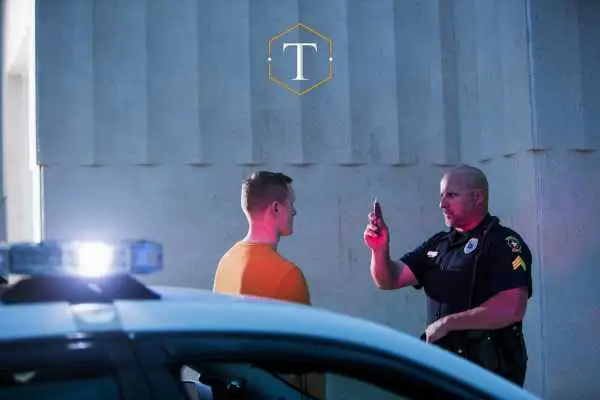
After an arrest, the officer will ask you to take a breath test. Under South Carolina's implied consent law, a person who drives in this state is considered to have consented to chemical tests of breath, blood, or urine if arrested for DUI ([S.C. Code Ann. § 56-5-2950](https://www.scstatehouse.gov/code/t56c005.php)). You may refuse. Before testing, the officer must give you a written copy of your rights and tell you that you do not have to take the test, but that your license must be suspended or denied for at least six months if you refuse, and that the refusal may be used against you in court. The officer must also tell you that the suspension is at least one month if your result is 0.15 or more, that you have the right to an independent test at your own expense, and that you may request a contested case hearing within 30 days of the notice of suspension.
If you refuse the test or your result is 0.15 or more, the arresting officer issues a notice of suspension ([S.C. Code Ann. § 56-5-2951](https://www.scstatehouse.gov/code/t56c005.php)). The notice explains your right to request a contested case hearing before the Office of Motor Vehicle Hearings and your right to a temporary alcohol license.
Within 30 days of the notice of suspension, not the arrest date, you may request that hearing and either enroll in the Ignition Interlock Device Program or get a temporary alcohol license (TAL) from the South Carolina Department of Motor Vehicles (SCDMV) for a $100 fee ([S.C. Code Ann. § 56-5-2951(B)](https://www.scstatehouse.gov/code/t56c005.php)). The Code says the TAL allows you to drive without restrictive conditions pending the outcome of the hearing, and it does not require an interlock device until the suspension is upheld or the hearing is waived ([S.C. Code Ann. § 56-5-2941(A)(5)](https://www.scstatehouse.gov/code/t56c005.php)). Confirm the current requirement for your case with SCDMV ([SCDMV license reinstatement](https://dmv.sc.gov/driver-services/license-reinstatement)).
If you do not request a contested case hearing, you waive the right to the hearing and the suspension continues. At the hearing, SCDMV and the arresting officer carry the burden of proof, and the issues are limited to matters such as whether the arrest or detention was lawful, whether you were given your implied consent rights, whether you refused, and, if you were tested, whether the result and the testing met the Code's requirements ([S.C. Code Ann. § 56-5-2951(F)](https://www.scstatehouse.gov/code/t56c005.php)). The administrative hearing does not decide the criminal case. A [Greenville DUI lawyer](/greenville/dui-lawyer/) can explain how the hearing process works.
> _Related:_ [_Misdemeanor DUI in South Carolina_](/misdemeanor-dui/)
## What Is The Criminal Penalty For A 1st Offense DUI In Greenville, South Carolina?
A first-time offender in South Carolina may face the following criminal penalties under [S.C. Code Ann. § 56-5-2930](https://www.scstatehouse.gov/code/t56c005.php):
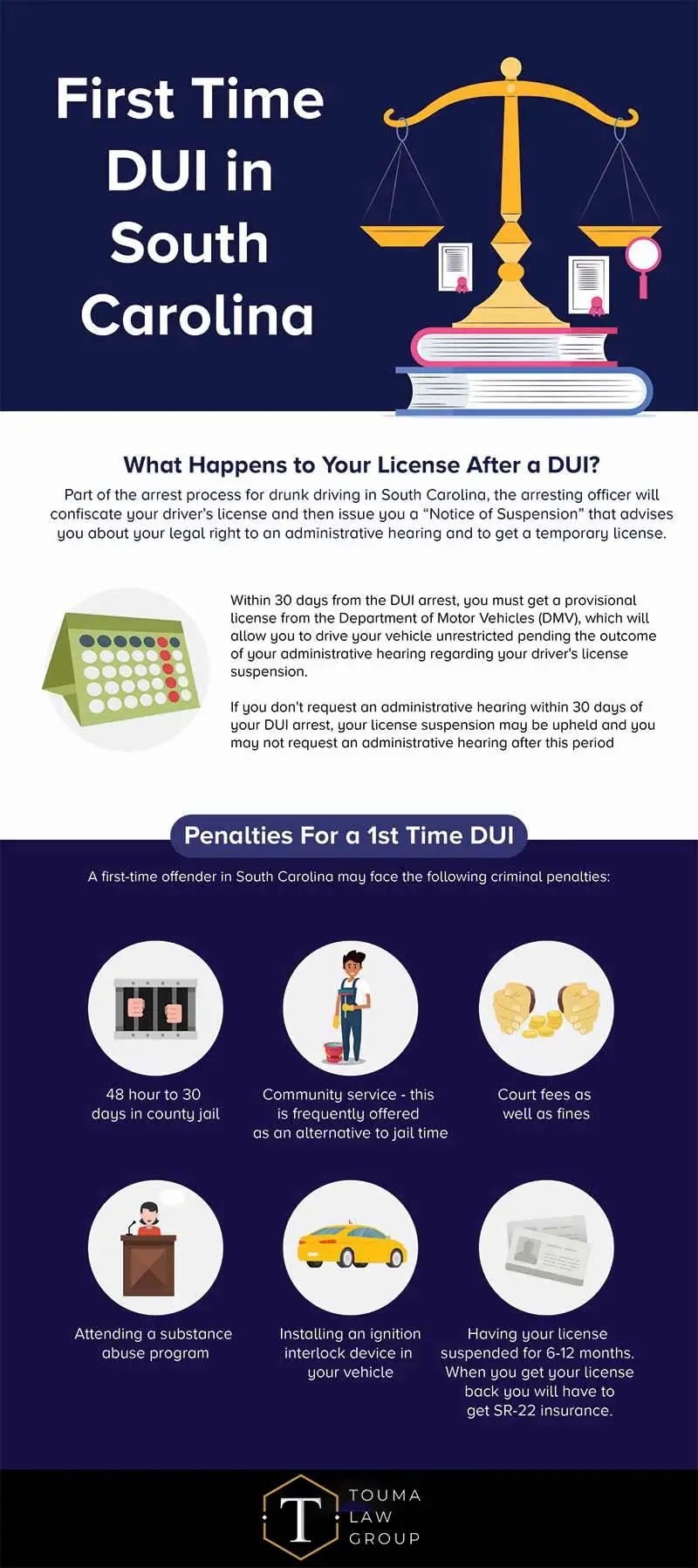
### Potential Jail Time
A first DUI conviction below an alcohol concentration of 0.10 carries a fine of $400 or imprisonment for 48 hours to 30 days. If the alcohol concentration is 0.10 to under 0.16, the penalty is a fine of $500 or imprisonment for 72 hours to 30 days. At 0.16 or more, it is a fine of $1,000 or imprisonment for 30 to 90 days. A first DUI offense may be tried in magistrates court. No part of the minimum sentence may be suspended.
### Community Service
In place of the minimum jail term, the court may allow public service employment for the same length of time: 48 hours, 72 hours, or 30 days, depending on the alcohol concentration tier above. The court may not compel you to perform public service in place of the minimum sentence.
### Fines
The fine is $400 for a first offense, $500 if the alcohol concentration is 0.10 to under 0.16, and $1,000 if it is 0.16 or more, plus court assessments. The fine on a first offense cannot be suspended.
### Substance Abuse Program
Everyone convicted of DUI must enroll in and complete an Alcohol and Drug Safety Action Program (ADSAP) certified by the Office of Substance Use Services. Costs are capped at $500 for education, $2,000 for treatment, and $2,500 in total, and a person who cannot pay performs 50 hours of community service instead of being denied services ([S.C. Code Ann. § 56-5-2930(H)](https://www.scstatehouse.gov/code/t56c005.php); [ADSAP information](https://bhdd.sc.gov/office-substance-use-services/services/treatment/dui-services)).
### Test Refusal
If you have no prior DUI or DUAC conviction and no prior suspension under S.C. Code Ann. § 56-1-286, § 56-5-2951 or § 56-5-2990 in the preceding ten years, refusing the chemical test brings a six-month administrative suspension. A test result of 0.15 or more brings a one-month suspension. In place of serving the rest of the suspension, you may enroll in the Ignition Interlock Device Program for the time remaining, with a minimum of three months ([S.C. Code Ann. § 56-5-2951(A), (I)](https://www.scstatehouse.gov/code/t56c005.php)).
### Ignition Interlock Device
Since May 19, 2024, every DUI or DUAC conviction requires enrollment in the Ignition Interlock Device Program, and there is no alcohol level threshold for a first offense. For a first offense, the device is required for 6 months ([S.C. Code Ann. § 56-5-2990](https://www.scstatehouse.gov/code/t56c005.php)). A first offender is not eligible for a provisional license. Offenses before May 19, 2024 followed the earlier rule, which required a device for a first offender only at an alcohol concentration of 0.15 or more.

### Driver's License Suspension
After a conviction, SCDMV suspends your driver's license. You may enroll in the Ignition Interlock Device Program, end the suspension, and obtain an ignition interlock restricted license for a $100 fee ([S.C. Code Ann. § 56-1-400(C)](https://www.scstatehouse.gov/code/t56c001.php)). If you choose not to install the device, the license stays suspended indefinitely ([S.C. Code Ann. § 56-1-400(E)](https://www.scstatehouse.gov/code/t56c001.php)).
When SCDMV suspends a license, it also suspends registrations unless the person files and maintains proof of financial responsibility, which an insurer commonly certifies on a form called an SR-22 ([S.C. Code Ann. § 56-9-500](https://www.scstatehouse.gov/code/t56c009.php)). On request, SCDMV waives the filing requirement after three years if it has received no record of a conviction or bail forfeiture that would require or permit suspension in that time ([S.C. Code Ann. § 56-9-620](https://www.scstatehouse.gov/code/t56c009.php)). Confirm the exact requirement for your case with SCDMV or your insurer ([SCDMV license reinstatement](https://dmv.sc.gov/driver-services/license-reinstatement)).
## Contact a Greenville DUI Lawyer Today for Legal Advice
The criminal penalties for impaired driving become harsher when the driver causes great bodily injury or death. Under [S.C. Code Ann. § 56-5-2945](https://www.scstatehouse.gov/code/t56c005.php), a person who drives under the influence and, by an act forbidden by law or a neglected legal duty in driving, proximately causes great bodily injury to another person faces a mandatory fine of $5,100 to $10,100 and mandatory imprisonment of 30 days to 15 years. If death results, the mandatory fine is $10,100 to $25,100 and the mandatory imprisonment is 1 to 25 years. Part of the mandatory sentence cannot be suspended, and probation cannot be granted for any portion. The statute refers to great bodily injury or death to "another person" and does not limit itself to crashes involving other vehicles or pedestrians.
If you have been charged with DUI in Greenville, speak with a Greenville DUI defense attorney at Touma Law Group about your case. A DUI conviction on your criminal record can have major consequences in your life, including the fines and jail sentences themselves. To schedule a free, no-obligation initial consultation, contact our Greenville law office today at [864-618-2323](tel:+18646182323).
## Greenville Appellate Lawyer
URL: https://toumalawgroup.com/greenville/appellate-lawyer/
The appellate process can be complex, with strict rules and short deadlines. In South Carolina, a notice of appeal from a criminal conviction must be served within 10 days after the sentence is imposed. Our law firm can help you understand your options for appealing a South Carolina conviction or sentence. Appeals from federal court go to the Fourth Circuit, which has its own bar admission process, so ask any lawyer you consult whether that lawyer is admitted to practice before it ([Fourth Circuit attorney bar status search](https://www.ca4.uscourts.gov/attorney-bar-and-cmecf-status)).
Whether you are considering an appeal of a lower court decision or need to respond to an appeal filed by the other side, our team can explain the process and help you decide on your next steps. The State may appeal only in limited circumstances, such as certain pre-trial orders ([SCACR Rule 203(b)(2)](https://www.sccourts.org/resources/judicial-community/court-rules/appellate/rule-203/)), and the United States may appeal certain orders in federal criminal cases ([18 U.S.C. § 3731](https://www.law.cornell.edu/uscode/text/18/3731)).
If you are facing an appellate matter in Greenville, SC, don't navigate the process alone. Contact our [criminal defense lawyers](/greenville/criminal-defense-lawyer/) today to schedule a consultation and learn how we can help you understand the appellate process.
Call our firm at [(864) 618-2323](tel:+18646182323) to schedule a free consultation, review your case, and discuss your options.
## When Should You Hire an Appellate Lawyer?
An appellate lawyer can be helpful when you disagree with a court decision and want to know whether it can be challenged in a higher court. Appellate lawyers review trial records, identify possible legal errors, and prepare written arguments for the court. If you believe that errors were made during your trial or that the law was misapplied, consulting with an appellate lawyer can clarify your options.
Because appeal deadlines are short, it helps to speak with a lawyer soon after sentencing or an adverse ruling. An appellate lawyer can also explain your options in the post-trial phase and what an appeal can and cannot do.

If you are contemplating an appeal or have received an adverse ruling in a legal matter, don't wait to seek legal advice. Speaking with an appellate attorney early in the process gives them time to review the deadlines and procedures that apply to your case. Contact our law firm today to schedule a consultation.
## Differences Between a Trial and Appellate Proceedings
Trial proceedings and appellate proceedings are distinct stages of the legal process, each serving different purposes and involving different procedures:
### Trial Proceedings
- **Purpose:** Trial proceedings are the initial stage of a case where the parties present evidence, witnesses, and arguments to a judge or jury to determine the facts of the case and reach a verdict.
- **Nature:** Trials are adversarial proceedings where the parties litigate the merits of their case, including presenting evidence, examining witnesses, and making legal arguments.
- **Burden of Proof:** In a criminal trial, the State must prove every fact necessary to constitute the crime beyond a reasonable doubt ([In re Winship, 397 U.S. 358 (1970)](https://www.law.cornell.edu/supremecourt/text/397/358)).
- **Decisions:** The outcome of a criminal trial is a verdict and, after a conviction, a sentence.
### Appellate Proceedings
- **Purpose:** Appellate proceedings occur after a trial, allowing a party dissatisfied with the trial court's decision to seek review by a higher court. The South Carolina Court of Appeals' jurisdiction is appellate only ([S.C. Code Ann. § 14-8-200](https://www.scstatehouse.gov/code/t14c008.php)).
- **Nature:** Appellate proceedings focus on legal arguments rather than re-litigating the facts. The record on appeal cannot include matter that was not presented to the lower court ([SCACR Rule 210(c)](https://www.sccourts.org/resources/judicial-community/court-rules/appellate/rule-210/)), and the appellant's brief must set out the issues presented for review, because ordinarily no point will be considered that is not set forth in the statement of issues ([SCACR Rule 208(b)(1)(B)](https://www.sccourts.org/resources/judicial-community/court-rules/appellate/rule-208/)).
- **Decisions:** The appellate court may affirm, reverse, or modify the decision below, or remand all or any issues for further proceedings ([SCACR Rule 220(a)](https://www.sccourts.org/resources/judicial-community/court-rules/appellate/rule-220/)).
In summary, trial proceedings focus on determining the facts and the verdict, while appellate proceedings focus on reviewing the trial court's record for legal errors. Appellate courts review the record from the trial court rather than holding a new trial.
## When Can You File an Appeal for a Criminal Case?
You can appeal a criminal case after a conviction or sentence. The deadlines are short, and they differ by court.
In South Carolina, after a plea or trial resulting in conviction, a notice of appeal must be served on all respondents within 10 days after the sentence is imposed. If a timely post-trial motion is made under Rule 29(a) of the South Carolina Rules of Criminal Procedure, the time to appeal is stayed and begins to run from receipt of written notice of the order granting or denying the motion ([SCACR Rule 203(b)(2)](https://www.sccourts.org/resources/judicial-community/court-rules/appellate/rule-203/)). The notice of appeal must then be filed with the clerk of the lower court and the clerk of the appellate court within 10 days after it is served, and if it is not timely filed, the appeal is dismissed ([SCACR Rule 203(d)](https://www.sccourts.org/resources/judicial-community/court-rules/appellate/rule-203/)). If the appeal is from a guilty plea, the notice must be accompanied by a written explanation showing an issue that can be reviewed on appeal (SCACR Rule 203(d)(1)(B)(iv)).
Most criminal appeals from the circuit court are filed with the Court of Appeals, and an appeal from a judgment that includes a sentence of death is filed with the Supreme Court (SCACR Rule 203(d)(1)(A)). The transcript of a General Sessions proceeding must be ordered within 30 days after the notice of appeal is served ([SCACR Rule 207(a)(1)](https://www.sccourts.org/resources/judicial-community/court-rules/appellate/rule-207/)). After the Court of Appeals rules, a petition for rehearing must be received within 15 days after the opinion is filed ([SCACR Rule 221(a)](https://www.sccourts.org/resources/judicial-community/court-rules/appellate/rule-221/)). A petition for a writ of certiorari to the Supreme Court is due within 30 days after the petition for rehearing is finally decided, and the Court grants it only where there are special and important reasons ([SCACR Rule 242](https://www.sccourts.org/resources/judicial-community/court-rules/appellate/rule-242/)). If a federal question is involved, a petition to the U.S. Supreme Court is generally due within 90 days ([28 U.S.C. § 1257(a)](https://www.law.cornell.edu/uscode/text/28/1257); [Supreme Court Rule 13](https://www.law.cornell.edu/rules/supct/rule_13)).
In federal court, a defendant's notice of appeal must be filed in the district court within 14 days after the entry of the judgment or order being appealed ([Fed. R. App. P. 4(b)](https://www.law.cornell.edu/rules/frap/rule_4)), and appeals from South Carolina federal courts go to the Fourth Circuit ([28 U.S.C. § 41](https://www.law.cornell.edu/uscode/text/28/41)).
It is important to follow the deadlines and procedural requirements to preserve your right to challenge the conviction or sentence. Speaking with an appellate lawyer as soon as possible after the trial can help you understand the deadlines that apply to your case and the issues that may be raised on appeal.
## Types of Cases Our Criminal Appeals Lawyers Can Help With
Criminal appellate lawyers handle cases where individuals have been convicted of crimes and want to know whether they can challenge their convictions or sentences. Here are some types of cases criminal appellate lawyers can assist with:
1. **Conviction Appeals**: When individuals believe errors or misconduct occurred during the trial, appellate lawyers can review the record for legal errors and, where appropriate, file an appeal challenging the conviction.
2. **Sentence Appeals**: Appellate lawyers can help individuals appeal their sentences if they believe the sentence was imposed in violation of law. In federal court, a defendant may appeal a sentence on specific grounds listed in [18 U.S.C. § 3742(a)](https://www.law.cornell.edu/uscode/text/18/3742).
3. **Post-Conviction Relief**: In South Carolina, a post-conviction relief (PCR) application under [S.C. Code Ann. § 17-27-20](https://www.scstatehouse.gov/code/t17c027.php) can raise claims such as a constitutional violation, a sentence that exceeds the maximum authorized by law, or evidence of material facts not previously presented, and it takes the place of other remedies that were previously available for challenging a conviction or sentence. A PCR application generally must be filed within one year ([S.C. Code Ann. § 17-27-45](https://www.scstatehouse.gov/code/t17c027.php)). A motion for a new trial based on after-discovered evidence must be made within one year after the evidence was or could have been discovered ([Rule 29(b), SCRCrimP](https://www.sccourts.org/resources/judicial-community/court-rules/criminal/rule-29/)). Claims of ineffective assistance of counsel are measured by [Strickland v. Washington, 466 U.S. 668 (1984)](https://www.govinfo.gov/content/pkg/USREPORTS-466/pdf/USREPORTS-466-668.pdf) and are usually raised in PCR. A federal prisoner may move to vacate, set aside, or correct a sentence under [28 U.S.C. § 2255](https://www.law.cornell.edu/uscode/text/28/2255), which has a one-year limitation period.
4. **Constitutional Issues**: Appellate lawyers handle cases involving claims of constitutional violations, such as illegal search and seizure, violation of the right to counsel, or due process violations.
5. **Juvenile Appeals**: Appeals in juvenile actions from the family court follow the same notice of appeal timing as criminal appeals from the Court of General Sessions ([SCACR Rule 203(b)(3)](https://www.sccourts.org/resources/judicial-community/court-rules/appellate/rule-203/)).
These are just a few examples of the types of cases criminal appellate lawyers can help with. If you are considering an appeal or have questions about your legal options after a criminal conviction, consulting with a criminal appeals lawyer can help you understand your options.
## Schedule a Free Consultation With a Greenville Appeals Attorney Today
Talking with a Greenville, SC criminal appellate attorney can help you understand the process of appealing a criminal conviction. An appellate attorney can review the trial record, identify legal issues, and draft appellate briefs. If your case involves federal charges, see our [Greenville federal criminal defense](/greenville/federal-criminal-defense-lawyer/) page. A federal appeal goes to the Fourth Circuit, so ask any lawyer you consult whether that lawyer is admitted to practice before that court. [Contact us](/contact/) today.
## Greenville Federal Criminal Defense Lawyer
URL: https://toumalawgroup.com/greenville/federal-criminal-defense-lawyer/
What exactly is a federal offense? Who handles the investigation? What are the potential penalties? How do I get help if I am under a federal government investigation? If these are questions you have about your current circumstance, you have come to the right place. Here we answer those common questions. For concerns about your specific federal case, contact our [criminal defense attorneys in Greenville](/greenville/criminal-defense-lawyer/) today.
## What is the Difference Between a Misdemeanor and a Felony?
Misdemeanors are less serious than felonies. Both can be punished by jail or prison time and fines, but the classification systems differ between South Carolina and federal law.
In South Carolina, felonies are classified into six categories, Class A through Class F, and misdemeanors into three, Class A through Class C. Offenses with a term of imprisonment of less than one year are misdemeanors that are exempt from the classification system ([S.C. Code Ann. § 16-1-10](https://www.scstatehouse.gov/code/t16c001.php)). A person convicted of a classified offense must be imprisoned for not more than 30 years for a Class A felony, 25 years for Class B, 20 years for Class C, 15 years for Class D, 10 years for Class E, and 5 years for Class F. For misdemeanors, the maximum is 3 years for Class A, 2 years for Class B, and 1 year for Class C ([S.C. Code Ann. § 16-1-20](https://www.scstatehouse.gov/code/t16c001.php)). Some offenses, such as murder, are exempt from this classification and carry the penalties set by their own statutes.
Under federal law, an offense that is not specifically classified is classified by its maximum authorized term of imprisonment. An offense punishable by life imprisonment or death is a Class A felony, and the other felony classes cover maximum terms from more than one year up to 25 years or more. An offense with a maximum term of one year or less is classified as a misdemeanor or, at five days or less, as an infraction ([18 U.S.C. § 3559](https://www.law.cornell.edu/uscode/text/18/3559)).
Fines are set by the statute that defines each offense. For federal offenses, an individual convicted of a felony may be fined up to $250,000, or the greater amount stated in the law that defines the offense ([18 U.S.C. § 3571](https://www.law.cornell.edu/uscode/text/18/3571)). A conviction can also carry consequences beyond the sentence. For example, it is unlawful under federal law for a person convicted of a crime punishable by more than one year of imprisonment to possess a firearm ([18 U.S.C. § 922(g)](https://www.law.cornell.edu/uscode/text/18/922)).
## What is the Difference Between Federal Criminal Charges and State Criminal Charges?
The biggest difference is who handles the case and where. State crimes are prosecuted by a solicitor ([S.C. Const. art. V, § 24](https://www.scstatehouse.gov/scconstitution/A05.pdf)) in the state court system. Federal crimes are prosecuted by United States Attorneys, who prosecute all offenses against the United States ([28 U.S.C. § 547](https://www.law.cornell.edu/uscode/text/28/547)), in federal district court, which has jurisdiction over offenses against the laws of the United States ([18 U.S.C. § 3231](https://www.law.cornell.edu/uscode/text/18/3231)). The same conduct can sometimes be prosecuted by both the state and the federal government ([Gamble v. United States, 587 U.S. 678 (2019)](https://www.law.cornell.edu/supremecourt/text/17-646)).
Just as South Carolina law sets the penalties for state offenses, federal law sets the penalties for federal offenses, and the penalty depends on the specific statute. In federal court, the judge considers the factors in [18 U.S.C. § 3553(a)](https://www.law.cornell.edu/uscode/text/18/3553), including the nature and circumstances of the offense and the history and characteristics of the defendant, along with the Sentencing Guidelines, which are advisory ([United States v. Booker, 543 U.S. 220 (2005)](https://www.law.cornell.edu/supremecourt/text/04-104)).
## Who Handles Investigations of Federal Crimes?
Several federal law enforcement agencies investigate federal crimes, and the agents assigned to a case often depend on the offense. The Attorney General may appoint officials to detect and prosecute crimes against the United States, and other departments and agencies may investigate crimes when investigative jurisdiction has been assigned to them by law ([28 U.S.C. § 533](https://www.law.cornell.edu/uscode/text/28/533)). Federal agencies that investigate crimes include:
- Bureau of Alcohol, Tobacco, Firearms, and Explosives (ATF) ([28 U.S.C. § 599A](https://www.law.cornell.edu/uscode/text/28/599A))
- Drug Enforcement Administration (DEA) ([21 U.S.C. § 878](https://www.law.cornell.edu/uscode/text/21/878))
- Federal Bureau of Investigation (FBI)
- Immigration and Customs Enforcement (ICE)
- Internal Revenue Service Criminal Investigation ([26 U.S.C. § 7608](https://www.law.cornell.edu/uscode/text/26/7608))
- Postal Inspection Service ([18 U.S.C. § 3061](https://www.law.cornell.edu/uscode/text/18/3061))
- Secret Service ([18 U.S.C. § 3056](https://www.law.cornell.edu/uscode/text/18/3056))
Offices of inspector general at federal agencies, such as the Department of Health and Human Services, the Social Security Administration, and the General Services Administration, can investigate matters related to the programs and operations of their agencies ([5 U.S.C. § 406](https://www.law.cornell.edu/uscode/text/5/406)). The Securities and Exchange Commission (SEC) brings civil enforcement actions and may send evidence of violations to the Attorney General, who may institute criminal proceedings ([15 U.S.C. § 78u(d)](https://www.law.cornell.edu/uscode/text/15/78u)).
For example, IRS criminal investigators enforce the criminal provisions of the internal revenue laws, which include [tax evasion](https://www.law.cornell.edu/uscode/text/26/7201) and other [white-collar crimes](/greenville/white-collar-crime-lawyer/).
## Different Types of Federal Criminal Law Charges
Federal crimes are defined by Congress, and the list is long. Here is a list of common federal offenses:
- Mail fraud ([18 U.S.C. § 1341](https://www.law.cornell.edu/uscode/text/18/1341)) and wire fraud ([18 U.S.C. § 1343](https://www.law.cornell.edu/uscode/text/18/1343))
- Piracy ([18 U.S.C. § 1651](https://www.law.cornell.edu/uscode/text/18/1651))
- Treason ([18 U.S.C. § 2381](https://www.law.cornell.edu/uscode/text/18/2381))
- Counterfeiting ([18 U.S.C. § 471](https://www.law.cornell.edu/uscode/text/18/471))
- [Drug trafficking](/greenville/drug-trafficking-lawyer/) ([21 U.S.C. § 841](https://www.law.cornell.edu/uscode/text/21/841))
- Hate crimes ([18 U.S.C. § 249](https://www.law.cornell.edu/uscode/text/18/249))
- Public corruption, such as bribery of public officials ([18 U.S.C. § 201](https://www.law.cornell.edu/uscode/text/18/201))
- Money laundering ([18 U.S.C. § 1956](https://www.law.cornell.edu/uscode/text/18/1956))
- Immigration crimes ([8 U.S.C. § 1324](https://www.law.cornell.edu/uscode/text/8/1324))
- Securities fraud ([18 U.S.C. § 1348](https://www.law.cornell.edu/uscode/text/18/1348))
- Child pornography offenses ([18 U.S.C. § 2252](https://www.law.cornell.edu/uscode/text/18/2252))

This list contains examples of just a few types of federal offenses. There are many more beyond this list. If you are facing federal charges, a criminal defense attorney can explain the charges against you and your options.
## What Should I Do If I'm Being Investigated by the Federal Government?
Contact a federal defense attorney. Because the stakes of a federal investigation are high, it is in your interest to seek legal counsel as soon as possible. If you have been contacted by a federal agent or suspect you are under criminal investigation, an attorney can help you protect your legal rights and avoid statements that could be used against you. Knowingly and willfully making a materially false statement to a federal agent in a federal matter can itself be a crime ([18 U.S.C. § 1001](https://www.law.cornell.edu/uscode/text/18/1001)).
The criminal justice process can be complicated, lengthy, and confusing. A federal criminal lawyer can help you prepare for the road ahead.
## What Should I Consider When Hiring a South Carolina Criminal Defense Lawyer?
Important factors when hiring a federal defense attorney include their experience with federal cases and how they communicate. Prepare questions to ask a potential attorney. Ask if they have handled federal cases similar to yours. Ask how they approach cases like yours. Ask how they will keep you informed about your case.
A person has a constitutional right to represent themselves when they voluntarily and intelligently choose to do so ([Faretta v. California, 422 U.S. 806 (1975)](https://www.law.cornell.edu/supremecourt/text/422/806)), but federal cases are complex and self-representation carries serious risks. If you cannot afford a lawyer, federal courts have plans to appoint counsel for financially eligible people charged with a felony or a Class A misdemeanor ([18 U.S.C. § 3006A](https://www.law.cornell.edu/uscode/text/18/3006A)).
At [Touma Law Group](/), our attorneys can review your situation, explain the federal process, and discuss your options. [Contact us](/contact/) today for your free consultation.
## Greenville White Collar Crime Lawyer
URL: https://toumalawgroup.com/greenville/white-collar-crime-lawyer/
If you have been accused of or charged with a white-collar crime, it is important to seek legal counsel promptly. White-collar cases can involve detailed financial records and complex statutes, and a lawyer can help you understand the charges, the evidence, and your options.
At [Touma Law Group](/) in Greenville, South Carolina, we can review your situation and explain the process, whether your case is in state or federal court.
## Common Types of White Collar Crimes in South Carolina
White-collar crime is a general description rather than a specific charge. The charges come from specific state and federal statutes. Examples of offenses commonly described as white-collar crimes include:
- Embezzlement of public funds ([S.C. Code Ann. § 16-13-210](https://www.scstatehouse.gov/code/t16c013.php)) and theft or embezzlement of federal property ([18 U.S.C. § 641](https://www.law.cornell.edu/uscode/text/18/641))
- Breach of trust with fraudulent intent ([S.C. Code Ann. § 16-13-230](https://www.scstatehouse.gov/code/t16c013.php))
- Extortion ([18 U.S.C. § 1951](https://www.law.cornell.edu/uscode/text/18/1951))
- Bankruptcy fraud ([18 U.S.C. § 152](https://www.law.cornell.edu/uscode/text/18/152) and [18 U.S.C. § 157](https://www.law.cornell.edu/uscode/text/18/157))
- Bribery of public officials ([18 U.S.C. § 201](https://www.law.cornell.edu/uscode/text/18/201))
- Insider trading, which can be charged under Section 10(b) of the Securities Exchange Act ([15 U.S.C. § 78j(b)](https://www.law.cornell.edu/uscode/text/15/78j); [United States v. O'Hagan, 521 U.S. 642 (1997)](https://www.law.cornell.edu/supremecourt/text/521/642))
- Securities fraud ([18 U.S.C. § 1348](https://www.law.cornell.edu/uscode/text/18/1348))
- Tax evasion ([26 U.S.C. § 7201](https://www.law.cornell.edu/uscode/text/26/7201)) and false tax returns ([26 U.S.C. § 7206](https://www.law.cornell.edu/uscode/text/26/7206))
- Mail fraud ([18 U.S.C. § 1341](https://www.law.cornell.edu/uscode/text/18/1341)) and wire fraud ([18 U.S.C. § 1343](https://www.law.cornell.edu/uscode/text/18/1343))
- Bank fraud ([18 U.S.C. § 1344](https://www.law.cornell.edu/uscode/text/18/1344))
- Money laundering ([18 U.S.C. § 1956](https://www.law.cornell.edu/uscode/text/18/1956) and [18 U.S.C. § 1957](https://www.law.cornell.edu/uscode/text/18/1957))
- Health care fraud ([18 U.S.C. § 1347](https://www.law.cornell.edu/uscode/text/18/1347))
- Insurance fraud, including presenting false claims for payment to an insurer ([S.C. Code Ann. § 38-55-170](https://www.scstatehouse.gov/code/t38c055.php))
Other offenses involving fraud, deception, or financial gain can also be charged as white-collar crimes. Whether a case is brought in state or federal court depends on the statute and the facts, and the same conduct can sometimes be prosecuted by both ([Gamble v. United States, 587 U.S. 678 (2019)](https://www.law.cornell.edu/supremecourt/text/17-646)).
## Penalties for White Collar Crimes in SC
Because white-collar crimes are charged under many different statutes, the penalties range widely and depend on the statute and the facts of the case. Many white-collar offenses can be charged under federal law. Some examples of maximum penalties under the statutes listed above:
- Mail fraud and wire fraud: a fine or imprisonment of not more than 20 years, or both, and a fine of not more than $1,000,000 or imprisonment of not more than 30 years if the offense affects a financial institution or involves a presidentially declared disaster or emergency ([18 U.S.C. § 1341](https://www.law.cornell.edu/uscode/text/18/1341); [18 U.S.C. § 1343](https://www.law.cornell.edu/uscode/text/18/1343))
- Bank fraud: a fine of not more than $1,000,000 or imprisonment of not more than 30 years, or both ([18 U.S.C. § 1344](https://www.law.cornell.edu/uscode/text/18/1344))
- Health care fraud: a fine or imprisonment of not more than 10 years, or both, with higher maximums if the violation results in serious bodily injury or death ([18 U.S.C. § 1347](https://www.law.cornell.edu/uscode/text/18/1347))
- Securities fraud: a fine or imprisonment of not more than 25 years, or both ([18 U.S.C. § 1348](https://www.law.cornell.edu/uscode/text/18/1348))
- Money laundering: a fine of not more than $500,000 or twice the value of the property involved, or imprisonment of not more than 20 years, or both ([18 U.S.C. § 1956(a)(1)](https://www.law.cornell.edu/uscode/text/18/1956))
- Tax evasion: a felony punishable by a fine of not more than $100,000 ($500,000 for a corporation) or imprisonment of not more than 5 years, or both, together with the costs of prosecution ([26 U.S.C. § 7201](https://www.law.cornell.edu/uscode/text/26/7201))

In South Carolina, the penalties for breach of trust with fraudulent intent depend on the amount involved ([S.C. Code Ann. § 16-13-230](https://www.scstatehouse.gov/code/t16c013.php)):
- $2,000 or less: a misdemeanor, with a fine of not more than $1,000 or imprisonment of not more than 30 days
- More than $2,000 but less than $10,000: a felony, with a fine in the court's discretion or imprisonment of not more than 5 years
- $10,000 or more: a felony, with a fine in the court's discretion or imprisonment of not more than 10 years
Embezzlement of public funds is a felony punishable by a fine proportioned to the amount embezzled and imprisonment of not more than 5 years if the amount is less than $10,000, or not more than 10 years if the amount is $10,000 or more ([S.C. Code Ann. § 16-13-210](https://www.scstatehouse.gov/code/t16c013.php)).
A sentence can include more than prison time or a fine. In South Carolina, when a conviction results in pecuniary damages or loss to a victim, the court must hold a hearing to determine restitution ([S.C. Code Ann. § 17-25-322](https://www.scstatehouse.gov/code/t17c025.php)), and federal law requires restitution to identifiable victims who suffered a physical injury or pecuniary loss for certain offenses, including offenses against property committed by fraud or deceit ([18 U.S.C. § 3663A](https://www.law.cornell.edu/uscode/text/18/3663A)).
To understand exactly what penalties you might face if you are convicted, a lawyer can review the specific statute and the facts of your case with you.
## Common Defenses Against White Collar Crime Charges
Which defenses may apply depends on the charge and the evidence. In a criminal case, the government must prove every fact necessary to constitute the crime beyond a reasonable doubt ([In re Winship, 397 U.S. 358 (1970)](https://www.law.cornell.edu/supremecourt/text/397/358)). A defense attorney can review whether the government can meet that burden on each element of the charge.
Lack of intent is one defense that may apply. Many white-collar statutes require proof of a particular state of mind. For example, the mail fraud and wire fraud statutes apply to a scheme or artifice to defraud, and the tax evasion statute applies to a person who willfully attempts to evade a tax. Evidence in these cases can include financial records, emails, and witness testimony, and a defense attorney can examine how that evidence is used to show intent.
Entrapment is another possible defense. It concerns the conduct of government agents who originate a criminal design, implant in an innocent person's mind the disposition to commit a criminal act, and then induce the crime ([Jacobson v. United States, 503 U.S. 540 (1992)](https://www.law.cornell.edu/supremecourt/text/503/540)).
A defense attorney can also look at other issues, such as whether the prosecution began too late. Unless a law provides otherwise, a noncapital federal prosecution generally must begin by indictment or information within five years after the offense ([18 U.S.C. § 3282](https://www.law.cornell.edu/uscode/text/18/3282)). Challenges to how evidence was obtained, such as a motion to suppress, generally must be raised before trial ([Fed. R. Crim. P. 12(b)(3)](https://www.law.cornell.edu/rules/frcrmp/rule_12)).
## Call Us Today
Greenville, South Carolina residents can face white-collar charges in state or federal court. If you have been charged with a white-collar crime in South Carolina, or believe you are under investigation, the criminal defense team of Touma Law Group can review your situation and explain your options.
Call us today at [(864) 618-2323](tel:+18646182323) for a free consultation.
## Greenville Violent Crimes Lawyer
URL: https://toumalawgroup.com/greenville/violent-crimes-lawyer/
South Carolina law defines a violent crime by listing specific offenses in a statute, so whether a charge counts as a violent crime depends on the offense charged. Reviewing that list is a good way to understand how the law treats these cases.
If you are facing a criminal charge for a violent crime, you should know that a conviction can have serious consequences for your future. You should turn to experienced legal representation to protect your rights and understand your options. Contact one of our [criminal defense attorneys](/greenville/criminal-defense-lawyer/) at Touma Law Group today to schedule your initial consultation.
## Understanding Violent Crimes in Greenville
To understand which offenses meet the legal definition of a violent crime, read [S.C. Code Ann. § 16-1-60](https://www.scstatehouse.gov/code/t16c001.php). Rather than describing a type of conduct, the statute lists specific offenses, including murder, attempted murder, voluntary manslaughter, assault and battery of a high and aggravated nature, armed robbery, kidnapping, and burglary in the first and second degree. It states that only the offenses specifically enumerated are considered violent offenses, and under [§ 16-1-70](https://www.scstatehouse.gov/code/t16c001.php) every other offense is a nonviolent crime.
Not every offense discussed on this page appears on that list. For example, involuntary manslaughter and assault and battery in the first, second, and third degree are not listed, while assault and battery of a high and aggravated nature and voluntary manslaughter are.
A Greenville violent crimes lawyer from Touma Law Group can help you understand what falls under the label of violent crime under South Carolina law. If you are facing Greenville criminal charges, our legal team can assist you in navigating the different steps you will need to take, make sure you plainly understand the options available to you and work with you to build a defense for your case.
> **Related Content**: [Understanding Your Miranda Rights](/miranda-rights/)
### Murder or Homicide
Under [S.C. Code Ann. § 16-3-10](https://www.scstatehouse.gov/code/t16c003.php), murder is the killing of any person with malice aforethought, either express or implied. Under [§ 16-3-20](https://www.scstatehouse.gov/code/t16c003.php), a person convicted of or pleading guilty to murder must be punished by death or by a mandatory minimum term of imprisonment of thirty years to life. When the State seeks the death penalty, the statute provides for a separate sentencing proceeding.
To obtain a murder conviction, prosecutors must prove that the killing was committed with malice aforethought, which the statute says may be express or implied. An unlawful killing without malice is manslaughter instead.
### Manslaughter
Under [S.C. Code Ann. § 16-3-50](https://www.scstatehouse.gov/code/t16c003.php), manslaughter is the unlawful killing of another without malice, express or implied. The statute provides for imprisonment of not less than two years and not more than thirty years. Manslaughter can be voluntary or involuntary.
Voluntary manslaughter is the unlawful killing of a human being in the sudden heat of passion upon sufficient legal provocation. The South Carolina Supreme Court has said that both the heat of passion and the legal provocation must be present at the time of the killing, and that the provocation must be such as to render the mind of an ordinary person incapable of cool reflection and produce an uncontrollable impulse to do violence ([State v. Cooley, 342 S.C. 63 (2000)](https://sccourts.org/opinions/htmlfiles/SC/25184.htm)).
Involuntary manslaughter requires criminal negligence. Under [S.C. Code Ann. § 16-3-60](https://www.scstatehouse.gov/code/t16c003.php), criminal negligence is the reckless disregard of the safety of others, a person may be convicted of involuntary manslaughter only upon a showing of criminal negligence, and the punishment is imprisonment of not more than five years.

### Assault and Battery
[Assault and battery charges](/greenville/assault-and-battery-lawyer/) are defined in [S.C. Code Ann. § 16-3-600](https://www.scstatehouse.gov/code/t16c003.php) and include assault and battery of a high and aggravated nature and offenses in the first, second, and third degree.
- Assault and battery of a high and aggravated nature applies when a person unlawfully injures another person and either great bodily injury results or the act is accomplished by means likely to produce death or great bodily injury. It is a felony punishable by imprisonment for not more than twenty years.
- First degree assault and battery applies when a person unlawfully injures another person during a robbery, burglary, kidnapping, or theft, or through nonconsensual touching of the private parts of a person with lewd and lascivious intent. It also applies when a person offers or attempts to injure another person with the present ability to do so, and the act is accomplished by means likely to produce death or great bodily injury or occurs during a robbery, burglary, kidnapping, or theft. It is a felony punishable by imprisonment for not more than ten years.
- Second degree assault and battery applies when a person unlawfully injures or attempts to injure another person and moderate bodily injury results or could have resulted, or the act involves nonconsensual touching of the private parts of a person. It is a misdemeanor punishable by a fine of not more than $2,500, imprisonment for not more than three years, or both.
- Third degree assault and battery applies when a person unlawfully injures or attempts to injure another person. It is a misdemeanor punishable by a fine of not more than $500, imprisonment for not more than thirty days, or both.
> **Learn More**: [Can You be Charged With Assault After a Bar Fight?](/assault-in-a-bar-fight-in-sc/)
### Assault and Battery by Mob
Under [S.C. Code Ann. § 16-3-210](https://www.scstatehouse.gov/code/t16c003.php), a "mob" is an assemblage of two or more persons, without color or authority of law, for the premeditated purpose and with the premeditated intent of committing an act of violence upon another person. The statute separates this charge into three degrees:
- Third degree applies when an act of violence by a mob results in bodily injury. It is a misdemeanor punishable by imprisonment for not more than one year.
- Second degree applies when an act of violence by a mob results in serious bodily injury. It is a felony punishable by imprisonment for not less than three years and not more than twenty-five years.
- First degree applies when an act of violence by a mob results in the death of the person. It is a felony punishable by imprisonment for not less than thirty years.
### Attempted Murder
Under [S.C. Code Ann. § 16-3-29](https://www.scstatehouse.gov/code/t16c003.php), a person who, with intent to kill, attempts to kill another person with malice aforethought, either expressed or implied, commits attempted murder. It is a felony punishable by imprisonment for not more than thirty years, and a sentence under that section may not be suspended and probation may not be granted.
## Hire a Greenville Criminal Law Attorney
If you are facing violent crime charges, it is important to speak with an attorney who handles criminal defense. A criminal lawyer can help you understand your legal situation, explore the options available to you, and protect your constitutional rights throughout the case.
At Touma Law Group we will work with you to develop a defense strategy for your Greenville County violent crime charges. Call us today or book an appointment online to schedule your initial consultation.
## Greenville Property Crimes Lawyer
URL: https://toumalawgroup.com/greenville/property-crimes-lawyer/
If you are facing criminal charges for property crimes in Greenville County South Carolina, you don’t need to move forward alone. While days in jail, permanent marks on your criminal record, and the looming threat of criminal conviction can be daunting, moving forward with experienced criminal defense lawyers can help relieve the stress of facing criminal offenses, and help bring your case to a better conclusion.
At Touma Law Group, we have daily experience in the criminal courts of South Carolina, defending citizens accused of all types of crimes from violent crimes to drug crimes, to property crimes. We use this experience every day to defend our clients before juries and judges. Whatever your charge, our Greenville property crimes lawyers have seen it before and are ready to help.
## What is a Property Crime?
Property crimes, or crimes involving public or personal property, are crimes that normally involve the destruction or theft of property that does not belong to you. These crimes range from misdemeanors to felony charges. This section of the law is extremely broad as it does cover many different crimes. These crimes include:
- Arson, of a vehicle, home, or any other private property or business
- Vandalism
- Theft or burglary, to include shoplifting charges, grand and petty larceny charges, and armed bank robbery
- Grand theft auto
- Extortion
- Identity theft

While these are the most common examples of property crime, anything that is related to property can be charged as a property crime. You may also be charged with additional crimes on top of your property crime, such as possession of burglary tools or assault and battery. If you are being charged with additional crimes, you need to inform your criminal defense team as soon as possible.
> **Related Content**: [What is a Bail Bond?](/bail-bond/)
## How Long do Defendants Normally Spend in Prison?
Because [property crime is a very broad spectrum](https://nij.ojp.gov/topics/crime/property-crimes), it can be hard to nail down an exact number for time behind bars and fees to be paid. For misdemeanor property crimes, which include property damage of less than $2000, this is normally 30 days in prison maximum sentence in South Carolina. For misdemeanor or felony property crimes involving between $2000 to $10,000 in damages, you can expect to spend between 31 days to 10 years in prison, and felony property crimes with more than $10,000 in damages carry sentences greater than 10 years.

These sentences vary greatly because the sentencing is entirely dependent on the circumstances of the case. For example, arson normally carries a first-time sentence of 15 years in jail in Greenville County, but if someone was injured or killed as a result of the arsonist’s fire, that can raise to life in jail, or even the death penalty depending on the physical harm caused.
Because of this, it is important to seek legal advice from an experienced criminal defense attorney so that you can understand, prior to your court dates, exactly the charges you are facing and the possible sentencing you may be subject to.
## Can You Receive a Plea Deal for Property Crimes?
While you can be offered a plea deal for any and every charge under the sun, property crimes normally do not warrant the need for a plea deal, unless the prosecutor has reason to believe that you were not the main person committing these crimes. For example, in extortion cases, prosecutors may offer plea deals in order to convince defendants to give up information on their bosses, as many extortionists have ties to organized crime but are not the “head of the serpent”, so to say. This can also be used in cases of armed robbery, as sometimes defendants are forced by others or working for others when committing these crimes.
If you believe that you have information the prosecution may be interested in, you should discuss this with your criminal defense attorney. Your defense counsel will be able to gauge whether or not the information you have is worth a conversation with the prosecution, and be able to begin discussing possible plea deals from there.
> **Learn More**: [Understanding Your Miranda Rights](/miranda-rights/)
## Should I Hire an Attorney?
As a general rule of thumb, you should always hire an attorney if you are facing anything more than 30-days of jail time, and sometimes even if you are facing less. When you hire a [Greenville criminal defense attorney](/greenville/criminal-defense-lawyer/), you are more likely to be offered fair plea deals, more likely to have your charges lowered or dropped, and more likely to win if your case goes to trial. While hiring an attorney isn’t foolproof, it does increase your chances of a much better outcome and is often suggested.
Criminal defense attorneys in South Carolina normally charge hourly rates to their clients, as well as an upfront retainer to being your case. Hourly charges range from $150 to $500 an hour and can add up quickly for complicated or long-lasting cases. The hourly rate you pay will depend on the experience of the attorney you hire, the more expensive the more prestigious, experienced, and respected your attorney is. Respected criminal defense lawyers are able to charge extreme rates because they have personal connections within the courthouse and with most prosecutors, and are able to secure deals that many other attorneys cannot.
## Call a Greenville Property Crimes Lawyer Today
At [Touma Law Group](/) we have the in-person experience and education needed to build the perfect legal strategy for your case. If you have been charged with any property crimes in Greenville South Carolina, we’re waiting for your call.
During a free initial consultation, we’ll go through all of the criminal activity you have been charged with, give you the realistic potential outcomes and positive outcomes that can be achieved through the criminal justice system, discuss any additional penalties you are facing, and review your criminal history before we begin to build your defense. We take our job as legal representation and our attorney-client relationship extremely seriously and are here to help you in every way that we can.
## Greenville Sex Crime Lawyer
URL: https://toumalawgroup.com/greenville/sex-crime-lawyer/
Sex crimes can have devastating consequences on your day-to-day life. Even allegations will severely damage your reputation and impact your personal and professional relationships. In light of this, it is important to remember that everyone has the same rights in the criminal justice system. You are innocent until proven guilty of the criminal charges leveled against you, and it is crucial that you take the situation seriously and speak with a Greenville sex crime lawyer who can explain the legal issues you are facing.
Our legal team at Touma Law Group can review the charge and explain your options, whatever the severity of the charge. Contact one of our [Greenville criminal defense lawyers](/greenville/criminal-defense-lawyer/) today to schedule a free confidential consultation for your case.
## What Offenses Qualify as Sex Crimes?
South Carolina charges most sexual offenses as criminal sexual conduct. The offense requires a "sexual battery," which the statute defines as sexual intercourse and certain other acts, including any intrusion, however slight, of a body part or an object into the genital or anal openings of another person's body, except for medically recognized treatment or diagnostic purposes ([S.C. Code Ann. § 16-3-651](https://www.scstatehouse.gov/code/t16c003.php)). Criminal sexual conduct is divided into degrees based on factors including the age of the affected person, the use of force, and the inability of a person to consent.

Each degree of criminal sexual conduct is a felony. First degree carries up to 30 years, second degree up to 20 years, and third degree up to 10 years ([S.C. Code Ann. §§ 16-3-652 through 16-3-654](https://www.scstatehouse.gov/code/t16c003.php)). Offenses involving a minor are covered by a separate statute with its own penalties, which include a mandatory minimum of 25 years or life when the victim is under eleven ([S.C. Code Ann. § 16-3-655](https://www.scstatehouse.gov/code/t16c003.php)). A separate statute covers sexual battery with a student by a person affiliated with a secondary school in an official capacity. It is a felony punishable by up to five years when the student is sixteen or seventeen, and a misdemeanor punishable by a fine of up to $500, thirty days, or both when the student is eighteen or older and no aggravated coercion or force is used ([S.C. Code Ann. § 16-3-755](https://www.scstatehouse.gov/code/t16c003.php)).
## Will You Have to Register as a Sex Offender?
A conviction for criminal sexual conduct in any degree is a listed offense under the registry law, so a conviction generally requires registration with the [South Carolina Sex Offender Registry](https://scor.sled.sc.gov/ConditionsOfUse.Aspx), which SLED administers ([S.C. Code Ann. § 23-3-430](https://www.scstatehouse.gov/code/t23c003.php)). The registry sorts offenses into three tiers. Even if you serve time in prison as part of your sentence, registration can last for years or for life, subject to the removal provisions of the statute. This can limit your personal life and affect your professional opportunities, because it appears on a criminal background check.
A person required to register must register twice each year for life, subject to the termination provisions, in each county where the person resides, owns real property, is employed, or attends school ([S.C. Code Ann. § 23-3-460](https://www.scstatehouse.gov/code/t23c003.php)). A person convicted of certain offenses involving minors, such as criminal sexual conduct with a minor in the first or second degree, may not live within 1,000 feet of a school, daycare center, children's recreational facility, park, or public playground ([S.C. Code Ann. § 23-3-535](https://www.scstatehouse.gov/code/t23c003.php)). A Tier I offender may ask SLED to end registration after 15 years and a Tier II offender after 25 years, subject to other conditions, and a Tier III offender convicted as an adult cannot ask SLED but may file a motion in general sessions court after 30 years ([S.C. Code Ann. §§ 23-3-462 and 23-3-463](https://www.scstatehouse.gov/code/t23c003.php)).
> **Learn More**: [How Much Does a Criminal Defense Lawyer Cost?](/criminal-defense-lawyers-cost-in-sc/)
## Penalties For Sex Crimes in Greenville
The various degrees of criminal sexual conduct recognized by law in South Carolina carry different penalties according to the circumstances surrounding the case. The consequences of a conviction are listed below:
### 1st-Degree Criminal Sexual Conduct
This is a felony charge that can result in a maximum prison sentence of 30 years. It is classified by the following circumstances:
- The use of violence aggravated physical force, or threatened use of a deadly weapon
- The circumstances surrounding the act involved extortion, trafficking, kidnapping, forced confinement, burglary, housebreaking, etc
- The victim was drugged into an incapacitated or helpless state without consent
### 2nd-Degree Criminal Sexual Conduct
This is a felony charge that can result in a maximum prison sentence of 20 years. It is classified by the following circumstances:
- The victim was coerced into an act of sexual battery through credible threats of violence or force of a high and aggravated nature

### 3rd-Degree Criminal Sexual Conduct
This is a felony charge that can result in a maximum prison sentence of 10 years. It is classified by the following circumstances:
- The victim was coerced into an act of sexual battery through the use of force without any additional aggravating circumstances
- Had knowledge or reasonable opportunity to have knowledge of the victim's mental or physical incapacitation
### 1st-Degree Assault and Battery Involving Private Parts
This is a felony charge under the assault and battery statute that can result in a maximum prison sentence of 10 years ([S.C. Code Ann. § 16-3-600(C)](https://www.scstatehouse.gov/code/t16c003.php)). It is classified by the following circumstances:
- The defendant unlawfully injured another person and the act involved nonconsensual touching of the private parts of a person, either under or above clothing, with lewd and lascivious intent. Private parts are the genital area or buttocks of a male or female or the breasts of a female.
### 2nd-Degree Assault and Battery Involving Private Parts
This is a misdemeanor charge under the assault and battery statute that can result in a fine of up to $2,500, a maximum prison sentence of 3 years, or both ([S.C. Code Ann. § 16-3-600(D)](https://www.scstatehouse.gov/code/t16c003.php)). It is classified by the following circumstances:
- The act involved the nonconsensual touching of the private parts of a person, either under or above clothing.
### Spousal Sexual Battery
This is a felony charge that can result in a maximum prison sentence of 10 years. It is classified by the following circumstances:
- One spouse commits an act of sexual battery against the other using aggravated force using the threat of a weapon, violence of a high and aggravated nature, or physical force
Sex crime charges are serious and can carry severe criminal punishments. A criminal defense attorney can review the charge with you.
### Dissemination of Harmful Material to a Minor
A person who, knowing the character or content of the material, sells, furnishes, presents or distributes material that is harmful to minors to a minor, or allows a minor to review it, is guilty of a felony and, upon conviction, must be imprisoned for not more than ten years or fined not more than $5,000, or both. Mistake of age is generally not a defense ([S.C. Code Ann. § 16-15-385](https://www.scstatehouse.gov/code/t16c015.php)).
## How Our Firm Can Help You
If you are facing criminal charges for sex crimes it helps to have a lawyer throughout the legal process. At [Touma Law Group](/), our sex crimes defense attorneys can review the charge, explain your options, including whether to consider a [plea offer](/should-i-plead-guilty/), and work to protect your legal rights. We understand the difficulties these charges can bring, and the right approach depends on the circumstances of your case. No lawyer can promise a particular result. Contact us today to schedule a no-cost initial consultation to see what we can do for you!
## Greenville Juvenile Criminal Defense Lawyer
URL: https://toumalawgroup.com/greenville/juvenile-criminal-defense-lawyer/
There are high legal standards to uphold when dealing with juvenile charges in South Carolina, including understanding everything the legal system entails. At Touma Law Group, we are dedicated to helping juvenile clients facing criminal charges throughout Greenville County, and providing them with the legal representation they need to protect their rights and build a strong defense.
A juvenile offense can still result in severe penalties including jail time, so having an attorney with experience defending juveniles can make all the difference in the outcome of your case.
## My Child Was Arrested in Greenville, SC. How Do I Get Them Out of Jail?
When a child is taken into custody in South Carolina, the officer must notify the parent, guardian, or custodian as soon as possible, and the officer may release the child to a parent or responsible adult who signs a written promise to bring the child to court ([S.C. Code Ann. § 63-19-810](https://www.scstatehouse.gov/code/t63c019.php)). If the child is not released, the family court must hold a detention hearing within 48 hours, not counting Saturdays, Sundays, and holidays ([S.C. Code Ann. § 63-19-830](https://www.scstatehouse.gov/code/t63c019.php)).
> Learn More: [Misdemeanor possession in SC](/misdemeanor-possession/)
If you find yourself in this situation, the best thing you can do is speak with a criminal defense lawyer. They will know the ins and outs of juvenile detention and the process involved in building a defense while making sure that every avenue is explored. A talented and experienced lawyer will do everything available to them to ensure your child is out of jail as quickly as possible.
## What Rights Does a Criminal Juvenile Defendant Have in South Carolina
Juvenile defendants have legal rights that must be upheld no different to any other defendant. These include:
### The 4th Amendment: No Unreasonable Search and Seizure
Individuals, juvenile offenders included, can be unreasonably searched by the government or agents of the government. This will include any items not included with criminal offense. This does not preclude any type of search, as reasonable cause can allow searches in South Carolina.
### The 5th Amendment: No Self-Incrimination
Juveniles are protected from any form of self-incrimination under U.S. law. These individuals cannot give testimony against themselves and have the right to work through the witnesses presented for and against them at a legal proceeding. Their criminal defense lawyer is permitted to confront testimony brought forward by juvenile court prosecutors and their witnesses.

### Due Process: Notice and a Lawyer
In family court, a child is entitled to adequate written notice of the specific charges and to be represented by a lawyer ([In re Gault, 387 U.S. 1 (1967)](https://www.law.cornell.edu/supremecourt/text/387/1)). Cases of children are heard by the judge without a jury, and the general public is excluded ([S.C. Code Ann. § 63-3-590](https://www.scstatehouse.gov/code/t63c003.php)).
### The 8th Amendment: No Mandatory Life Without Parole
The Supreme Court has held that a sentencing scheme that requires life in prison without the possibility of parole for a person who committed a homicide as a juvenile violates the Eighth Amendment ([Miller v. Alabama, 567 U.S. 460 (2012)](https://www.law.cornell.edu/supremecourt/text/10-9646)), and that a juvenile may not be sentenced to life without parole for a nonhomicide crime ([Graham v. Florida, 560 U.S. 48 (2010)](https://www.law.cornell.edu/supremecourt/text/08-7412)).
Experienced Greenville juvenile criminal defense lawyers will be able to offer appropriate guidance throughout the process and walk you through what to expect for your criminal charge. They will work to protect your rights and explain what pitfalls you may face throughout your case.
## Should My Child Have a Lawyer Before Speaking with the Police?
This is one of the most common questions asked by parents is whether their child needs an attorney when speaking with police officers. It is critical that you take the right steps from the start of the legal process.
The best option for you from the start is to consult with a juvenile defense lawyer. Having your child face legal trouble can be an incredibly challenging time, but an attorney with plenty of experience working with juvenile offenders will ensure that the right steps are taken to protect your child and that their legal rights are upheld.
## Hire a Greenville Juvenile Criminal Offense Lawyer
If your child is facing criminal charges the first thing you should do is hire a [Greenville defense attorney](/greenville/criminal-defense-lawyer/). You should make initial contact with your attorney as soon as possible to get involved in your child’s legal situation from the start.
At Touma Law Group, we will work to protect our juvenile clients from rights abuses, walk you through all the legal options for them, and build a strong defense if the case goes to trial. Call us today or schedule an appointment online for an initial consultation on your case.
## Greenville Simple Possession Lawyer
URL: https://toumalawgroup.com/greenville/simple-possession-lawyer/
South Carolina law makes it a crime to knowingly or intentionally possess a controlled substance unless it was obtained directly from, or under a valid prescription or order of, a practitioner acting in the course of professional practice ([S.C. Code Ann. § 44-53-370(c)](https://www.scstatehouse.gov/code/t44c053.php)). Marijuana is not legal in South Carolina, and the penalties for possession depend on the drug, the amount, and whether there are earlier convictions. This page is general information, not legal advice.
If you are facing simple possession charges for a controlled substance in South Carolina, contacting a Greenville simple possession lawyer should be an early step. At Touma Law Group, we represent people charged with drug offenses, and an attorney at the firm will review the facts of your case.
## Criminal Convictions for Illegal Possession
The possible consequences of a simple possession conviction in South Carolina depend on the drug. The following are the maximum penalties the statute sets for first and later offenses, plus court costs and assessments ([S.C. Code Ann. § 44-53-370(d)](https://www.scstatehouse.gov/code/t44c053.php) and [§ 44-53-375(A)](https://www.scstatehouse.gov/code/t44c053.php)):
- Possession of marijuana (28 grams or one ounce or less):
- First offense: up to 30 days in jail, or a fine of $100 to $200
- Second or later offense: up to 1 year in jail, or a fine of $200 to $1,000, or both
- Possession of cocaine (one gram or less):
- First offense: up to 3 years in jail, or a fine of up to $5,000, or both
- Second offense: a felony, up to 5 years, or a fine of up to $7,500, or both
- Possession of heroin (two grains or less):
- First offense: up to 2 years in jail, or a fine of up to $5,000, or both
- Second offense: a felony, up to 5 years, or a fine of up to $5,000, or both
- Possession of methamphetamine (less than 1 gram):
- First offense: up to 3 years in jail, or a fine of up to $5,000, or both
- Second offense: a felony, up to 5 years, or a fine of up to $7,500, or both
- Possession of MDMA (15 tablets or fewer):
- First offense: up to 6 months in jail, or a fine of up to $1,000, or both
- Second offense: up to 1 year in jail, or a fine of up to $2,000, or both
- Possession of LSD (50 micrograms or less):
- First offense: up to 2 years in jail, or a fine of up to $5,000, or both
- Second offense: a felony, up to 5 years, or a fine of up to $5,000, or both
Whether a later charge counts as a second or later offense depends on the earlier convictions and when they happened. For marijuana, a conviction for a first possession violation within the previous five years makes the next offense a second offense, and for other drugs the look-back for a first violation is ten years ([S.C. Code Ann. § 44-53-470](https://www.scstatehouse.gov/code/t44c053.php)). Under the statute, a second possession offense is a felony for cocaine, heroin, methamphetamine, and LSD, but it remains a misdemeanor for marijuana and MDMA. For some drugs, third and later offenses carry higher maximums, and a [felony drug charge](/felony-drug-charge-lawyer/) carries added consequences. Ask an attorney how your prior record applies.
> **Learn More**: [Why You Should get a Lawyer for Drug Charges in SC](/lawyer-for-drug-charges-in-greenville/)
## Other Drugs You can be Charged With Possession for Having
The list above does not contain every possession charge. Possession of any other controlled substance in Schedules I through V is a misdemeanor punishable by up to six months in jail or a fine of up to $1,000, or both, on a first offense, and up to one year or a fine of up to $2,000, or both, on a second or later offense ([S.C. Code Ann. § 44-53-370(d)(2)](https://www.scstatehouse.gov/code/t44c053.php)). Drug types can range from fully illegal substances such as "magic mushrooms" to controlled substances like Adderall or Xanax. Being in possession of prescription drugs without a valid prescription is illegal.
## The Smallest Details can Make Huge Differences in Your Case
The difference between possession and possession with intent to distribute can come down to the amount. For example, possessing more than 28 grams of marijuana, more than one gram of cocaine, or more than 15 tablets of MDMA is prima facie evidence of a violation of the distribution statute ([S.C. Code Ann. § 44-53-370(d)(5)](https://www.scstatehouse.gov/code/t44c053.php)). That presumption can be challenged. [Drug distribution and trafficking](/greenville/drug-trafficking-lawyer/) both carry much larger sentences than simple possession. Prosecutors may also point to other circumstances, such as scales or small bags, as evidence of intent to distribute, even when the amount is small.
If you are facing possession with intent charges, you should seek legal advice immediately. Possession with intent to distribute a controlled substance is a felony ([S.C. Code Ann. § 44-53-370(b)](https://www.scstatehouse.gov/code/t44c053.php)), and the penalties depend on the drug and any earlier convictions. A [criminal defense attorney](/greenville/criminal-defense-lawyer/) can review the evidence, the lab results, and the way the evidence was gathered. No lawyer can promise that a charge will be lowered or dismissed.
## Call Our Greenville Simple Possession Lawyers Today
No matter the types of drug charges you are facing in South Carolina, we want to help you understand your options. A drug offense does not have to be the end of the line, and a guilty plea is not the only option in every case. Our firm believes that everyone makes mistakes.
At [Touma Law Group](/) we take every client and every case seriously. Call a [drug attorney in Greenville](/greenville/drug-lawyer/) at [864-618-2323](tel:+18646182323) to schedule a free consultation and learn about your options.
## Greenville Drug Trafficking Lawyer
URL: https://toumalawgroup.com/greenville/drug-trafficking-lawyer/
If you are facing drug distribution or trafficking charges in Greenville, the possibility of a long prison term can be frightening. A charge that begins as simple possession can become a distribution or trafficking charge depending on the amount involved and the other facts, and some drug cases can also involve federal law. This page is general information, not legal advice.
A drug trafficking conviction is a felony. A person convicted of a crime punishable by more than one year in prison is barred under federal law from possessing firearms ([18 U.S.C. § 922(g)(1)](https://www.law.cornell.edu/uscode/text/18/922)), and a felony conviction can have other long-term effects on work and housing. Speaking with a Greenville drug trafficking lawyer early can help you understand the charge.
Because these offenses carry heavy consequences, an attorney can review the weight attributed to you, the evidence, and the way it was gathered. At Touma Law Group, we will review the facts of your case and explain your options. No lawyer can promise a particular result.
## What is Drug Trafficking?
Under South Carolina law, trafficking applies when a person knowingly sells, manufactures, cultivates, delivers, purchases, or brings into the state, or is knowingly in actual or constructive possession of, a threshold amount of a controlled substance ([S.C. Code Ann. § 44-53-370(e)](https://www.scstatehouse.gov/code/t44c053.php)). Methamphetamine and cocaine base have their own trafficking provision ([S.C. Code Ann. § 44-53-375(C)](https://www.scstatehouse.gov/code/t44c053.php)). The charge is based on weight, and the weight includes any compound or mixture that contains the substance.
The lowest weights that can support a trafficking charge are:
- 10 pounds of marijuana
- 10 grams of cocaine, methamphetamine, or cocaine base
- 4 grams of heroin, morphine, or opium
- 4 grams of fentanyl or a fentanyl-related substance
- 100 dosage units of LSD or MDMA
- Other controlled substances named in the statute, such as methaqualone, flunitrazepam, and GHB, have their own thresholds
Prescription drugs can be involved when they fall within one of these categories, and the specific medication matters. A person who has less than these amounts can still be charged with possession with intent to distribute, which is a felony with different penalties and no weight threshold. Possessing more than certain amounts, such as more than 28 grams of marijuana or more than one gram of cocaine, is prima facie evidence of intent to distribute ([S.C. Code Ann. § 44-53-370(d)(5)](https://www.scstatehouse.gov/code/t44c053.php)). Prosecutors may also point to other facts, such as scales or small bags.
> **Learn More:** [Do You Need a Lawyer for Drug Charges?](/lawyer-for-drug-charges-in-greenville/)
## What are the Penalties for Drug Trafficking?
Trafficking is a felony, and the penalties depend on the type of drug, the weight, and whether it is a first, second, or later offense. No part of a trafficking sentence may be suspended, and probation may not be granted. Examples for a first offense from [S.C. Code Ann. § 44-53-370(e)](https://www.scstatehouse.gov/code/t44c053.php):
- Marijuana, 10 pounds or more but less than 100 pounds: 1 to 10 years in prison and a $10,000 fine. At 100 pounds or more, or 100 or more plants, the statute provides a mandatory 25 years.
- Cocaine, 10 grams or more but less than 28 grams: 3 to 10 years and a $25,000 fine. At 28 grams or more but less than 100 grams: 7 to 25 years and a $50,000 fine. At 100 grams or more but less than 200 grams: a mandatory 25 years.
- Methamphetamine or cocaine base, 10 grams or more but less than 28 grams: 3 to 10 years and a $25,000 fine ([S.C. Code Ann. § 44-53-375(C)](https://www.scstatehouse.gov/code/t44c053.php)).
- Heroin, 4 grams or more but less than 14 grams: 7 to 25 years and a $50,000 fine. At 14 grams or more but less than 28 grams: a mandatory 25 years and a $200,000 fine. At 28 grams or more: 25 to 40 years.

A person sentenced to a mandatory 25-year term is not eligible for parole, extended work release, or supervised furlough. Your sentence depends on the weight attributed to you, whether it was found on you or in a car or home, and any prior convictions.
Drug trafficking is listed as a violent crime in [S.C. Code Ann. § 16-1-60](https://www.scstatehouse.gov/code/t16c001.php). That has consequences, including for pretrial intervention. A person charged with a crime of violence as defined there generally is not considered for pretrial intervention, unless the solicitor determines the elements of the crime do not fit the charge ([S.C. Code Ann. § 17-22-50](https://www.scstatehouse.gov/code/t17c022.php)). Bail rules for violent offenses also differ, so ask an attorney how they apply to your case.
## What Should You do if Charged With Drug Trafficking?
A trafficking charge is serious. A lawyer can review the evidence and explain your options, which may include challenging the search, the weight, or the evidence that you possessed the drugs, discussing a plea, or asking the prosecutor to reduce the charge. Whether any of these is available depends on the facts of your case, and no result can be promised. Speaking with a dedicated [Greenville criminal defense attorney](/greenville/criminal-defense-lawyer/) early is a first step.
## Contact Us Today for a Free Consultation
At [Touma Law Group](/), we take every case seriously. Through a free initial consultation, we will sit down with you, go over the facts and evidence of your case, and explain your options. Contact our [Greenville drug charge lawyers](/greenville/drug-lawyer/) to schedule a consultation.
## Greenville Domestic Violence Lawyer
URL: https://toumalawgroup.com/greenville/domestic-violence-lawyer/
Facing domestic violence charges in Greenville, South Carolina? Your future hangs in the balance. A conviction can bring life-altering consequences, impacting your freedom, family, and reputation.
Don't navigate this complex legal landscape alone. A Greenville domestic violence lawyer can explain the charge and your options. Contact us today at [864-618-2323](tel:+18646182323) for an initial consultation to discuss your case.
## Understanding Domestic Violence Charges in South Carolina
In South Carolina, domestic violence laws are serious [criminal charges](/greenville/criminal-defense-lawyer/) and can carry serious penalties. South Carolina defines domestic violence as causing physical harm or injury to a household member, or offering or attempting to do so with apparent present ability under circumstances reasonably creating fear of imminent peril ([S.C. Code Ann. § 16-25-20(A)](https://www.scstatehouse.gov/code/t16c025.php)). A "household member" is a spouse, a former spouse, a person with whom you have a child in common, or a male and female who are cohabiting or formerly have cohabited ([S.C. Code Ann. § 16-25-10](https://www.scstatehouse.gov/code/t16c025.php)). In [Doe v. State, Opinion No. 27728 (S.C. Nov. 17, 2017)](https://www.sccourts.org/media/opinions/htmlfiles/SC/27728.pdf), the South Carolina Supreme Court declared that definition unconstitutional as applied to an unmarried same-sex couple who lived together, and held that the family court may not use it to keep people in similar relationships from seeking an order of protection. The Court did not rewrite the statute, and the Code still reads "a male and female," so whether a particular relationship is covered in a criminal case is a question for an attorney. The household relationship is what differentiates the charge from an [assault and battery charge](/greenville/assault-and-battery-lawyer/). The law categorizes these charges into degrees based on severity, with penalties increasing for higher degrees and repeat offenses.
### Degrees of Domestic Violence
South Carolina law outlines various degrees of domestic violence:
- **Domestic Violence Third Degree:** This is the base misdemeanor offense, involving physical harm or an offer or attempt to cause harm that creates fear of imminent peril. The penalty is a fine of $1,000 to $2,500, up to 90 days in jail, or both ([S.C. Code Ann. § 16-25-20(D)](https://www.scstatehouse.gov/code/t16c025.php)).
- **Domestic Violence Second Degree:** A more serious misdemeanor, it involves moderate bodily injury, violating a protection order while committing third-degree domestic violence, or a prior domestic violence conviction within ten years. The penalty is a fine of $2,500 to $5,000, up to three years in jail, or both ([S.C. Code Ann. § 16-25-20(C)](https://www.scstatehouse.gov/code/t16c025.php)).
- **Domestic Violence First Degree:** A felony charge, this involves great bodily injury, violating a protection order while committing second-degree domestic violence, two or more prior domestic violence convictions within ten years, or the use of a [firearm](/greenville/weapons-gun-charges-lawyer/). It is punishable by up to ten years in prison ([S.C. Code Ann. § 16-25-20(B)](https://www.scstatehouse.gov/code/t16c025.php)).
- **Domestic Violence of a High and Aggravated Nature (DVHAN):** This is the most severe felony charge, which applies, for example, when the offense is committed under circumstances showing extreme indifference to the value of human life, such as using a deadly weapon, and great bodily injury results. It is punishable by up to 20 years in prison ([S.C. Code Ann. § 16-25-65](https://www.scstatehouse.gov/code/t16c025.php)).
It's crucial to understand that even seemingly minor incidents can lead to a severe criminal charge, and an officer may arrest, with or without a warrant, a person the officer has probable cause to believe has committed or freshly committed domestic violence, even if the act did not happen in the officer's presence ([S.C. Code Ann. § 16-25-70](https://www.scstatehouse.gov/code/t16c025.php)).
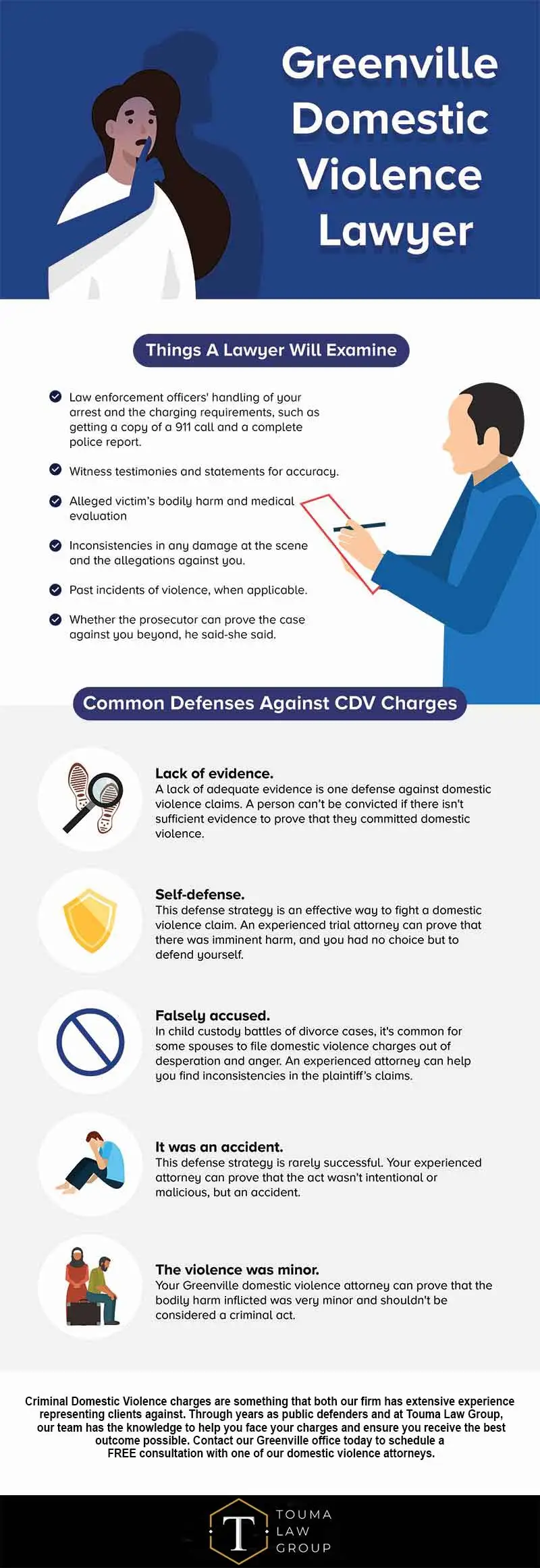
## The Severe Impact of a Domestic Violence Conviction
A domestic violence conviction in [South Carolina](https://www.scstatehouse.gov/) can have a severe impact on your life far beyond any jail sentence or fines. These consequences can include:
- **Criminal Record:** A conviction will result in a permanent criminal record, which can affect future employment, housing, and educational opportunities.
- **Jail Time and Fines:** Depending on the degree of the charge, you could face anywhere from up to 90 days in jail for third degree to up to 20 years in prison for domestic violence of a high and aggravated nature, and the lower degrees carry fines.
- **Intervention Program:** A court that suspends all or part of a sentence can require completion of a domestic violence intervention program ([S.C. Code Ann. § 16-25-20(E)](https://www.scstatehouse.gov/code/t16c025.php)).
- **Restraining Orders and No Contact Orders:** A judge may issue restraining orders or no contact orders, which can prevent you from returning to your home or having contact with the alleged domestic violence victim, impacting family law implications, child custody, and visitation rights.
- **Firearms Restrictions:** State law bars possession of a firearm or ammunition for life after a high and aggravated nature conviction, for ten years after a first degree conviction, and in some second and third degree cases for three years, and federal law can apply separately ([S.C. Code Ann. § 16-25-30](https://www.scstatehouse.gov/code/t16c025.php); [18 U.S.C. § 922(g)(9)](https://www.law.cornell.edu/uscode/text/18/922)).
- **Reputational Damage:** The social stigma associated with domestic abuse charges can damage your personal and professional relationships.
Given these severe potential consequences, securing experienced legal advice from a trusted criminal defense firm is paramount.

## Building Your Defense with a Greenville Domestic Violence Lawyer
When facing domestic violence charges, a Greenville domestic violence attorney can investigate your case, review the prosecution's evidence, and help protect your rights. Common defense strategies may include:
### False Accusations
Unfortunately, false allegations are a common reason for domestic violence charges. These can arise from heated arguments, misunderstandings, or even be used as leverage in contentious family law matters like divorce or child custody battles. Your criminal defense lawyer will examine all evidence, witness statements, and any inconsistencies to expose fabricated claims.
### Self Defense or Defense of Others
If you acted to protect yourself or another household member from imminent harm, you might have a valid claim of self-defense. Whether self-defense applies depends on the facts and the force used, and a lawyer must review the details of your case.
### Insufficient Evidence
The prosecution bears the burden of proving your guilt beyond a reasonable doubt. If there is insufficient evidence, inconsistent testimony, or a lack of credible witnesses, your defense attorney can argue for a dismissal of charges or a not guilty verdict. This often involves a thorough review of police officers' reports, forensic evidence, and any other relevant materials.
### Violation of Rights
Law enforcement officers must adhere to strict constitutional guidelines during an investigation and arrest. If your rights were violated, such as an unlawful search or seizure, or if you were interrogated without being read your Miranda rights, a criminal defense attorney can move to suppress evidence or even have the case dismissed.
### Lack of Intent or Accident
In some cases, injuries may have occurred accidentally or without malicious intent. For example, a slip or fall during an argument could result in an injury that is mistakenly perceived as domestic abuse. Your legal representation will work to present the full context of the situation and demonstrate the absence of intent to cause harm.
> **Did you know?** Touma Law Group can help with [federal criminal charges.](/greenville/federal-criminal-defense-lawyer/)
## Why Choose a Greenville Domestic Violence Defense Attorney?
Navigating domestic violence charges requires more than just legal knowledge; it demands compassionate attention and a strategic approach. Many times individuals go to court unrepresented because they unknowingly waived their rights. A dedicated Greenville domestic violence lawyer understands the local court system, judges, and prosecutors, which can be invaluable in crafting an effective defense.
From your initial consultation, a defense attorney will listen to your side of the story without judgment, providing clear legal advice and outlining your options. They will work diligently to:
- Conduct an independent investigation, gathering evidence and interviewing witnesses.
- Negotiate with prosecutors for reduced charges or alternative resolutions, such as diversion programs, especially if it's your first criminal charge.
- Challenge evidence and procedural errors.
- Prepare your case for trial, if necessary, and speak on your behalf in court.
- Help you make smart decisions throughout the legal process.
Your choice of legal services can significantly impact the outcome of your case. Don't let domestic violence charges define your future.

## Take Action Today
If you are facing domestic violence charges in Greenville, South Carolina, the time to act is now. Every moment counts in protecting your rights. [Greenville domestic violence defense attorneys](/) at Touma Law Group can review your case and explain your options.
Call our trusted criminal defense firm today at [864-618-2323](tel:+18646182323) for an initial consultation. We can review the charge and talk with you about your options. No lawyer can promise a particular outcome.
## Greenville Theft Lawyer
URL: https://toumalawgroup.com/greenville/theft-lawyer/
Overall, Greenville South Carolina is a relatively safe city. As reported by the FBI, only around 2000 violent crimes are reported each year in Greenville County, while around 1600 non-violent property crimes are reported each year, such as vehicle theft, petty theft, and larceny charges.
While this doesn’t seem like a lot, most criminal researchers agree that somewhere around 50-60% of property crimes are never reported. Because these crimes can be as simple as stealing a pack of bubble gum from a gas station, or a robbery at gunpoint, it is impossible to tell how many actual property crimes and thefts are committed each year.
Because of the global pandemic that has taken over the world in the last year, many people have found themselves in hard times. Some of those people may have turned to theft to make ends meet, and survive, not realizing the severity of the criminal penalties you can face for theft of property or other theft crimes.
Whatever your situation, there is always light at the end of the tunnel. At the Touma Law Group, our Greenville theft lawyers are dedicated to providing the people of Greenville County with experienced legal counsel for these charges and helping our clients put their past behind them, where it belongs.
## What are the Different Types of Theft Charges in South Carolina?
There are two main criminal offense theft charges, petit larceny, and [grand larceny](https://www.scstatehouse.gov/code/t16c013.php). In South Carolina, these charges are decided by the value of the stolen items. Petit larceny is a misdemeanor charge that covers any theft of $2,000 or less and comes with up to 30 days of prison time, or $1,000 in fines.
Grand larceny, which is a felony charge, covers any theft worth over $2,000. If the act of theft is valued between $2,000 and $10,000, the perpetrator can face up to 5 years in prison, and a fine decided by the judge. Anything worth over $10,000 is punishable with up to 10 years of prison time, and a fine.
While petit and grand larceny are the main theft charges in South Carolina, there is a slew of additional charges that can be added depending on the method of theft. Additional charges can include:
- Grand theft auto
- Identity theft
- Robbery
- Armed robbery
- Shoplifting
- Writing bad checks or bank fraud
- Fraud, including social security fraud
- Embezzlement
- Theft of services
All of these various, additional theft crime charges carry harsher penalties than larceny, and these additional penalties can add years onto your expected jail time, as well as thousands, up to millions, of dollars in fines and reparations.
## Can I Fight a Theft Charge?
There are many options when it comes to fighting back against theft charges, whether you are facing a petty theft charge, or a grand larceny charge. For a criminal complaint of larceny, prosecutors must prove that the defendant stole something they knew didn’t belong to them, they did not have permission to take that item, and they had no intention of returning the item(s). The job of a criminal defense team is to disprove at least one of these three claims.
The route your defense counsel takes is dependent on your charges and the circumstances of your criminal complaint. Your defense lawyer could argue that you had good reason to believe that the item(s) you took either belonged to you, or you had permission to take them. An experienced theft attorney may also argue that you were under duress while committing the crime and that you only committed the theft or crime under threat of bodily harm or blackmail.
The last common defense is entrapment. In these cases, your attorney will argue that you only committed the crime under the encouragement or pressure of law enforcement, who were trying to trick you into committing a crime. For this defense, it is imperative that you and your defense team are able to prove that you would not have committed the alleged crime without the pressure and encouragement from the law enforcement officer you are accusing of entrapment. In these cases, it is imperative that you do not have prior arrests, charges, or convictions for similar crimes.
> **Learn More**: [Greenville Juvenile Crime Attorney](/greenville/juvenile-criminal-defense-lawyer/)
## We’re Here to Help You Fight Your Charge
Theft conviction, or theft charges, may feel like the end of the world, but there is always hope for a positive outcome. If this is your first misdemeanor offense, or even just your first theft offense, an experienced criminal defense attorney may be able to talk the judge into a light sentence, which may not involve any days in jail or a lighter prison sentence, and could consist of only parole and fines, or a mixture of all three.
For those facing felony criminal charges, there are still options to get your life back on track after you serve your time, and no matter your crime you may be able to clear your criminal record after completing your sentence, through expungement.
Whatever your circumstances, there is nothing more important than getting legal advice, based on extensive experience, from a [criminal defense attorney in Greenville](/greenville/criminal-defense-lawyer/). At the law offices of Touma Law Group, our goal is the lightest sentences possible through a strong defense strategy.
## Greenville Criminal Defense Lawyer
URL: https://toumalawgroup.com/greenville/criminal-defense-lawyer/
If you or a loved one has been arrested or charged with a criminal offense, you need a dedicated Greenville criminal defense lawyer who can protect your rights and explain your legal options from day one.
At Touma Law Group, our experienced criminal defense team works closely with clients throughout South Carolina, helping them understand the charges they face, whether it involves fines, license suspension from a DUI, probation, community service, or potential prison time. We take a strategic approach based on the evidence presented by the solicitor’s office and fight for the best possible result. Our experience in South Carolina Criminal Defense cases allows us to tailor a strategic defense plan suited to your exact situation.
Our firm has successfully defended individuals across the state charged with offenses including drug possession, domestic violence, sex crimes, assault, traffic violations, and more. We know that facing any type of crime can be a difficult time for individuals and their families, especially when dealing with felony offenses that carry the risk of long jail time. With a long record of securing favorable outcomes, we offer game-changing representation for those in need.
Call Touma Law Group today at [(864) 618-2323](tel:+18646182323) for a free consultation with a Greenville criminal defense attorney.
## Can I Afford a Criminal Defense Attorney in Greenville?
If this is your first run-in with the law, you might be tempted to take a plea deal the solicitor’s office offers, especially if they claim they have enough evidence against you. But remember: their goal isn’t to protect your rights, it’s to close cases quickly.
Prosecutors and law enforcement are not obligated to tell you if their case is weak. Many use intimidation tactics to push plea deals, even when the criminal offense may not hold up in court. These deals may result in a lesser offense, but without legal guidance, you could still face serious consequences.
> Related Content: [First-Time DUI in South Carolina](/first-time-dui/)
At Touma Law Group, our role is to evaluate the case objectively, review the evidence, and identify potential defenses to reduce or dismiss your charges. You can’t afford not to have legal representation; your constitutional rights, criminal record, and freedom are on the line. Our legal team takes pride in offering a clear understanding of the criminal justice process, ensuring that your legal rights are fully protected every step of the way.

## Why You Need a Greenville Criminal Defense Lawyer
Trying to defend yourself in a criminal case is like trying to do your own surgery; it’s dangerous and can end badly. Criminal cases are serious and often very complex. The rules, the procedures, and the pressure can feel overwhelming. One small mistake could lead to jail time, a ruined reputation, or consequences that follow you for the rest of your life.
That’s why working with a criminal defense attorney is one of the most important decisions you can make. A skilled lawyer knows how to handle every part of the legal process. They understand how the court system works, how to talk to judges and prosecutors, and how to present your side of the story clearly and strongly.
A skilled criminal defense attorney understands:
- How to navigate courtroom procedures
- How to communicate with judges and prosecutors
- How to present compelling arguments and evidence
- How to identify weaknesses in the prosecution’s case
> Know Your Rights: [When Can a Cop Search Your Car in South Carolina?](/cop-search-your-car-in-south-carolina/)
When you’re in a complicated situation, having the right legal help can make all the difference. A good attorney doesn’t just react; they plan ahead. They focus on creating the strongest defense possible, one that’s based on your unique circumstances.
We take the time to look closely at every piece of information, and we don’t miss the small details that could matter. Our goal is to help you get through this challenge and work toward the most positive outcome we can achieve, so you can move forward with your life.
> Learn More: [South Carolina Underage DUI Charges](/underage-dui/)
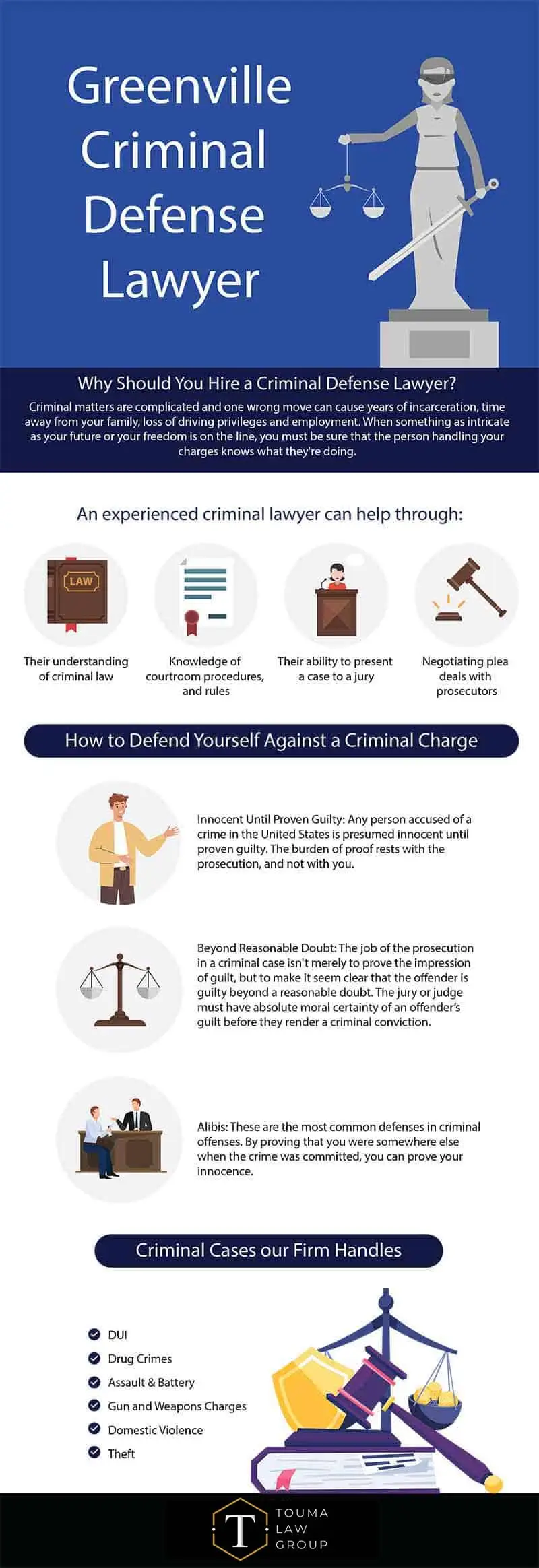
## When to Hire a Criminal Defense Attorney in South Carolina
The sooner you take action, the better. If you’ve been arrested, are being investigated, or have already been charged with a crime, getting a lawyer involved early is one of the smartest things you can do. It gives your legal team the chance to build a robust defense before important evidence disappears or before anything you say can be used against you.
If you’re dealing with any of the following charges in South Carolina, don’t wait—reach out to our team right away:
- Assault or any other criminal defense matters
- DUI or drug-related charges
- Domestic violence or other violent crimes
- Theft, robbery, or sex-related offenses
> FAQ: [Do I Need a Lawyer for Drug Charges in Greenville?](/lawyer-for-drug-charges-in-greenville/)
Many people don’t realize how quickly the criminal justice system moves. Things can happen fast, and if you’re not prepared, you could miss your chance to fight back. Our job is to fully understand your exact situation so we can put together a strategic defense plan that fits your case and protects your rights.
If you’re facing felony offenses, the stakes are even higher. These charges can carry serious penalties, including long prison sentences and a permanent mark on your record. But with a strong, early defense, you’ll be in the best position to get the best possible outcome.
## Common Defense Strategies for Criminal Charges
Every criminal case is different, and the right approach depends on the specific facts and circumstances involved. That’s why a personalized defense is so important. At Touma Law Group, we take the time to understand your side of the story and examine every detail of the case against you. While no two situations are exactly alike, there are several proven strategies that criminal defense attorneys commonly use to challenge charges and protect their clients’ rights. Some of the most effective and widely used defenses include:
### 1\. Presumption of Innocence
In the United States, you’re innocent until proven guilty, and the burden of proof falls entirely on the prosecution. This key principle of the criminal justice process ensures that no one can be punished without strong, reliable evidence. It protects your rights by requiring the government to prove every element of the case beyond a reasonable doubt. A skilled criminal defense attorney uses this standard to challenge weak or flawed evidence, making sure your rights are upheld and helping you pursue the most favorable outcome possible.
### 2\. Reasonable Doubt
A conviction in any criminal case requires proof beyond a reasonable doubt, which is the highest legal standard in the justice system. This means the prosecution must present clear and convincing evidence that leaves no reasonable doubt about your guilt. If there are gaps, inconsistencies, or unanswered questions in the prosecution’s case, your criminal defense lawyer can use those weaknesses to raise doubt in the minds of the judge or jury. Highlighting this uncertainty can be a powerful tool in securing a dismissal, a reduced charge, or avoiding jail time altogether. In many cases, casting reasonable doubt is the cornerstone of a strong and effective defense strategy.

### 3\. Alibis
If you were in a different location when the crime took place, presenting a solid alibi can be one of the strongest defenses available. Evidence like receipts, surveillance video, GPS data, or witness statements can clearly show that you couldn’t have committed the crime. A well-supported alibi helps your criminal defense attorney create a clear and convincing timeline that proves your innocence. When this kind of documentation is consistent and detailed, it can be highly persuasive to a judge or jury and may lead to dropped charges or an acquittal.
### 4\. Constitutional Violations
If your rights were violated at any point during your arrest, such as through an illegal search, seizure, or lack of proper procedure, your criminal defense attorney can file a motion to suppress any evidence that was obtained unlawfully. When key evidence is thrown out, it can significantly weaken the prosecution’s case. Protecting your constitutional rights is a vital part of building a strong defense, and holding law enforcement accountable can lead to reduced charges or even a full dismissal, especially if the case relied heavily on that evidence.
> **Related Content**: [Greenville Juvenile Crimes Lawyer](/greenville/juvenile-criminal-defense-lawyer/)
Your Touma Law Group criminal defense team will analyze every detail of your case to determine the best approach. We believe in equality in defense and treat every client with respect, care, and diligence, especially during what is often an extremely difficult time in their lives.
## A Law Firm Committed to Justice Across South Carolina
We proudly serve clients throughout Greenville and across South Carolina, including those facing charges in federal courts. Whether you’re seeking Conduct Defense or simply don’t know where to start, we’re here to guide you with honesty and strength.
> Be Prepared: [What to Do After a DUI in Greenville](/after-a-dui-in-greenville/)
Our firm understands the challenges of navigating the legal system alone. Having a dedicated team that knows the ins and outs of South Carolina Criminal Defense gives you peace of mind. When the stakes are high, choosing the right lawyer can be the difference between conviction and positive outcomes.
## Contact Touma Law Group Today
Don’t risk your future by facing the system alone. At Touma Law Group, our seasoned team is here to protect your rights, provide clarity, and fight for the outcome you deserve.
Whether you’re preparing for trial, navigating bond hearings, or facing formal charges, our attorneys will walk with you every step of the way. We understand how overwhelming this time can be and are here to support you with clear advice and aggressive representation.
Call now at [(864) 618-2323](tel:+18646182323) for a free case evaluation with a trusted criminal defense lawyer in Greenville, South Carolina.
## Greenville Assault and Battery Lawyer
URL: https://toumalawgroup.com/greenville/assault-and-battery-lawyer/
In everyday speech, assault means threatening or attempting to hurt someone, and battery means actually making harmful or offensive contact. South Carolina does not charge them as two separate offenses. Its statute, [S.C. Code Ann. § 16-3-600](https://www.scstatehouse.gov/code/t16c003.php), defines four levels of assault and battery based on what the person did and how serious the injury was or could have been. The older common law offenses of simple assault and aggravated assault were abolished for offenses committed on or after June 2, 2010 ([2010 Act No. 273, Section 7.B](https://www.scstatehouse.gov/sess118_2009-2010/bills/1154.htm)).
- Third degree assault and battery: a misdemeanor, up to 30 days in jail, a fine of up to $500, or both
- Second degree assault and battery: a misdemeanor, up to 3 years in jail, a fine of up to $2,500, or both
- First degree assault and battery: a felony, up to 10 years in prison
- Assault and battery of a high and aggravated nature: a felony, up to 20 years in prison
Assault and battery of a high and aggravated nature applies when a person unlawfully injures another person and great bodily injury results, or when the act is accomplished by means likely to produce death or great bodily injury. A person who, with intent to kill, attempts to kill another with malice aforethought can be charged separately with attempted murder, a felony punishable by up to 30 years with no suspension and no probation ([S.C. Code Ann. § 16-3-29](https://www.scstatehouse.gov/code/t16c003.php)). Criminal sexual conduct, including what many people call rape, is charged under its own statutes and not as assault and battery ([S.C. Code Ann. §§ 16-3-651 to 16-3-659.1](https://www.scstatehouse.gov/code/t16c003.php)).
Third degree and second degree are misdemeanors under the statute. First degree and the high and aggravated nature offense are felonies.
## What if Battery Does Not Cause Bodily Harm?
An injury is not always required. Third degree assault and battery covers a person who unlawfully injures another person or who offers or attempts to injure another person with the present ability to do so. Second degree covers cases in which moderate bodily injury results or could have resulted, and cases that involve the nonconsensual touching of the private parts of a person, either under or above clothing ([S.C. Code Ann. § 16-3-600](https://www.scstatehouse.gov/code/t16c003.php)).
When the other person is a household member, the conduct is charged under the domestic violence statute instead. South Carolina defines a household member as a spouse, a former spouse, a person with whom you have a child in common, or a male and female who are cohabiting or formerly have cohabited ([S.C. Code Ann. § 16-25-10](https://www.scstatehouse.gov/code/t16c025.php)). In [Doe v. State, Opinion No. 27728 (S.C. Nov. 17, 2017)](https://www.sccourts.org/media/opinions/htmlfiles/SC/27728.pdf), the South Carolina Supreme Court declared that definition unconstitutional as applied to an unmarried same-sex couple who lived together, and held that the family court may not use it to keep people in similar relationships from seeking an order of protection. The Court did not rewrite the statute, and the Code still reads "a male and female," so whether a particular relationship is covered in a criminal case is a question for an attorney. A person holding family members at gunpoint, for example, can face charges under [S.C. Code Ann. § 16-25-20](https://www.scstatehouse.gov/code/t16c025.php) and the firearm statutes, whether or not anyone is hurt. Our page on [firearm charges](/greenville/weapons-gun-charges-lawyer/) explains the weapons side.
## What if the Alleged Victim Is a Child, an Older Adult or a Household Member?
Different statutes can apply depending on who is involved. Harm to a household member is charged under the domestic violence statutes, which provide for up to 20 years for domestic violence of a high and aggravated nature ([S.C. Code Ann. § 16-25-65](https://www.scstatehouse.gov/code/t16c025.php)). The list of violent crimes in [S.C. Code Ann. § 16-1-60](https://www.scstatehouse.gov/code/t16c001.php) also names inflicting great bodily injury upon a child, abuse or neglect of a vulnerable adult resulting in great bodily injury or death, and armed robbery. Those are separate offenses with their own statutes and penalties, and a lawyer must review the exact statute named in a warrant or indictment.

## What if You Have Been Incorrectly Charged?
The facts alleged, and not only the label on the warrant, decide which degree applies. The statute turns on whether great bodily injury or moderate bodily injury resulted or could have resulted, whether the act was accomplished by means likely to produce death or great bodily injury, and whether it happened during a robbery, burglary, kidnapping or theft ([S.C. Code Ann. § 16-3-600](https://www.scstatehouse.gov/code/t16c003.php)). The State must prove each element of the charged degree beyond a reasonable doubt.
Each lesser degree is a lesser-included offense of the more serious ones, so a person charged with a higher degree can be convicted of a lower one instead. A lawyer can compare the facts in the warrant or indictment with the statute and the evidence, and can look at whether the charge fits what the evidence shows. If you think the charge is higher than it should be, or you believe the accusation is false, speak with a licensed [criminal defense attorney in Greenville](/greenville/criminal-defense-lawyer/) as soon as possible.
## What to do if You are Arrested for Assault and Battery
Your case begins the moment you are read your rights and arrested. Anything you say can be used against you in court ([Miranda v. Arizona, 384 U.S. 436 (1966)](https://www.law.cornell.edu/supremecourt/text/384/436)). If you are arrested for alleged assault or battery, you can exercise your right to remain silent.
You may be asked for basic information such as your name or your ID, but you are not required to answer questions about the case. If officers ask you questions, you can politely say that you wish to remain silent and would like to speak to an attorney.

While you do not have to answer questions, you should obey the lawful orders of the arresting officers. Refusing to follow lawful orders can lead to additional charges, such as resisting arrest ([S.C. Code Ann. § 16-9-320](https://www.scstatehouse.gov/code/t16c009.php)), and can give the prosecution evidence to use against you in court.
You should, however, stay alert and take in what you can. Anything you remember or notice, such as cameras that may have recorded the incident or people who may have witnessed it, can help your attorney review your case.
## Let Us Work for You
Touma Law Group is a criminal defense law firm that handles assault and battery cases. During your initial consultation, we will listen to your story, look at the evidence you have gathered, explain how the process works in South Carolina, and discuss possible defenses and your options, including whether a plea offer is worth considering. No lawyer can promise a particular result, and the right approach depends on the facts and the charge.
At Touma Law Group we know that these criminal charges are serious and that a conviction can affect your criminal record. An arrest for assault does not have to be the end of the story. A lawyer can explain the charge and what the law says about your options.
## Columbia Appellate Lawyer
URL: https://toumalawgroup.com/columbia/appellate-lawyer/
The appellate process can be complex, with strict rules and short deadlines. In South Carolina, a notice of appeal from a criminal conviction must be served within 10 days after the sentence is imposed ([SCACR Rule 203(b)(2)](https://www.sccourts.org/resources/judicial-community/court-rules/appellate/rule-203/)). Our law firm can help you understand your options for appealing a conviction or sentence in a South Carolina state court.
Whether you are considering an appeal of a lower court decision or need to respond to an appeal filed by the other side, our team can explain the process and help you decide on your next steps. The State may appeal only in limited circumstances, such as certain pre-trial orders (SCACR Rule 203(b)(2)). A licensed South Carolina attorney at our firm must review the facts of your case before you rely on general information like this.
If you are facing an appellate matter in Columbia, don't navigate the process alone. Contact our [Columbia criminal defense lawyers](/columbia/criminal-defense-lawyer/) today to schedule a consultation and learn how we can help you understand the appellate process.
Call our office at [(803) 879-4499](tel:+18038794499) to schedule a free consultation, review your case, and discuss your options for an appeal.
## How an Appeal Works in South Carolina
The criminal appellate process in South Carolina is a review of what happened in the trial court. If you are unhappy with the outcome of a plea or trial, the first step is a notice of appeal, which must be served within a short, fixed time after the sentence is imposed (see below). The appellate court then reviews the record from the lower court, which includes transcripts, exhibits, and the rulings made. The record on appeal cannot include matter that was not presented to the lower court ([SCACR Rule 210(c)](https://www.sccourts.org/resources/judicial-community/court-rules/appellate/rule-210/)).

The South Carolina Court of Appeals' jurisdiction is appellate only ([S.C. Code Ann. § 14-8-200](https://www.scstatehouse.gov/code/t14c008.php)). On appeal, the appellant's brief must set out the issues presented for review, and ordinarily no point will be considered that is not set forth in the statement of issues ([SCACR Rule 208(b)(1)(B)](https://www.sccourts.org/resources/judicial-community/court-rules/appellate/rule-208/)). The appellate court may affirm, reverse, or modify the decision below, or remand all or any issues for further proceedings ([SCACR Rule 220(a)](https://www.sccourts.org/resources/judicial-community/court-rules/appellate/rule-220/)). You can find the court's own information at the [South Carolina appellate courts](https://www.sccourts.org/appeals/) page.
## What an Appeals Lawyer Does
During an appeal of a criminal conviction, an attorney can play several roles:
1. **Reviewing the Trial Record:** The attorney examines the record, including transcripts, evidence, motions, and rulings, to identify possible errors or legal issues that could form the basis of the appeal.
2. **Researching Legal Issues:** The attorney researches the statutes, rules, and cases that apply to your case to identify arguments and grounds for appeal.
3. **Drafting Appellate Briefs:** Attorneys prepare written briefs setting out the issues presented for review and the legal arguments on each one. These briefs are filed with the appellate court.
4. **Oral Arguments:** In some cases, the court may hear oral argument. At argument, the attorney responds to questions from the judges and clarifies points raised in the briefs.
5. **Representing the Client's Interests:** Throughout the appeal, the attorney explains each step to you and protects your rights, including the filing deadlines.
## Why Should You Hire an Attorney for an Appeals Case
Criminal appeals involve rules and deadlines that are different from those at trial. A lawyer who works with those rules can explain which deadlines apply to your case and what an appeal can and cannot do.
A lawyer can also review the trial record to identify issues that may have been preserved for appeal. Because ordinarily no point will be considered that is not set forth in the statement of issues, the way the issues are framed in the brief matters. Without a lawyer, you risk overlooking a deadline or making a procedural mistake that could jeopardize your appeal.
An appeal can also be a stressful time. A lawyer can answer your questions about the process, tell you what to expect at each stage, and keep you informed.
An appeal does not guarantee a particular result. If you are considering an appeal or have already begun the process, speak with a licensed attorney who can review the record and your deadlines.
## What to Expect From the Criminal Appeals Process
Here is an overview of how a criminal appeal from a South Carolina circuit court generally works. The deadlines are short, and they differ by court.
1. **Serve and File a Notice of Appeal**: After a plea or trial resulting in conviction, a notice of appeal must be served on all respondents within 10 days after the sentence is imposed. If a timely post-trial motion is made under Rule 29(a) of the South Carolina Rules of Criminal Procedure, the time to appeal is stayed and begins to run from receipt of written notice of the order granting or denying the motion ([SCACR Rule 203(b)(2)](https://www.sccourts.org/resources/judicial-community/court-rules/appellate/rule-203/)). The notice of appeal must then be filed with the clerk of the lower court and the clerk of the appellate court within 10 days after it is served, and if it is not timely filed, the appeal is dismissed ([SCACR Rule 203(d)](https://www.sccourts.org/resources/judicial-community/court-rules/appellate/rule-203/)). If the appeal is from a guilty plea, the notice must be accompanied by a written explanation showing an issue that can be reviewed on appeal (SCACR Rule 203(d)(1)(B)(iv)).
2. **Order the Transcript**: The transcript of a General Sessions proceeding must be ordered within 30 days after the notice of appeal is served ([SCACR Rule 207(a)(1)](https://www.sccourts.org/resources/judicial-community/court-rules/appellate/rule-207/)).
3. **Identify Grounds for Appeal**: Work with your attorney to identify the issues for review, such as legal errors, constitutional violations, or insufficient evidence to support the conviction.
4. **Prepare Appellate Briefs**: Your attorney prepares briefs that present the legal authorities and arguments supporting your appeal.
5. **Oral Argument**: In some cases, the court may schedule oral argument.
6. **Await the Court's Decision**: The appellate court may affirm, reverse, or modify the decision, or remand for further proceedings (SCACR Rule 220(a)). After the Court of Appeals rules, a petition for rehearing must be received within 15 days after the opinion is filed ([SCACR Rule 221(a)](https://www.sccourts.org/resources/judicial-community/court-rules/appellate/rule-221/)). A petition for a writ of certiorari to the Supreme Court is due within 30 days after the petition for rehearing is finally decided, and the Court grants it only where there are special and important reasons ([SCACR Rule 242](https://www.sccourts.org/resources/judicial-community/court-rules/appellate/rule-242/)).
Most criminal appeals from the circuit court are filed with the Court of Appeals, and an appeal from a judgment that includes a sentence of death is filed with the Supreme Court (SCACR Rule 203(d)(1)(A)). Federal court deadlines are different. In federal court, a defendant's notice of appeal must be filed in the district court within 14 days after the entry of the judgment or order being appealed ([Fed. R. App. P. 4(b)](https://www.law.cornell.edu/rules/frap/rule_4)). If your case is in federal court, ask us whether our firm can handle your appeal before you rely on this page.
The outcome of an appeal is not guaranteed, and the process can be complex. If you are considering appealing a criminal conviction in South Carolina, consult with a licensed attorney to discuss your options.
## Contact Our Firm About the Appeals Process
Talking with a Columbia criminal appeals attorney can help you understand your deadlines and your options after a conviction. An appeals attorney can review the trial record, identify legal issues, and draft the appellate briefs.
If you are facing the prospect of an appeal in a criminal case, call our Columbia office at [(803) 879-4499](tel:+18038794499) or [contact us](/contact/) today.
## Columbia White Collar Crime Lawyer
URL: https://toumalawgroup.com/columbia/white-collar-crime-lawyer/
White collar charges may not involve physical violence, but the consequences can still be life-changing. Allegations like embezzlement, fraud, or identity theft can lead to fines, imprisonment, and a damaged reputation, both personally and professionally. If you're being investigated or have already been charged, it's important to act quickly to protect your future.
An experienced white collar crime lawyer in Columbia can guide you through every step of the legal process and prepare a defense on your behalf. Call Touma Law at [(803) 879-4499](tel:+18038794499) today to schedule a confidential consultation and get the help you need to understand your situation.
## What Is Considered a White Collar Crime in South Carolina?
White collar crimes are non-violent offenses typically motivated by financial gain. These crimes are committed by individuals in professional settings or positions of trust, often involving deceit or manipulation. Both South Carolina law and federal law address them. Common examples include:
- **Fraud**: This involves intentionally deceiving another party to gain a financial benefit. Federal statutes include mail fraud ([18 U.S.C. § 1341](https://www.law.cornell.edu/uscode/text/18/1341)) and wire fraud ([18 U.S.C. § 1343](https://www.law.cornell.edu/uscode/text/18/1343)), each punishable by imprisonment of not more than 20 years, or not more than 30 years and a fine of not more than $1,000,000 if the violation affects a financial institution or involves benefits tied to a declared major disaster or emergency. Bank fraud ([18 U.S.C. § 1344](https://www.law.cornell.edu/uscode/text/18/1344)) carries a fine of not more than $1,000,000 or imprisonment of not more than 30 years, or both. Health care fraud ([18 U.S.C. § 1347](https://www.law.cornell.edu/uscode/text/18/1347)) carries imprisonment of not more than 10 years, increasing to 20 years if serious bodily injury results, and securities and commodities fraud ([18 U.S.C. § 1348](https://www.law.cornell.edu/uscode/text/18/1348)) carries imprisonment of not more than 25 years. In South Carolina, obtaining a signature or property by false pretense with intent to cheat and defraud is a crime under [S.C. Code Ann. § 16-13-240](https://www.scstatehouse.gov/code/t16c013.php), and presenting a false claim for payment to an insurer is a crime under [§ 38-55-170](https://www.scstatehouse.gov/code/t38c055.php). Under both South Carolina statutes, the offense is a felony when the amount is more than $2,000 and a misdemeanor when it is $2,000 or less, and the maximum prison term for a felony is five years when the amount is less than $10,000 and ten years when it is $10,000 or more.
- **Embezzlement**: The misappropriation or theft of funds entrusted to one's care, typically by an employee or official. South Carolina addresses embezzlement of public funds in [S.C. Code Ann. § 16-13-210](https://www.scstatehouse.gov/code/t16c013.php), which is a felony punishable by imprisonment of not more than ten years if the amount is $10,000 or more and not more than five years if it is less than $10,000. A breach of trust with fraudulent intent is treated as larceny under [§ 16-13-230](https://www.scstatehouse.gov/code/t16c013.php), which is a misdemeanor if the amount is $2,000 or less, a felony punishable by up to five years if the amount is more than $2,000 but less than $10,000, and a felony punishable by up to ten years if the amount is $10,000 or more. Federal law also covers theft or bribery involving organizations and governments that receive more than $10,000 a year in federal program benefits, where the property or transaction involved is worth $5,000 or more, with imprisonment of not more than 10 years under [18 U.S.C. § 666](https://www.law.cornell.edu/uscode/text/18/666).
- **Identity theft**: The act of obtaining and using someone's personal information without permission, usually for financial gain. Under [S.C. Code Ann. § 16-13-510](https://www.scstatehouse.gov/code/t16c013.php), financial identity fraud and identity fraud are felonies punishable by a fine in the discretion of the court, imprisonment of not more than ten years, or both, and the court may order restitution to the victim. Federal law, [18 U.S.C. § 1028](https://www.law.cornell.edu/uscode/text/18/1028), also prohibits knowingly transferring, possessing, or using a means of identification of another person without lawful authority with intent to commit, or in connection with, unlawful activity. Depending on the circumstances, that offense carries imprisonment of not more than 5 years, or not more than 15 years if the person obtains anything of value aggregating $1,000 or more during any one-year period, and higher maximums apply in certain other circumstances.
- **Forgery**: Creating, altering, or using documents with the intent to defraud. [S.C. Code Ann. § 16-13-10](https://www.scstatehouse.gov/code/t16c013.php) covers falsely making, forging, or counterfeiting a writing, and uttering or publishing as true a forged writing, with an intention to defraud. The offense is a felony punishable by imprisonment of not more than ten years if the amount of the forgery is $10,000 or more, and not more than five years if it is less than $10,000. If the forgery does not involve a dollar amount, it is a misdemeanor punishable by imprisonment of not more than three years.
- **Money laundering**: Money laundering is addressed by federal law. [18 U.S.C. § 1956](https://www.law.cornell.edu/uscode/text/18/1956) applies to certain financial transactions involving the proceeds of specified unlawful activity, undertaken with intent to promote that activity or knowing that the transaction is designed to conceal the proceeds or avoid a reporting requirement, and carries a fine of not more than $500,000 or twice the value of the property involved, or imprisonment of not more than twenty years, or both. [18 U.S.C. § 1957](https://www.law.cornell.edu/uscode/text/18/1957) applies to monetary transactions in criminally derived property of a value greater than $10,000 and carries imprisonment of not more than ten years. Under [18 U.S.C. § 982(a)(1)](https://www.law.cornell.edu/uscode/text/18/982), a court sentencing a person convicted under §§ 1956 or 1957 shall order forfeiture of property involved in the offense.
- **Bribery or corruption**: Offering or accepting bribes to influence public officials. [S.C. Code Ann. § 16-9-210](https://www.scstatehouse.gov/code/t16c009.php) punishes corruptly giving or offering a gift to an executive, legislative, or judicial officer with intent to influence an official act by imprisonment of up to five years, or a fine of up to $3,000 and imprisonment of up to one year in jail. Under [§ 16-9-220](https://www.scstatehouse.gov/code/t16c009.php), an officer who corruptly accepts a gift or promise in exchange for a particular vote, opinion, or judgment is subject to imprisonment of up to ten years, or a fine of up to $5,000 and up to two years in jail, and must forfeit the office and is disqualified from holding any public office. Federal bribery of public officials is addressed in [18 U.S.C. § 201](https://www.law.cornell.edu/uscode/text/18/201), which provides for imprisonment of not more than fifteen years for the offenses in subsection (b).
Each of these statutes sets its own penalties, and for many of them the penalty depends on the dollar amount involved. A conviction can carry significant legal consequences, so it is important to understand the specific statute you are charged under.
## How Are White Collar Crimes Investigated?
White collar crimes are often complex and can involve lengthy investigations by both state and federal authorities. Because these offenses typically involve financial transactions, business records, or digital communications, agencies rely on detailed evidence-gathering and coordination across multiple departments.
Law enforcement task forces may lead or assist in white collar investigations. These may include local police, state investigators, the FBI, or other federal law enforcement agencies. Task forces are especially common when multiple jurisdictions are involved.
Agencies like the Internal Revenue Service (IRS) and the U.S. Postal Inspection Service may also be involved when conduct involves taxes or the mail. The Securities and Exchange Commission (SEC) can bring civil actions in federal district court to enjoin violations of the securities laws, and under [15 U.S.C. § 78u(d)](https://www.law.cornell.edu/uscode/text/15/78u) it may transmit evidence to the Attorney General, who may in his discretion institute criminal proceedings.
Investigators often use subpoenas to obtain bank records, emails, business contracts, or other documents. They may also conduct interviews, audit financial systems, and analyze large amounts of digital data. Forensic accountants and technology experts are commonly brought in to trace money movement or uncover deleted files.
Because of the technical and financial nature of these cases, investigations can be lengthy.
## Can White Collar Crimes Be Charged in Federal Court?
Yes, white collar crimes can be charged in federal court. Federal statutes such as mail fraud, wire fraud, bank fraud, health care fraud, securities fraud, and money laundering apply to financial conduct, and federal offenses are prosecuted by United States Attorneys under [28 U.S.C. § 547](https://www.law.cornell.edu/uscode/text/28/547). Certain factors determine whether a white collar [crime will be prosecuted at the state or federal level](/federal-vs-state-charges/). A federal charge depends on whether a federal statute applies, including:
- **Interstate or international elements**: Some federal statutes include an interstate or international element. Wire fraud under [18 U.S.C. § 1343](https://www.law.cornell.edu/uscode/text/18/1343), for example, requires a transmission by wire, radio, or television communication in interstate or foreign commerce for the purpose of executing a scheme to defraud, and mail fraud under [18 U.S.C. § 1341](https://www.law.cornell.edu/uscode/text/18/1341) involves the Postal Service or a private or commercial interstate carrier.
- **Financial institutions and federal programs**: Some federal statutes apply because of the victim or the funds involved. Bank fraud under [18 U.S.C. § 1344](https://www.law.cornell.edu/uscode/text/18/1344) concerns schemes to defraud a financial institution or to obtain property under its custody or control, and [18 U.S.C. § 666](https://www.law.cornell.edu/uscode/text/18/666) concerns theft or bribery involving an organization, government, or agency that receives more than $10,000 in federal program benefits in a one-year period.
- **Federal statutes**: Some white collar crimes are specifically governed by federal laws, such as wire fraud, bank fraud, health care fraud, and securities fraud, as described above.
### Impact on Potential Penalties and Case Complexity
[Federal charges](/what-to-do-if-charged-with-federal-crime/) carry the penalties set by the federal statute charged, which can be substantial, as the examples above show. In federal court, a judge considers the U.S. Sentencing Guidelines, which are advisory under [United States v. Booker, 543 U.S. 220 (2005)](https://www.law.cornell.edu/supremecourt/text/04-104), and must consider the factors in [18 U.S.C. § 3553(a)](https://www.law.cornell.edu/uscode/text/18/3553). Federal law also provides for forfeiture in some cases, including under [18 U.S.C. § 982](https://www.law.cornell.edu/uscode/text/18/982).
Federal financial cases can involve extensive records, expert testimony, and coordination among agencies. The process may involve lengthy investigations and the potential for federal agencies to pursue multiple related charges.

Because the charge, the statute, and the court all affect what a person faces, it is important to have experienced legal representation.
## What Legal Defenses Can Be Used Against White Collar Crime Charges?
When facing white collar crime charges, several legal defenses can be used to challenge the prosecution's case. The defenses that apply depend on the facts and the statute charged. Here are some common approaches:
### Lack of Intent or Knowledge
Many white collar offenses require proof of intent or knowledge. For example, the federal bank fraud statute applies to a person who "knowingly executes" a scheme to defraud a financial institution ([18 U.S.C. § 1344](https://www.law.cornell.edu/uscode/text/18/1344)), health care fraud requires that the person act "knowingly and willfully" ([18 U.S.C. § 1347](https://www.law.cornell.edu/uscode/text/18/1347)), and South Carolina's false pretenses statute requires "intent to cheat and defraud" ([S.C. Code Ann. § 16-13-240](https://www.scstatehouse.gov/code/t16c013.php)). If a defendant did not have the necessary intent or knowledge, that can be a defense.
In cases of insurance fraud, the defendant may argue that they did not intend to deceive anyone or that they were unaware of the fraudulent nature of their actions. If a mistake in paperwork or miscommunication led to the alleged crime, they may argue that it was unintentional.
### Insufficient Evidence
Another common defense is challenging the sufficiency of the evidence presented by the prosecution. The Due Process Clause protects the accused against conviction except upon proof beyond a reasonable doubt of every fact necessary to constitute the crime charged ([In re Winship, 397 U.S. 358 (1970)](https://www.law.cornell.edu/supremecourt/text/397/358)). This defense may be relevant if the prosecution's case is based on circumstantial evidence or if key evidence is missing or unreliable.
If there is no clear documentation or physical evidence linking the defendant to the crime or if the evidence is based on unreliable witness testimony, the defense may argue that the prosecution has failed to prove the case beyond a reasonable doubt.
### Mistaken Identity or False Accusations
Mistaken identity or false accusations can also be used as a defense. In white collar crime cases, especially those involving complex financial transactions, investigators can link the wrong person to a transaction. A defendant may argue that they were mistakenly linked to the crime or that they were not involved in the alleged fraudulent activity at all.
If someone else had access to the company's accounts or if the defendant's name was mistakenly linked to fraudulent transactions, a defense of mistaken identity or false accusations might be raised.
### Unlawful Search or Seizure of Financial Records
The Fourth Amendment protects the right of the people to be secure in their persons, houses, papers, and effects against unreasonable searches and seizures, and provides that no warrants shall issue but upon probable cause ([U.S. Const. amend. IV](https://www.law.cornell.edu/constitution/fourth_amendment)). If law enforcement violated the defendant's constitutional rights, the defense may file a pretrial motion to suppress evidence, which in federal court is raised under [Fed. R. Crim. P. 12(b)(3)](https://www.law.cornell.edu/rules/frcrmp/rule_12). This may be relevant in white collar cases, where evidence often involves financial records, emails, and other private documents.
If the authorities searched the defendant's office or personal devices without a warrant or proper legal justification, the defense may argue that the evidence obtained in that manner should be excluded from trial.
These defenses can be used individually or in combination, depending on the circumstances of the case. Working with an [experienced Columbia defense attorney](/columbia/criminal-defense-lawyer/) can help determine the strategy for challenging the charges and protecting the defendant's rights.
## How Can a White Collar Crime Lawyer Help?
A white collar crime lawyer can play an important role in protecting someone facing charges. Here's how a defense attorney can help:
### Intervening Early in Investigations
One of the important ways a white collar crime lawyer can help is by getting involved early in the investigation process. When someone is under investigation for a white collar crime, having legal representation at the outset can help avoid potential pitfalls.

A lawyer can protect the client's rights and advise the client on how to respond to questions from investigators, including the right not to be compelled to be a witness against oneself under the Fifth Amendment ([U.S. Const. amend. V](https://www.law.cornell.edu/constitution/fifth_amendment)).
### Communicating with Prosecutors
A white collar crime lawyer can also communicate with prosecutors on behalf of a client. In federal court, a plea agreement can include terms such as the government agreeing not to bring, or to dismiss, other charges, or to recommend or agree to a particular sentence or sentencing range, as described in [Fed. R. Crim. P. 11(c)](https://www.law.cornell.edu/rules/frcrmp/rule_11). A lawyer can explain what an offer means and how it compares to the other options.
A lawyer with experience in white collar cases can also identify weaknesses in the prosecution's case or gaps in the evidence and raise them with the prosecutor or the court.
### Developing a Defense Based on Evidence and Case Law
White collar criminal defense attorneys rely on evidence and case law to build defenses for their clients. They carefully review the evidence collected by investigators, including financial documents, emails, and other digital records, to identify inconsistencies or flaws in the prosecution's case.
They may also consult expert witnesses who can testify to the technical aspects of the case. A lawyer will develop a defense strategy tailored to the unique details of the case, challenging the evidence or offering reasonable explanations for the accused's actions.
### Presenting Mitigating Information
Even if the case goes to trial, a white collar crime lawyer can present information to the court about the client. In federal court, [18 U.S.C. § 3553(a)](https://www.law.cornell.edu/uscode/text/18/3553) requires the court to consider, among other factors, the nature and circumstances of the offense and the history and characteristics of the defendant.
An attorney can present mitigating factors to the court, such as lack of prior convictions, cooperation with investigators, or the defendant's role in the crime.
By working closely with the client, a white collar crime lawyer helps to ensure that all legal avenues are explored and that the client's rights are protected throughout the legal process.
## Facing White Collar Charges in Columbia?
White collar cases often involve complex financial records and lengthy investigations. Trying to handle it on your own can put your rights and future at serious risk. Whether you're under investigation or already facing charges, having an experienced attorney on your side can help you understand your options.
Our [Columbia federal defense lawyers](/columbia/federal-criminal-defense-lawyer/) understand how high the stakes are. We'll take the time to understand your situation and explain your options. [Contact our firm](/contact/) in Richland County today to schedule a consultation and get started on your defense.
## Columbia Federal Criminal Defense Lawyer
URL: https://toumalawgroup.com/columbia/federal-criminal-defense-lawyer/
Determining when to seek legal counsel and understanding the scope of cases handled by federal criminal defense lawyers can be challenging. No one wants to face federal charges, but they can happen to anyone. If you are facing federal criminal charges it is important that you seek legal counsel as soon as possible.
A Columbia SC federal criminal defense lawyer can provide strong legal representation and significantly impact your criminal investigation case. They can navigate the complex and intimidating federal criminal justice system to get the best outcome.
At Touma Law Group our team understands the legal strategy and will create a strong defense on your behalf. The legal process can be daunting, and our lawyers can explain it and the options available to you. Call our office today at [(803) 879-4499](tel:+18038794499) to schedule a free consultation.
## When is a Criminal Charge Federal?
When determining whether a criminal charge is federal or not, it depends on the nature of the crime and the jurisdiction. A charge is federal when it is an offense against the laws of the United States, and the federal district courts have jurisdiction over those offenses ([18 U.S.C. § 3231](https://www.law.cornell.edu/uscode/text/18/3231)). Some federal statutes require a connection to interstate commerce and others do not.
Crimes such as wire fraud, tax fraud, bank fraud, mail fraud, mortgage fraud, tax evasion, money laundering counterfeiting, kidnapping, internet sex crimes, and certain [drug trafficking offenses](/columbia/drug-trafficking-lawyer/) can be prosecuted at both the state and federal levels.
The same conduct can also be prosecuted by the state, because the federal government and a state are separate sovereigns ([Gamble v. United States, 587 U.S. 678 (2019)](https://www.law.cornell.edu/supremecourt/text/17-646)). Federal crimes are typically investigated and prosecuted by federal law enforcement agencies such as the FBI, DEA, and ATF and carry significant penalties including steep fines and long prison sentences.
Experience matters, therefore it is advisable to seek the guidance of an experienced Columbia SC federal criminal defense lawyer to understand the charge, the process, and your options.
## What Law Enforcement Agencies Investigate Federal Crimes?
Federal crimes are investigated by a variety of law enforcement agencies at the federal level, including the Federal Bureau of Investigation (FBI), Drug Enforcement Administration (DEA), Bureau of Alcohol, Tobacco, Firearms and Explosives (ATF), U.S. Marshals Service (USMS), and Homeland Security Investigations (HSI). Each agency has its specific area of expertise and jurisdiction when it comes to investigating federal crimes.
It is important to note that each of these agencies has its own set of rules and regulations when it comes to gathering evidence, conducting federal investigations, and making arrests. For this reason, a federal criminal defense lawyer from Touma Law Group with ample experience can be invaluable in helping you understand the process and ensure that your rights are protected throughout.
## When Should You Hire a Federal Criminal Defense Lawyer?
When facing federal criminal charges, it is critical to have a skilled and experienced attorney by your side. One of the most important times to hire a federal criminal lawyer is when you are under investigation by the government.
Many people learn they are being investigated either through contact with an investigator, disclosure from another witness or party involved in the case, or publicity surrounding the case. It is key to understand that neither the federal government nor its representatives are interested in protecting your interests – making quality legal advice essential.
Federal law enforcement authorities can be intimidating and aggressive, so having an experienced criminal defense attorney there to protect your rights is incredibly important. A qualified lawyer will help explain potential consequences and build a strategic defense based on sound legal decisions.
The details of any particular case will dictate which strategies should be employed, which is why hiring a lawyer as soon as possible when facing possible prosecution can make all the difference in the resolution of the matter. The cost of quality legal representation pales in comparison to what could result if you are found guilty on a federal criminal charge — so never hesitate to call counsel.
## Common Types of Federal Charges Lawyers Handle
A federal criminal defense lawyer is a highly specialized type of attorney who provides legal representation to individuals charged with federal crimes. Federal criminal defense lawyers handle all types of cases, including white-collar and organized crime offenses.
### Wire Fraud
Wire fraud is a serious criminal offense that can result in substantial fines and even federal prison time. It is a federal crime that involves using electronic communication systems such as the Internet, telephone, or radio to commit a fraudulent act. Wire fraud can be committed in many different ways, including stealing money by transferring it between accounts without authorization or creating false representations of goods or services.
### Tax Fraud
Tax fraud is a serious federal criminal offense as well. It involves intentionally falsifying or omitting information on a tax return in order to reduce the amount of taxes owed or to receive an undeserved refund. Depending on the degree of fraud involved, individuals charged with tax fraud can face serious criminal penalties including jail time and hefty fines.
### Mortgage Fraud
Mortgage fraud is a type of financial crime that involves providing false or misleading information on a mortgage application to secure an improper financial gain. This type of fraud can include inflating the value of the real estate, misrepresenting income or assets, and omitting liabilities to qualify for a loan. Mortgage fraud can also involve more complex schemes such as straw buyers, identity theft, and illegal property flipping.
### Money Laundering
Money laundering is a crime in which illegally obtained money or property is made to appear to have come from a legitimate source. It’s a serious federal offense that can result in stiff financial penalties.
### Drug Crimes
Drug crimes are a serious matter in the state of South Carolina, and those accused of these offenses need to take swift action to protect their rights and defend themselves. Drug crimes can range from [simple possession charges](/columbia/simple-possession-lawyer/) to more serious offenses related to trafficking, distribution, or manufacturing drugs.

The penalties for drug crimes vary. A qualified and experienced Columbia federal criminal defense lawyer can provide invaluable assistance in this regard.
### White Collar Crimes
White-collar crimes are financial crimes that are committed by business owners, corporate executives, government officials, or other individuals in positions of authority. These types of criminal offenses typically involve fraud or the misrepresentation of information related to finances and property. Examples of [white-collar crime](/columbia/white-collar-crime-lawyer/) include bribery, embezzlement, insider trading, identity theft, securities fraud, counterfeiting, and computer intrusion.
### Mail Fraud
Mail fraud is a federal criminal offense in the United States and it is often punishable by heavy fines or jail time. It involves any form of a deceptive scheme that uses the mail to commit a crime, such as fraud. Mail fraud may take the form of a Ponzi scheme, identity theft, insurance fraud, or any other type of financial scam involving the mail.
## What Makes Federal Crimes Different
When a federal crime is committed and someone is convicted of the offense, they may face criminal penalties set out by U.S. federal law. This includes prison sentences in a [U.S. Bureau of Prisons](https://www.bop.gov/) facility, probation, house arrest, split sentence (which combines prison and probation), or financial fines.
Depending on the type of crime and its severity, a person may even receive multiple forms of punishment for their crime which can include any combination of these penalties.
### Heavier Prison Sentences
Heavier prison sentences are a reality for many federal criminal cases. When someone is facing the possibility of a federal conviction, they need to understand that the potential punishments may be much harsher than those associated with similar state convictions. This is why it’s so important to retain a qualified federal criminal defense lawyer who understands the nuances of federal law and can advocate on behalf of their client.
### Large Fines and Fees
Large fines and fees are a real risk that must be considered when dealing with federal criminal charges. Depending on the nature of the crime, an individual could be facing hefty fines or even exorbitant monetary penalties from the court. In some cases, these fines and fees can reach tens of thousands of dollars or more. When facing such intimidating amounts of money, it is important to seek the assistance of a Columbia federal criminal defense lawyer to help protect your rights.
### Longer Lasting Effects on Background
When someone is convicted of a federal crime, the consequences can be severe and last for years. For example, a criminal record can make it difficult to find employment, housing, or even be admitted into college. Even if the crime was minor, these issues can remain present for many years and continue to haunt the person long after they have served their sentence.
## What to Expect From the Court Process of a Federal Charge
When you are facing federal charges, it is important to understand [what to expect in criminal court](/what-to-expect-in-criminal-court/). This will help you prepare for the legal process and make the best decisions moving forward.
If facing potential charges, seeking professional legal counsel is recommended to ensure the protection of your rights throughout the process.
> **Learn More**: [Differences Between State and Federal Charges](/federal-vs-state-charges/)
The federal criminal justice system can be complex, and having a knowledgeable attorney on your side is essential. Your defense lawyer will work to build the strongest defense possible and fight for the best outcome under the law. You must understand the various aspects of the process and what to expect during each stage.
Your lawyer will be able to explain everything clearly and make sure you fully understand the situation. The level of professionalism of your experienced attorney is crucial in making informed decisions for your case.
## Benefits of Working With our Federal Criminal Defense Team
At our law firm, we are proud to provide exceptional legal representation for clients facing federal criminal charges. There are numerous benefits to hiring us to handle your legal defense. Here are just a few of the benefits you can expect when working with our federal criminal defense team:

### Aggressive Representation
When facing a federal criminal charge, it is essential to have an experienced and aggressive lawyer who is committed to protecting your rights. At Touma Law Group, we offer aggressive representation for clients in Columbia, South Carolina who are facing federal criminal charges.
### Strategies Tailored to YOUR Case
When facing criminal charges, it is important to have a Columbia federal criminal defense lawyer who is knowledgeable and experienced in developing strategies tailored specifically to your case. An effective defense strategy should be designed to minimize the risks associated with a criminal trial while also taking into account the unique facts of your particular situation.
Your Columbia federal criminal defense lawyer can help you through the criminal justice process and work to protect your legal rights and interests. Your lawyer will evaluate all aspects of your case to determine which strategies may be best suited for your defense. This includes evaluating the facts of the case, analyzing any evidence that has been collected, and determining whether any constitutional violations may have occurred.
### Always Here to Speak With You About Questions You May Have
When you have questions about your case, it is important to be able to speak with your federal criminal defense lawyer who can provide you with the answers you need. At Touma Law Group, we are always here to speak with our clients about any questions they may have. We understand that facing a federal criminal charge can be confusing and overwhelming, especially for those unfamiliar with the legal system.
## Contact Touma Law Group Today!
Are you facing federal criminal charges in Columbia, South Carolina? If so, it is important to have a trusted and experienced federal criminal defense lawyer by your side. Touma Law Group has the resources needed to provide you with the best legal representation during this difficult time.
We understand that federal criminal charges are some of the most serious offenses a person can face. Federal laws and regulations can be complicated and overwhelming, and that’s why it is essential to have an experienced [Columbia criminal defense lawyer](/columbia/criminal-defense-lawyer/) on your side to protect your rights and help you navigate the complexities of federal law. Call us today for a free consultation about your case!
## Columbia Assault and Battery Lawyer
URL: https://toumalawgroup.com/columbia/assault-and-battery-lawyer/
If you're facing assault and battery charges in South Carolina, it's natural to feel overwhelmed. These charges can impact your freedom, your criminal record, and your future.
At Touma Law Group, we understand what's at stake and are here to help you understand the charge and your options at every stage. From your initial consultation to courtroom representation, our [Columbia criminal defense lawyers](/columbia/criminal-defense-lawyer/) can review the facts of your case and explain what the law says.
> Don't face assault and battery charges alone. Call Touma Law Group today at [(864) 618-2323](tel:+18646182323) for a confidential consultation to talk about your case.
## Types of Assault and Battery Charges in Columbia, SC
South Carolina's assault and battery statute sets out four offenses, and each has its own definition and penalty ([S.C. Code Ann. § 16-3-600](https://www.scstatehouse.gov/code/t16c003.php)). The older common law offenses of simple assault and aggravated assault were abolished for offenses committed on or after June 2, 2010 ([2010 Act No. 273, Section 7.B](https://www.scstatehouse.gov/sess118_2009-2010/bills/1154.htm)), so a charge is brought under one of these four.

### Assault and Battery in the Third Degree
A person commits third degree assault and battery by unlawfully injuring another person, or by offering or attempting to injure another person with the present ability to do so. It is a misdemeanor punishable by a fine of not more than $500, imprisonment of not more than 30 days, or both. Because the statute reaches an offer or attempt to injure, physical contact is not always required.
### Assault and Battery in the Second Degree
Second degree applies when a person unlawfully injures another person, or offers or attempts to injure another person with the present ability to do so, and moderate bodily injury results or could have resulted, or the act involves the nonconsensual touching of the private parts of a person, either under or above clothing. It is a misdemeanor punishable by a fine of not more than $2,500, imprisonment of not more than three years, or both.
### Assault and Battery in the First Degree
First degree has two forms. In the first, the person unlawfully injures another person and the act involves nonconsensual touching of the private parts of a person with lewd and lascivious intent, or occurs during a robbery, burglary, kidnapping, or theft. In the second, the person offers or attempts to injure another person with the present ability to do so and the act is accomplished by means likely to produce death or great bodily injury, or occurs during a robbery, burglary, kidnapping, or theft. It is a felony punishable by imprisonment of not more than ten years.
### Assault and Battery of a High and Aggravated Nature
A person commits this offense by unlawfully injuring another person when great bodily injury results or when the act is accomplished by means likely to produce death or great bodily injury. It is a felony punishable by imprisonment of not more than twenty years. A person who, with intent to kill, attempts to kill another person with malice aforethought can instead be charged with attempted murder, a felony punishable by up to thirty years ([S.C. Code Ann. § 16-3-29](https://www.scstatehouse.gov/code/t16c003.php)).
### Domestic Violence
When the other person is a household member, the conduct is charged under the domestic violence statute rather than the general assault and battery statute. South Carolina defines a household member as a spouse, a former spouse, a person with whom you have a child in common, or a male and female who are cohabiting or formerly have cohabited ([S.C. Code Ann. § 16-25-10](https://www.scstatehouse.gov/code/t16c025.php)). In [Doe v. State, Opinion No. 27728 (S.C. Nov. 17, 2017)](https://www.sccourts.org/media/opinions/htmlfiles/SC/27728.pdf), the South Carolina Supreme Court declared that definition unconstitutional as applied to an unmarried same-sex couple who lived together, and held that the family court may not use it to keep people in similar relationships from seeking an order of protection. The Court did not rewrite the statute, and the Code still reads "a male and female," so whether a particular relationship is covered in a criminal case is a question for an attorney. Domestic violence is graded in three degrees plus a high and aggravated nature offense, with penalties of up to 90 days, three years, ten years and twenty years ([S.C. Code Ann. §§ 16-25-20 and 16-25-65](https://www.scstatehouse.gov/code/t16c025.php)). See our page on [domestic violence charges in South Carolina](/domestic-violence-charges-in-sc/).
### Sexual Assault
South Carolina charges sexual assault as criminal sexual conduct under a separate set of statutes, and not as assault and battery. First degree criminal sexual conduct carries up to 30 years, second degree up to 20 years, and third degree up to 10 years, with separate provisions for minors and spouses ([S.C. Code Ann. §§ 16-3-651 to 16-3-659.1](https://www.scstatehouse.gov/code/t16c003.php)). A conviction generally requires registration on the sex offender registry ([S.C. Code Ann. § 23-3-430](https://www.scstatehouse.gov/code/t23c003.php)).
> Check Out: [Can you get charged with assault in a Bar Fight in SC?](/assault-in-a-bar-fight-in-sc/)
## Difference/Legal Definitions of Assault and Battery
In everyday speech, assault means threatening or attempting to harm someone, and battery means actual physical contact that causes injury or is offensive. South Carolina's statute does not treat them as two separate offenses. It defines four levels of assault and battery, and the level depends on what the person did, how serious the injury was or could have been, and the circumstances, such as whether the act occurred during a robbery, burglary, kidnapping, or theft.
Each lesser degree is a lesser-included offense of the more serious degrees, so a person charged with a higher degree can be convicted of a lower one ([S.C. Code Ann. § 16-3-600](https://www.scstatehouse.gov/code/t16c003.php)).

## The Legal Process for Assault and Battery Cases in Columbia, SC
### Arrest and Booking
If police believe you committed assault or battery, you may be arrested, or a warrant may be issued. During booking, your personal information is recorded and fingerprints are taken. Knowing your rights during this process is important.
### Initial Court Appearances
After arrest, you will be brought before a judge for a bond hearing, where the court decides whether you can be released while the case is pending and on what conditions. Your attorney can explain what to expect and help you understand the proceedings.
### Pre-Trial Proceedings
Before trial, lawyers can review evidence, interview witnesses, and file motions. Pre-trial negotiations may lead to a plea offer, and a lawyer can explain what an offer means for your record and your rights. Key evidence often includes:
- Photographs of injuries
- Medical records from medical professionals
- Witness statements
- Private investigations
### Trial Process
During a trial, your lawyer presents evidence, examines witnesses, and responds to the prosecution's case. The State must prove each element of the charge beyond a reasonable doubt. Challenging the reliability of eyewitness testimony or medical claims can be part of that work.
### Sentencing and Appeals
If convicted, the sentence can depend on:
- The degree of the offense and the penalty range the statute sets
- Aggravating factors (for example, prior criminal history or use of a weapon)
- Mitigating factors (for example, lack of intent or provocation)
- The severity of injuries or property damage
Appeals may be possible if there were procedural errors or violations of rights during arrest or trial.
## Penalties for Assault and Battery in Columbia, SC
### Fines and Court Costs
The statute sets a fine of up to $500 for third degree and up to $2,500 for second degree. The first degree and high and aggravated nature statutes state a term of imprisonment and do not state a fine. Courts can also order victim restitution and impose court costs and other fees.
### Jail Time and Prison Sentences
The penalties stated in [S.C. Code Ann. § 16-3-600](https://www.scstatehouse.gov/code/t16c003.php) are:
- Third degree: up to 30 days
- Second degree: up to three years
- First degree: up to ten years in prison
- High and aggravated nature: up to twenty years in prison
Related offenses can carry longer terms, such as attempted murder or [assaults involving deadly weapons](/assault-with-a-deadly-weapon-in-south-carolina/).
### Probation
A court can sometimes suspend part or all of a sentence and place a person on probation. The court sets the conditions, which can include counseling or community service. Attempted murder, however, cannot be suspended and no probation may be granted ([S.C. Code Ann. § 16-3-29](https://www.scstatehouse.gov/code/t16c003.php)).
### Restitution to Victims
Courts may require payment to victims for medical expenses, lost wages, or other losses.
> Related: [Penalties for Sexual Assault Charges in South Carolina.](/sexual-assault-penalties-south-carolina/)

## Legal Defenses for Assault and Battery Charges
### Self-Defense
A person may be justified in using force to protect themselves or others. Whether self-defense applies depends on the facts and the force used, and a lawyer must review the details of your case.
### Lack of Intent
If the harm was accidental or unintentional, that can matter to the charge. Examples include:
- Mistaken identity
- Contact that was not intended to cause harm
### False Accusations
Some defendants face charges because of false allegations or misidentification. A careful investigation can uncover evidence that bears on the accusation.
### Procedural Errors
Errors during arrest, booking, or evidence collection can be challenged, and some errors can lead to evidence being excluded.
## The Role of an Assault and Battery Lawyer
### Case Evaluation
A thorough review of your case is essential. Lawyers examine:
- Witness statements and photographs of injuries
- Medical records and private investigation findings
- Arrest warrants and law enforcement reports
### Representation in Court
Your lawyer can:
- Explain and, when appropriate, negotiate plea offers
- Present arguments at trial and at sentencing
- Present mitigating factors for the court to consider
### Protecting Rights
A lawyer works to see that your rights are protected at every stage, from arrest to appeals. This includes:
- Challenging unlawful arrests
- Addressing procedural errors
- Raising constitutional issues under state and federal law
### Navigating Legal Procedures
Assault and battery cases can involve related issues, including:
- Criminal domestic violence and sexual assault laws
- Drug charges if substances are involved
- Mitigating factors for sentencing and probation

## Frequently Asked Questions
**What should I do if I am charged with assault or battery in Columbia, SC?**
Contact a criminal defense lawyer promptly. Avoid speaking to law enforcement without legal guidance.
**How can an assault and battery lawyer assist with my case?**
A lawyer evaluates your case, explains the charge, reviews the evidence, and represents you in court. No lawyer can promise a particular result.
**What are the potential penalties for assault and battery offenses?**
Penalties depend on the degree. They range from up to 30 days for third degree to up to 20 years for assault and battery of a high and aggravated nature ([S.C. Code Ann. § 16-3-600](https://www.scstatehouse.gov/code/t16c003.php)). A conviction also leaves a criminal record.
**Can assault and battery charges be reduced or dismissed?**
It depends on the facts, the evidence, and how the case was investigated. A lawyer can review the details and explain your options, but no one can promise that a charge will be reduced or dismissed.
## Moving Forward with Confidence
Facing assault and battery charges in Columbia, SC, can be stressful, but you don't have to navigate the process alone. Whether the charge is third degree assault and battery, domestic violence, or a more serious offense, Touma Law Group's criminal defense lawyers can review your case and explain your options. If you or a loved one is dealing with assault charges, don't wait. Reach out to Touma Law Group for a [free initial consultation](/contact/) today.
## Columbia Theft Lawyer
URL: https://toumalawgroup.com/columbia/theft-lawyer/
Facing a theft charge in Columbia, South Carolina? Don’t let a criminal charge define your future.
If you’ve been accused of theft in Columbia, South Carolina, you may be facing serious legal consequences. Whether it’s a minor incident or a more serious allegation, understanding your rights and the legal process is critical. A knowledgeable [Columbia, SC theft charges lawyer](/columbia/) from Touma Law Group can help guide you through the system and protect your future. When facing criminal charges in Columbia or across Richland County, timely legal advice can make all the difference in your case.
## Types of Theft Crimes in Columbia, SC
Theft and Property Offenses are categorized based on the value of the stolen items and the method used.
> **Related Content**: [What is General Sessions Court in SC?](/general-sessions-court-in-sc/)
### Petit Larceny
Petit larceny, also known as petty theft, is larceny of property valued at $2,000 or less. It is a misdemeanor, triable in magistrates court or municipal court, with a fine of not more than $1,000 or imprisonment of not more than 30 days ([S.C. Code Ann. § 16-13-30(A)](https://www.scstatehouse.gov/code/t16c013.php)). Shoplifting has its own statute with the same value tiers ([S.C. Code Ann. § 16-13-110](https://www.scstatehouse.gov/code/t16c013.php)). A theft conviction can still lead to fines, probation, and a criminal record. A criminal defense lawyer can explain these charges and what to expect in a municipal court or magistrate court.
### Grand Larceny
Grand larceny is larceny of property valued at more than $2,000. Under South Carolina law, it is a felony punishable by up to five years in prison if the value is under $10,000 and up to ten years if the value is $10,000 or more, with a fine in the court's discretion ([S.C. Code Ann. § 16-13-30(B)](https://www.scstatehouse.gov/code/t16c013.php)). If you are facing these types of criminal charges, a Columbia criminal defense lawyer can explain the charge and your options.
### Theft from a Person
This type of theft, such as pickpocketing or purse snatching, is taken seriously by law enforcement and prosecutors and can result in felony charges. It differs from a violent crime like robbery, but still carries a significant risk.
### Burglary
Burglary is the act of unlawfully entering a home or business with the intent to commit theft or another crime. The penalties can be especially harsh, depending on whether the building was occupied. Burglary is often considered one of the more severe theft crimes, especially when it involves forced entry or occurs at night.
### Theft by Deception and Identity Theft
Theft by deception involves using fraud or false promises to obtain property. This includes scams, impersonation, or misleading someone into giving away money or valuables. In this digital age, this can often include a charge of identity theft, which is a significant criminal offense.

## The Criminal Justice Process in Columbia, SC
The criminal justice process often begins with a state law enforcement investigation. The Richland County Sheriff’s Department or the Columbia Police Department may review surveillance footage or interview witnesses. The State Law Enforcement Division or the attorney general may also become involved in more complex cases.
During this phase, it’s crucial to exercise your right to remain silent and consult with legal counsel immediately. Early representation from a [criminal defense lawyer in Columbia](/columbia/criminal-defense-lawyer/) can protect your rights from the start.
### Charges and Arraignment
After an arrest, a person charged with a bailable offense must have a bond hearing within 24 hours, where a judge decides whether to release the person and on what conditions ([S.C. Code Ann. § 22-5-510(B)](https://www.scstatehouse.gov/code/t22c005.php)). In a General Sessions case, the stage where you are told the charge and asked how you plead, often called an arraignment, comes at later court dates ([Judicial Branch FAQ](https://www.sccourts.org/media/qo3ng1z1/faq_eng_generalsessions.pdf)).
### Pre-Trial Proceedings
Pre-trial proceedings include filing motions, reviewing evidence (discovery), and negotiating potential legal options like a plea bargain or plea deal. An experienced criminal defense attorney can use this phase to gain leverage or resolve the case before it reaches trial. You may also be a candidate for pretrial intervention programs or diversion programs, which can lead to a case dismissal and help you avoid a criminal record.
### Trial Process
If your case goes to trial, both sides present evidence and make arguments. A trial lawyer will ensure your rights are protected throughout this complex and high-stakes process, working to cast doubt on the prosecution’s case.

### Sentencing and Appeals
If convicted, a judge imposes penalties like jail time, fines, or probation. Your legal team may also explore alternative sentencing options or pursue appeals if there were legal errors.
## Penalties for Theft Charges in South Carolina
The potential consequences will vary depending on the severity of your Theft offenses.
- **Fines and Fees:** Many theft convictions come with fines and court fees that can be significant and long-lasting, especially for repeat offenders.
- **Jail Time and Probation:** A serious theft conviction can lead to jail time. A good criminal defense lawyer can argue for alternative sentencing options that prioritize rehabilitation.
- **Restitution:** Courts often require you to pay restitution to victims to compensate for financial losses.
- **Criminal Record:** A theft conviction results in a criminal record, which can negatively affect employment, housing, and education. Unlike a drunk driving conviction or a drug crime conviction, theft crimes can be seen as a “crime of moral turpitude” and have a lasting impact.
## Legal Defenses Against Theft Charges
A successful defense strategy is key to a positive outcome.
- **Lack of Intent:** To be convicted, the prosecution must prove you intended to permanently deprive the owner of their property.
- **Mistaken Identity:** A defense lawyer can challenge the identification process if it relied on unclear evidence like surveillance footage or eyewitness accounts.
- **Consent or Ownership:** You may have believed you had consent to take the property.
- **Violation of Rights:** If law enforcement agencies violated your rights during their investigation, a skilled attorney can work to have key evidence suppressed.
## The Role of a Columbia Theft Lawyer

A trusted law firm like Touma Law Group will begin with a thorough case evaluation. A criminal defense lawyer will review all available evidence, police reports, and witness accounts. Having a Columbia theft lawyer who understands courtroom tactics and local procedures at the circuit court, magistrate court, or municipal court can give you a critical advantage.
Your legal team can also represent you in court and negotiate for a favorable plea agreement or a plea deal. They can help you navigate the entire criminal justice process, from filing paperwork to attending court dates.
We can also help you understand and explore pretrial intervention programs and [diversion programs](https://scprosecutors.sc.gov/diversion). If your charges are related to theft from a major retailer, we can deal with the retailer’s loss prevention task force. We can also help you with a reduction of your electronic monitoring standards if you are on house arrest. Our firm also has extensive legal contacts with prosecutors and judges across the state. In some cases, our trial lawyer may be able to have charges dismissed entirely.
## Conclusion: Protect Your Future
Being charged with theft in Columbia, SC, is not something to take lightly. A conviction can affect your reputation, your career, and even your future opportunities. But you don’t have to face these challenges on your own. The dedicated criminal defense lawyers at Touma Law Group are here to listen, guide, and fight for you every step of the way. We know how overwhelming this situation can feel, and our goal is to give you clarity, support, and a defense strategy designed to protect what matters most to you.
Now is the time to take action. The sooner you have an experienced team on your side, the stronger your defense can be. Don’t leave your future to chance. Reach out to Touma Law Group today at [(803) 879-4499](tel:+18038794499) for a confidential consultation and start building the path toward the best possible outcome.
## Columbia Simple Possession Lawyer
URL: https://toumalawgroup.com/columbia/simple-possession-lawyer/
Simple possession charges are fairly common in Columbia. If you have been charged with simple possession, speak with a criminal defense attorney about your rights. This page is general information, not legal advice.
A Columbia simple possession lawyer can help you understand your rights and the process for drug charges, and can represent you in court. A lawyer can also explain plea bargains or alternative sentencing options that may be available in your case, and no lawyer can promise a particular outcome. Call our firm at [(803) 879-4499](tel:+18038794499) to schedule a free consultation with a [Columbia drug charge attorney](/columbia/drug-lawyer/).
## Legal Definition of Simple Possession
Simple possession is a criminal offense. It is unlawful for a person to knowingly or intentionally possess a controlled substance unless it was obtained directly from, or under a valid prescription or order of, a practitioner acting in the course of professional practice ([S.C. Code Ann. § 44-53-370(c)](https://www.scstatehouse.gov/code/t44c053.php)).
A first offense of simple possession is a misdemeanor for most drugs, and the penalty depends on the drug involved. Penalties can include fines, probation, and jail time. A court may also require a drug treatment program in some cases.

If the defendant has prior drug convictions, the penalties may be more severe. A second possession offense is a felony for cocaine, heroin, methamphetamine, and LSD ([S.C. Code Ann. § 44-53-370(d)](https://www.scstatehouse.gov/code/t44c053.php) and [§ 44-53-375(A)](https://www.scstatehouse.gov/code/t44c053.php)).
## Penalties for Simple Possession in South Carolina
The penalties for a simple possession conviction depend on the type and amount of drugs involved. For a first offense, the statute provides, for example:
- 28 grams (one ounce) or less of marijuana, or 10 grams or less of hashish: up to 30 days in jail, or a fine of $100 to $200
- Most other controlled substances in Schedules I through V, including Xanax and MDMA: up to 6 months in jail, or a fine of up to $1,000, or both
- Cocaine, or less than one gram of methamphetamine or cocaine base: up to 3 years in jail, or a fine of up to $5,000, or both
- Heroin and LSD: up to 2 years in jail, or a fine of up to $5,000, or both
Court costs and assessments are added to these amounts. The drug penalty statutes list imprisonment and fines, and they do not provide for a driver's license suspension. If you have a question about your license, ask an attorney or SCDMV.
## What Courts Handle Simple Possession Charges?
Magistrates have jurisdiction over offenses that carry a fine of not more than $500 or imprisonment of not more than 30 days, or both ([S.C. Code Ann. § 22-3-550](https://www.scstatehouse.gov/code/t22c003.php)), and the marijuana possession statute refers to a magistrate or municipal judge ([S.C. Code Ann. § 44-53-370(d)(5)](https://www.scstatehouse.gov/code/t44c053.php)). Possession charges that carry longer sentences, such as cocaine or heroin possession, are outside that jurisdiction and are generally heard in General Sessions Court. Ask an attorney which court will hear your case.
## Benefits of Hiring a Columbia Simple Possession Lawyer
When facing a simple possession charge in Columbia, South Carolina, it is important to consider all your options for responding to the charge. You have the right to represent yourself, but it is wise to consult with a Columbia drug defense lawyer who can help you understand your legal options and navigate the criminal justice system.
An attorney brings knowledge of the drug laws and experience in court that those representing themselves may not have.
> **Learn More**: [What Happens if You Are Caught With a Small Amount of Marijuana in SC?](/caught-with-a-small-amount-of-marijuana/)
An attorney can also help make sure your rights are protected throughout the process.
### Knowledgeable About the Legal Process
When you need a Columbia drug possession lawyer, it is important to look for someone who can explain the legal process.
During an initial consultation, an attorney should be able to explain South Carolina law and the penalties for drug crimes clearly and understandably.
They should also be familiar with the courts and with how prosecutors approach cases like yours. That knowledge can matter when reviewing the evidence, discussing a plea agreement, or working with the court.
### Experience Defending These Types of Charges
When a person is facing simple possession charges, it can be a stressful time. Fines and even jail time are possible outcomes of a drug conviction, and an accused person can benefit from legal advice.
A Columbia drug crime lawyer can review the evidence in a drug possession case and explain what the State must prove.
### True Understanding of the Laws Regarding Drug Offenses
Drug offenses can be difficult to navigate, because the laws governing them vary from state to state. Defendants need an accurate understanding of the laws at play.
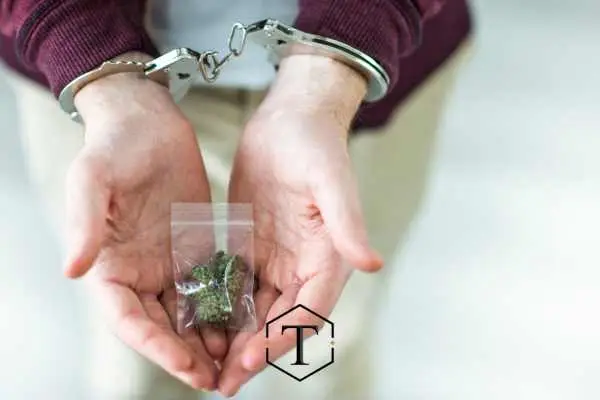
In Columbia, South Carolina, one of the most common drug offenses is simple possession. Simple possession occurs when a person knowingly or intentionally possesses a controlled substance without a valid prescription. For constructive possession, the State must prove that the person had the right and power to control the drugs and that the person knew about the drugs and intended to control them ([State v. Stewart, Opinion No. 28029 (S.C. 2021)](https://www.sccourts.org/media/opinions/htmlfiles/SC/28029.pdf)).
### Dedication to Your Rights and Interests
When it comes to a drug possession case in Columbia, it is important to find a lawyer who is dedicated to protecting your rights. A drug possession lawyer can explain your options and the defense strategies that may apply. Your attorney should be familiar with the laws related to your type of drug case and with recent court rulings in similar cases.
At Touma Law Group, we believe that everyone deserves the right to a fair trial and the help of an attorney. We strive to keep our clients informed every step of the way.
## Schedule a Free Consultation With TLG for a Simple Possession Charge
If you are in the Columbia area and have been charged with simple possession, you should consider scheduling a free consultation with Touma Law Group. We are a criminal defense law firm that represents people charged with simple possession.
At your free consultation, you can discuss the details of your case with our [Columbia criminal defense attorneys](/columbia/criminal-defense-lawyer/). We will explain your rights and options under South Carolina law and help you decide how to proceed. No lawyer can promise a particular outcome.
## Columbia College Student Defense Lawyer
URL: https://toumalawgroup.com/columbia/college-student-defense-lawyer/
Criminal charges can have severe consequences for college students, potentially affecting academic standing, future employment, and personal reputation. In Columbia, South Carolina, students facing allegations such as underage drinking, drug offenses, or assault may also encounter university disciplinary actions alongside legal proceedings. Navigating these challenges requires a comprehensive understanding of both legal and institutional processes.
At Touma Law, we know how to defend college students against criminal charges in Columbia. Our experienced attorneys are committed to safeguarding your rights, striving to minimize the impact on your academic and personal life. If you or someone you know is a student facing legal issues, call our firm at [(803) 879-4499](tel:+18038794499) today for a confidential consultation. We’re here to provide the guidance and representation you need during this critical time.
## Common Legal Issues College Students May Face
As a college student in Columbia, South Carolina, you may face a variety of legal challenges that could affect your academic and personal future. A skilled [criminal defense lawyer in Columbia, SC](/columbia/criminal-defense-lawyer/), can help you navigate these issues and protect your rights. Here are some of the most common legal issues faced by students:
### Drug Offenses
Drug-related charges are among the most common legal issues faced by college students. These charges can include possession of controlled substances, distribution of drugs, and use of illegal substances on or near campus. Even minor offenses, like possession of marijuana, can lead to criminal charges that may have long-lasting consequences. Depending on the type and quantity of the drug involved, students may face serious fines, probation, or jail time. A [Columbia drug defense lawyer](/columbia/drug-lawyer/) can help reduce charges or seek alternative sentencing options to minimize the impact on your academic career.
### DUI Charges
Driving under the influence is a serious offense for college students. These charges result from operating a vehicle with a [blood alcohol content above the legal limit](/blood-alcohol-concentration-sc/) or being impaired by drugs. A DUI conviction can lead to hefty fines, license suspension, mandatory alcohol education classes, and even jail time. For college students, a conviction can also jeopardize their ability to drive, attend school, or secure future employment. A [skilled DUI attorney in Columbia](/columbia/dui-lawyer/) can help defend against a this charge and potentially reduce penalties.
### Theft and Shoplifting
[Theft and shoplifting charges](/columbia/theft-lawyer/) are common among college students, often arising from incidents on or near campus. Whether it’s a theft from a dorm room, a stolen bicycle, or a shoplifting incident at a local store, these offenses carry significant legal consequences. A conviction for theft can result in fines, community service, probation, or even jail time. Additionally, a criminal record can severely impact a student’s future, from job opportunities to graduate school admissions. Legal representation is essential for students facing these charges to minimize the long-term consequences.
### Assault and Disorderly Conduct
Assault, battery, and disorderly conduct charges are serious offenses that can have a significant impact on a college student’s life. These charges can stem from physical altercations, fights, or disturbances involving alcohol or personal conflicts. A conviction for assault or battery can result in criminal penalties, including jail time, fines, and a permanent criminal record. Disorderly conduct charges typically involve behavior that disrupts the peace, such as fighting or causing a public disturbance. A skilled attorney can work to have charges reduced or dismissed and help prevent the offense from affecting the student’s education and reputation.
If you’re a college student in Columbia, SC, facing any of these legal challenges, it’s crucial to seek the assistance of a knowledgeable defense lawyer. With the right legal support, you can protect your future and minimize the impact of these charges on your academic and personal life.
## How Criminal Charges Can Affect College Students
Criminal charges can have far-reaching consequences for college students, affecting not only their academic future but also their personal lives and future career opportunities. Understanding these potential impacts is crucial for students who are facing legal challenges.
### Academic Consequences
One of the immediate consequences for college students facing criminal charges is the potential for academic discipline. Many colleges and [universities have strict codes of conduct](https://sc.edu/about/offices_and_divisions/student_conduct_and_academic_integrity/), and criminal behavior, even off-campus, can lead to severe academic consequences.
These may include suspension, expulsion, or probation, all of which can disrupt a student’s education. Additionally, a conviction can affect some scholarships and other aid that carry conduct rules. Federal student aid is no longer affected by a drug conviction, but incarceration can limit it ([studentaid.gov](https://studentaid.gov/understand-aid/eligibility/requirements/criminal-convictions)). Ask the school's financial aid office about the aid you receive. If a student is expelled, it can be difficult to transfer to another institution, especially if the disciplinary record is disclosed.
### Employment and Career Opportunities
A criminal record can significantly affect a college student’s future employment opportunities. Many employers conduct background checks during the hiring process, and a conviction, even for a minor offense, can impact a student’s chances of getting hired.
Certain professions, especially those in healthcare, law, or government, may have additional restrictions, and a criminal conviction could disqualify a student from pursuing their intended career path. Additionally, students may face challenges obtaining professional licenses, as some licensing boards consider criminal history when making decisions.
### Personal and Social Repercussions
The personal and social consequences of criminal charges can be profound. Legal issues may strain relationships with family, friends, and peers, and students may face social stigma, especially if the charges are widely known on campus. A criminal charge or conviction can damage a student’s reputation, making it harder to establish new friendships or connections within social circles. Emotional distress, including feelings of embarrassment, guilt, or shame, may also affect a student’s mental health and overall well-being.
Given the potential academic, career, and personal consequences, it is essential for college students facing criminal charges to seek legal assistance as soon as possible. A qualified defense attorney can help minimize the impact of these charges and protect the student’s future.
## What to Do if You Are Arrested as a College Student in Columbia, SC
Being arrested can be a stressful experience, especially for college students facing the added pressure of academics and future career prospects. It’s essential to know your rights and the [steps you should take after an arrest](/after-youve-been-arrested/) to protect your future.
- **Stay Calm and Avoid Self-Incrimination**: The first and most important step is to stay calm. While it’s natural to feel anxious, remaining composed can help you avoid saying anything that might harm your case later. Anything you say during the arrest or interrogation can be used against you in court. Politely decline to answer questions until you have legal representation. Remember, you have the right to remain silent.
- **Contact a Qualified Defense Attorney**: Once you’re arrested, your next step should be to contact a qualified defense attorney. An experienced lawyer can provide guidance during the arrest process and represent your interests throughout the legal proceedings. Having an attorney on your side ensures that your rights are protected and that you understand your legal options. They can also work to reduce or dismiss charges, negotiate plea deals, or defend you in court if necessary.
- **Understand Your Rights During the Arrest Process**: During the arrest, police officers are required to inform you of your rights, including the right to remain silent and the right to an attorney. Be sure to listen carefully to these warnings. Understanding your rights during this process is essential to avoid any legal missteps that could harm your case.
- **How to Handle Your University’s Involvement in the Legal Process**: In addition to dealing with criminal charges, your university may become involved in the process, especially if the offense occurred on or near campus. Universities have their own code of conduct, and they may take disciplinary action regardless of the outcome of your criminal case.
It’s crucial to be mindful of this and consult your attorney before making any statements to university officials. Your attorney can guide you on how to handle the university’s involvement and ensure that your legal rights are respected throughout both the legal and academic processes.
By staying calm, understanding your rights, and working with a skilled attorney, you can navigate the complexities of being arrested as a college student in Columbia, SC, and minimize the impact on your future.
## The Role of a College Student Defense Lawyer
When a college student faces criminal charges, a defense lawyer plays a crucial role in ensuring their rights are protected and their best interests are represented. From case evaluation to dealing with college disciplinary actions, a defense attorney can provide valuable guidance and support throughout the legal process.
### Case Evaluation
A thorough case evaluation is one of the first and most important steps a defense lawyer will take. By carefully reviewing the evidence, speaking with witnesses, and considering the specifics of the charges, the lawyer can develop the most effective defense strategy. This process helps identify potential weaknesses in the prosecution’s case and allows the lawyer to formulate a plan to challenge the charges or negotiate a favorable outcome, such as a reduced sentence or dismissal of the case.
### Representation in Court
In addition to providing guidance outside the courtroom, a defense lawyer represents college students in court. This includes advocating on the student’s behalf during hearings and trials, presenting evidence, cross-examining witnesses, and making legal arguments. If the case goes to trial, the lawyer will work diligently to protect the student’s rights and ensure that the case is presented fairly. In many instances, the defense attorney may also negotiate with prosecutors to secure a plea deal, reducing potential penalties or charges. Their goal is to achieve the best possible outcome for the student.
### Handling College Disciplinary Actions
Beyond the criminal case, a defense lawyer also helps students navigate potential disciplinary actions from their college or university. Many educational institutions have codes of conduct that may lead to academic probation, suspension, or even expulsion if the student is found guilty of criminal behavior. A defense lawyer can assist in addressing these disciplinary matters, ensuring the student’s side of the story is heard and that any college proceedings are conducted fairly. In some cases, the lawyer may be able to intervene to prevent or reduce disciplinary consequences.
### Protecting Rights
Throughout the legal process, the defense lawyer’s primary role is to protect the student’s rights. From the moment of arrest through interactions with law enforcement and the college, the lawyer ensures that the student is treated fairly and that their constitutional rights are upheld. This includes advising the student about their right to remain silent, their right to an attorney, and their right to a fair trial. The lawyer also ensures that the student’s privacy and rights are respected during any interactions with the college or university, including any hearings or disciplinary proceedings.

By working closely with a skilled defense lawyer, college students can better navigate the legal system, minimize potential consequences, and protect their future educational and career opportunities.
## Facing Charges as a College Student? We Can Help
As a student, when you are facing criminal charges it can become overwhelming and you may not be able to make crucial decisions that involve your future. You may need the help of an aggressive defense attorney that has adequate legal experience and knowledge in criminal law to help you prepare a strong defense.
At Touma Law, we understand the unique challenges college students face when dealing with criminal charges. Our team works to build a strategic defense aimed at achieving the best possible outcome. If you or a loved one is a student in Columbia facing legal trouble, [contact us today](/contact/) to discuss your options.
## Columbia Drug Lawyer
URL: https://toumalawgroup.com/columbia/drug-lawyer/
Being charged with a drug offense in Columbia or anywhere in South Carolina can be frightening. The possibility of jail time, fines, and a criminal record can feel overwhelming. A charge is not a conviction. If you are facing a drug offense in Richland or Lexington County, an attorney can explain the charge and your options.
Speaking with a drug lawyer early can help. Contact our [Columbia drug lawyers](/contact/) for a confidential consultation about your case. This page is general information, not legal advice.
## The Serious Reality of South Carolina Drug Laws
Law enforcement takes drug charges seriously, whether the charge is simple possession, possession with intent to distribute (PWID), drug trafficking, or drug manufacturing. The controlled substance schedules and penalties are set out in [Title 44, Chapter 53 of the South Carolina Code](https://www.scstatehouse.gov/code/t44c053.php).
The consequences vary based on the type and quantity of the controlled substance involved, from marijuana to Schedule I and II drugs like heroin, cocaine, or methamphetamine.

### Understanding Felony vs. Misdemeanor Drug Offenses
The charge you face determines the potential penalty.
- **Misdemeanor:** A first offense of simple possession is a misdemeanor for most drugs. For example, possession of 28 grams (one ounce) or less of marijuana carries up to 30 days in jail or a fine of $100 to $200 on a first offense ([S.C. Code Ann. § 44-53-370(d)(5)](https://www.scstatehouse.gov/code/t44c053.php)). Even a misdemeanor can lead to a criminal record that affects jobs and housing.
- **Felony:** Possession with intent to distribute, distribution, manufacturing, and trafficking are felonies ([S.C. Code Ann. § 44-53-370](https://www.scstatehouse.gov/code/t44c053.php)). Trafficking sentences have mandatory minimums that cannot be suspended, and no probation may be granted for them. Distributing within one-half mile of a school, public playground or park, or college is a separate felony ([S.C. Code Ann. § 44-53-445](https://www.scstatehouse.gov/code/t44c053.php)).
A [criminal defense lawyer](/columbia/criminal-defense-lawyer/) can explain which charge applies to the facts of your case.
> **_Related:_** Arrested? Contact our [drug trafficking lawyers](/columbia/drug-trafficking-lawyer/) today.
## Why Your Choice of a Columbia Drug Lawyer Matters
Facing drug charges in South Carolina can feel like a heavy weight, but you do not have to face it alone. Choosing a Columbia drug lawyer is an important decision. At Touma Law Group, we understand that a charge is not a conviction, and we work to protect the rights of our neighbors in the Midlands. If you are ready to discuss your options, we invite you to reach out for a private consultation.
> **_Read more:_** Learn more about how we approach [simple possession](/columbia/simple-possession-lawyer/) drug charges.
An attorney can review the evidence, talk with prosecutors, and look for procedural errors. No lawyer can promise a particular result, and the options available depend on the facts of your case.

## Your Constitutional Rights and Defense Strategies
A defense in a drug case often starts not with the drug itself, but with how law enforcement gathered the evidence. Your constitutional protections are the foundation of your defense.
### Challenging Law Enforcement's Actions
In many drug cases, the prosecution's evidence depends on the legality of the initial police contact, search, and arrest. An attorney can review each step, including:
- **Illegal Searches and Seizures:** Did law enforcement have a valid search warrant or probable cause to stop your vehicle or search your property? The Fourth Amendment protects you against unreasonable searches. If evidence was collected in violation of your rights, it may be suppressed in court.
- **Unlawful Stops:** Was the initial stop or detention legitimate? Evidence gathered after an unlawful stop may be excluded.
- **Miranda Rights Violations:** Were you in custody and questioned without being read your Miranda rights? Statements made during an unconstitutional interrogation may be excluded.
- **Evidence Collection and Lab Testing:** An attorney can look at the chain of custody for seized items and the accuracy of lab testing.
> Related: Touma Law Group defends against [LSD drug charges](/lsd-drug-charges-in-sc/) in South Carolina
### Defense Against Intent and Knowledge
For charges like PWID, distribution, or trafficking, the State must prove beyond a reasonable doubt that you possessed the drugs and intended to sell or distribute them.
For possession charges, the State must prove that you had the right and power to control the drugs and that you knew about the drugs and intended to control them ([State v. Stewart, Opinion No. 28029 (S.C. 2021)](https://www.sccourts.org/media/opinions/htmlfiles/SC/28029.pdf)). Evidence such as phone records or surveillance can bear on the allegation of intent, and not every possession charge is a distribution case.

## Navigating the Columbia and South Carolina Court System
Being charged in Richland and Lexington Counties means dealing with local court procedures and with state or federal prosecutors. An attorney who practices in these courts can explain how the process works.
> **_Did you know?_** We wrote about whether there is a [statute of limitations on drug charges](/statute-of-limitations-drug-charges-sc/) in South Carolina.
### Alternative Sentencing and Diversion Programs
For some first-time or non-violent drug charges, there may be alternatives within the criminal justice system.
- **Pretrial Intervention (PTI):** If a person successfully completes the program, the solicitor enters a noncriminal disposition of the charge, and the person may apply to the court to destroy the arrest records ([S.C. Code Ann. § 17-22-150](https://www.scstatehouse.gov/code/t17c022.php)). A person charged with a crime of violence as defined in [S.C. Code Ann. § 16-1-60](https://www.scstatehouse.gov/code/t16c001.php), which lists drug trafficking, generally is not considered for PTI, unless the solicitor determines the elements of the crime do not fit the charge ([S.C. Code Ann. § 17-22-50](https://www.scstatehouse.gov/code/t17c022.php)).
- **Conditional Discharge:** For a possession charge, a person with no earlier conviction under the controlled substances article or for a related marijuana, stimulant, depressant, or hallucinogenic drug offense may be eligible. If the person completes probation, the proceedings are dismissed without an adjudication of guilt. It can happen only once, and a fee applies ([S.C. Code Ann. § 44-53-450](https://www.scstatehouse.gov/code/t44c053.php)).
- **Plea Bargain:** In some cases, an attorney can negotiate with the prosecutor over the charge or the sentence. No result can be promised.
### The Trial Process and Federal Drug Cases
If your case proceeds to trial, you should have an attorney who handles criminal litigation. Federal drug cases involve federal statutes and a distinct set of court rules.
> **_We've got you covered._** Our Columbia office handles [federal drug cases](/columbia/federal-criminal-defense-lawyer/).
## The Lasting Impact of a Drug Conviction
A drug conviction can affect more than your immediate freedom. Possible long-term consequences include:
- **Loss of Rights:** Federal law bars firearm possession by anyone convicted of a crime punishable by more than one year in prison ([18 U.S.C. § 922(g)(1)](https://www.law.cornell.edu/uscode/text/18/922)).
- **Property Forfeiture:** The State may seek forfeiture of property alleged to be connected to drug offenses ([S.C. Code Ann. § 44-53-520](https://www.scstatehouse.gov/code/t44c053.php)).
- **Personal and Professional Effects:** A criminal record can make it harder to find a job or rent an apartment, and licensing boards may consider a conviction.
## Secure Your Future: Contact a Columbia Drug Lawyer Now
When you are facing the possibility of jail time and a criminal record, it helps to have an attorney who will keep you informed and explain your options.
Our goal is to review your case carefully and discuss the paths that may be open to you, such as dismissal, a diversion program, or trial. No lawyer can promise a particular outcome.
You do not have to face the state and federal prosecutors alone. Call our Columbia office at [(803) 879-4499](tel:+18038794499) to start the conversation.
## Columbia Domestic Violence Lawyer
URL: https://toumalawgroup.com/columbia/domestic-violence-lawyer/
Domestic violence charges in South Carolina carry serious legal and personal consequences. A conviction can lead to jail time, fines, and a lasting criminal record that affects employment, housing, and custody rights. The state has strict laws on domestic violence, with offenses classified by degree based on the severity of the alleged incident. Understanding these laws and the potential defenses available is essential when navigating the legal process.
A careful review of the facts can matter in a domestic violence case. At Touma Law Group, our domestic violence lawyers in Columbia can explain the charge and your legal options, and guide you through each step of the legal process. No lawyer can promise a particular result. If you or a loved one has been charged with domestic violence, call our firm at [(803) 879-4499](tel:+18038794499) to discuss your case and explore your legal options during a free consultation.
## How Does South Carolina Define Domestic Violence?
[South Carolina law defines domestic violence](https://www.scstatehouse.gov/code/t16c025.php) as causing physical harm or injury to a household member, or offering or attempting to cause physical harm or injury to a household member with apparent present ability under circumstances reasonably creating fear of imminent peril ([S.C. Code Ann. § 16-25-20(A)](https://www.scstatehouse.gov/code/t16c025.php)). A "household member" is a spouse, a former spouse, a person with whom you have a child in common, or a male and female who are cohabiting or formerly have cohabited ([S.C. Code Ann. § 16-25-10](https://www.scstatehouse.gov/code/t16c025.php)). In [Doe v. State, Opinion No. 27728 (S.C. Nov. 17, 2017)](https://www.sccourts.org/media/opinions/htmlfiles/SC/27728.pdf), the South Carolina Supreme Court declared that definition unconstitutional as applied to an unmarried same-sex couple who lived together, and held that the family court may not use it to keep people in similar relationships from seeking an order of protection. The Court did not rewrite the statute, and the Code still reads "a male and female," so whether a particular relationship is covered in a criminal case is a question for an attorney.
Domestic violence is generally a method of gaining power and establishing control over the victim. Because of this, domestic violence is often both physical and psychological in nature.
It is important to remember that just being arrested and [charged with domestic violence in South Carolina](/domestic-violence-charges-in-sc/) does not confer guilt on you. Working with an experienced domestic violence law attorney will help you determine what opportunities you have to defend yourself, and allow you to avoid common pitfalls while fighting your criminal charges.
## Types of Domestic Violence Charges in South Carolina
South Carolina categorizes domestic violence offenses based on the severity of the alleged actions, the injuries involved, and any prior offenses. These charges range from misdemeanors to serious felonies, each carrying different penalties.
- **Domestic Violence in the Third Degree**: This is the least severe domestic violence charge. A person may face third-degree charges if they cause or attempt to cause physical harm to a household member or threaten them with harm. It is a misdemeanor punishable by a fine of $1,000 to $2,500, up to 90 days in jail, or both.
- **Domestic Violence in the Second Degree**: This charge applies when the offense results in moderate bodily injury or involves aggravating factors, such as prior domestic violence convictions or violations of a protective order. It is a misdemeanor punishable by a fine of $2,500 to $5,000, up to three years in jail, or both.
- **Domestic Violence in the First Degree**: First-degree domestic violence is a felony. It applies, for example, when great bodily injury results, when a firearm is used in any manner, or when the person has two or more prior domestic violence convictions within ten years. A conviction can result in up to 10 years in prison.
- **Domestic Violence of a High and Aggravated Nature (DVHAN)**: This is the most serious domestic violence charge in South Carolina. It applies, for example, when the offense is committed under circumstances showing extreme indifference to the value of human life, such as using a deadly weapon, and great bodily injury results or the victim would reasonably fear imminent great bodily injury or death. DVHAN is a felony punishable by up to 20 years in prison.
> **Learn More**: [Can Women Be Charged With CDV?](/can-women-be-charged-with-cdv/)
## Penalties for Domestic Violence Charges in Columbia, SC
Domestic violence charges in South Carolina come with a range of penalties depending on the severity of the offense. Convictions can result in financial, legal, and personal consequences that vary based on the degree of the charge and any aggravating factors.
### Fines and Court Fees
Financial penalties are a common component of domestic violence convictions. The statute sets a fine of $1,000 to $2,500 for third degree and $2,500 to $5,000 for second degree. The first degree and high and aggravated nature statutes state a term of imprisonment and do not state a fine. In addition to fines, defendants are often responsible for court fees and costs associated with required programs or services, which can increase the overall financial burden.
### Jail Time and Probation
The potential for incarceration depends on the severity of the charge:
- **Third-degree domestic violence**: Up to 90 days in jail.
- **Second-degree domestic violence**: Up to three years in prison.
- **First-degree domestic violence**: Up to 10 years in prison.
- **Domestic violence of a high and aggravated nature (DVHAN)**: Maximum sentence of up to 20 years in prison.
In some cases, probation may be granted as an alternative to jail time, often accompanied by conditions like counseling or community service.
### Restraining Orders and Protective Orders
[Domestic violence charges can lead to restraining orders](/restraining-orders-domestic-violence-cases/). These orders impose strict limitations, such as:
- Prohibiting any form of contact with the victim.
- Restricting access to shared residences or workplaces.
- Prohibiting possession of firearms or ammunition, if the family court makes the findings the statute requires and orders it ([S.C. Code Ann. § 16-25-30(A)](https://www.scstatehouse.gov/code/t16c025.php)).
Violating these orders can result in additional criminal charges and harsher penalties.
### Counseling and Treatment Programs
A court that suspends all or part of a sentence can require the person to complete a domestic violence intervention program, and the court or the program can refer the person to supplemental substance abuse or mental health treatment ([S.C. Code Ann. § 16-25-20(E) and (G)](https://www.scstatehouse.gov/code/t16c025.php)). These may include:
- Domestic violence intervention programs approved by the circuit solicitor.
- Supplemental substance abuse or mental health treatment, if ordered or referred.
Participation in these programs aims to address the underlying causes of domestic violence and reduce the likelihood of reoffending.
Domestic violence penalties in Columbia are severe and can have lasting impacts on your personal and professional life. If you are facing charges, it's essential to understand the potential consequences and work with a legal professional to protect your rights.
## What to Expect From the Legal Process if You Are Charged With Domestic Violence
Being charged with domestic violence involves a detailed legal process that begins with your arrest and continues through resolution in court. Knowing [what to expect from domestic violence charges](/what-to-expect-charged-with-domestic-violence/) can help you navigate the system and protect your rights.
### Arrest and Booking
If law enforcement believes domestic violence has occurred, you may be arrested at the scene. During booking, authorities will record your personal information, take your fingerprints, and possibly set a bond amount for your release. Allegations involving physical harm or violations of protective orders are often prioritized, and the circumstances of your arrest may influence the charges brought against you.
### Initial Hearing and Bond Hearing
Shortly after your arrest, you will appear in court for a bond hearing. A bond hearing for a charge under Chapter 25 of Title 16 must occur within twenty-four hours after the arrest ([S.C. Code Ann. § 22-5-510(F)](https://www.scstatehouse.gov/code/t22c005.php)). The court decides whether you can be released while awaiting trial and under what conditions. Common bond conditions in domestic violence cases include:
- No contact with the alleged victim.
- Restrictions on returning to a shared residence.
These conditions are intended to minimize the risk of further incidents while your case proceeds. Violating bond conditions can lead to additional criminal charges, making it essential to fully understand the terms set by the court.
### Restraining Orders or Protective Orders
In many cases, the alleged victim may request a restraining or protective order. These orders can:
- Prohibit contact with the victim or children.
- Require you to stay away from certain locations, such as the victim's home or workplace.
> **Learn More**: [South Carolina Domestic Violence Statistics](/domestic-violence-statistics/)
A violation of these orders can result in significant legal repercussions, including additional penalties and a potential impact on your criminal record. Protective orders are intended to ensure safety but can be challenging for the accused, particularly in situations involving shared custody or cohabitation.
### Pretrial Proceedings
Before the trial begins, several pretrial steps occur:
- Discovery: Both sides exchange evidence, such as police reports, medical records, and witness statements. Allegations of bodily injury or other forms of harm are often central to the evidence presented.
- Motions: Your attorney may file motions to suppress evidence, dismiss charges, or modify bond conditions.
- Plea Negotiations: The prosecution may offer a plea, which your attorney can help you evaluate, including what it would mean for your record.
Pretrial proceedings are an important phase in which an attorney can review the evidence and the prosecution's case.
### Trial
If your case proceeds to trial, the prosecution must prove the charges beyond a reasonable doubt. During the trial, expect the following stages:
- **Jury Selection**: A jury will be chosen to hear the case unless you opt for a bench trial (where the judge decides the verdict).
- **Opening Statements**: Both sides present an overview of their arguments.
- **Presentation of Evidence**: Witness testimony, physical evidence, and expert opinions will be introduced.
- **Closing Arguments**: Attorneys summarize their cases for the jury or judge.
- **Verdict and Sentencing**: If convicted, the court will impose penalties, such as fines, a jail sentence, or counseling.
A domestic violence defense attorney prepares for trial by reviewing the evidence and the elements the State must prove.
### Post-Trial Options
If you are convicted of a, you may have the option to appeal the verdict or sentence. An attorney can advise you on whether an appeal is appropriate and guide you through the appellate process.

Understanding the legal process is crucial when facing domestic violence charges. Consulting with a criminal defense attorney early on can help you understand the process and your options.
## Legal Defenses Against Domestic Violence Charges
Facing domestic violence charges in South Carolina is serious, but several defenses may apply depending on the facts. The right defense strategy will depend on the circumstances of the case. Below are common defenses used in domestic violence cases.
- **Self-Defense**: A person may be justified in using force to protect themselves or another person. Whether self-defense applies depends on the facts and the force used, and a lawyer must review the details of your case.
- **Defense of Others**: Similar to self-defense, a person may argue they acted to protect someone else from harm, such as a child or family member. The use of force must still meet the standard of being reasonable and proportional to the perceived threat.
- **False Allegations**: False accusations can occur for various reasons, such as revenge, custody disputes, or attempts to gain an advantage in divorce proceedings. In these cases, the defense may:
- Highlight inconsistencies in the accuser's statements.
- Present evidence disproving the allegations, such as witness testimony or communication records.
- **Lack of Evidence**: Prosecutors must prove the case beyond a reasonable doubt. If there is insufficient evidence, it may be possible to challenge the charges. Examples of lacking evidence include:
- No visible injuries on the alleged victim.
- Conflicting witness statements.
- Lack of corroborating evidence, such as medical or police reports.
- **Violation of Rights or Procedural Errors**: Mistakes during the investigation or arrest can also form the basis of a defense. Examples include:
- Unlawful search and seizure.
- Failure to read Miranda rights.
- Coerced or improperly obtained statements.
## How an Attorney Can Help With Domestic Violence Charges
[Domestic violence charges can have long term consequences](/long-term-impact-of-domestic-violence-conviction/), but a lawyer can protect your rights throughout the case and explain your options. No lawyer can promise a particular outcome. The Role of a Domestic Violence Lawyer
- **Case Evaluation**: Emphasize the importance of a thorough evaluation of the case to identify legal strategies and possible defenses.
- **Representation in Court**: Discuss how a domestic violence lawyer represents clients during court proceedings, including negotiations and trials.
- **Protecting Rights**: Describe how a lawyer helps protect clients' rights and ensures fair treatment throughout the legal process.
- **Navigating Legal Procedures**: Explain how a lawyer assists with navigating the complexities of domestic violence legal procedures, including restraining orders and court appearances.
## Get the Defense You Need for Your Domestic Violence Case
A domestic violence charge can have long-term consequences, and a lawyer can help protect your rights. Every case is different, and the details surrounding the accusations matter. Building a defense requires careful review of the evidence, witness statements, and police procedures.
One of the first steps that should be taken after a domestic violence arrest is contacting a [criminal defense attorney in Columbia](/columbia/criminal-defense-lawyer/). A domestic violence attorney at Touma Law Group can provide you with the legal representation you will need to [respond to domestic violence charges](/prove-domestic-violence-charges-are-false/) in court. Contact us today to schedule an appointment for a free case consultation!
## Unwavering Criminal Defense in Columbia, SC
URL: https://toumalawgroup.com/columbia/criminal-defense-lawyer/
Facing criminal charges in Columbia, SC? Your freedom and future are at stake. Don’t navigate the complex legal system alone.
When you’re accused of a crime in Columbia, South Carolina, the weight of the legal system can feel overwhelming. From the moment of a criminal investigation to a potential trial, every step of the legal process is critical. This is where a dedicated and experienced [Columbia SC criminal defense lawyer](/columbia/) becomes your most vital asset.
In the heart of South Carolina, particularly within Richland County and neighboring Lexington County, criminal charges carry serious consequences that can impact every aspect of your life. Whether you’re a student at the University of South Carolina, a long-time resident, or just passing through, understanding your rights and having powerful legal representation is non-negotiable.
> Don’t let charges mess up your life – let us help you fight for what’s right. Call us now at [803-879-4499](tel:+18038794499)
## Types of Criminal Charges in Columbia, SC
The range of criminal charges in Columbia, SC, is broad, encompassing everything from minor [misdemeanors](https://www.law.cornell.edu/wex/misdemeanor) to severe felonies. A skilled criminal defense attorney must be proficient in defending against a diverse array of accusations.
Common charges that necessitate the experience of a Columbia SC Criminal Defense Lawyer include:
### DUI Charges (Driving Under the Influence)
[A DUI charge](/columbia/dui-lawyer/) or DUI attorney is crucial for navigating these cases, which can lead to license revocation, hefty fines, and jail time. South Carolina has strict DUI laws, and even a first offense can have significant repercussions. Understanding [breathalyzer equipment](/breathalyzer-in-south-carolina/) and video analysis can be key defense strategies.
> **Related:** [Getting your first DUI](/first-time-dui/)
### Drug Crimes
From simple possession of marijuana to complex drug trafficking allegations, [drug charges](/columbia/drug-lawyer/) can involve state and federal courts. These often require a deep understanding of evidence collection, search and seizure laws, and potential federal crime charges.
### Violent Crimes
Charges like assault, battery, armed robbery, and domestic violence are prosecuted aggressively in South Carolina. A strong [violent crime defense strategy](/columbia/domestic-violence-lawyer/) is essential to protect your rights and challenge the state prosecutor’s case.
### White Collar Crimes
These offenses, such as money laundering, fraud, and computer crime, often involve intricate financial investigations. A criminal defense lawyer with experience in [white-collar offenses](/columbia/domestic-violence-lawyer/) can meticulously analyze financial records and present a compelling defense.
### Sex Crimes
Accusations of [sex crimes](/columbia/sex-crime-lawyer/), including internet child pornography, carry immense social stigma and severe penalties. These cases demand a highly sensitive and strategic legal defense.
### Weapons Charges
Violations related to [firearms and other weapons](/columbia/gun-charge-lawyer/) can result in significant jail time. Understanding South Carolina’s gun laws is paramount for an effective defense.

### Juvenile Crimes
When a minor faces juvenile charges, the legal process differs from adult courts, focusing more on rehabilitation. A compassionate and knowledgeable defense attorney can help protect a young person’s future with professional [juvenile defense.](/columbia/juvenile-crime-lawyer/)
### Professional Misconduct & Licensing
For professionals whose careers depend on a clean record and a professional license, allegations of professional misconduct can be devastating. A criminal defense lawyer can also assist with Licensing and Regulation issues, working to protect your professional standing.
> **You may want to know:** [How much does a criminal defense lawyer cost?](/criminal-defense-lawyers-cost-in-sc/)
## Why You Need a Dedicated Columbia SC Criminal Defense Lawyer
When facing any criminal charge, the consequences extend far beyond immediate penalties. A conviction can lead to a permanent criminal record, impacting employment opportunities, housing, and even your civil rights. This is why securing experienced legal representation is not just an option but a necessity.
A Columbia law firm focused on criminal defense can provide:
1. **Navigating the Legal System:** The criminal justice process is complex. A seasoned criminal defense attorney understands the intricacies of state and federal courts, local procedures in Richland County and Lexington County, and how to effectively navigate each stage, from initial criminal investigations to a parole hearing.
2. **Robust Defense Strategy:** Every case is unique, and a successful defense begins with a comprehensive case evaluation. This involves thorough evidence collection, interviewing witnesses, identifying judicial mistakes, and developing a tailored legal strategy. Whether it’s challenging breathalyzer equipment readings in a DUI case or dissecting financial documents in a white-collar crime, your lawyer will build the strongest possible defense.
3. **Negotiating with Prosecutors:** Many criminal cases are resolved through a plea deal rather than a trial. An effective defense lawyer has strong negotiation skills and can work with the state prosecutor or federal prosecutors to achieve the best possible outcome, potentially reducing charges or penalties.
4. **Trial Experience:** Should your case proceed to trial, you need a trial lawyer who is comfortable and competent in the courtroom. This includes aggressive cross-examination, presenting compelling arguments, and advocating tirelessly for your innocence. High-stakes cases, some even gaining attention on Court TV, demonstrate the importance of an attorney with a proven track record.
5. **Protection of Your Rights:** From the moment of arrest, your constitutional rights are at stake. A criminal defense attorney ensures law enforcement adheres to proper procedures, protecting you from civil rights violations and unlawful actions by federal law enforcement.
6. **Guidance Through Stressful Times**: Being criminally accused is an incredibly stressful experience. Your legal counsel provides not only legal experience but also a steady hand and clear communication, keeping you informed at every step of the legal process. Many firms offer free consultations to discuss your situation and outline potential pathways forward.
## What to Look for in a Columbia, SC Criminal Defense Lawyer
Choosing the right criminal defense lawyer in Columbia, SC, is a critical decision. Consider these factors:
- **Experience:** Look for an attorney with extensive experience specifically in criminal defense, especially in the types of charges you are facing. Experience in both state and federal courts is a significant advantage.
- **Local Knowledge:** A lawyer deeply familiar with the local courts, judges, and prosecutors in Richland County and Lexington County can anticipate challenges and leverage relationships for your benefit.
- **Track Record:** While no attorney can guarantee a specific outcome, inquire about their past case results and success stories. Client testimonials and peer reviews can provide valuable insights.
- **Communication:** Your attorney should be accessible, responsive, and able to explain complex legal issues in clear, understandable terms.
- **Resources:** A dedicated firm will have the resources to conduct thorough investigations, hire witnesses, and handle the significant trial preparations often required in complex criminal defense litigation.
- **Compassion and Dedication:** You need a lawyer who genuinely cares about your future and is committed to fighting for your best interests.

## Don’t Wait – Act Now!
The moments immediately following an arrest or accusation are crucial. The sooner you engage a Columbia SC criminal defense lawyer, the better your chances of a favorable outcome. Early intervention allows your legal counsel to:
- Preserve critical evidence.
- Interview witnesses while memories are fresh.
- Advise you on what to say (and what not to say) to law enforcement.
- Begin building a strong defense strategy from day one.
Delay can seriously jeopardize your case. The prosecution is already building their case against you; you need someone equally aggressive and knowledgeable on your side.
### The Role of Local Context: Columbia and Its Courts
Columbia, SC’s status as the state capital and location of the University of South Carolina creates a dynamic legal scene. Cases from Richland or Lexington Counties have specific court processes with unique nuances.
A skillful Columbia SC Criminal Defense Lawyer knows these local dynamics, court tendencies, and prosecutor tendencies, offering an advantage through familiarity with both local and state law contexts.

## Why Choose Touma Law Group?
We’re not just another law firm. [Our attorneys](/about/) bring extensive experience in South Carolina criminal courts, a strong record of favorable case results, and a commitment to providing high-quality, personalized legal representation.
We know that every client’s situation is different, which is why we take the time to listen, investigate, and create a custom defense strategy. Each case is treated with the focus it deserves, especially when there’s a possibility of jail time or lasting legal consequences.
Clients choose us because:
- We’re known for our aggressive defense strategies
- We understand the high stakes of every criminal matter
- We work directly with clients, not through legal assistants or intermediaries
- We stay available, responsive, and supportive throughout the entire case
When you’re going through a tough time, you need a team that’s experienced, reliable, and ready to fight for you. At Touma Law Group, we’re a competent law firm that offers real legal advice, an honest approach, and support through every step of the criminal process.
## Get Help From an Experienced Criminal Lawyer Today
If you or a loved one is facing criminal charges in Columbia, SC, the stakes are incredibly high. Your freedom, reputation, and future are on the line. Do not face the powerful machinery of the state and federal criminal justice systems alone. Secure the guidance and advocacy of a highly qualified Columbia, SC criminal defense lawyer.
> Call [(803)879-4499](tel:+8038794499) today for a free consultation!
They will serve as your shield, your advocate, and your guide through what is undoubtedly one of the most challenging experiences of your life. From handling initial criminal investigations and navigating bail hearings to executing sophisticated trial preparations and securing the best possible case results, a dedicated defense attorney is your strongest ally.
Don’t gamble with your future. Contact Touma Law Group today for a [free consultation](/contact/) to discuss your case and understand your legal options. Your future depends on it.
## Columbia Traffic Lawyer
URL: https://toumalawgroup.com/columbia/traffic-lawyer/
After a police officer hands you a ticket, it is normal to wonder whether you need to do anything beyond paying the fine. Even common violations can lead to points on your license, a suspension, and higher insurance costs. No matter how small the charge looks, it should be taken seriously.
A licensed South Carolina attorney at the firm must review the facts of a case before anyone relies on the general information on this page. If you have been cited in Columbia, call Touma Law Group at [(803) 879-4499](tel:+18038794499) for a [free case review](/contact/).
## How Points Work in South Carolina

South Carolina assigns points to traffic violations under [S.C. Code Ann. § 56-1-720](https://www.scstatehouse.gov/code/t56c001.php). The DMV records them when you are convicted. A conviction in another state for a violation that would also break South Carolina traffic law may be recorded against you the same way ([§ 56-1-790](https://www.scstatehouse.gov/code/t56c001.php)).
A few examples of the point values in the statute:
| Violation | Points |
| --- | --- |
| Reckless driving | 6 |
| Speeding 25 miles per hour or more over the limit | 6 |
| Speeding more than 10 but less than 25 miles per hour over | 4 |
| Disobeying a traffic control device | 4 |
| Failing to yield the right of way | 4 |
| Speeding no more than 10 miles per hour over | 2 |
The word "conviction" matters here. Under [§ 56-1-710](https://www.scstatehouse.gov/code/t56c001.php), it includes a guilty plea, a no contest plea (nolo contendere), and forfeiting bail or collateral. A warning ticket carries no points under [§ 56-1-730](https://www.scstatehouse.gov/code/t56c001.php).
## When Your License Can Be Suspended
Several things can lead to a suspension. Some come from traffic tickets, and some do not.
**Too many points.** Under [S.C. Code Ann. § 56-1-740](https://www.scstatehouse.gov/code/t56c001.php), the DMV may suspend a license at 12 points. The suspension is three months for 12 to 15 points, four months for 16 or 17, five months for 18 or 19, and six months for 20 or more. A person who is employed or enrolled in college and lives more than a mile from work or school may be able to apply for a special restricted license to drive to and from work or school during that suspension. The fee is $100.
**Driving while your license is suspended.** This is its own criminal offense under [S.C. Code Ann. § 56-1-460](https://www.scstatehouse.gov/code/t56c001.php). A conviction can also extend the suspension by a like period. Read our guide to [driving with a suspended license](/driving-with-a-suspended-license/).
**Driving without insurance.** Under [S.C. Code Ann. § 56-10-520](https://www.scstatehouse.gov/code/t56c010.php), operating an uninsured vehicle is a misdemeanor, and the DMV must suspend the license when it receives notice of the violation.
**An alcohol or drug offense.** A DUI brings its own suspension rules and is a separate kind of case. Our [Columbia DUI lawyers](/columbia/dui-lawyer/) handle those, and our article on [losing your license after a DUI](/lose-your-license-for-a-dui/) explains the periods.
**A pattern of convictions.** Enough qualifying convictions in three years can lead to a [habitual traffic offender](/habitual-traffic-offender/) designation, which bars a license for five years unless the period is reduced.

## Can You Remove a Traffic Violation From Your Record?
The conviction itself stays on your driving record. The points are what lose value over time.
Under [§ 56-1-750](https://www.scstatehouse.gov/code/t56c001.php), when the DMV totals your points after a violation, those from the previous 12 months count in full, those from 12 to 24 months before count at half value, and older ones do not count. A driver can also reduce points by four by completing an approved defensive driving course, no more than once in any three year period ([§ 56-1-770](https://www.scstatehouse.gov/code/t56c001.php)).
The better chance to protect your record is at the start, before there is a conviction. How a ticket is resolved decides whether points are assessed at all.
## Going to Court on a Ticket in Richland County
Most traffic tickets are heard in magistrate or municipal court, which handle offenses with the lower penalties set by statute ([S.C. Code Ann. § 22-3-550](https://www.scstatehouse.gov/code/t22c003.php)). You may wait with the other cases on the docket before yours is called, and the officer who wrote the ticket has presented cases before.
Some tickets are not minor. Reckless driving carries a fine of $25 to $200 or up to 30 days in jail, and a second offense within five years brings a three month suspension under [§ 56-5-2920](https://www.scstatehouse.gov/code/t56c005.php). Speeding 25 or more miles per hour over the limit carries up to $200 or 30 days in jail under [§ 56-5-1520(G)](https://www.scstatehouse.gov/code/t56c005.php).
## What a Columbia Traffic Lawyer Can Do
No lawyer can promise a particular result on a ticket. A lawyer can look at the whole picture before you respond:
* **Review the citation and the law behind it,** including the offense, the speed, and the court.
* **Explain what a plea would mean for your points** and your record before you enter one.
* **Look for defenses** and for ways a charge might be resolved that carry fewer points.
* **Handle the court appearance** in many cases, so you may not have to attend.
* **Spot the bigger problems,** such as an existing suspension, a second reckless driving charge, or an insurance issue.
If a suspension has already happened, our guide to [driver's license reinstatement costs](/drivers-license-reinstatement/) explains the fees and the payment program.
## Talk With Touma Law Group About Your Ticket
If you have been cited in Columbia, contact Touma Law Group at [(803) 879-4499](tel:+18038794499) to [schedule a free consultation](/contact/). Our [Columbia criminal defense attorneys](/columbia/criminal-defense-lawyer/) serve clients in Richland County and the surrounding Midlands area. A licensed South Carolina attorney at the firm must review the facts of your case before you rely on any general information on this page.
## Frequently Asked Questions
Under [§ 56-1-740](https://www.scstatehouse.gov/code/t56c001.php), the DMV may suspend a license at 12 points. The suspension is three months for 12 to 15 points and rises to six months at 20 or more.
No. Under [§ 56-1-750](https://www.scstatehouse.gov/code/t56c001.php), points from violations more than 24 months before your latest violation do not count toward your total, and points from 12 to 24 months before count at half value. The conviction itself stays on your driving record.
Possibly. Under [§ 56-1-740(B)](https://www.scstatehouse.gov/code/t56c001.php), a person who is employed or enrolled in college and lives more than a mile from work or school may apply for a special restricted license for $100.
No. [§ 56-1-730](https://www.scstatehouse.gov/code/t56c001.php) says warning tickets are not assigned a point value.
Yes. Under [§ 56-5-1520(G)](https://www.scstatehouse.gov/code/t56c005.php), speeding is a misdemeanor, and the statute sets fines by how far over the limit you were driving.
## Greenville Traffic Lawyer
URL: https://toumalawgroup.com/greenville/traffic-lawyer/
A traffic ticket looks small until you add up the points on your license, the fine, and what the conviction can do to your insurance costs. If you have been cited in Greenville, you have choices about how to respond, and paying the ticket is not always the best one.
A licensed South Carolina attorney at the firm must review the facts of a case before anyone relies on the general information on this page. If you have a ticket and a court date, call Touma Law Group at [(864) 618-2323](tel:+18646182323) for a [free case review](/contact/).
## What a Traffic Ticket Can Cost You

A ticket has three kinds of cost, and the fine is usually the smallest.
* **The fine or sentence.** Traffic offenses are crimes under South Carolina law, and most carry a fine. Some carry jail time.
* **Points on your license.** Points follow a conviction, and enough of them lead to a suspension.
* **Your insurance costs.** Insurers look at your driving record, so a conviction can matter beyond the court. How much depends on your insurer.
Speeding is the most common ticket, so it is a good example. Under [S.C. Code Ann. § 56-5-1520(G)](https://www.scstatehouse.gov/code/t56c005.php), a speeding violation is a misdemeanor. For a first offense the statute sets these fines:
| How far over the posted limit | Fine for a first offense |
| --- | --- |
| Not more than 10 miles per hour | $15 to $25 |
| More than 10 but less than 15 miles per hour | $25 to $50 |
| More than 15 but less than 25 miles per hour | $50 to $75 |
| More than 25 miles per hour | $75 to $200, or up to 30 days in jail |
The statute also requires the citation to note the speed it was issued for ([§ 56-5-1520(H)](https://www.scstatehouse.gov/code/t56c005.php)). The court can tell you the total amount due on your ticket.
## What Happens If You Just Pay the Ticket
Paying can feel like the quickest way to be done. The risk is in what the law counts as a conviction.
For points, [S.C. Code Ann. § 56-1-710](https://www.scstatehouse.gov/code/t56c001.php) says a conviction includes the entry of a guilty plea, the entry of a no contest plea (nolo contendere), and the forfeiture of any bail or collateral posted to secure your appearance in court. A ticket that is paid or forfeited can therefore end the same way as one you lose at trial. A warning ticket carries no points under [§ 56-1-730](https://www.scstatehouse.gov/code/t56c001.php).
Read the ticket first. It states the offense, the court, and what you must do, and the date matters. A lawyer can often explain your options before a deadline passes.
## How the South Carolina Point System Works
The point values are set by [S.C. Code Ann. § 56-1-720](https://www.scstatehouse.gov/code/t56c001.php). Some examples:
| Violation | Points |
| --- | --- |
| Reckless driving | 6 |
| Speeding 25 miles per hour or more over the limit | 6 |
| Speeding more than 10 but less than 25 miles per hour over | 4 |
| Disobeying a traffic control device | 4 |
| Failing to yield the right of way | 4 |
| Following too closely | 4 |
| Speeding no more than 10 miles per hour over | 2 |
| Driving in an improper lane or improper backing | 2 |
Twelve points can lead to a suspension. Under [S.C. Code Ann. § 56-1-740](https://www.scstatehouse.gov/code/t56c001.php), 12 to 15 points means a three month suspension, 16 or 17 points four months, 18 or 19 points five months, and 20 or more points six months.
Points also lose value over time. Under [§ 56-1-750](https://www.scstatehouse.gov/code/t56c001.php), when the DMV totals your points after a violation, those from the previous 12 months count in full, those from 12 to 24 months before count at half, and older ones do not count. A driver can also reduce points by four by completing an approved defensive driving course, no more than once in any three year period ([§ 56-1-770](https://www.scstatehouse.gov/code/t56c001.php)).

## When a Ticket Is More Than a Ticket
Some citations carry real criminal exposure, and they deserve a lawyer even if the first number on the page looks small.
* **Reckless driving.** It is a six point offense. Under [§ 56-5-2920](https://www.scstatehouse.gov/code/t56c005.php), the punishment is a fine of $25 to $200 or up to 30 days in jail, and a second offense within five years carries a three month license suspension.
* **Driving under suspension.** A first offense can bring a fine of $300 or up to 30 days in jail under [§ 56-1-460](https://www.scstatehouse.gov/code/t56c001.php), with higher penalties for later offenses. Our guide to [driving with a suspended license](/driving-with-a-suspended-license/) explains the tiers.
* **Driving without insurance.** Under [§ 56-10-520](https://www.scstatehouse.gov/code/t56c010.php), operating an uninsured vehicle is a misdemeanor that can bring a license suspension.
* **A pattern of tickets.** Enough convictions in three years can lead to a [habitual traffic offender](/habitual-traffic-offender/) designation, which carries a long suspension.
If the stop involved alcohol, the case may be a [DUI](/greenville/dui-lawyer/), which is handled very differently from a ticket.
An officer may also hand you an insurance verification form with a moving violation ticket. Under [§ 56-7-12](https://www.scstatehouse.gov/code/t56c007.php), the completed form must go back to the issuing agency within fifteen days, and failing to return it is prima facie evidence that the vehicle was uninsured.
## Going to Court Without a Lawyer
You have the right to handle your own ticket, and many people do. Before you decide, think about what the day looks like. Most traffic tickets are heard in magistrate or municipal court, which handle offenses with the lower penalties set by statute ([S.C. Code Ann. § 22-3-550](https://www.scstatehouse.gov/code/t22c003.php)). You may wait with the other cases on the docket before yours is called. When the case is called, it can come down to your account against the officer's, and the officer has done it before.
In many traffic cases a lawyer can handle the appearance for you, which can mean less time away from work or school. Ask us whether that applies to your court and your charge. A lawyer can also check the things you may not know to ask about, such as how the speed was measured, whether the stop was lawful, and whether the citation matches the law.
## How a Greenville Traffic Lawyer Can Help
No lawyer can promise a particular result on a ticket. What a lawyer can do is look at the whole picture before you respond.
* **Review the citation and the law behind it.** Offense, speed, location, and court all matter.
* **Explain what a plea would mean for your points** and your record before you enter one.
* **Look for defenses**, and for ways a charge might be resolved that carry fewer points.
* **Handle the court appearance** in many cases, so you may not have to attend.
* **Spot the bigger problems**, such as a suspension, a second reckless driving charge, or an insurance issue.
## Talk With Touma Law Group About Your Ticket
If you have been cited in Greenville, contact Touma Law Group at [(864) 618-2323](tel:+18646182323) to [schedule a free consultation](/contact/). Our [Greenville criminal defense attorneys](/greenville/criminal-defense-lawyer/) can review your ticket and explain your options. A licensed South Carolina attorney at the firm must review the facts of your case before you rely on any general information on this page.
## Frequently Asked Questions
Often it does. Under [§ 56-1-710](https://www.scstatehouse.gov/code/t56c001.php), a conviction for point purposes includes a guilty plea, a no contest plea, and the forfeiture of bail or collateral. Read the ticket and talk to a lawyer before you pay.
Under [§ 56-1-720](https://www.scstatehouse.gov/code/t56c001.php), speeding no more than 10 miles per hour over the limit is 2 points, more than 10 but less than 25 over is 4 points, and 25 or more over is 6 points.
Twelve points. Under [§ 56-1-740](https://www.scstatehouse.gov/code/t56c001.php), the suspension is three months for 12 to 15 points and rises to six months at 20 or more.
They lose value over time. Under [§ 56-1-750](https://www.scstatehouse.gov/code/t56c001.php), points from violations more than 24 months before your latest violation do not count toward your total, and points from 12 to 24 months before count at half value.
Under [§ 56-1-770](https://www.scstatehouse.gov/code/t56c001.php), completing an approved course after points are assessed reduces them by four, and a driver may use this no more than once in any three year period.
# Team
## Attorney Adam Touma
URL: https://toumalawgroup.com/about/adam-touma/
Adam Touma has made legal advocacy his life’s mission. A criminal defense attorney and
managing partner of Touma Law Group, Adam has been voted Best Criminal Defense Attorney
in Greenville three times by the readers of the Post and Courier; a reflection of the trust he
has earned from the community he serves.
Adam is a South Carolina native, born and raised in Columbia. He attended Cardinal Newman
High School. He then attended [Clemson University](https://www.clemson.edu/), graduating in 2013 with a degree in History
and a minor in psychology, where he also founded a historical research society, before returning to Columbia to attend the [University of South Carolina School of Law](https://sc.edu/study/colleges_schools/law/), where he graduated in 2017 and served as President of the Intellectual Property Society.
In 2018, Adam moved to Greenville to serve as a law clerk for the Honorable [Robin B. Stillwell](https://ballotpedia.org/Robin_B._Stilwell) in the Thirteenth Judicial Circuit. That experience shaped the way he practices to this day: he
learned how a judge views the trial and plea process, how to evaluate arguments in the
courtroom, and how to avoid the common mistakes trial attorneys make. He also learned the
intricacies of sentencing and plea negotiation as well as garnering valuable experience assisting in the courtroom and dealing with juries.
Following his clerkship, Adam became an Assistant Public Defender, representing hundreds of
people throughout Greenville County. There he learned the ins and outs of the [Greenville County Courthouse](https://www.greenvillecounty.org/ClerkOfCourt/Default.aspx) and built deep experience defending clients against prosecution. Adam is
admitted to practice law in both South Carolina state courts and Federal court. He brings that
Experience and his drive for defending others to every case he handles at Touma Law
Group. He has handled cases from DUI all the way to Murder.
Adam has also served in the Army’s Judge Advocate General (JAG) Corps as a First
Lieutenant, where he defended Soldiers in military legal matters, advised senior Army officials,
and worked on criminal and civil cases.
Adam is a practicing Catholic and a parishioner at St. Mary Magdalene. In his free time, he
enjoys going to the gym, reading, hiking, visiting with his family, spending time with his dog,
Arno and girlfriend, Cyann. Most of all, Adam enjoys getting great results for his clients and
seeing his firm thrive.
## Attorney Jarrett Roman
URL: https://toumalawgroup.com/about/jarrett-roman/
Jarrett is a native New Yorker, born in the heart of Brooklyn and raised in inner-city New Jersey. In 2003, as a 17-year-old kid, Jarrett left home to serve his country in the [United States Marine Corps](https://www.marines.com/). After 4 honorable years, and a combat deployment to Fallujah, Iraq, Jarrett left the Marine Corps and joined the United States Army, where he was assigned to the 101st Airborne Division and completed 1 combat tour to Kandahar, Afghanistan.
After his military service was complete, Jarrett attended [Fordham University](https://www.fordham.edu/) in New York City where he received his Bachelor of Arts degree, summa cum laude, in 2015 with a double major in Middle East Studies and Theology. With a heart for service and a love for people, Jarrett decided to attend law school in 2018 with hopes of one day becoming a criminal defense attorney.
In 2018, Jarrett was accepted into [The University of Alabama, School of Law](https://law.ua.edu/), a Top 25 law program. While at Alabama, Jarrett was involved in the Military Law Society (President), the Public Interest Student Board (Chairman), and the Federalist Society (Secretary). Upon graduation, Jarrett was inducted into Alabama Law’s most prestigious legal honor society, the Bench & Bar Legal Honor Society, which is reserved for students displaying a high grade point average as well as a showing of leadership and diversity in their studies.
After graduating from law school in 2021, Jarrett successfully passed the Bar Exam on the first try and was licensed in North Carolina and South Carolina. Jarrett immediately went to work with a non-profit organization, The Bail Project, where he helped indigent defendants obtain bail money and regain their freedom. He then served as an Assistant Solicitor with the 10th Circuit in [Anderson County](https://www.andersoncountysc.org/departments-a-z/clerk-of-court/), where he prosecuted a variety of crimes ranging from Assault and Battery to Larceny.
To know more about Jarrett, he is an attorney with extremely humble beginnings. Growing up with very little, Jarrett understands the struggle that his clients sometimes go through and has dedicated his life to serving those in need.
# Articles
- [Understanding Your Rights When Arrested in Greenville, SC](https://toumalawgroup.com/understanding-your-rights-when-arrested/): Arrested in Greenville? Learn your Miranda rights, what to say at a traffic stop, and how to protect your case. Call Touma Law Group for a free consultation.
- [Can I Get My Criminal Record Expunged in Columbia, SC?](https://toumalawgroup.com/criminal-record-expunged-in-south-carolina/): Learn which South Carolina criminal records qualify for expungement, what it costs, and how the process works in Columbia. Call for a free case review today.
- [Simple Possession Charges in Anderson, SC](https://toumalawgroup.com/simple-possession-charges-in-anderson-sc/): Charged with simple possession in Anderson, SC? Learn the potential penalties, how intent charges happen, and diversion options. Call for a free consultation.
- [What Happens if I Get Caught with a Small Amount of Marijuana in SC?](https://toumalawgroup.com/caught-with-a-small-amount-of-marijuana/): Caught with a small amount of marijuana in South Carolina? See how a first offense gets charged, what the penalties are, and which options may still apply.
- [What Makes a Drug Charge a Felony in South Carolina?](https://toumalawgroup.com/what-makes-drug-charge-a-felony/): Drug type, weight, and evidence of distribution determine felony status in SC. See how an Anderson drug case escalates and what a defense lawyer reviews first.
- [When Can a Cop Search Your Car in South Carolina?](https://toumalawgroup.com/cop-search-your-car-in-south-carolina/): In certain scenarios a police office can search your car even if they do not have a warrant. We have outlined when they can and what you can do after a search.
- [Burglary Charges in South Carolina](https://toumalawgroup.com/burglary-charges-in-south-carolina/): Charged with burglary in Anderson, SC? Learn how first, second, and third-degree burglary differ, what each one carries, and how a defense lawyer can help.
- [Penalties for Drug Paraphernalia Possession](https://toumalawgroup.com/possession-of-drug-paraphernalia/): Learn what South Carolina law says about drug paraphernalia charges, the civil fine, Columbia's city ordinance, and what to do after a citation.
- [Is Bodycam Footage Usable in a DUI Arrest?](https://toumalawgroup.com/is-bodycam-footage-usable-in-a-dui-arrest/): Bodycam footage can help or hurt a South Carolina DUI case. Learn what the video must show, how a defendant can request it, and what courts have said.
- [South Carolina's New Gun Laws](https://toumalawgroup.com/south-carolinas-new-gun-laws/): What South Carolina's constitutional carry law says, what changed in 2026 for old handgun possession charges, and where the statutes can be read.
- [Can You Get Charged With Assault in a Bar Fight in SC?](https://toumalawgroup.com/assault-in-a-bar-fight-in-sc/): Facing an assault charge after a bar fight in South Carolina? Learn how assault and battery charges work, possible penalties, defenses, and your legal options.
- [How Long Does A DUI Stay On Your Record In South Carolina?](https://toumalawgroup.com/dui-record-south-carolina/): A DUI conviction can follow you for life in South Carolina. Learn how long it stays on your record, how it affects insurance, and how Touma Law Group can help.
- [What Is Pretrial Intervention (PTI) in South Carolina? ](https://toumalawgroup.com/pre-trial-intervention/): Pretrial Intervention (PTI) is a diversion program run by South Carolina circuit solicitors. See who may be considered, the statutory fees, the application deadline, and how the process works.
- [What Are the Penalties for Having a Fake ID in South Carolina?](https://toumalawgroup.com/penalties-for-having-a-fake-id/): Using or possessing a fake ID in South Carolina can lead to criminal charges, fines, jail exposure, and license suspension. Learn the penalties and your options.
- [Federal vs. State Drug Trafficking Charges](https://toumalawgroup.com/federal-vs-state-drug-trafficking/): Federal and South Carolina drug trafficking charges follow different weight rules, different sentencing, and different courts. See what decides where you land.
- [Penalties for Sexual Assault in South Carolina](https://toumalawgroup.com/sexual-assault-penalties-south-carolina/): See how South Carolina charges and punishes criminal sexual conduct, from penalties by degree to sex offender registration, and what to do if you are accused.
- [Penalties for a DUI in South Carolina](https://toumalawgroup.com/penalties-for-a-dui-in-sc/): Penalties for a DUI in South Carolina can include fines, jail, license suspension, an ignition interlock device, mandatory alcohol education and more.
- [Should I Take a Breathalyzer in South Carolina?](https://toumalawgroup.com/breathalyzer-in-south-carolina/): While declining a breathalyzer can make it harder to prove you were under the influence, it also leads to a longer suspension of your drivers' license.
- [Fleeing and Eluding Police in Columbia, SC](https://toumalawgroup.com/fleeing-and-eluding-charges-in-sc/): Fleeing and eluding charge in Columbia, SC? Learn the penalties under S.C. Code 56-5-750, what the state must prove, and next steps. Free consultation.
- [Navigating Drug Charges: A Guide for Anderson & Oconee Counties](https://toumalawgroup.com/anderson-oconee-drug-possession-charges/): Facing drug possession charges in Anderson or Oconee County? Learn how South Carolina defines possession, the penalty ranges, and what to do after an arrest.
- [From Classroom to Courtroom: The Consequences of College Arrests](https://toumalawgroup.com/college-student-arrest-impacts-student-record/): A college arrest near Furman or Clemson can start two separate cases. Learn how court and campus processes work and what may happen to your record.
- [Anderson County Criminal Court Process Explained](https://toumalawgroup.com/anderson-county-criminal-court-process/): Learn how Anderson County criminal cases move from arrest to trial, from bond hearings to General Sessions Court. Get a free consultation today.
- [Greenville County's Bond Court System: A Step-by-Step Guide 2026](https://toumalawgroup.com/greenville-county-bond-court-guide/): Arrested in Greenville County? Learn how bond court works, what affects your bond amount, and how our defense attorneys can help. Free case review available.
- [USC Student Criminal Charges: Court and Campus Consequences](https://toumalawgroup.com/criminal-charge-usc-student-in-columbia/): Charged with a crime as a USC student in Columbia? Learn how court and campus discipline work separately and what steps to take. Free consultation.
- [Probable Cause for Search and Seizure in Anderson, SC](https://toumalawgroup.com/probable-cause-search-and-seizure-anderson-sc/): Learn when police can search you, your vehicle, or your property under South Carolina law and what protections the Fourth Amendment may provide. Contact us now!
- [What Is Possession With Intent in South Carolina?](https://toumalawgroup.com/possession-with-intent-in-sc/): Possession with intent charges carry serious penalties and felony consequences. Learn your options and how Touma Law Group can fight for you. Contact us today!
- [Understanding LLR Administrative Hearings in Columbia, SC](https://toumalawgroup.com/llr-administrative-hearings/): Learn how South Carolina LLR complaints work, from investigations and board hearings to appeals before the Administrative Law Court in Columbia.
- [State vs. Federal Defense in Columbia, South Carolina](https://toumalawgroup.com/state-vs-federal-columbia/): Learn how state and federal criminal cases differ in Columbia, SC, including grand juries, detention hearings, and sentencing guidelines. Call Touma Law Group.
- [BUI on Lake Hartwell: Boating Under the Influence in Anderson County](https://toumalawgroup.com/bui-lake-hartwell-anderson-county/): Learn what happens after a BUI arrest on Lake Hartwell in Anderson County, SC, including the penalties and your options. Contact Touma Law Group.
- [Do I Need a Lawyer for Drug Charges in Greenville?](https://toumalawgroup.com/lawyer-for-drug-charges-in-greenville/): Do I need a lawyer for drug charges in Greenville, SC? Learn the risks, penalties, and how a defense attorney can help. Call today for a consultation.
- [The Five Points Arrest Guide: Protecting Your Future at University of South Carolina](https://toumalawgroup.com/five-points-arrest-guide-usc/): Arrested in Five Points near USC? Learn how the criminal case and the university process work, what charges students face, and what to do next.
- [DUI Statistics in South Carolina](https://toumalawgroup.com/dui-statistics-in-south-carolina/): See official NHTSA figures on alcohol-impaired driving deaths in South Carolina, how DUI laws work, and the penalties. Call Touma Law Group today.
- [Search and Seizure Laws in Drug Arrests SC](https://toumalawgroup.com/search-and-seizure-laws-in-drug-arrests-sc/): How search and seizure law applies in South Carolina drug cases: warrants, exceptions, motions to suppress and the exclusionary rule. Contact Touma Law Group.
- [How to Prepare for a Consultation With a Criminal Defense Lawyer](https://toumalawgroup.com/consultation-with-a-criminal-defense-lawyer/): Get ready for your consultation with a criminal defense lawyer with these tips. Learn what to bring, questions to ask, and how to make the most of your meeting.
- [Penalties for Drug Trafficking Charges in South Carolina](https://toumalawgroup.com/drug-trafficking-charges-in-sc/): Facing drug trafficking charges in South Carolina? Learn penalties, defenses, and how a Greenville drug trafficking lawyer can help protect your future.
- [Drug Trafficking Charges in Anderson, SC](https://toumalawgroup.com/drug-trafficking-anderson/): Learn how drug trafficking charges in Anderson SC are prosecuted, what the statute says about weight and penalties, and what a defense attorney reviews.
- [Trafficking Cocaine Charges in SC](https://toumalawgroup.com/trafficking-cocaine-charges-in-sc/): If you have been charged with cocaine trafficking in SC, learn how the statute sets penalties by weight and call Touma Law Group for a consultation.
- [Understanding Unlawful Possession of a Firearm in SC](https://toumalawgroup.com/unlawful-possession-of-a-firearm/): Learn how unlawful gun possession in Greenville, SC is charged, who may be prohibited, the penalties involved, and how a criminal defense attorney can help.
- [How to Find the Best DUI Lawyer in Greenville](https://toumalawgroup.com/find-the-best-dui-lawyer/): Looking for the best DUI lawyer in Greenville, SC? Learn what to consider when hiring a defense attorney and how the right legal help can impact your case.
- [Can You Get Charged With Assault in a Bar Fight in Anderson, SC?](https://toumalawgroup.com/charged-with-assault-in-a-bar-fight-anderson-sc/): Charged with assault after a bar fight in Anderson, SC? See the assault and battery degrees, penalties and defenses, and what to do next.
- [What Happens After a DUI in Anderson, SC?](https://toumalawgroup.com/what-happens-dui-anderson/): Learn what happens after a DUI arrest in Anderson, SC, including the license suspension process, court steps, and the deadlines that start right away.
- [Is There a Statute of Limitations on Drug Charges in South Carolina?](https://toumalawgroup.com/statute-of-limitations-drug-charges-sc/): South Carolina's criminal code sets no general time limit for filing drug charges. Learn what that means, what federal law says, and how delay can matter.
- [Do You Need a Lawyer for Domestic Violence Charges in South Carolina?](https://toumalawgroup.com/domestic-violence-charges-in-sc/): Facing domestic violence charges in South Carolina? Learn the degrees, penalties, and what to do next, and speak with a Touma Law Group attorney today.
- [Private Attorney vs Public Defender: Make the Right Choice](https://toumalawgroup.com/private-attorney-vs-public-defender/): Choosing between a public defender and a private attorney is a serious decision. Learn how each works in South Carolina. Call now for a Free Consultation.
- [Petit vs. Grand Larceny in Anderson, SC](https://toumalawgroup.com/petit-vs-grand-larceny/): Charged with theft in Anderson, SC? Learn how petit and grand larceny differ under S.C. Code 16-13-30, including value tiers, penalties, and court.
- [What to Expect if You're Charged With a Felony](https://toumalawgroup.com/what-expect-if-charged-with-felony/): Charged with a felony in Columbia, South Carolina? Learn the steps from bond hearing to sentencing and the deadlines that apply to your case.
- [How To Choose a DUI Lawyer in Anderson, SC](https://toumalawgroup.com/find-best-dui-lawyer/): Facing DUI charges in Anderson, SC? Learn what happens after an arrest and what to consider when choosing a DUI lawyer. Free consultation with Touma Law Group.
- [Domestic Violence Lawyer in Anderson, SC](https://toumalawgroup.com/anderson-domestic-violence-lawyer/): Facing domestic violence charges in Anderson, SC? Learn how the charge is graded, what bond and court orders can mean, and how a defense lawyer can review your case.
- [Can You Get Arrested for a THC Vape in South Carolina?](https://toumalawgroup.com/arrested-for-a-thc-vape-in-sc/): Learn how South Carolina law treats THC vape pens, hemp, and delta-8, and what criminal charges you may face if arrested.
- [Misdemeanor Possession in South Carolina](https://toumalawgroup.com/misdemeanor-possession/): Facing misdemeanor possession in South Carolina? Understand charges, penalties, and defense strategies to protect your future. Speak with Touma Law Group today.
- [Types of South Carolina Firearm Charges](https://toumalawgroup.com/south-carolina-firearm-charges/): Learn the types of SC firearm charges, the statutes behind them and the penalties they carry, and what to do if you are charged with a gun offense.
- [Federal Drug Classification Laws Explained](https://toumalawgroup.com/federal-drug-classification-laws/): Learn how federal drug classification laws and schedules affect charges and penalties, and what to do after an arrest. Call Touma Law Group.
- [Do I Need a Lawyer for Drug Charges in Anderson, SC?](https://toumalawgroup.com/anderson-drug-charges-lawyer/): Facing a drug charge in Anderson, SC? Learn how South Carolina drug charges and penalties work, and when to talk with a Touma Law Group attorney.
- [What to Do if There is a Warrant For Your Arrest](https://toumalawgroup.com/warrant-for-your-arrest/): Have a warrant for your arrest in South Carolina? Learn your legal options with Touma Law Group. Get immediate help from a criminal defense attorney today.
- [What is the DUI Lookback Period in South Carolina?](https://toumalawgroup.com/dui-lookback-period/): Learn how South Carolina's 10-year DUI lookback period decides whether a new DUI is a first, second or third offense and how that affects penalties.
- [Jarrett Roman Leading Anderson’s Best Criminal Defense Attorneys](https://toumalawgroup.com/best-criminal-defense-attorney-anderson/): Veteran attorney Jarrett Roman leads Touma Law Group Anderson. Get dedicated criminal & DUI defense from a lawyer with deep Upstate local court familiarity.
- [Reckless Homicide in South Carolina](https://toumalawgroup.com/reckless-homicide-in-south-carolina/): Reckless vehicular homicide is a felony in South Carolina. See what the statute says, the penalties, and what to do if you are charged after a fatal crash.
- [Adam Touma Rated Among Nation’s Top Criminal Defense Attorneys](https://toumalawgroup.com/rated-nations-top-criminal-defense-attorneys/): Discover Adam Touma's remarkable achievements, from National Trial Lawyers Top 40 Under 40 to Greenville's Best Attorney awards. He is a true leader in SC law.
- [How to Get a Drug Trafficking Charge Dismissed: Key Defense Options](https://toumalawgroup.com/drug-trafficking-charge-dismissed/): Facing charges? Find out how to get a drug trafficking charge dismissed. Explore proven defense strategies and protect your future with Touma Law Group.
- [DUI vs DUAC in South Carolina: Do You Know the Difference?](https://toumalawgroup.com/dui-vs-duac/): Facing DUI or DUAC charges in SC? Learn how the two charges differ, how each is proven, and the penalties. Call Touma Law Group today.
- [What Constitutes Drug Trafficking in Columbia, SC?](https://toumalawgroup.com/what-constitutes-drug-trafficking/): What constitutes drug trafficking in South Carolina? See the weight thresholds, the penalties, and the defenses to review. Free consultation available.
- [Facing Gun Charges in Columbia, SC? Learn the Laws & Penalties](https://toumalawgroup.com/gun-charges-in-columbia-south-carolina/): Gun charges in Columbia, South Carolina can carry serious penalties. Learn how the 2024 carry law and state and federal statutes apply. Call for a free consult.
- [How Are Controlled Substances Classified in SC?](https://toumalawgroup.com/controlled-substances-classified-sc/): Learn how South Carolina classifies controlled substances into five schedules and how the drug, the amount, and your record affect charges and penalties.
- [Don't Make These 5 Mistakes After Drug Trafficking Charges](https://toumalawgroup.com/charged-with-drug-trafficking/): Five mistakes to avoid after drug trafficking charges in South Carolina, and what to do first. Touma Law Group offers free consultations.
- [Who Is Prohibited from Owning a Gun in SC?](https://toumalawgroup.com/prohibited-owning-gun-sc/): Learn who is prohibited from owning a gun in SC under state and federal laws. Contact Touma Law Group today for a free consultation about a gun charge.
- [What To Do After an Arrest for DUI in SC](https://toumalawgroup.com/after-a-dui-arrest-sc/): Arrested for DUI in South Carolina? Learn how the license suspension process, the criminal case and the penalties work, and what to do in the first 30 days.
- [10 Questions to Ask a Columbia Criminal Defense Lawyer](https://toumalawgroup.com/ask-a-columbia-criminal-defense-lawyer/): Facing criminal charges in Columbia, SC? These 10 questions can help you evaluate a criminal defense lawyer before you decide whom to hire.
- [Mandatory Minimum Sentences for Felony Drug Convictions in SC](https://toumalawgroup.com/min-sentences-felony-drug-convictions/): Learn which South Carolina drug offenses carry mandatory minimum prison terms, including trafficking weights and penalties, and what options may exist.
- [How Much Does a Domestic Violence Lawyer Cost?](https://toumalawgroup.com/domestic-violence-lawyer-cost/): The cost of a domestic violence lawyer in South Carolina depends on the case. Learn what affects fees, fee structures, and options if you cannot afford a lawyer.
- [What You Should Do if Your Child Has Been Arrested](https://toumalawgroup.com/what-you-should-do-child-arrested/): If your child was taken into custody, learn how questioning, detention, and family court work in South Carolina and what rights your family has.
- [What Rights Do You Lose if Convicted of a Felony](https://toumalawgroup.com/rights-you-lose-convicted-of-felony/): Learn which rights a felony conviction can affect in South Carolina, including voting, firearms, jury service and public office, and how some are restored.
- [How Self-Defense Works in Homicide Cases in SC](https://toumalawgroup.com/self-defense-in-sc-homicide-cases/): Self-defense can be raised in South Carolina homicide cases. Learn the elements, the Castle Doctrine and no duty to retreat, and the immunity process.
- [What Makes a Crime a Felony in South Carolina?](https://toumalawgroup.com/what-makes-a-crime-a-felony-in-sc/): South Carolina classifies felonies into Class A through Class F with different maximum prison terms. Learn how the classes work and what a conviction can mean.
- [How Restraining Orders in Domestic Violence Cases Work](https://toumalawgroup.com/restraining-orders-domestic-violence-cases/): Learn how orders of protection, bond conditions, and no-contact orders work in South Carolina domestic violence cases, and what happens if one is violated.
- [What Constitutes Parental Kidnapping Under SC Law](https://toumalawgroup.com/parental-kidnapping-under-sc-law/): South Carolina charges parental kidnapping as custodial interference under S.C. Code 16-17-495. Learn the elements, the penalties, and how federal law applies.
- [What to Expect if You Are Charged With Domestic Violence](https://toumalawgroup.com/what-to-expect-charged-with-domestic-violence/): Domestic violence charges in South Carolina carry serious penalties. Learn what to expect after an arrest, from bond and court orders to degrees and defenses.
- [The Long-Term Impact of a Domestic Violence Conviction](https://toumalawgroup.com/long-term-impact-of-domestic-violence-conviction/): A domestic violence conviction in South Carolina can affect your job, housing, firearm rights, and family. Learn the long-term consequences and your legal options.
- [What to Do if You Are Charged With a DUI in Anderson](https://toumalawgroup.com/charged-with-dui-in-anderson/): Facing DUI charges in Anderson, SC? Learn about license deadlines, penalties under South Carolina law, and the steps to take after an arrest.
- [Questions to Ask an Anderson Criminal Defense Lawyer](https://toumalawgroup.com/questions-ask-anderson-criminal-defense-lawyer/): Before you hire an Anderson criminal defense lawyer, here are questions to ask about experience, strategy, fees, communication, and what to expect.
- [Should You Take a Plea Deal for Federal Charges?](https://toumalawgroup.com/plea-deal-for-federal-charges/): Learn how federal plea agreements work under Rule 11, what rights you give up by pleading guilty, and what to weigh before you accept a plea deal.
- [Possession of a Weapon by a Felon Charges in SC](https://toumalawgroup.com/possession-of-weapon-by-felon/): What South Carolina and federal law say about possession of a firearm by a person with a felony conviction, the penalties, and where to read the statutes.
- [Can a Plea Deal Reduce a DUI to a Lesser Charge](https://toumalawgroup.com/can-plea-deal-reduce-dui-to-lesser-charge/): In some DUI cases, prosecutors agree to a lesser charge. Learn which charges are possible, what affects an offer and the risks of pleading in South Carolina.
- [How Diversion Programs Work for First-Time Drug Offenses in SC](https://toumalawgroup.com/diversion-programs-first-drug-offenses-sc/): Learn how pretrial intervention and other diversion options work for first-time drug charges in South Carolina, who may qualify, and how to apply.
- [What to Expect From Pretrial Motions in Federal Criminal Cases](https://toumalawgroup.com/pretrial-motions-in-federal-criminal-cases/): Learn how federal pretrial motions work under Rules 12, 16, and 41, including motions to suppress, dismiss, and for discovery, and how deadlines are set.
- [What is Post-Conviction Relief?](https://toumalawgroup.com/post-conviction-relief/): Post-conviction relief (PCR) in South Carolina lets a person challenge a conviction or sentence on limited grounds. Learn the grounds and the one year deadline.
- [How to Hire a Federal Criminal Defense Lawyer](https://toumalawgroup.com/hire-federal-criminal-defense-lawyer/): Learn what to look for when hiring a federal criminal defense lawyer, including experience, federal court admission, fees, and how federal cases differ from state cases.
- [Search and Seizure Laws in Drug Arrests](https://toumalawgroup.com/search-and-seizure-laws-drug-arrests/): South Carolina search and seizure laws limit what officers can do during drug investigations. Learn your rights and how unlawful searches are challenged
- [Penalties for a Drug Conspiracy Conviction](https://toumalawgroup.com/penalties-for-a-drug-conspiracy-conviction/): Understand the penalties for a drug conspiracy conviction under federal and South Carolina law, and how the drug and quantity set the sentence.
- [Signs of Impairment Police Look for in Drivers](https://toumalawgroup.com/signs-of-impairment-police-look-for/): Police watch for specific signs of impairment during traffic stops. Learn which behaviors or observations can be used as evidence in a DUI investigation
- [Penalties for Drug Manufacturing Charges in South Carolina](https://toumalawgroup.com/manufacturing-charges-in-sc/): Learn the penalties for drug manufacturing charges in South Carolina, how the law defines manufacturing, and what can affect a case. Call Touma Law Group.
- [What You Can Expect From the Criminal Appeals Process in SC](https://toumalawgroup.com/criminal-appeals-process-in-sc/): Learn how a criminal appeal works in South Carolina, from the 10 day notice of appeal deadline to briefs, oral argument and the court's decision.
- [Understanding Controlled Substance Schedules](https://toumalawgroup.com/understanding-controlled-substance-schedules/): Controlled substance schedules classify drugs by medical use and abuse risk. Learn how these categories can impact criminal charges and sentencing in court.
- [Delta-8 Distribution Charges in South Carolina](https://toumalawgroup.com/delta-8-distribution-charges/): Selling delta-8 in South Carolina carries legal risk, and the law is unsettled and changing. Learn how distribution charges work and what to do if you are charged.
- [Delta-8 Regulations in South Carolina](https://toumalawgroup.com/delta-8-regulations-in-south-carolina/): South Carolina has no law that names delta-8, and federal hemp rules are changing. See what the hemp statute, the schedules and recent bills say.
- [What is SR-22 Insurance?](https://toumalawgroup.com/what-is-sr-22-insurance/): Learn what South Carolina law says about SR-22 proof of financial responsibility after a license suspension, how it is filed and when SCDMV may waive it.
- [Expungements for Unlawful Carrying Charges in SC](https://toumalawgroup.com/expungements-for-unlawful-carrying-charges/): How South Carolina law treats expungement of unlawful carrying convictions: eligibility, waiting periods, fees and the application process.
- [What Happens to Your Car After a DUI?](https://toumalawgroup.com/what-happens-to-your-car-after-a-dui/): Learn what can happen to your car after a South Carolina DUI arrest or conviction, including towing, immobilization, forfeiture, and license suspension.
- [What to Do if You Are Charged With a Federal Crime](https://toumalawgroup.com/what-to-do-if-charged-with-federal-crime/): Learn what to do if you are charged with a federal crime. Understand your rights, the importance of legal representation and how to navigate the court system.
- [Common Grounds for Filing a Criminal Appeal](https://toumalawgroup.com/common-grounds-for-filing-a-criminal-appeal/): Discover the common grounds for filing a criminal appeal, including procedural errors, jury misconduct, prosecutorial misconduct, and legal errors.
- [Can You Record the Police in South Carolina?](https://toumalawgroup.com/can-you-record-the-police-in-sc/): Can you record police in South Carolina? Learn how the First Amendment, the state recording law and interference charges apply, and what to do if charged.
- [Can You Be Charged for Boating Under the Influence in SC?](https://toumalawgroup.com/charged-for-boating-under-the-influence-in-sc/): Know the law for boating under the influence in South Carolina, the penalties for it, and what to do if you are charged with this offense.
- [How to Appeal a Criminal Conviction in South Carolina](https://toumalawgroup.com/appeal-a-criminal-conviction/): Learn when you can file an appeal, the timeframe to do it, what to expect from the process, and options you have if it is denied in this guide.
- [Can You Be Arrested for Having Delta 8 in South Carolina?](https://toumalawgroup.com/arrested-for-delta-8-in-south-carolina/): Delta-8 THC law in South Carolina is unsettled and changing. Learn the risks of possessing or selling delta-8 products and what to do if you are arrested.
- [How Much Does an Ignition Interlock Device Cost in SC?](https://toumalawgroup.com/ignition-interlock-device-cost/): Learn which ignition interlock costs are set by South Carolina law, which depend on the provider, and how to apply for financial assistance.
- [What is Constructive Possession in South Carolina?](https://toumalawgroup.com/constructive-possession-in-south-carolina/): In South Carolina, constructive possession is when drugs or a firearm are not found on a suspect's person, but in their vehicle, residence.
- [What to Expect From a Plea Bargain](https://toumalawgroup.com/what-to-expect-from-a-plea-bargain/): Learn about the process of plea bargains and what to expect during legal negotiations. Discover how this legal strategy can impact your case and your future.
- [What is the Difference Between Homicide and Murder?](https://toumalawgroup.com/difference-between-homicide-and-murder/): Explore the distinctions between homicide and murder charges in criminal law. Gain insight into the nuances that define these terms and their penalties in SC.
- [How Long Does a DUI Affect Your Insurance in SC?](https://toumalawgroup.com/how-long-does-a-dui-affect-your-insurance/): A South Carolina DUI conviction can affect your auto insurance. Learn what the law says about SR-22 proof of insurance and why rates vary by insurer.
- [LSD Drug Charges in SC](https://toumalawgroup.com/lsd-drug-charges-in-sc/): Learn how South Carolina charges LSD possession, distribution, and trafficking, and what penalties S.C. Code 44-53-370 sets for each.
- [What Are Violent Crimes in South Carolina?](https://toumalawgroup.com/violent-crimes-in-south-carolina/): See which offenses South Carolina law lists as violent crimes, the penalties for murder, assault, robbery and more, and when to talk to a defense lawyer.
- [What is Drug Paraphernalia?](https://toumalawgroup.com/drug-paraphernalia/): Learn what South Carolina law counts as drug paraphernalia, the civil fine for possession, and how paraphernalia can matter in a larger drug case.
- [Meth Manufacturing Charges in South Carolina](https://toumalawgroup.com/meth-manufacturing-charges/): Learn how South Carolina law treats meth manufacturing, the penalty ranges by offense and weight, and related charges. Call Touma Law Group.
- [Penalties for Possession of Adderall in South Carolina](https://toumalawgroup.com/possession-of-adderall-in-south-carolina/): Adderall is a Schedule II drug in South Carolina. See the penalties for possession without a prescription and for distribution, and when to call a lawyer.
- [Meth Distribution Charges in South Carolina](https://toumalawgroup.com/meth-distribution-charges-in-south-carolina/): Learn how South Carolina law treats meth distribution and possession with intent, the penalty ranges by offense, and the defenses a lawyer can review.
- [Possession of Meth in South Carolina](https://toumalawgroup.com/possession-of-meth-in-south-carolina/): Possession of meth in South Carolina is a very serious drug charge to face. For more information call our team of drug crime lawyers today for a free consult!
- [Heroin Trafficking Charges in South Carolina](https://toumalawgroup.com/heroin-trafficking-charges/): Heroin trafficking charges in South Carolina carry heavy consequences. For more information call Touma Law Group today for a free consultation!
- [Possession of Cocaine Penalties in South Carolina](https://toumalawgroup.com/possession-of-cocaine-penalties-in-south-carolina/): Simple possession of cocaine is a misdemeanor on a first offense in South Carolina, with higher penalties for repeat offenses and for intent to distribute. Read the statute and call Touma Law Group.
- [Penalties for Murder in South Carolina](https://toumalawgroup.com/penalties-for-murder-in-south-carolina/): The penalties for murder in South Carolina are quite severe. If you need help then call a capable Greenville criminal defense attorney today for a free consult!
- [Marijuana Trafficking Charges in SC](https://toumalawgroup.com/marijuana-trafficking-charges-in-sc/): Marijuana trafficking in SC begins at 10 pounds and carries mandatory prison terms. See the penalties by weight and call Touma Law Group for a consultation.
- [Meth Trafficking Charges in South Carolina](https://toumalawgroup.com/meth-trafficking-charges-in-south-carolina/): If you have questions about meth trafficking charges in South Carolina then call Touma Law Group today and schedule a free consultation with our attonreys!
- [South Carolina Domestic Violence Statistics](https://toumalawgroup.com/domestic-violence-statistics/): If you want more information on the alarming domestic violence statistics in South Carolina, then check out this article! Call Touma Law Group today!
- [Assault Charges Involving a Deadly Weapon in South Carolina](https://toumalawgroup.com/assault-with-a-deadly-weapon-in-south-carolina/): South Carolina has no offense named assault with a deadly weapon. Learn how S.C. Code 16-3-600 and firearm laws treat weapon-related assault charges.
- [What to Do if You've Been a Victim of Racial Profiling by Police in South Carolina](https://toumalawgroup.com/victim-of-racial-profiling/): Learn what racial profiling means, what the law says in South Carolina, how to document a police stop, and how to file a complaint. Call Touma Law Group.
- [A Guide to Emma's Law in South Carolina](https://toumalawgroup.com/guide-to-emmas-law-in-south-carolina/): What Emma's Law, South Carolina's ignition interlock law, requires after a DUI conviction, how long a device is required, and the penalties for violations.
- [Can I Get a Temporary License After a DUI in South Carolina?](https://toumalawgroup.com/temporary-license-after-a-dui/): Learn about the temporary alcohol license, ignition interlock restricted license, and other driving options after a South Carolina DUI arrest. Call for a free consultation.
- [Can Police in South Carolina Search Your Purse?](https://toumalawgroup.com/can-police-search-your-purse/): When can police search your purse in South Carolina? Learn how warrants, consent, arrest and probable cause apply, and what happens to the evidence.
- [South Carolina Open Container Laws](https://toumalawgroup.com/open-container-laws/): In South Carolina open containers of alcohol must be stored in a luggage compartment, failure to do so can result in a misdemeanor charge.
- [Aggravated DUI in South Carolina](https://toumalawgroup.com/aggravated-dui-in-south-carolina/): South Carolina has no offense named aggravated DUI, but higher alcohol levels, injuries and child passengers carry heavier penalties. Free consultation available.
- [How to Get Someone Out of Jail without Bond?](https://toumalawgroup.com/how-to-get-someone-out-of-jail-without-bond/): Held without bond in South Carolina? Learn what a bond hearing decides and how to get a loved one released. Call Touma Law Group for a free consultation.
- [What Makes Evidence Inadmissible in a Criminal Case?](https://toumalawgroup.com/what-makes-evidence-inadmissible/): Learn what makes evidence inadmissible in a South Carolina criminal case, from hearsay and relevance to unlawful searches, and how a defense lawyer can challenge it.
- [What is a Habitual Traffic Offender Charge in SC?](https://toumalawgroup.com/habitual-traffic-offender/): Habitual traffic offender status in SC: which convictions count under S.C. Code 56-1-1020, the five year suspension, and when you can ask to drive again.
- [Common Juvenile Crimes and Your Legal Options](https://toumalawgroup.com/common-juvenile-crimes/): Learn what charges young people can face in South Carolina family court, how a juvenile case moves forward, and what legal options a family may have.
- [What Are Your Rights When Pulled Over?](https://toumalawgroup.com/rights-when-pulled-over/): It is important to know your rights when pulled over to protect your rights and should an arrest occur what steps you should take next.
- [What are the Different Heroin Charges in SC?](https://toumalawgroup.com/heroin-charges-in-sc/): Heroin charges in South Carolina range from possession to trafficking. See the penalties in S.C. Code 44-53-370 and what to do if you are charged.
- [Federal vs State Charges](https://toumalawgroup.com/federal-vs-state-charges/): The differences between federal vs state charges can be complicated. Call an experienced criminal defense attorney in Greenville, SC today at Touma Law Group!
- [What to Expect in Criminal Court](https://toumalawgroup.com/what-to-expect-in-criminal-court/): If you or someone close to you has been arrested, you likely have many questions, such as: What are the steps involved in a criminal trial? What is the
- [What Are the Different Types of Cocaine Charges in SC?](https://toumalawgroup.com/types-of-cocaine-charges-in-sc/): All types of cocaine charges in SC come with harsh penalties, we recommend you take them seriously and contact a lawyer as soon as possible.
- [What Happens If You Violate Probation?](https://toumalawgroup.com/consequences-of-violating-probation/): Accused of violating probation in South Carolina? Learn how a violation is reported, what happens at the hearing and what a judge can order.
- [What to Do if Your Teenager was Charged with a Crime in South Carolina](https://toumalawgroup.com/teenager-was-charged-with-a-crime/): If your teenager was charged with a crime in South Carolina, learn how juvenile custody, detention hearings, family court, and expungement work.
- [What Should You Do After You’ve Been Arrested?](https://toumalawgroup.com/after-youve-been-arrested/): Arrested in South Carolina? What you say and do next matters. Learn your rights and the first steps to take. Call Touma Law Group to schedule a consultation.
- [What if the Police Mishandle my Investigation?](https://toumalawgroup.com/police-mishandle-my-investigation/): There are several ways that the police can mishandle an investigation. If you think that your case has been mishandled then contact Adam Touma today!
- [What Is the Key Difference Between Being Charged and Indicted?](https://toumalawgroup.com/difference-between-being-charged-and-indicted/): Charged means you are accused of a crime. Indicted means a grand jury returned a true bill. Learn how the two steps differ in South Carolina.
- [What Are the Penalties for Shoplifting in South Carolina?](https://toumalawgroup.com/penalties-for-shoplifting/): Shoplifting penalties in South Carolina rise with the value taken, from a misdemeanor to a felony under S.C. Code 16-13-110. Call us for a free consultation.
- [What is an Arraignment?](https://toumalawgroup.com/what-is-an-arraignment/): Learn what an arraignment is, how it fits into a South Carolina criminal case, and the pleas you may be asked to enter. Call Touma Law Group to talk with an attorney.
- [Zero Tolerance Law in South Carolina](https://toumalawgroup.com/zero-tolerance-law-in-sc/): South Carolina's zero tolerance law sets a lower alcohol limit for drivers under 21. Learn the suspensions and your options. Call us today.
- [South Carolina Criminal Trespassing Laws](https://toumalawgroup.com/south-carolina-criminal-trespassing-laws/): Learn how South Carolina trespass law works under S.C. Code 16-11-600 and following, including posting rules, penalties, and defenses. Call Touma Law Group.
- [Ignition Interlock Device Program in SC](https://toumalawgroup.com/ignition-interlock-device-program/): After a DUI conviction in South Carolina, an ignition interlock device is required. Learn the program lengths, the point system, and the penalties for violations.
- [Understanding Your 4th Amendment Rights](https://toumalawgroup.com/understanding-your-4th-amendment-rights/): Learn what the Fourth Amendment protects, when police may search, and what can happen to evidence if your rights were violated during a search or an arrest.
- [What Are the Different Types of Meth Charges in SC?](https://toumalawgroup.com/what-are-the-different-types-of-meth-charges-in-sc/): Learn the main types of meth charges in South Carolina, from simple possession to trafficking, with the penalty ranges set by state law.
- [Can I Get My Revoked Driver's License Back in SC?](https://toumalawgroup.com/get-my-revoked-drivers-license-back/): A revoked SC license is not restored like a suspension. Learn the difference under S.C. Code 56-1-10, common causes, and the steps to apply for a new license.
- [Minor in Possession of Alcohol Charges in South Carolina](https://toumalawgroup.com/minor-in-possession-of-alcohol/): Learn what South Carolina law says about underage possession of alcohol, the penalties, the license effects, and options such as the alcohol education program.
- [Questions to Ask a DUI Lawyer](https://toumalawgroup.com/questions-to-ask-a-dui-lawyer/): Charged with DUI in South Carolina? Here are questions to ask a lawyer about experience, penalties, how long a case can take and how the lawyer will work with you.
- [What Happens at a Bond Hearing in Greenville?](https://toumalawgroup.com/what-happens-at-a-bond-hearing/): In South Carolina, a person charged with a bailable offense must have a bond hearing within 24 hours of arrest. Learn how bond is set and what conditions a judge can impose.
- [Understanding Prescription Drug Charges in South Carolina](https://toumalawgroup.com/prescription-drug-charges/): The legal consequences of prescription drug charges in South Carolina are severe: potential jail term, hefty fines, and a permanent criminal record.
- [Should I Plead Guilty?](https://toumalawgroup.com/should-i-plead-guilty/): Accepting a plea deal may help in one case and hurt in another. Learn how plea deals work in South Carolina and why to speak with an attorney before you plead.
- [Arrest at a DUI Checkpoint in South Carolina](https://toumalawgroup.com/dui-checkpoint-in-south-carolina/): DUI checkpoints in South Carolina have rules officers must follow. Learn your rights at a stop and how an arrest can be challenged. Call us today.
- [How Much Do Criminal Defense Lawyers Cost in SC?](https://toumalawgroup.com/criminal-defense-lawyers-cost-in-sc/): How much a criminal defense lawyer costs will depend on the type of charge you are facing, number of charges, and how complex it is.
- [Can I Get My Drug Charges Dropped in Greenville, SC?](https://toumalawgroup.com/drug-charges-dropped/): Learn how drug charges in South Carolina can be dismissed or reduced, and what to do after an arrest. Contact Touma Law Group for a free consultation.
- [What Is a Preliminary Hearing in South Carolina?](https://toumalawgroup.com/preliminary-hearing-in-south-carolina/): A preliminary hearing in South Carolina tests whether the state has probable cause. Learn what happens and why it matters. Call Touma Law Group today.
- [What is Probable Cause for Search and Seizure in South Carolina?](https://toumalawgroup.com/probable-cause-for-search-and-seizure/): Police can search with a warrant, your consent, or an exception that rests on probable cause. Learn what probable cause means and when a search is unreasonable.
- [What is a Bail Bond?](https://toumalawgroup.com/bail-bond/): Learn what a bail bond is in South Carolina, how a judge sets bond, the ways to post it, and what happens if you miss court. Call Touma Law Group today.
- [What is General Sessions Court in South Carolina?](https://toumalawgroup.com/general-sessions-court-in-sc/): General Sessions Court is the criminal division of the South Carolina Circuit Court. Learn which cases it hears and how a case moves from bond hearing to sentencing.
- [Field Sobriety Tests in Greenville, SC](https://toumalawgroup.com/field-sobriety-tests-in-greenville/): Standard field sobriety tests in Greenville can include but are not limited to, the walk-and-turn test, one-leg stand test, and the horizontal gaze test.
- [Driving With a Suspended License in South Carolina](https://toumalawgroup.com/driving-with-a-suspended-license/): Driving on a suspended license is a crime in SC. Learn the penalties under S.C. Code 56-1-460, how the suspension is extended, and what a lawyer can do.
- [Understanding Miranda Rights in South Carolina](https://toumalawgroup.com/miranda-rights/): Knowing and understanding Miranda Rights is very important if you are facing arrest. Learn more about your rights from the defense team at Touma Law Group.
- [Falsely Accused of Domestic Violence in South Carolina](https://toumalawgroup.com/prove-domestic-violence-charges-are-false/): Accused of domestic violence in South Carolina and say it is false? Learn how the charges work, the penalties, common defenses, and what to avoid. Call Touma Law Group.
- [Do You Lose Your License for a South Carolina DUI?](https://toumalawgroup.com/lose-your-license-for-a-dui/): If you are arrested for DUI and refuse a chemical test, or test at 0.15 or more, South Carolina law requires a license suspension. Learn the periods and your options.
- [How Much Does Driver's License Reinstatement Cost in South Carolina?](https://toumalawgroup.com/drivers-license-reinstatement/): SC charges a $100 reinstatement fee for each suspension under S.C. Code 56-1-390. Learn the payment program rules, other costs, and how to get back on the road.
- [Can Women be Charged With CDV in South Carolina?](https://toumalawgroup.com/can-women-be-charged-with-cdv/): There is a common misconception that domestic violence is exclusively committed by men but women can be arrested and charged with this offense in SC as well.
- [Blood Alcohol Concentration (BAC) in South Carolina](https://toumalawgroup.com/blood-alcohol-concentration-sc/): South Carolina DUI charges usually turn on your BAC. Learn the legal limits, how testing works and what to do next. Call us for a free consultation.
- [What to Do After a DUI in Greenville?](https://toumalawgroup.com/after-a-dui-in-greenville/): The steps you take after a DUI in Greenville can seriously alter how your case will play out. Here, we have outlined what you can do to help your outcome.