Facing gun charges in Columbia, South Carolina, is a serious matter that can affect your future. Whether the accusation involves possession by a person who is prohibited from having a firearm, unlawful carrying into a restricted place, or a felon in possession charge, the penalties can include prison time and the loss of firearm rights. A conviction can also create problems with background checks, employment, and housing.
South Carolina firearm law changed in 2024. The South Carolina Constitutional Carry/Second Amendment Preservation Act of 2024 (2024 Act No. 111, H.3594) rewrote the state’s unlawful carrying statute effective March 7, 2024 (S.C. Code Ann. § 16-23-20). The rules for where and by whom a firearm may be carried are detailed, so it is important to understand exactly what you are charged with. A licensed South Carolina attorney at our firm must review the facts of your case before you rely on this general information. You can start by speaking with a criminal defense lawyer in Columbia.
Unlawful Possession of a Firearm
South Carolina law makes it unlawful for certain people to possess handguns, and federal law has its own list of prohibited persons. Under S.C. Code Ann. § 16-23-30, the handgun prohibition covers a person who:
- Has been convicted of a crime of violence
- Is a fugitive from justice
- Is a habitual drunkard or a drug addict
- Has been adjudicated mentally incompetent
- Is a member of a subversive organization
- Is under the age of eighteen (with limited exceptions)
- Has been adjudged unfit to carry or possess a firearm by order of a circuit judge or county court judge, after notice and a hearing
South Carolina also bars firearm and ammunition possession by people convicted of certain domestic violence offenses and by people subject to certain family court orders of protection. The length of the prohibition depends on the offense and, in some cases, on the judge’s order (S.C. Code Ann. § 16-25-30). Federal law separately prohibits possession by a person convicted of a misdemeanor crime of domestic violence (18 U.S.C. § 922(g)(9)).
Even a charge that seems minor can become a felony if the facts fit a more serious statute or if there is a prior record.
Legal Consequences for Unlawful Possession of a Firearm
A person who violates § 16-23-30 is guilty of a felony and, upon conviction, faces a fine of not more than $2,000, imprisonment of not more than five years, or both (S.C. Code Ann. § 16-23-50(A)(1)). The handgun involved must also be confiscated (§ 16-23-50(B)). A person charged with possession of a stolen handgun or one with the original serial number removed or obliterated is charged under § 16-23-30(C) and faces the same penalty range.
A conviction can also affect other parts of your life, including background checks. A criminal defense attorney can review whether the stop, search, or arrest was lawful.
Unlawful Carrying of a Firearm
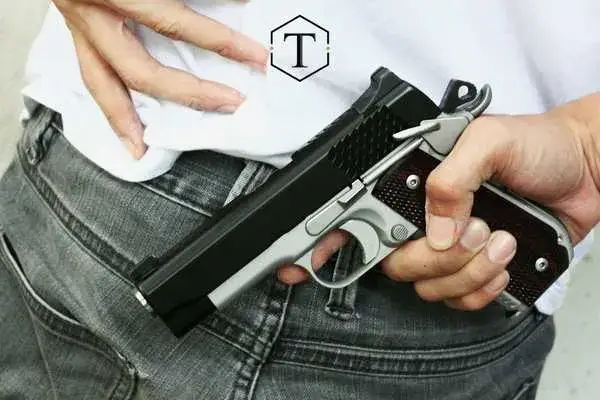
Since March 7, 2024, South Carolina law has allowed many adults who are not otherwise prohibited by law to carry a handgun, whether concealed or not, without a concealed weapon permit. But the law still prohibits carrying a handgun into certain places. Under S.C. Code Ann. § 16-23-20(A), it is unlawful, whether or not the person has a concealed weapon permit, to carry a handgun into a:
- Law enforcement, correctional, or detention facility
- Courthouse, courtroom, or other publicly owned building where court is held, while court is in session
- Polling place on election days
- Office of, or business meeting of, the governing body of a county, public school district, municipality, or special purpose district
- School or college athletic event not related to firearms
- Daycare or preschool facility
- Place where federal law prohibits carrying firearms
- Church or other established religious sanctuary, unless express permission is given by the appropriate church official or governing body
- Hospital, medical clinic, doctor’s office, or other facility where medical services or procedures are performed, unless expressly authorized
- Residence or dwelling place of another person, without the express permission of the owner or the person in legal control
Other statutes add to this list. For example, it is a felony to possess a firearm on school, college, or university property, or in a publicly owned building, without the express permission of the authorities in charge, with a fine of not more than $5,000, imprisonment of not more than five years, or both (S.C. Code Ann. § 16-23-420). Carrying a weapon on elementary or secondary school property is a separate felony (§ 16-23-430). Knowingly carrying a firearm into a business that sells alcohol for on-premises consumption can be a separate misdemeanor, and the statute’s exceptions are narrow if the person consumes alcohol or if the business has posted a sign or asked the person to leave (§ 16-23-465).
Private property is treated differently. A person who carries a concealable weapon into a place clearly marked with a sign prohibiting it that complies with S.C. Code Ann. § 23-31-235 may be charged only with trespass under S.C. Code Ann. § 16-11-620, and not with a violation of § 16-23-20.
Legal Consequences for Unlawful Carrying of a Firearm
The penalty for violating § 16-23-20 depends on whether it is a first or repeat offense. A first offense is a misdemeanor with a fine of not more than $1,000, imprisonment of not more than one year, or both. A second offense is a misdemeanor with imprisonment of not more than three years. A third or subsequent offense is a felony with imprisonment of not more than five years (S.C. Code Ann. § 16-23-50(A)(2)). Additional penalties may apply under other statutes, such as § 16-23-495, which can add up to three years for a crime involving a concealable weapon when the person did not have a valid concealed weapon permit (the separate count must be alleged in the indictment). That section does not apply to a person with a valid permit.
Concealed Weapon Violations
Under South Carolina’s 2024 carry law, a permit is not required for most lawful carrying by a person who is not otherwise prohibited. A person may still apply for a concealed weapon permit, which SLED issues to a qualified applicant (S.C. Code Ann. § 23-31-215). A permit does not allow carrying into the places listed in § 16-23-20(A), because that subsection applies whether or not the person has a permit.
Charges may arise when a handgun is taken into:
- One of the restricted places listed above
- A place covered by another statute, such as a school or an alcohol business
- A situation where the person is prohibited from having a firearm at all
Legal Consequences for Concealed Weapon Violations
The penalties are the ones set out above for the specific statute that is charged. A conviction can also lead to a prohibition on future firearm possession under the statutes described on this page. Depending on the offense, there may be consequences for professional licensing.
A defense lawyer can examine the facts of the stop and search, including whether a search was lawful.
Felon in Possession of a Firearm
South Carolina law makes it unlawful for a person who has been convicted of a crime punishable by a maximum term of imprisonment of more than one year to possess a firearm or ammunition (S.C. Code Ann. § 16-23-500(A)). The statute excludes certain offenses, including some business-regulation offenses, some misdemeanors punishable by five years or less, and convictions that have been expunged, set aside, or pardoned (with restoration of civil rights), unless the pardon or other order says otherwise (§ 16-23-500(F)). A felon in possession charge is a felony.
Federal law has its own prohibition on possession by a person convicted of a crime punishable by imprisonment for more than one year (18 U.S.C. § 922(g)(1)). A person who knowingly violates § 922(g) can be fined, imprisoned for not more than 15 years, or both (18 U.S.C. § 924(a)(8)). The same conduct can be prosecuted by state and federal authorities (Gamble v. United States, 587 U.S. 678 (2019)).
Legal Consequences for a Felon in Possession
Under state law, a first offense carries imprisonment of not more than five years. A second offense carries a mandatory minimum of five years and a maximum of twenty years. A third or subsequent offense carries a mandatory minimum of ten years and a maximum of thirty years (S.C. Code Ann. § 16-23-500(B)). The firearm or ammunition involved must also be confiscated (§ 16-23-500(C)). Because both state and federal law apply, it is important to know which court has the case.
Other Weapons-Related Offenses
South Carolina law covers other firearm conduct as well. Examples include:
- Pointing a firearm at another person. It is a felony to present or point a loaded or unloaded firearm at another person, with a fine in the court’s discretion or imprisonment of not more than five years. The statute does not abridge the right of self-defense (S.C. Code Ann. § 16-23-410).
- Discharging a firearm at or into a dwelling, building, or occupied vehicle. This is a felony with penalties that increase when someone is struck or injured (S.C. Code Ann. § 16-23-440).
- Possession of a stolen handgun or one with a removed serial number (S.C. Code Ann. § 16-23-30(C)). Federal law separately addresses firearms with removed, obliterated, or altered serial numbers (18 U.S.C. § 922(k)).
- Possession of a firearm during a violent crime. A person who possesses a firearm or visibly displays what appears to be one during a violent crime, and is convicted of that violent crime, must be imprisoned for five years in addition to the punishment for the principal crime (S.C. Code Ann. § 16-23-490). The additional punishment may not be imposed unless the indictment alleged it as a separate count.
Related: SC gun laws
Penalties for Weapons Charges
The penalties depend on the specific statute and the facts. Under the statutes described on this page:
- Unlawful carrying (§ 16-23-20): Misdemeanor with up to one year and a fine of up to $1,000 for a first offense, and up to three years for a second offense. A third or later offense is a felony with up to five years.
- Unlawful possession by a prohibited person (§ 16-23-30): Felony with a fine of up to $2,000, up to five years, or both.
- Felon in possession (§ 16-23-500): Up to five years for a first offense, with mandatory minimums for later offenses.
- Firearm during a violent crime (§ 16-23-490): An additional five years.
- Confiscation: The firearm involved in a violation must be confiscated under the statutes cited above.
- Federal charges: Up to 15 years for a violation of 18 U.S.C. § 922(g).
Beyond the immediate penalties, a conviction can affect background checks and future firearm rights. In some cases, a record can be expunged. For example, a first offense of unlawful possession of a firearm or weapon carrying a penalty of not more than one year or a fine of $1,000, or both, may be eligible for expungement after three years if the person meets the statute’s requirements (S.C. Code Ann. § 22-5-910(A)).
Building a Defense for Gun Charges
Every firearm charge in Columbia should be reviewed closely. The validity of a police stop, the scope of a search and seizure, and the facts of the alleged possession can all matter. The Fourth Amendment protects against unreasonable searches and seizures (U.S. Const. amend. IV), and an attorney can look at whether the arrest and search followed the law and whether evidence was obtained lawfully.
Defenses may involve challenging who possessed the firearm, questioning the chain of custody, or arguing that the weapon was found during an unlawful search. Whether any defense applies depends on the facts and the evidence. No lawyer can promise a particular outcome, such as a reduced or dismissed charge.
Speak With a Columbia Gun Charge Lawyer
When accused of any firearm offense, acting quickly is important. A lawyer can explain the statute you are charged under, review the evidence, and explain your options.
At Touma Law Group, we represent people charged with unlawful possession, unlawful carrying, felon in possession, and other weapons offenses. Call (803) 879-4499 to speak with a Columbia gun lawyer about your charge.
Frequently Asked Questions About Gun Charges in Columbia, SC
If you are facing a firearm offense in Columbia or want to better understand South Carolina law, you probably have questions. Below are answers to some common ones about possession, carrying, and other weapons charges.
1. What happens if I am charged with unlawful possession of a firearm in South Carolina?
It depends on the statute. Possession by a person who is prohibited under § 16-23-30 is a felony punishable by a fine of up to $2,000, up to five years in prison, or both (S.C. Code Ann. § 16-23-50(A)(1)). A person with a prior conviction for a crime punishable by more than one year can be charged under § 16-23-500, which has different penalties. A criminal defense lawyer can review which statute applies.
2. Can I carry a handgun in Columbia without a permit?
Since March 7, 2024, South Carolina has allowed many adults who are not otherwise prohibited by law to carry a handgun, concealed or not, without a concealed weapon permit (S.C. Code Ann. § 16-23-20). However, it is still unlawful to carry into the places listed in that statute, such as a courthouse while court is in session, a polling place on election day, a school or college athletic event not related to firearms, or another person’s home without permission. Other statutes apply to school property and alcohol businesses.
3. What are the penalties for a felon in possession of a firearm?
Under state law, a first offense carries up to five years in prison, a second offense carries five to twenty years with a mandatory minimum of five years, and a third or later offense carries ten to thirty years with a mandatory minimum of ten years (S.C. Code Ann. § 16-23-500). Federal law has a separate prohibition with a maximum of 15 years (18 U.S.C. § 924(a)(8)). Because both state and federal authorities can prosecute these cases, it is important to speak with a lawyer promptly.