The criminal penalties for a first time DUI in South Carolina are lower than those for later offenses. Still, a conviction can affect your future. If convicted, you could face a fine or jail time, an ignition interlock device requirement, a license suspension, a requirement to show proof of insurance before your license and registration are restored, and a negative impact on your professional and personal life.
Alcohol-impaired driving is a serious problem in this state. The National Highway Traffic Safety Administration (NHTSA) estimates that 417 of the 1,038 traffic deaths in South Carolina in 2024 (40%) happened in crashes involving a driver with a blood alcohol concentration of 0.08 or more (NHTSA, State Alcohol-Impaired-Driving Estimates: 2024 Data). NHTSA estimates alcohol levels when test results are missing and may revise the 2024 figures.

A first DUI charge can come as a surprise, including to people with no prior record. If you or a loved one were recently arrested for a DUI in Greenville or the surrounding areas, contact the Greenville criminal defense attorneys at Touma Law Group today at 864-618-2323. A licensed South Carolina attorney at the firm must review the facts of your case before anyone relies on this page, which is general information and not legal advice.
What Happens When I Get My First DUI in South Carolina?
Under S.C. Code Ann. § 56-5-2930, it is unlawful to drive a motor vehicle while under the influence of alcohol, drugs, or a combination of both to the extent that your faculties to drive are materially and appreciably impaired. DUI is an impairment based offense, and that section does not set a specific alcohol level.
A separate offense, driving with an unlawful alcohol concentration (DUAC), applies when a chemical test shows an alcohol concentration of 0.08 or more (S.C. Code Ann. § 56-5-2933). In a DUI case, an alcohol concentration of 0.08 or more at the time of the test may be inferred to mean the person was under the influence, an alcohol concentration over 0.05 and under 0.08 carries no inference either way, and 0.05 or less is conclusively presumed not under the influence of alcohol (S.C. Code Ann. § 56-5-2950(G)). A driver whose result is under 0.08 can still be charged with DUI if the State claims alcohol or drugs materially and appreciably impaired the ability to drive.
When a law enforcement officer stops you on suspicion of drunk driving, the officer is already building a case by observing your driving behavior before the stop begins.
If the officer suspects you are driving under the influence, he or she may ask you to perform field sobriety tests. These roadside tests are not part of the implied consent law, and the Code says a refusal to take a field sobriety test “does not constitute disobeying a police command” (S.C. Code Ann. § 56-5-2953). The exception is a crash in which the officer suspects the driver caused a death: that driver must submit to field sobriety tests (S.C. Code Ann. § 56-5-2948).
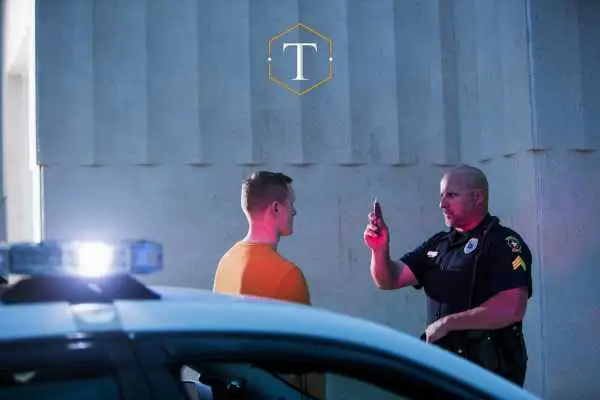
After an arrest, the officer will ask you to take a breath test. Under South Carolina’s implied consent law, a person who drives in this state is considered to have consented to chemical tests of breath, blood, or urine if arrested for DUI (S.C. Code Ann. § 56-5-2950). You may refuse. Before testing, the officer must give you a written copy of your rights and tell you that you do not have to take the test, but that your license must be suspended or denied for at least six months if you refuse, and that the refusal may be used against you in court. The officer must also tell you that the suspension is at least one month if your result is 0.15 or more, that you have the right to an independent test at your own expense, and that you may request a contested case hearing within 30 days of the notice of suspension.
If you refuse the test or your result is 0.15 or more, the arresting officer issues a notice of suspension (S.C. Code Ann. § 56-5-2951). The notice explains your right to request a contested case hearing before the Office of Motor Vehicle Hearings and your right to a temporary alcohol license.
Within 30 days of the notice of suspension, not the arrest date, you may request that hearing and either enroll in the Ignition Interlock Device Program or get a temporary alcohol license (TAL) from the South Carolina Department of Motor Vehicles (SCDMV) for a $100 fee (S.C. Code Ann. § 56-5-2951(B)). The Code says the TAL allows you to drive without restrictive conditions pending the outcome of the hearing, and it does not require an interlock device until the suspension is upheld or the hearing is waived (S.C. Code Ann. § 56-5-2941(A)(5)). Confirm the current requirement for your case with SCDMV (SCDMV license reinstatement).
If you do not request a contested case hearing, you waive the right to the hearing and the suspension continues. At the hearing, SCDMV and the arresting officer carry the burden of proof, and the issues are limited to matters such as whether the arrest or detention was lawful, whether you were given your implied consent rights, whether you refused, and, if you were tested, whether the result and the testing met the Code’s requirements (S.C. Code Ann. § 56-5-2951(F)). The administrative hearing does not decide the criminal case. A Greenville DUI lawyer can explain how the hearing process works.
Related: Misdemeanor DUI in South Carolina
What Is The Criminal Penalty For A 1st Offense DUI In Greenville, South Carolina?
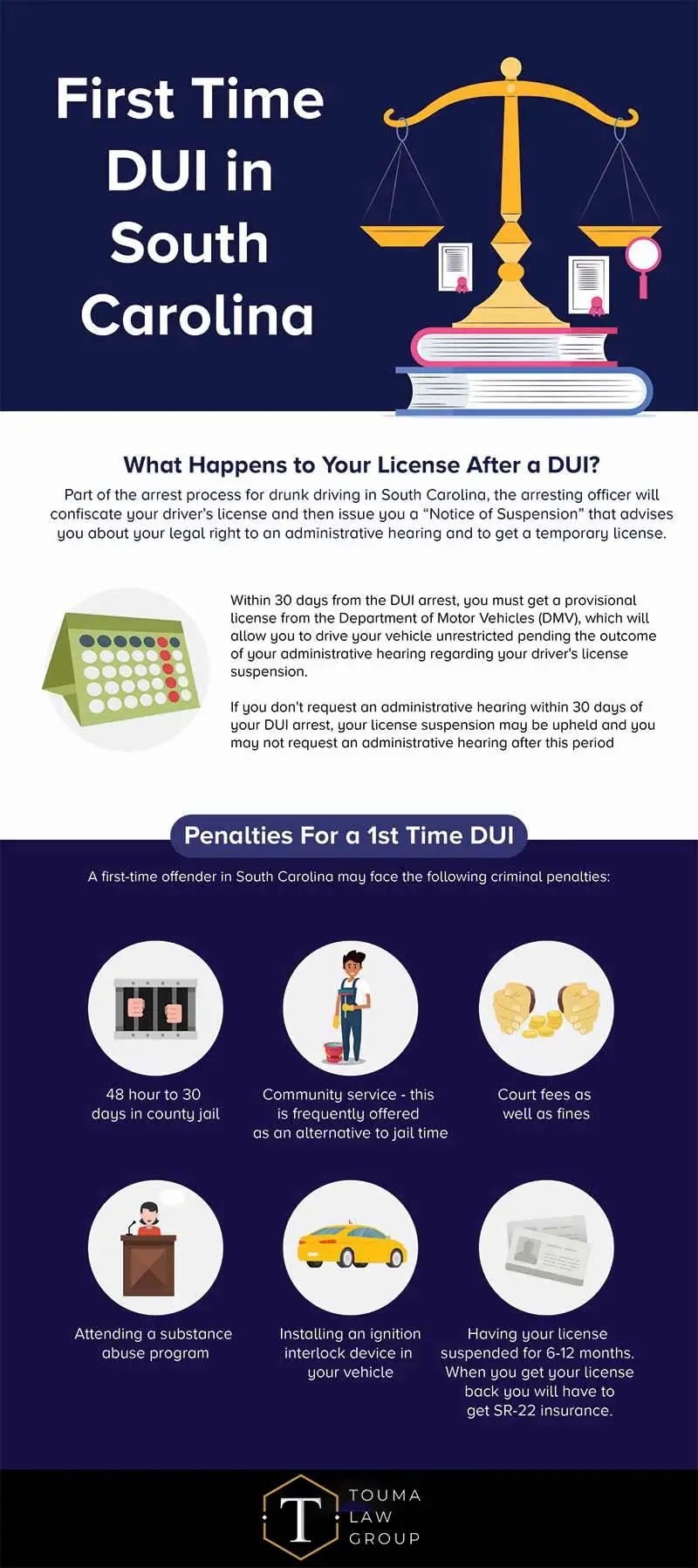
A first-time offender in South Carolina may face the following criminal penalties under S.C. Code Ann. § 56-5-2930:
Potential Jail Time
A first DUI conviction below an alcohol concentration of 0.10 carries a fine of $400 or imprisonment for 48 hours to 30 days. If the alcohol concentration is 0.10 to under 0.16, the penalty is a fine of $500 or imprisonment for 72 hours to 30 days. At 0.16 or more, it is a fine of $1,000 or imprisonment for 30 to 90 days. A first DUI offense may be tried in magistrates court. No part of the minimum sentence may be suspended.
Community Service
In place of the minimum jail term, the court may allow public service employment for the same length of time: 48 hours, 72 hours, or 30 days, depending on the alcohol concentration tier above. The court may not compel you to perform public service in place of the minimum sentence.
Fines
The fine is $400 for a first offense, $500 if the alcohol concentration is 0.10 to under 0.16, and $1,000 if it is 0.16 or more, plus court assessments. The fine on a first offense cannot be suspended.
Substance Abuse Program
Everyone convicted of DUI must enroll in and complete an Alcohol and Drug Safety Action Program (ADSAP) certified by the Office of Substance Use Services. Costs are capped at $500 for education, $2,000 for treatment, and $2,500 in total, and a person who cannot pay performs 50 hours of community service instead of being denied services (S.C. Code Ann. § 56-5-2930(H); ADSAP information).
Test Refusal
If you have no prior DUI or DUAC conviction and no prior suspension under S.C. Code Ann. § 56-1-286, § 56-5-2951 or § 56-5-2990 in the preceding ten years, refusing the chemical test brings a six-month administrative suspension. A test result of 0.15 or more brings a one-month suspension. In place of serving the rest of the suspension, you may enroll in the Ignition Interlock Device Program for the time remaining, with a minimum of three months (S.C. Code Ann. § 56-5-2951(A), (I)).
Ignition Interlock Device
Since May 19, 2024, every DUI or DUAC conviction requires enrollment in the Ignition Interlock Device Program, and there is no alcohol level threshold for a first offense. For a first offense, the device is required for 6 months (S.C. Code Ann. § 56-5-2990). A first offender is not eligible for a provisional license. Offenses before May 19, 2024 followed the earlier rule, which required a device for a first offender only at an alcohol concentration of 0.15 or more.

Driver’s License Suspension
After a conviction, SCDMV suspends your driver’s license. You may enroll in the Ignition Interlock Device Program, end the suspension, and obtain an ignition interlock restricted license for a $100 fee (S.C. Code Ann. § 56-1-400(C)). If you choose not to install the device, the license stays suspended indefinitely (S.C. Code Ann. § 56-1-400(E)).
When SCDMV suspends a license, it also suspends registrations unless the person files and maintains proof of financial responsibility, which an insurer commonly certifies on a form called an SR-22 (S.C. Code Ann. § 56-9-500). On request, SCDMV waives the filing requirement after three years if it has received no record of a conviction or bail forfeiture that would require or permit suspension in that time (S.C. Code Ann. § 56-9-620). Confirm the exact requirement for your case with SCDMV or your insurer (SCDMV license reinstatement).
Contact a Greenville DUI Lawyer Today for Legal Advice
The criminal penalties for impaired driving become harsher when the driver causes great bodily injury or death. Under S.C. Code Ann. § 56-5-2945, a person who drives under the influence and, by an act forbidden by law or a neglected legal duty in driving, proximately causes great bodily injury to another person faces a mandatory fine of $5,100 to $10,100 and mandatory imprisonment of 30 days to 15 years. If death results, the mandatory fine is $10,100 to $25,100 and the mandatory imprisonment is 1 to 25 years. Part of the mandatory sentence cannot be suspended, and probation cannot be granted for any portion. The statute refers to great bodily injury or death to “another person” and does not limit itself to crashes involving other vehicles or pedestrians.
If you have been charged with DUI in Greenville, speak with a Greenville DUI defense attorney at Touma Law Group about your case. A DUI conviction on your criminal record can have major consequences in your life, including the fines and jail sentences themselves. To schedule a free, no-obligation initial consultation, contact our Greenville law office today at 864-618-2323.