
Facing domestic violence charges in Greenville, South Carolina? Your future hangs in the balance. A conviction can bring life-altering consequences, impacting your freedom, family, and reputation.
Don’t navigate this complex legal landscape alone. A Greenville domestic violence lawyer can explain the charge and your options. Contact us today at 864-618-2323 for an initial consultation to discuss your case.
Understanding Domestic Violence Charges in South Carolina
In South Carolina, domestic violence laws are serious criminal charges and can carry serious penalties. South Carolina defines domestic violence as causing physical harm or injury to a household member, or offering or attempting to do so with apparent present ability under circumstances reasonably creating fear of imminent peril (S.C. Code Ann. § 16-25-20(A)). A “household member” is a spouse, a former spouse, a person with whom you have a child in common, or a male and female who are cohabiting or formerly have cohabited (S.C. Code Ann. § 16-25-10). In Doe v. State, Opinion No. 27728 (S.C. Nov. 17, 2017), the South Carolina Supreme Court declared that definition unconstitutional as applied to an unmarried same-sex couple who lived together, and held that the family court may not use it to keep people in similar relationships from seeking an order of protection. The Court did not rewrite the statute, and the Code still reads “a male and female,” so whether a particular relationship is covered in a criminal case is a question for an attorney. The household relationship is what differentiates the charge from an assault and battery charge. The law categorizes these charges into degrees based on severity, with penalties increasing for higher degrees and repeat offenses.
Degrees of Domestic Violence
South Carolina law outlines various degrees of domestic violence:
- Domestic Violence Third Degree: This is the base misdemeanor offense, involving physical harm or an offer or attempt to cause harm that creates fear of imminent peril. The penalty is a fine of $1,000 to $2,500, up to 90 days in jail, or both (S.C. Code Ann. § 16-25-20(D)).
- Domestic Violence Second Degree: A more serious misdemeanor, it involves moderate bodily injury, violating a protection order while committing third-degree domestic violence, or a prior domestic violence conviction within ten years. The penalty is a fine of $2,500 to $5,000, up to three years in jail, or both (S.C. Code Ann. § 16-25-20(C)).
- Domestic Violence First Degree: A felony charge, this involves great bodily injury, violating a protection order while committing second-degree domestic violence, two or more prior domestic violence convictions within ten years, or the use of a firearm. It is punishable by up to ten years in prison (S.C. Code Ann. § 16-25-20(B)).
- Domestic Violence of a High and Aggravated Nature (DVHAN): This is the most severe felony charge, which applies, for example, when the offense is committed under circumstances showing extreme indifference to the value of human life, such as using a deadly weapon, and great bodily injury results. It is punishable by up to 20 years in prison (S.C. Code Ann. § 16-25-65).
It’s crucial to understand that even seemingly minor incidents can lead to a severe criminal charge, and an officer may arrest, with or without a warrant, a person the officer has probable cause to believe has committed or freshly committed domestic violence, even if the act did not happen in the officer’s presence (S.C. Code Ann. § 16-25-70).
The Severe Impact of a Domestic Violence Conviction
A domestic violence conviction in South Carolina can have a severe impact on your life far beyond any jail sentence or fines. These consequences can include:
- Criminal Record: A conviction will result in a permanent criminal record, which can affect future employment, housing, and educational opportunities.
- Jail Time and Fines: Depending on the degree of the charge, you could face anywhere from up to 90 days in jail for third degree to up to 20 years in prison for domestic violence of a high and aggravated nature, and the lower degrees carry fines.
- Intervention Program: A court that suspends all or part of a sentence can require completion of a domestic violence intervention program (S.C. Code Ann. § 16-25-20(E)).
- Restraining Orders and No Contact Orders: A judge may issue restraining orders or no contact orders, which can prevent you from returning to your home or having contact with the alleged domestic violence victim, impacting family law implications, child custody, and visitation rights.
- Firearms Restrictions: State law bars possession of a firearm or ammunition for life after a high and aggravated nature conviction, for ten years after a first degree conviction, and in some second and third degree cases for three years, and federal law can apply separately (S.C. Code Ann. § 16-25-30; 18 U.S.C. § 922(g)(9)).
- Reputational Damage: The social stigma associated with domestic abuse charges can damage your personal and professional relationships.
Given these severe potential consequences, securing experienced legal advice from a trusted criminal defense firm is paramount.

Building Your Defense with a Greenville Domestic Violence Lawyer
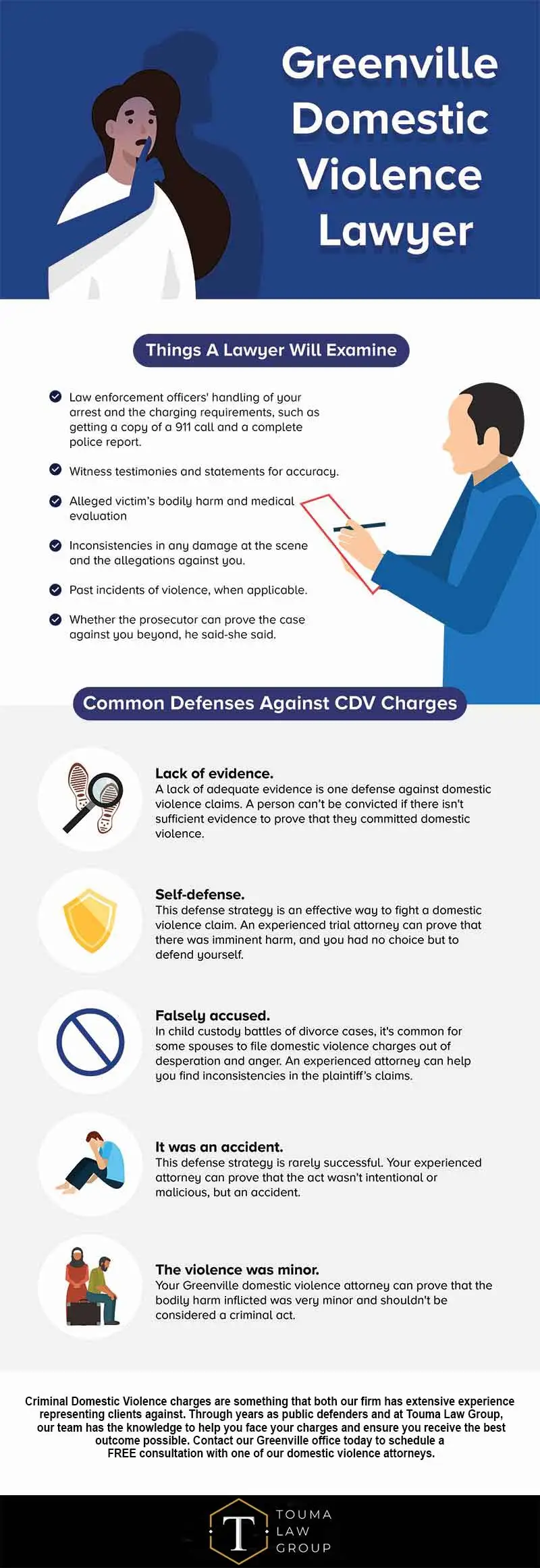
When facing domestic violence charges, a Greenville domestic violence attorney can investigate your case, review the prosecution’s evidence, and help protect your rights. Common defense strategies may include:
False Accusations
Unfortunately, false allegations are a common reason for domestic violence charges. These can arise from heated arguments, misunderstandings, or even be used as leverage in contentious family law matters like divorce or child custody battles. Your criminal defense lawyer will examine all evidence, witness statements, and any inconsistencies to expose fabricated claims.
Self Defense or Defense of Others
If you acted to protect yourself or another household member from imminent harm, you might have a valid claim of self-defense. Whether self-defense applies depends on the facts and the force used, and a lawyer must review the details of your case.
Insufficient Evidence
The prosecution bears the burden of proving your guilt beyond a reasonable doubt. If there is insufficient evidence, inconsistent testimony, or a lack of credible witnesses, your defense attorney can argue for a dismissal of charges or a not guilty verdict. This often involves a thorough review of police officers’ reports, forensic evidence, and any other relevant materials.
Violation of Rights
Law enforcement officers must adhere to strict constitutional guidelines during an investigation and arrest. If your rights were violated, such as an unlawful search or seizure, or if you were interrogated without being read your Miranda rights, a criminal defense attorney can move to suppress evidence or even have the case dismissed.
Lack of Intent or Accident
In some cases, injuries may have occurred accidentally or without malicious intent. For example, a slip or fall during an argument could result in an injury that is mistakenly perceived as domestic abuse. Your legal representation will work to present the full context of the situation and demonstrate the absence of intent to cause harm.
Did you know? Touma Law Group can help with federal criminal charges.
Why Choose a Greenville Domestic Violence Defense Attorney?
Navigating domestic violence charges requires more than just legal knowledge; it demands compassionate attention and a strategic approach. Many times individuals go to court unrepresented because they unknowingly waived their rights. A dedicated Greenville domestic violence lawyer understands the local court system, judges, and prosecutors, which can be invaluable in crafting an effective defense.
From your initial consultation, a defense attorney will listen to your side of the story without judgment, providing clear legal advice and outlining your options. They will work diligently to:
- Conduct an independent investigation, gathering evidence and interviewing witnesses.
- Negotiate with prosecutors for reduced charges or alternative resolutions, such as diversion programs, especially if it’s your first criminal charge.
- Challenge evidence and procedural errors.
- Prepare your case for trial, if necessary, and speak on your behalf in court.
- Help you make smart decisions throughout the legal process.
Your choice of legal services can significantly impact the outcome of your case. Don’t let domestic violence charges define your future.

Take Action Today
If you are facing domestic violence charges in Greenville, South Carolina, the time to act is now. Every moment counts in protecting your rights. Greenville domestic violence defense attorneys at Touma Law Group can review your case and explain your options.
Call our trusted criminal defense firm today at 864-618-2323 for an initial consultation. We can review the charge and talk with you about your options. No lawyer can promise a particular outcome.