A DUI arrest happens fast. One traffic stop on Woodruff Road, a few questions, and you are holding a court date and a notice about your driver’s license.
A charge is not a conviction. The State still has to prove its case, and much of your stop is open to challenge. Legal help early protects your case and your license.
Touma Law Group is a criminal defense law firm that defends people charged with driving under the influence across the Upstate of South Carolina. Our office sits right on Main St. in downtown Greenville, so come in for a free consultation today.

What Your First Two Weeks After A Greenville DUI Arrest Look Like
A South Carolina DUI puts you in two systems at once, and most people learn about the second one too late. The first is the criminal case: the charge on your ticket, with a court date, possible jail time, and a criminal record attached.
The second runs through the DMV. If you refused the breath test, or blew 0.15 percent or higher, your license faces an administrative suspension that starts on its own (S.C. Code Ann. § 56-5-2951). It does not wait for the court system.
What matters in those first two weeks:
- Write down what you remember about the stop while it is fresh.
- Check your paperwork for a notice of suspension.
- Request an administrative hearing within 30 days of the notice of suspension if that notice is there.
- Ask a criminal defense attorney to pull the roadside and breath test video before it is overwritten.
- Say nothing more to police officers about that night.
 How South Carolina Defines Driving Under The Influence
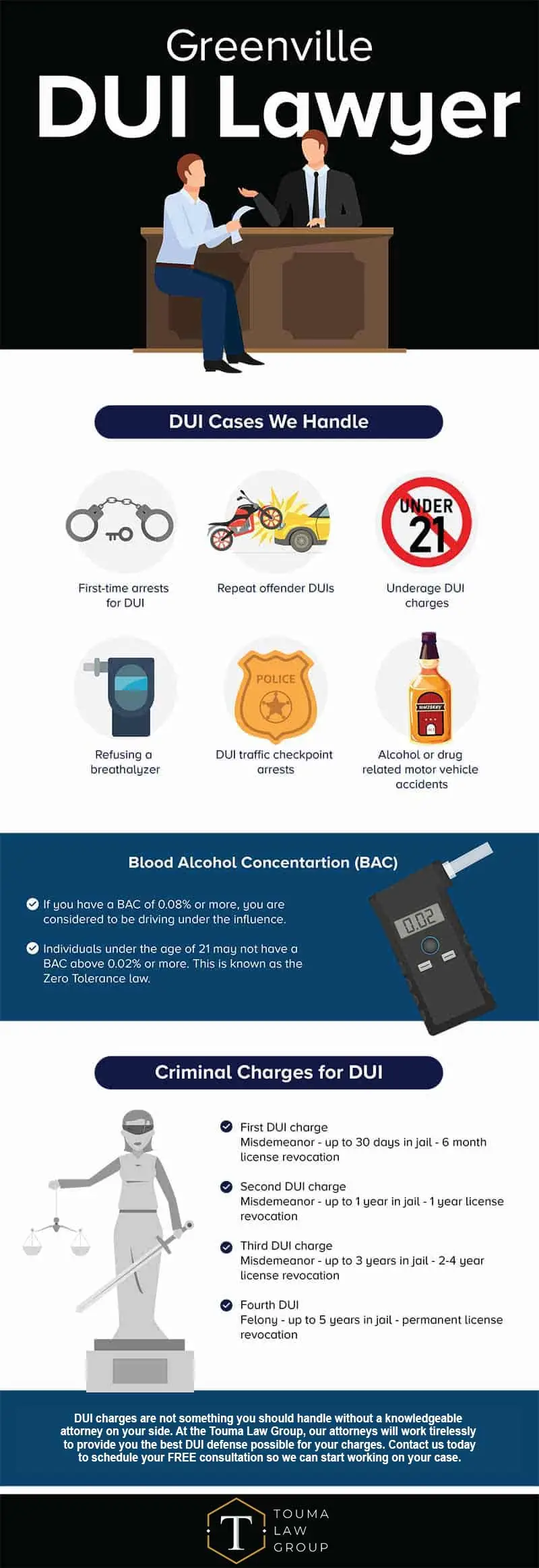
South Carolina charges this offense as DUI. Under the South Carolina Code of Laws, a driver commits DUI when alcohol, drugs, or both materially and appreciably impair the ability to drive (S.C. Code Ann. § 56-5-2930).
The number most people know is 0.08 percent. An alcohol concentration at or above it supports a separate charge of driving with an unlawful alcohol concentration (DUAC) (S.C. Code Ann. § 56-5-2933), and in a DUI case a result of 0.08 or more may be inferred to mean the person was under the influence (S.C. Code Ann. § 56-5-2950(G)).
Impairment and alcohol level are not the same thing. Police officers can arrest a driver with a blood alcohol level under 0.08 if they believe impaired driving occurred. Prescription medication and marijuana stops work the same way, and separate drug charges can follow.
Did you know?
You can be charged for an
in South Carolina.
What A DUI Conviction Carries In South Carolina
Penalties rise with your blood alcohol concentration and any prior criminal history (S.C. Code Ann. § 56-5-2930). A first-time DUI offense is a misdemeanor in magistrate or municipal court:
- Under 0.10 percent: a $400 fine, or 48 hours to 30 days in jail.
- 0.10 to under 0.16 percent: a $500 fine, or 72 hours to 30 days in jail.
- 0.16 percent and above: a $1,000 fine, or 30 to 90 days in jail.
Court assessments add to every fine above. A conviction also brings enrollment in an Alcohol and Drug Safety Action Program and a license suspension, and on a first offense the court may allow public service employment in place of the minimum jail term.
Since May 19, 2024, South Carolina requires an ignition interlock device after every DUI conviction, including a first offense. That runs six months for a first offense and two years for a second-time DUI (S.C. Code Ann. § 56-5-2990). Prior convictions count only if the violations occurred within ten years including and immediately preceding the date of the last violation (S.C. Code Ann. § 56-5-2930(D)).
A conviction stays on your criminal record. A DUI conviction cannot be expunged under the general expungement statute, which excludes offenses involving the operation of a motor vehicle (S.C. Code Ann. § 22-5-910), and no DUI statute provides for expungement. A DUI charge that is discharged, dismissed, or ends in a not guilty finding can be expunged (S.C. Code Ann. § 17-1-40(B)).
The 30 Day Clock On Your Driver’s License
Under South Carolina’s implied consent law, driving on state roads means you are considered to have consented to breath, blood, or urine testing if you are arrested for DUI (S.C. Code Ann. § 56-5-2950). You may refuse, but the officer must tell you that a refusal brings a suspension of at least six months and may be used against you in court.
Refusing the test triggers a license suspension on its own, separate from criminal court. A first refusal brings six months when you have no prior DUI or DUAC conviction or related suspension in the preceding ten years. A test result of 0.15 percent or higher triggers a one month suspension under the same conditions, even without a conviction (S.C. Code Ann. § 56-5-2951(A), (I)).
You have 30 days from the notice of suspension to request a contested case hearing with the Office of Motor Vehicle Hearings. Miss it and you waive the hearing and the suspension continues. With that request, you may either enroll in the Ignition Interlock Device Program or get a temporary alcohol license (TAL) from the DMV for a $100 fee. The Code says the TAL allows you to drive without restrictive conditions pending the outcome of the hearing (S.C. Code Ann. § 56-5-2951(B)).

Field Sobriety Tests, Breathalyzer Results, And What The Video Shows
South Carolina law requires officers to video record both the incident site and the breath test site in most DUI arrests (S.C. Code Ann. § 56-5-2953). The recording has to capture any field sobriety test, show you being advised of your Miranda rights, and cover the breath test procedure. Appellate court decisions keep shaping what counts as compliance.
Three Standardized Field Sobriety Tests show up in almost every case:
- Horizontal Gaze and Nystagmus- where an officer watches your eyes track a stimulus.
- Walk and Turn- scored on specific clues as you walk a line.
- One-Leg Stand- scored on balance, swaying, and counting.
None of these are pass or fail. Officers score them against training standards, and weather, uneven pavement, injuries, nerves, and footwear all affect the score.
The Datamaster DMT breath test carries its own rules. Operators must be certified, the machine needs current calibration records, and a 20-minute observation period comes first. Blood cases turn on the blood collection report and the chain of custody behind it.
Schedule you free consultation
with Touma Law Group today!
Where A DUI Defense Strategy Usually Starts
Every case turns on its own facts, so no honest lawyer promises an outcome. Here is where we look.
- The reason for the stop, and whether law enforcement had a lawful basis for it.
- Whether the implied consent warnings were read and recorded correctly.
- Whether the video matches the officer’s written account of your speech, balance, and driving.
- How each field sobriety test was administered and scored.
- Calibration, operator certification, and the observation period behind any BAC test.
- Your legal rights during questioning, including Miranda rights.
That work sometimes supports a motion to suppress evidence, sometimes a better negotiation, and sometimes a trial.
Greenville Courts And Who Brings These Charges
Most first offense DUI cases here go through Greenville Municipal Court or Greenville County Magistrate Court. A felony DUI offense involving great bodily injury or death moves to General Sessions Court, prosecuted by the 13th Circuit Solicitor’s Office.
Arrests come from Greenville Police Department officers, Greenville County Sheriff’s Office deputies, and South Carolina Highway Patrol troopers. Each agency handles reports, video, and breath testing differently, and that knowledge is courtroom experience you only get by working these courts. We also take cases in Greer, Simpsonville, Mauldin, Easley, and Spartanburg.
Talk To Someone Before Your First Court Date
Adam Touma founded Touma Law Group after clerking for a 13th Circuit judge and serving as an Assistant Public Defender in Greenville County. He is also a Judge Advocate General officer in the U.S. Army. That background shapes how we build a case: early, organized, and grounded in the record.
We are a veteran-owned firm with a Spanish-speaking paralegal on staff, and our client reviews speak to how we treat people. Contact the Touma Law Group today at (864) 618-2323.
FAQs
Not in every case. A refusal or a reading of 0.15 percent or higher starts a suspension right away, and you have 30 days from the notice of suspension to request a hearing and get a temporary alcohol license.
You can decline, but refusal carries a license suspension of at least six months, and the refusal may be used against you in court (S.C. Code Ann. § 56-5-2950). Whether that helps or hurts depends on your facts.
These roadside tests are not part of the implied consent law, and declining one is not disobeying a police command (S.C. Code Ann. § 56-5-2953). The exception is a crash where the officer suspects the driver caused a death, in which case the driver must submit to field sobriety tests (S.C. Code Ann. § 56-5-2948).
No. A first offense is a misdemeanor. DUI becomes a felony when great bodily injury or death results (S.C. Code Ann. § 56-5-2945), and a fourth or later offense is a Class F felony.
A DUI conviction cannot be expunged under South Carolina’s general expungement statute, and no DUI statute provides for expungement. Confirm your situation with a lawyer.