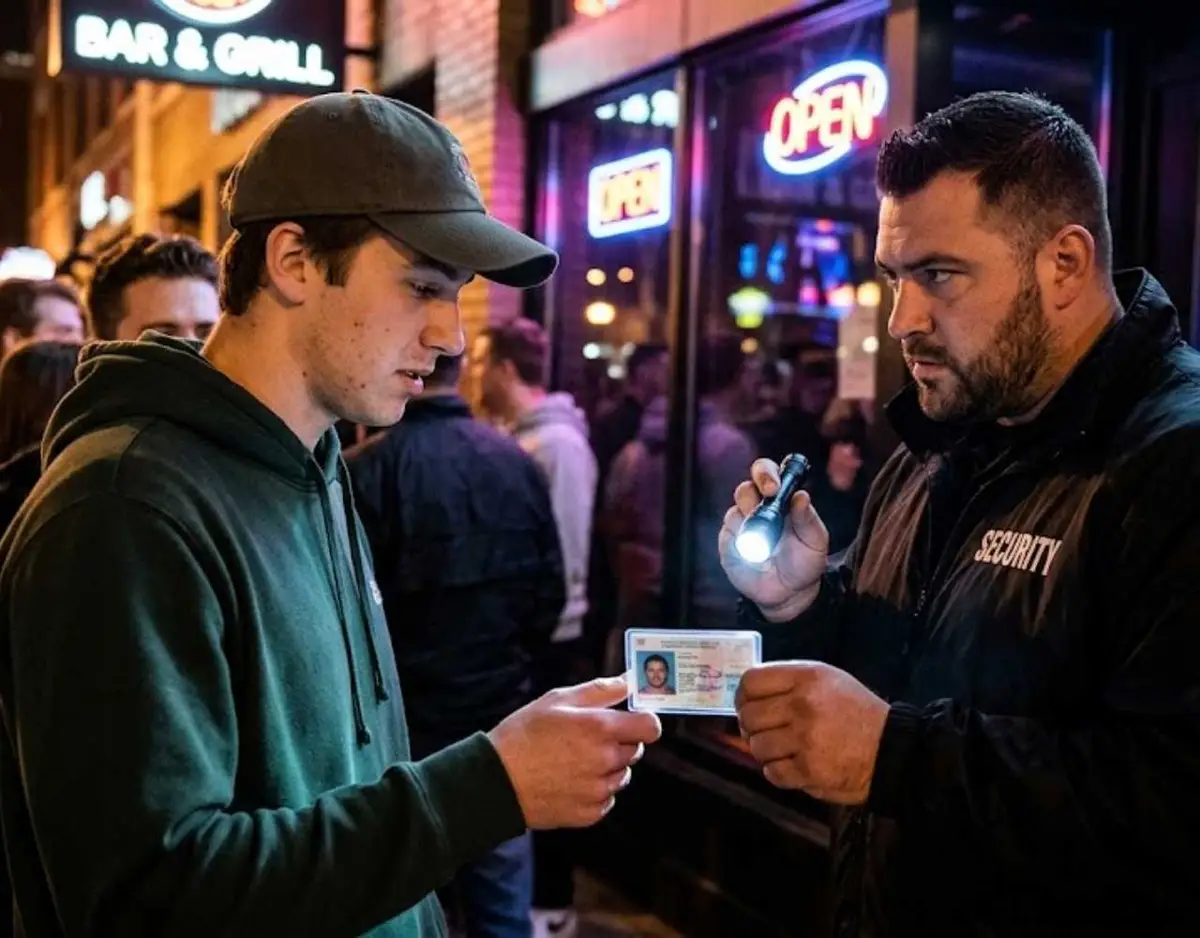
A fake ID might feel like a harmless shortcut for underage drinking or getting into a bar before you turn 21. In South Carolina, it can be a criminal offense that follows you long after one night out.
The main South Carolina statutes tied to fake IDs are misdemeanors, but the penalties can escalate if the ID involves someone else’s real identity or gets used to commit fraud. Fines, jail time, and a suspended driver’s license are all possible, even for a first offense.
If you or your student are already facing a fake ID charge, contact Touma Law Group today for a free consultation before you talk to anyone else.
How South Carolina Charges a Fake ID Case
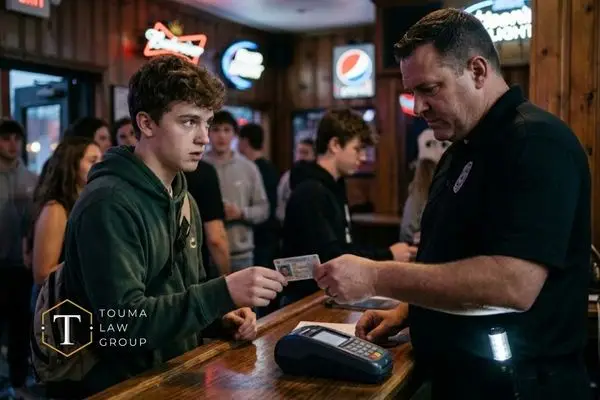
South Carolina handles fake ID conduct under several statutes in the driver’s license law, including S.C. Code Ann. § 56-1-515 and § 56-1-510. The charge you face depends on what you actually did with the ID.
- Altering a driver’s license or selling or issuing a fictitious one (§ 56-1-515(1)): This is a misdemeanor punishable by a fine of up to $2,500, up to six months in jail, or both.
- Using a license or ID card that is not yours, or one that is altered or has false information, to defraud another or violate the law (§ 56-1-515(2)): This is a misdemeanor punishable by a fine of up to $100 or up to 30 days in jail.
- Having a fraudulently altered driver’s license or personal identification card in your possession (§ 56-1-510(1)): This is a misdemeanor punishable by a fine of up to $200 or up to 30 days in jail for a first offense, and a fine of up to $500 or up to six months in jail for a second or subsequent offense.
Separate laws apply when a person under 21 uses a fake ID to get alcohol. S.C. Code Ann. § 63-19-2440 makes it unlawful for a person under 21 to purchase, attempt to purchase, consume, or knowingly possess beer or wine, and § 63-19-2450 does the same for liquor and also makes it unlawful to falsely represent your age to get liquor. S.C. Code Ann. § 61-4-60 separately covers knowingly giving false information about your age to buy beer or wine. Each is a misdemeanor punishable by a fine of $100 to $200, up to 30 days in jail, or both. A conviction under § 63-19-2440 or § 63-19-2450 also requires completing an alcohol prevention education or intervention program approved by the state alcohol and drug abuse services agency (DAODAS), which must be at least eight hours and cost no more than $150.
None of these are small consequences. A conviction becomes part of your criminal record and can show up on background checks for years.
What the Statutes Cover
The statutes describe specific conduct rather than one general “fake ID” offense. Examples include:
- Altering a motor vehicle driver’s license so that it shows false information, or selling or issuing a fictitious driver’s license (§ 56-1-515(1))
- Using a driver’s license not issued to you, an altered driver’s license, an identification card with false information, or an identification card not issued to you, to defraud another or violate the law (§ 56-1-515(2))
- Having a canceled, revoked, suspended, or fraudulently altered driver’s license or personal identification card in your possession (§ 56-1-510(1))
- Lending your driver’s license or identification card to another person, or knowingly permitting another person to use it (§ 56-1-510(2))
- Using a false or fictitious name on an application for a driver’s license or identification card (§ 56-1-510(5))
That means someone else’s real, valid ID used to misrepresent your identity can lead to a charge if it is used to defraud another or violate the law. Looking real does not make it legal. If the state did not issue the identification card to you and you use it to defraud another or violate the law, § 56-1-515(2) can apply no matter how convincing the card looks.
Fines, Jail Time, and License Consequences
The table below breaks down the fines, jail time, and license consequences tied to fake ID charges in South Carolina. Every case is different, and each statute sets a maximum or a range within which a judge has discretion.
| Offense | Classification | Fine | Jail Time | License Consequence |
|---|---|---|---|---|
| Altering a license or selling or issuing a fictitious license (56-1-515(1)) | Misdemeanor | Up to $2,500 | Up to 6 months | Suspension required (56-1-746) |
| Using a license or ID that is not yours, or is altered or false, to defraud or violate the law (56-1-515(2)) | Misdemeanor | Up to $100 | Up to 30 days | Suspension required (56-1-746) |
| Having a fraudulently altered license or ID in your possession (56-1-510(1)) | Misdemeanor | Up to $200 (first) | Up to 30 days (first); up to 6 months (second) | Not listed in 56-1-746 |
| Underage alcohol offenses, including false age information (63-19-2440, 63-19-2450, 61-4-60) | Misdemeanor | $100 to $200 | Up to 30 days | Suspension required (56-1-746) |
| Identity fraud using another person’s identifying information (16-13-510) | Felony | Court’s discretion | Up to 10 years | Not listed in 56-1-746 |
Under S.C. Code Ann. § 56-1-746, the Department of Motor Vehicles must suspend the driver’s license of a person convicted under § 56-1-510(2), § 56-1-510(5), § 56-1-515, § 61-4-60, § 63-19-2440, or § 63-19-2450. A first offense means 120 days. A second or subsequent offense means one year, and a conviction for a listed offense within ten years of the date of the violation counts as a prior offense. The suspension applies even if the fake ID had nothing to do with driving.
The same section allows a person who is employed or enrolled in a college or university to apply for a special restricted driver’s license that permits driving only to and from work or school and in the course of employment or education. The department may issue it only if the person lives more than one mile from the workplace or school and there is no adequate public transportation. That is worth knowing if you rely on your license for work, school, or family.
When a Fake ID Charge Involves a Felony
The main fake ID statutes above are misdemeanors. Other laws can apply in some situations, and they carry much heavier penalties.
| Circumstance | Possible Charge | Maximum Penalty |
|---|---|---|
| Without permission, using another person’s identifying information (such as a Social Security number, driver’s license number, or date of birth) with intent to appropriate their financial resources, devise a scheme to defraud, or obtain money, property, or services by false pretenses | Financial identity fraud (S.C. Code Ann. § 16-13-510(B)) | Felony: fine in the court’s discretion, up to 10 years, or both |
| Using another individual’s identifying information to obtain employment or to avoid identification by law enforcement | Identity fraud (§ 16-13-510(C)) | Felony: fine in the court’s discretion, up to 10 years, or both |
| Falsely making, forging, or counterfeiting a writing, or uttering one as true, with intent to defraud | Forgery (§ 16-13-10) | Felony up to 5 years if the amount is under $10,000, up to 10 years if $10,000 or more; misdemeanor up to 3 years if no dollar amount is involved |
| Producing or transferring a document that is or appears to be a driver’s license or personal identification card, or more than five identification documents, in or affecting interstate commerce or through the mail | Federal identification document fraud (18 U.S.C. § 1028) | Up to 15 years |
| Knowingly using another person’s means of identification during and in relation to certain listed federal felonies | Federal aggravated identity theft (18 U.S.C. § 1028A) | An additional 2 years that must run consecutively |
These come from S.C. Code Ann. § 16-13-510, § 16-13-10, 18 U.S.C. § 1028, and 18 U.S.C. § 1028A. Whether a particular fake ID falls under the forgery statute or a federal statute depends on the facts of the case.
Using a real person’s identifying information is the line that matters most. The identity fraud statute lists Social Security numbers, driver’s license numbers, and dates of birth among its examples of personal identifying information, and a charge under it requires the specific intent the statute describes. A charge under § 56-1-515 carries a much lower maximum penalty.
Repeat offenses can matter too. A second or subsequent offense under § 56-1-510 carries a fine of up to $500 or up to six months in jail, compared with $200 and 30 days for a first offense, and a second or subsequent conviction within ten years under § 56-1-746 means a one-year license suspension. Separately, it is a misdemeanor to misrepresent your identification to a law enforcement officer for the purpose of avoiding arrest or criminal charges, punishable by a fine of up to $200 or up to 30 days in jail (S.C. Code Ann. § 16-17-725).
What Prosecutors and Law Enforcement Look For
Bouncers, retail clerks, and law enforcement often look for red flags such as:
- A birth date that does not match the person’s apparent age
- Edges, fonts, or lamination that feel slightly off
- A barcode or magnetic stripe that scans with mismatched information
- Inconsistent answers when asked to confirm an address or zip code
If law enforcement gets involved, an officer may take a statement and then issue a citation or make an arrest, depending on the circumstances.
Building a Defense Against a Fake ID Charge

A fake ID charge is not automatically a conviction. Several defense angles can apply, depending on the facts.
- Lack of knowledge: If someone else gave you the ID and you had no reason to know it was fake, that matters. Several of these statutes turn on what you knew or intended, such as “knowingly possess” in § 63-19-2440 and “to defraud another or violate the law” in § 56-1-515(2).
- Improper search or seizure: If the ID turned up through a search that violated your constitutional rights, you can ask the court to exclude it as evidence (Mapp v. Ohio, 367 U.S. 643 (1961)).
- Misidentification: Sometimes the wrong person gets charged in a group setting, especially at parties or bars.
- Alcohol education program: Each circuit solicitor has discretion to run an alcohol education program for certain alcohol-related offenses. A person may be considered if they were at least 17 but under 21 at the time of arrest, have no prior alcohol-related offenses, and have no significant history of prior delinquency or criminal activity. The eligible charges include possession of an altered driver’s license or other false documentation under § 56-1-515 and the underage alcohol offenses above. A person who successfully completes the program receives a noncriminal disposition, and a person may participate only once (S.C. Code Ann. §§ 17-22-510 to 17-22-530).
We cannot promise a result before we know the facts of your case. What we can do is review the police report and your record, then explain the realistic paths forward.
Fake ID Cases in Greenville, Columbia, and Anderson
Fake ID charges can arise anywhere in South Carolina, including around college towns, and the process looks a little different depending on where the case lands.
In Greenville, near Furman University, magistrates can hear offenses punishable by a fine of up to $500, up to 30 days in jail, or both (S.C. Code Ann. § 22-3-550), which covers charges such as § 56-1-515(2). A charge with a higher maximum, such as § 56-1-515(1) with up to six months, is not within that limit. Anyone who was arrested rather than just cited goes through the bond court process. Our Greenville criminal defense lawyer team represents clients in both situations.
In Columbia, fake ID cases involving University of South Carolina students can also involve the university’s own conduct process, described below. Our Columbia criminal defense lawyer team can walk you through both tracks.
Around Anderson and the Clemson area, cases move through the Anderson County criminal court process, and our Anderson team can walk you through what to expect at each stage.
How a Fake ID Charge Can Affect College Students
For college students, the courtroom is often the smaller problem. Many schools run their own conduct process independent of the criminal case.
- University disciplinary action: Many schools treat a fake ID arrest as a code of conduct violation, separate from any court outcome.
- University housing: Some housing agreements include conduct clauses that a criminal charge can trigger.
- Scholarships and financial aid: A conviction can jeopardize aid tied to good conduct standards.
- Immigration issues: International students should talk to an immigration attorney before entering any plea, since even a misdemeanor conviction can have immigration consequences. The U.S. Supreme Court has held that defense counsel must advise a noncitizen client about the risk of deportation before a guilty plea (Padilla v. Kentucky, 559 U.S. 356 (2010)).
A single charge can turn into two separate problems: one in criminal court, and one with the school.
What Minors and Their Parents Should Know
Under South Carolina law, a “child” or “juvenile” is generally a person under 18 (S.C. Code Ann. § 63-19-20), with an exception for some 17-year-olds charged with serious felonies. Family court has exclusive original jurisdiction over a child alleged to have violated a state or local law (S.C. Code Ann. § 63-3-510), so a fake ID case involving someone under 18 usually moves through family court rather than adult court. Talk to an attorney about what a family court finding could mean for your child later, including for college applications. Underage alcohol offenses from the same event can also lead to additional charges in addition to the fake ID charge itself.
What to Do If You Are Charged With Having a Fake ID
- Stay quiet beyond basic identifying information. You do not have to explain how you got the ID. Do not give a false name, since misrepresenting your identification to an officer is its own offense.
- Do not resist or argue with law enforcement. Save your explanation for your attorney.
- Write down what happened while it is fresh, including the location, time, and what the officer said.
- Keep any paperwork you receive, including citations, court dates, or a police report.
- Call a criminal defense attorney before your first court date. Early advice can shape what happens next.
Protecting Your Record After a Fake ID Charge

A fake ID conviction does not just mean a fine. It means a criminal record, a possible license suspension, and in some cases a felony charge. A person convicted of a crime carrying a penalty of not more than 30 days in jail or a $1,000 fine may apply to the circuit court for expungement after three years if there is no other conviction during that period, but that section does not apply to an offense involving the operation of a motor vehicle (S.C. Code Ann. § 22-5-910). Every case depends on its own facts, and an attorney who knows how South Carolina prosecutors, universities, and the SCDMV handle these charges can explain your options.
Touma Law Group represents clients facing fake ID and identity fraud charges across Greenville, Columbia, and Anderson. Schedule your free consultation to talk through your options before your next court date.
Frequently Asked Questions
Usually not. The main fake ID statutes, such as Section 56-1-515 and Section 56-1-510, are misdemeanors. Other laws, such as the identity fraud statute in Section 16-13-510 or federal identification document fraud, can carry felony penalties when the ID involves someone else’s real identity, financial fraud, or producing and transferring IDs.
In most cases, yes, after a conviction. South Carolina Code Section 56-1-746 requires the DMV to suspend your license after a conviction under Section 56-1-515 or the underage alcohol statutes it lists, even if you were not driving when the ID was used.
Under Section 56-1-746, a second or subsequent conviction within ten years means a one-year license suspension instead of the 120-day suspension for a first offense. Under Section 56-1-510, a second or subsequent offense also carries a higher maximum penalty than a first offense.
It can. Many universities run their own disciplinary process for a fake ID arrest, separate from the criminal court case. That process can affect housing, scholarships, and standing with the school regardless of the court outcome.
Contact an attorney who handles juvenile cases as soon as possible. Cases involving a person under 18 generally move through family court rather than adult court, and how the case is handled early on can matter for your record going forward.